

Key Highlights
- What Is the New Zealand Green List?
- What Are the Two Tiers of the New Zealand Green List (Tier 1 vs Tier 2)?
- Which Occupations Are on the New Zealand Green List?
- Who Is Eligible for the New Zealand Green List?
- What Are the Salary and Wage Thresholds for New Zealand Green List Roles?
- How Do Indians Apply for the New Zealand Green List From India?
- How Long Does New Zealand Green List Visa Processing Take?
- Green List vs New Zealand Skilled Migrant Visa: Which Pathway Should You Choose?
- What Common Mistakes Should You Avoid on the New Zealand Green List Pathway?
- What's New in the New Zealand Green List for 2026?
- Conclusion
Green List New Zealand is New Zealand's official list of occupations in shortage, which provides a direct path to residence or a faster path to permanent residence after 2 years of work for eligible skilled migrants.
It's important for Indian candidates because many jobs on the Green List are connected to high-demand talent in India, such as trades, healthcare, engineering, and information technology. Below is the job, eligibility, and PR path guide for 2026.
What Is the New Zealand Green List?

The New Zealand Green List is a targeted list of in-demand occupations introduced in 2022, replacing the country’s former Essential Skills in Demand lists (including the Long Term, Regional and other skill shortage lists). It is for determining whether jobs are eligible for residence pathways, but it does not provide a visa.
-
Supporting Detail: Immigration New Zealand's main list of current roles and requirements is the official Green List page, which is updated regularly based on labour market information and is provided by the Minister of Immigration.
-
The New Zealand Curriculum: Green List pathways and related residence settings were updated in 2025 for several occupations, including nurses, doctors, auditors, and selected trades, reflecting ongoing labour-market changes.
-
Official Source: Must meet the requirements for immigration to New Zealand with the Green List.
As per our TerraTern Expert Divyansh, the Green List replaced three older, fragmented shortage lists. If you researched New Zealand immigration before 2022 and remember the "Long Term Skill Shortage List," that framework no longer applies.
Also Read: New Zealand Work Visa Comprehensive Guide for Indians
What Are the Two Tiers of the New Zealand Green List (Tier 1 vs Tier 2)?
The two tiers of the New Zealand Green List are:
|
Tier |
Visa |
Eligibility |
Timeline |
Typical Occupations |
Employer |
|
Tier 1 |
Straight to Residence Visa |
Valid job offer in a listed role; role-specific requirements met; age 55 or under |
Apply immediately |
Doctors, nurses, engineers, and software engineers |
Accredited employer |
|
Tier 2 |
Work to Residence Visa |
Eligible listed role with required full-time work history; age 55 or under |
After 24 months of eligible work |
Electricians, plumbers, early childhood teachers, and welders |
Accredited employer |
What is Tier 1: Straight to Residence Visa?
Tier 1 in the Green List New Zealand pathway applies to individuals who have a secure job offer from, or are already working for, an accredited employer in a listed Tier 1 occupation and who meet all the role-specific qualification, registration, and wage requirements. They need to meet the demands of the occupation and may apply from within NZ or from India.
What is Tier 2: Work to Residence Visa?
Those in Tier 2 of the Green List New Zealand pathway must complete 24 months of continuous full-time work in the listed occupation at or above the required wage before they can apply for residence.
Typical steps are holding an Accredited Employer Work Visa (AEWV) and working full-time in the listed occupation while consistently meeting the required wage throughout the full 24-month period; if your pay drops below the threshold during those 24 months, that time cannot be counted toward Work to Residence.
Important Note: If your role is Tier 2, protect your 24-month clock: any sustained drop below the required wage or a break in accredited employment can reset or invalidate part of that work history.
Which Occupations Are on the New Zealand Green List?
The Green List New Zealand covers shortage occupations across healthcare, engineering, construction and trades, ICT, education, and primary industries. Most Tier 1 roles are degree-level or professional jobs, while Tier 2 is heavier on trades and technician-level work.
|
Sector |
Typical occupations |
Usual tier |
|
Healthcare and medical |
General Practitioners, Registered Nurses, Midwives, Clinical Psychologists, Medical Radiation Therapists |
Mostly Tier 1 |
|
Engineering and construction |
Civil, Mechanical, Electrical, and Structural Engineers; Construction Project Managers; Quantity Surveyors; Electricians; Plumbers; Diesel Motor Mechanics |
Tier 1 and Tier 2 |
|
ICT and technology |
Software Engineers, ICT Security Specialists, Database Administrators |
Mostly Tier 1 |
|
Education |
Secondary and Primary School Teachers; Early Childhood and Special Needs Teachers |
Tier 1 and Tier 2 |
|
Trades and primary industries |
Dairy Farm Managers, Welders, Metal Fabricators, Panel Beaters |
Mostly Tier 2 |
Healthcare and Medical Roles
In the Green List New Zealand, healthcare is one of the strongest sectors, with roles such as General Practitioners, Registered Nurses, Midwives, Clinical Psychologists, and Medical Radiation Therapists. Most of these are Tier 1, reflecting persistent shortages and the need for qualified, registered professionals.
Engineering and Construction Roles
Engineering and construction roles on the Green List New Zealand include Civil, Mechanical, Electrical, and Structural Engineers, as well as Construction Project Managers and Quantity Surveyors. Trades such as Electricians, Plumbers, and Diesel Motor Mechanics are commonly Tier 2, which usually means a work period is required before residence.
ICT and Technology Roles
ICT roles in the Green List New Zealand include Software Engineers, ICT Security Specialists, and Database Administrators. These are generally Tier 1 roles, and some may also need a salary to meet the required threshold above the standard median wage.
Education Roles
Education occupations in the Green List New Zealand include Secondary and Primary School Teachers, usually in Tier 1, while Early Childhood and Special Needs Teachers can fall under Tier 2. These roles depend on meeting registration, qualification, and job-offer requirements.
Trades and Primary Industries
Trades and primary industries are important in the Green List New Zealand, especially for workers in dairy farming, welding, metal fabrication, and panel beating. Many of these roles are Tier 2, and several were strengthened through the 2025 expansion to reflect ongoing labour shortages.
Expert Advice: The published occupation list changes over time; always verify your exact role against Immigration New Zealand's live Green List search tool before making any career or visa decisions, not against any third-party summary (including this one).
Who Is Eligible for the New Zealand Green List?
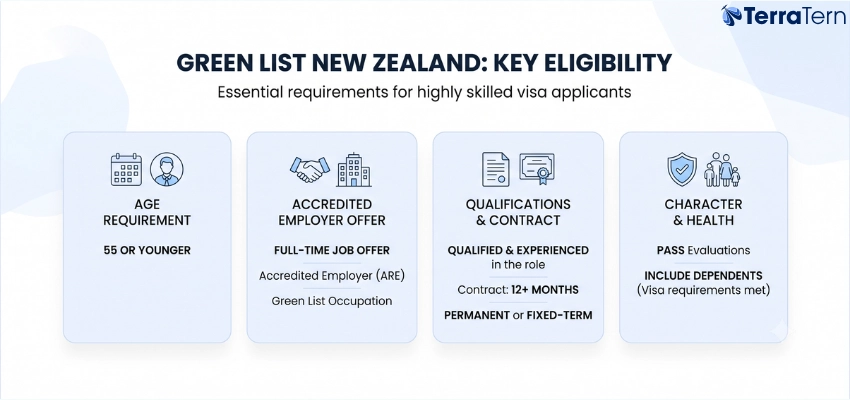
The following are eligible for the Green List New Zealand:
-
Age 55 or younger
-
Full-time job or job offer for an Accredited Employer (ARE) in a Green List occupation.
-
Permanent or fixed-term for 12 months and over.
-
Should be qualified, registered, and experienced in this role.
-
Be able to pass health and character evaluations.
-
Children who are dependents of the applicant and/or partner may be included if they fulfill the visa requirements.
Expert Tip: Meeting the general Green List criteria isn't enough on its own; your actual job description and duties must match your occupation's exact ANZSCO definition, which is the single most common reason otherwise qualified applicants are declined.
What Are the Salary and Wage Thresholds for New Zealand Green List Roles?
The majority of Green List New Zealand positions come with either an occupation-specific pay rate or the NZ median wage.
- Some roles must be paid at or above the immigration median wage, while others have higher occupation-specific wage floors or multipliers set by Immigration New Zealand. Always check the live wage rule for your exact occupation.
- Tier 1 applicants must meet the pay requirement when applying.
- Tier 2 applicants are required to maintain the required wage level for the entire 24-month work period.
- If income falls below the threshold, this will jeopardise eligibility and could result in refusal.
|
Threshold Type |
What it Means |
When it Applies |
|
Occupation-specific pay rate |
Some roles have their own required wage |
At application and during employment |
|
Median wage |
If no special rate is set, the general median wage applies |
Common baseline for many roles |
|
1.3x or 2x median wage |
Higher pay is required for selected roles |
Applies to specific occupations only |
Important Tip: Salary is compared to your specific occupation's market rate, not just the minimum threshold. Being paid barely above the legal minimum can still trigger a "genuineness" review even if you technically clear the bar.
How Do Indians Apply for the New Zealand Green List From India?
The following steps can be taken by Indians for the New Zealand Green List from India:
- Make sure your job is on the current Green List New Zealand and whether it is Tier 1 or Tier 2.
-
If your Indian qualification is not on New Zealand’s exempt list, you must apply for an International Qualification Assessment (IQA) so that your degree can be formally recognised in New Zealand.
-
Get a job offer from an Accredited Employer (full-time).
-
Make sure you have your passport and PCC/school and work certificates, etc., ready, and have English test scores (if required).
-
If your role is Tier 1, you can apply directly for the Straight to Residence visa. If your role is Tier 2, you must first obtain an Accredited Employer Work Visa (AEWV), complete 24 months of eligible work, and then apply for Work to Residence.
-
Complete all required health and character checks, and include your partner and dependent children in the application if they meet the visa requirements.
As per TerraTern Expert: Start your International Qualification Assessment (IQA) and police clearance certificate early; these two India-specific document steps are the most common causes of avoidable delay in an otherwise straightforward Green List application.
How Long Does New Zealand Green List Visa Processing Take?
While Straight to Residence Visa (Tier 1) applications are commonly processed within a few months once complete, Tier 2 applicants must first complete 24 months of eligible work before their Work to Residence application is even lodged. Because volumes fluctuate, generally check Immigration New Zealand’s live processing-times tool rather than relying on a single guaranteed number for the Green List New Zealand pathway.
|
Green List Tier |
Work Requirement |
Visa Processing Time |
|
Tier 1 |
None |
Commonly, a few months |
|
Tier 2 |
24 months |
Assessed after the work period |
Pro Tip: Tier 1 applicants often assume a wait comparable to Tier 2; in reality, a complete and accurate Tier 1 application is usually New Zealand's fastest residence pathway available today.
Green List vs New Zealand Skilled Migrant Visa: Which Pathway Should You Choose?
The Green List New Zealand pathway is occupation-driven, determining eligibility strictly by your specific role and tier. In contrast, the New Zealand skilled migrant visa is points-driven, combining age, qualifications, and work experience.
|
Feature |
Green List Pathway |
Skilled Migrant Visa |
|
Eligibility |
Specific occupation and tier |
6-point system |
|
Structure |
Direct single application |
Expression of Interest required |
|
2026 Updates |
Periodic occupation reviews |
New experience and trades pathways |
Key Note: If your occupation is on the Green List, it's almost always the faster and simpler route; reserve the Skilled Migrant Category for cases where your role isn't listed or where your individual points profile is unusually strong
What Common Mistakes Should You Avoid on the New Zealand Green List Pathway?
Avoid the following critical errors when pursuing the Green List New Zealand:
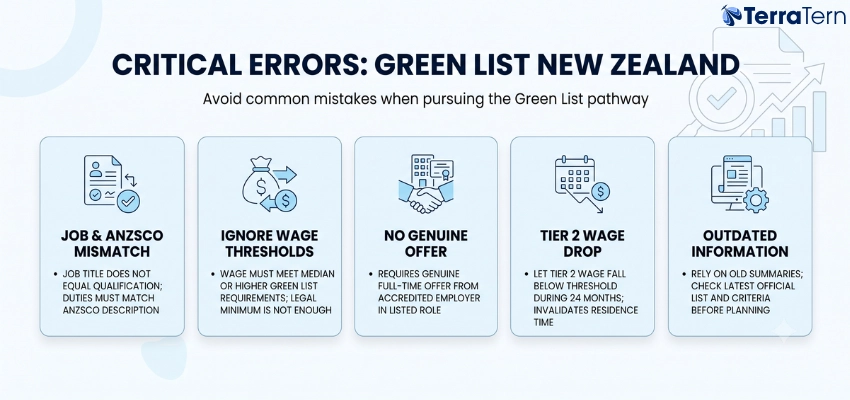
- Assuming a matching job title automatically qualifies you, instead of checking that your duties match the official ANZSCO/NOL occupation description.
- Meeting only the minimum legal wage and ignoring the higher, occupation-specific or median-wage thresholds required for Green List roles.
- Applying without a genuine full-time job offer from an accredited New Zealand employer in a listed Green List occupation.
- Letting your Tier 2 wage drop below the required threshold at any point during the 24-month work period can invalidate that time for residence.
- Relying on outdated Green List summaries instead of checking the latest official list and criteria before planning your move.
- Ignoring health and character requirements or delaying IQA and police clearance causes avoidable processing delays or refusals.
Pro Tip: The single most preventable reason for rejection is a mismatch between your actual day-to-day job duties and the official ANZSCO occupation description. Have your employer's job description reviewed against the Green List definition before you apply, not after.
What's New in the New Zealand Green List for 2026?
Three major developments for 2025–2026 affect applicants: an updated median wage threshold, a 2025 trades expansion, and a full restructuring of the Skilled Migrant Category, launching in August 2026. Here are the critical updates shaping the Green List New Zealand pathway today:
-
Latest Statistic (9 March 2026): New Zealand’s immigration median wage, which underpins many Green List and Skilled Migrant Category wage thresholds, was updated to NZD $35.00 per hour.
-
Industry Development (18 August 2025): Ten additional trades, including Metal Fabricator, Welder, Fitter, and Panel Beater, were officially added to the Tier 2 Work to Residence pathway.
-
Policy Shift (24 August 2026): Immigration New Zealand is restructuring the Skilled Migrant Category into two new pathways: Skilled Work Experience and Trades and Technician. These will sit alongside, not replace, the Green List.
-
Trend Analysis: Nursing and midwifery roles were moved from Tier 2 to Tier 1 in late 2022 and have remained there, reflecting a persistent long-term shortage in healthcare.
-
Expert Insight: Licensed immigration advisers consistently flag that Green List eligibility relies on a precise ANZSCO occupation match, exact salary evidence, and accredited employment—a matching job title alone is never enough.
-
Family Policy Update (30 April 2026): New Zealand raised the income thresholds for Parent Category visas, directly affecting Green List residents planning future family reunification.
Key Note: Don't rely on older guides; the Green List's salary thresholds and the surrounding Skilled Migrant Category framework are both changing in 2026, so always cross-check the current figure on Immigration New Zealand's official site before applying.
Conclusion
The New Zealand Green List remains one of the fastest and clearest residency pathways available to skilled Indian professionals in 2026. Whether navigating the direct Tier 1 route or the 24-month Tier 2 track, applicants must secure accredited employment and meet the updated NZD $35.00/hour median wage.
To successfully manage these strict requirements and the India-specific application steps for the Green List New Zealand, schedule a free eligibility assessment and consultation with TerraTern today.
Contact TerraTern for more information on the New Zealand Green List 2026: Complete Jobs & PR Guide.




 AI Summary