


Key Highlights
- GRE vs IELTS — What's the Core Difference?
- What Is the GRE and What Is It Used For?
- What Is the IELTS and What Is It Used For?
- What Is the Key Difference Between GRE and IELTS?
- How Do the GRE and IELTS Exam Structures Compare?
- Which Is Harder — GRE or IELTS for Indian Students?
- How Do GRE and IELTS Scores Compare?
- How Much Does the GRE vs IELTS Cost in India?
- Do Indian Students Need Both the GRE and IELTS?
- Which Countries Accept GRE and IELTS Scores?
- How Should You Choose Between GRE and IELTS?
- How Can You Prepare for the GRE and IELTS in India?
- What Do Top Universities Expect — GRE or IELTS?
- 2026 Industry Context
- Conclusion
Before deciding, consider your 2026 study-abroad goals and whether GRE vs IELTS fits them better. The GRE assesses readiness for graduate study through verbal reasoning, quantitative reasoning, and analytical writing. IELTS is used to demonstrate English proficiency for study, work, or immigration, depending on the destination and institution.
GRE vs IELTS — What's the Core Difference?

The core difference is:
-
GRE or IELTS: Use GRE for graduate admissions (MS/PhD) to gauge preparation; IELTS is for language requirements and/or visas to study in English.
-
The GRE Has Levels of Difficulty as follows: Problem-solving/math: 3 sections (~2 hours), while the IELTS has four skills with varying degrees of difficulty (~2.75 hours).
-
GRE Upside/Downside: School for students worldwide (USA/Europe); IELTS downside/upside: school in the UK/Canada/Australia/USA (undergrad/postgrad/immigration).
-
GRE vs IELTS for Indians: If you are planning to go for a post-graduate course in the USA, you have to take both the GRE for admission and the IELTS for English proof. See information about the particular universities.
Also Read: What Exams Are Required to Study Abroad? (2026 Guide)
What Is the GRE and What Is It Used For?
The GRE is used for the following:
-
Context about GRE - Graduate Record Examination vs IELTS GRE Full Form & Conductor: GRE is conducted by a US-based not-for-profit organisation - ETS (Educational Testing Service).
-
Test Formats: The GRE includes the General Test, which is used most often for admissions, and Subject Tests for specific disciplines.
-
Primary Use: GRE vs IELTS, evaluates preparedness for Master's studies (MS), PhD and some MBA programs through analytical, verbal and quantitative skills.
-
Modes of Acceptance: The GRE is primarily computer-based, with paper-delivered testing available only in limited locations or circumstances.
|
Fact |
Details |
|
Duration |
~1 hr 58 min |
|
Score |
260–340; Analytical Writing: 0–6 separately |
|
Validity |
5 years |
As per TerraTern Expert, Divyansh , the GRE General Test is the most widely accepted version for graduate admissions. Most Indian students do not need the GRE Subject Test unless applying to highly specialised research programmes in fields like Physics, Chemistry, or Mathematics.
What Is the IELTS and What Is It Used For?
IELTS is jointly owned by the British Council, IDP Education, and Cambridge Assessment English.
-
Test Types: IELTS Academic vs (applications for work/immigration) IELTS General Training.
-
Sections Overview: Listening, Reading, Writing, Speaking tests practical English skills.
-
So, You Should Know the Difference Between GRE and IELTS for Indians, as you can study/work in the UK, Australia, Canada and New Zealand. IELTS is accepted by over 11,500 organisations in more than 140 countries.
-
The 2026 Update of this Information is as Follows: GRE vs IELTS—IELTS One Skill Retake allows candidates to retake one section of the test in eligible locations.
|
Fact |
Details |
|
Duration |
~2 hr 45 min |
|
Score |
0–9 bands |
|
Validity |
2 years |
Important Note: Always confirm whether your target university requires IELTS Academic or IELTS General Training; they are scored and assessed differently. Most university admissions require IELTS Academic, while General Training is for immigration (like Canada PR or Australia PR).
What Is the Key Difference Between GRE and IELTS?
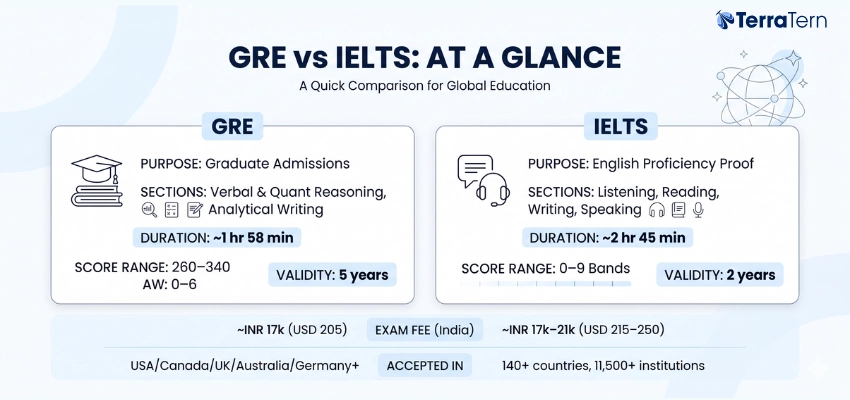
The GRE is for using English for academic pursuits (graduation level); IELTS validates English for study or work, or to immigrate to the country. Most applicants with studies at Indian institutes send letters of recommendation to American schools.
|
Parameter |
GRE |
IELTS |
|
Full Form |
Graduate Record Examination |
International English Language Testing System |
|
Purpose |
Graduate admissions |
English proficiency proof |
|
Conducted By |
ETS |
British Council/IDP/Cambridge |
|
Sections |
Verbal/Quant Reasoning, Analytical Writing |
Listening/Reading/Writing/Speaking |
|
Duration |
~1 hr 58 min |
~2 hr 45 min |
|
Score Range |
260–340; Analytical Writing: 0–6 separately |
0–9 bands |
|
Validity |
5 years |
2 years |
|
Exam Fee (India) |
~INR 17,000 (USD 205) |
~INR 17,000–21,000 (USD 215–250) |
|
Attempts/Year |
You may retake the GRE once every 21 days, up to five times in a rolling 12-month period |
Once every 21 days, up to five times in a rolling 12-month period. |
|
Accepted In |
USA/Canada/UK/Australia/Germany+ |
140+ countries, 11,500+ institutions |
Expert Tip: The score validity gap is critical for Indian students: IELTS scores expire in just 2 years, while GRE scores remain valid for 5 years. If you're planning ahead, time your IELTS closer to your application window.
Also Read: Types of IELTS: Explore All Exams, Changes & Tips
How Do the GRE and IELTS Exam Structures Compare?
GRE vs IELTS structures differ fundamentally: GRE has 3 sections (Verbal, Quantitative, Analytical Writing) testing academic skills in ~1 hr 58 min; IELTS has 4 (Listening, Reading, Writing, Speaking) assessing English proficiency in ~2 hr 45 min. GRE is adaptive and shorter post-2023 redesign.
What Does the GRE Exam Pattern Look Like?
GRE vs IELTS, the new GRE (shorter format) is computer-adaptive.
|
Section |
Questions/Time |
Score |
|
Analytical Writing |
1 task / 30 min |
0–6 |
|
Verbal Reasoning (2 sections) |
27 total / ~41 min |
130–170 |
|
Quantitative Reasoning (2 sections) |
27 total / ~47 min |
130–170 |
Expert Advice: The GRE redesign shortened the test substantially, reducing total test time to about 1 hour and 58 minutes. A significant reduction in test fatigue, a major complaint among Indian test-takers. If you took a mock test using the old format, re-familiarise yourself with the new, shorter structure.
What Does the IELTS Exam Pattern Look Like?
GRE vs IELTS, IELTS tests practical English across 4 sections.
-
Listening: 40 questions from 4 recordings, ~30 min (+10 min transfer).
-
Reading: 40 questions from 3 texts, 60 min (Academic: scholarly; General: everyday).
-
Writing: 60 min Task 1 (150 words), Task 2 (250 words).
-
Speaking: 11–14 min face-to-face (3 parts: intro, cue card, discussion).
Important Note: The IELTS Speaking test is conducted face-to-face with a human examiner, not AI or a computer, which many students find more natural but also more nerve-wracking. Practising mock interviews with a real person (not just apps) is essential.
Which Is Harder — GRE or IELTS for Indian Students?
GRE vs IELTS difficulty varies by strengths: GRE challenges Indian students with verbal vocabulary and abstract writing, but Quant favours strong math backgrounds. IELTS tests speaking fluency and everyday English, where reading often excels, but accents hinder. The GRE is generally harder overall for Indians.
|
Factor |
GRE |
IELTS |
|
Vocabulary |
Very High |
Moderate |
|
Math Skills |
High |
None |
|
Speaking |
None |
Face-to-face |
|
Writing |
Academic essays |
Descriptive/opinion |
|
For Indians |
Harder (verbal) |
Moderate |
As per TerraTern Expert: If you're strong in mathematics but struggle with spoken English fluency, the GRE may play to your strengths, but you'll still need IELTS for most graduate programmes outside the USA. Build your IELTS speaking skills through consistent daily practice, not just exam prep.
How Do GRE and IELTS Scores Compare?
GRE vs IELTS scores aren't directly comparable, but benchmark success: GRE 310+ (V+Q) competitive; IELTS 6.5+ bands strong. Indians average GRE V~151/Q~153; target 320+ top US programs.
|
Score Type |
GRE |
IELTS |
|
Range |
260–340 (V+Q); 0–6 AWA |
0–9 bands |
|
Good Score |
310+ |
6.5–7.0 |
|
Top Programs |
320+ |
7.5+ |
|
Validity |
5 years |
2 years |
Pro Tip: Don't just aim for the minimum band score; aim for the competitive threshold. A 7.0 IELTS vs a 6.5 IELTS can be the difference between acceptance and waitlisting at top UK and Australian universities.
Also Read: Exams for Foreign Studies: New Exam Guide by Experts
How Much Does the GRE vs IELTS Cost in India?
GRE vs IELTS fees are similar in India in 2026: GRE fixed; IELTS city-variable. Add-ons like score reports are extra.
|
Cost Item |
GRE |
IELTS |
|
Base Fee |
INR 17,000 (USD 205) |
INR 17,000–21,000 (USD 215–250) |
|
Reschedule |
~INR 5,000 |
Varies |
|
Extra Scores |
USD 30/add'l |
Included |
|
Coaching |
INR 15k–60k |
INR 10k–40k |
Key Note: Factor in not just the exam fee but the total cost of preparation. If you need to retake IELTS (common for students aiming for a 7.0+ band), budget for 2–3 attempts, each costing INR 17,000–INR 21,000. Strategic preparation with expert coaching often reduces total retake costs.
Do Indian Students Need Both the GRE and IELTS?
Many US graduate programmes require the GRE, while most also require proof of English proficiency, such as IELTS or TOEFL. The UK/Canada/Aus often require only IELTS.
|
Destination |
GRE Required? |
IELTS Required? |
|
USA (MS/PhD) |
Usually |
Yes |
|
USA (MBA) |
or GMAT |
Yes |
|
UK |
Rarely |
Yes |
|
Canada |
Rarely |
Yes |
|
Australia |
Some |
Yes |
|
Germany (English) |
Rarely |
Yes |
|
New Zealand |
Yes |
As per TerraTern Expert, Divyansh, never assume; always check your specific programme's requirements on the university's official admissions page. Some US programmes have waived GRE requirements post-pandemic, and this continues to vary by programme and intake year.
Which Countries Accept GRE and IELTS Scores?
GRE vs IELTS acceptance:
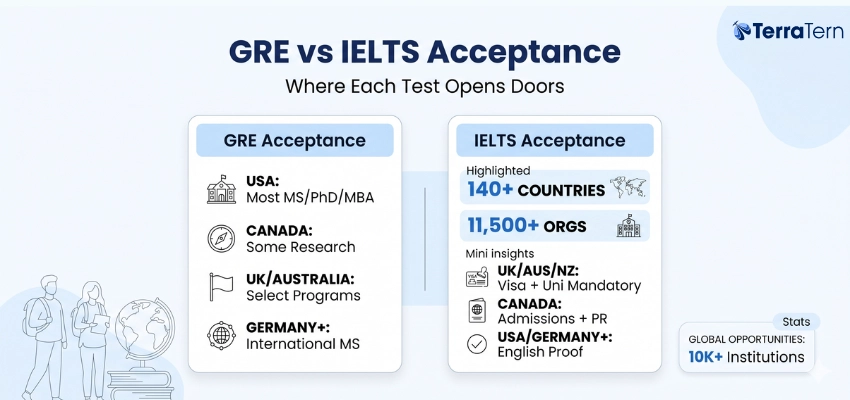
GRE:
-
USA: Most MS/PhD/MBA.
-
Canada: Some research.
-
UK/Australia: Select programs.
-
Germany: International MS.
IELTS (140+ countries, 11,500+ orgs):
-
UK/Aus/NZ: Visa + uni mandatory.
-
Canada: Admissions + PR.
-
USA/Germany/Ireland/France/Sweden: English proof.
Important Note: For Indian students targeting Canada PR or Australia PR alongside their studies, IELTS scores are used both for university admission AND visa/immigration applications, making it doubly important to achieve a competitive band score from the start.
Also Read: International Exams: Latest Insights, Dates & English Proficiency
How Should You Choose Between GRE and IELTS?
GRE vs IELTS decision guide:
Choose GRE if:
-
US MS/PhD/MBA apps.
-
Uni requires it.
-
Strong in math/analytical.
Choose IELTS if:
-
UK/Aus/Canada/NZ unis/visas.
-
English proof needed.
-
No GRE req; work/PR focus.
-
Both if: US grads.
Checklist:
-
Review uni admissions.
-
Check visa rules.
-
Match your strengths.
-
GRE, 2–4 mo prep; IELTS: 1–3 mo.
Expert Tip: A common strategy is to take the GRE first, then prepare for IELTS closer to the application window, then prepare for IELTS in the months before your application window opens, ensuring both scores are valid when you submit.
How Can You Prepare for the GRE and IELTS in India?
Indian students can ace the GRE and IELTS through self-study with official ETS/British Council materials or structured coaching. GRE prep takes 2–4 months; IELTS 1–3 months. Use apps like Magoosh, practice mocks, and build vocab/speaking skills. TerraTern offers personalised IELTS coaching for a band score of 7.5+.
How Should You Prepare for the GRE?
To prepare for the GRE is
-
Timeline: 2–4 months for Indian students.
-
Official Resources: ETS free GRE Prep, PowerPrep tests.
-
Key Focus: Verbal (advanced vocab lists); Analytical Writing (Issue essays); Quant (speed, data interpretation—your strength).
-
Apps: Official GRE, Magoosh, Manhattan Prep.
-
Mocks: 3–4 full-length timed tests.
-
Pitfall: Don't underestimate Verbal—it's tougher than daily English.
How Should You Prepare for the IELTS?
To prepare for IELTS is
-
Timeline: 1–3 months (longer for 7.5+ bands).
-
Official resources: British Council, IDP, Cambridge tests.
-
Key Focus: Speaking (fluency); Writing Task 2 (essays); Listening (multi-accents: British/Aussie/US/Canadian).
-
Apps: IELTS Official Prep, Magoosh IELTS, British Council LearnEnglish.
-
TerraTern Edge: Personalised coaching for all sections.
-
Tip: Use One Skill Retake for weak sections.
Pro Tip: For IELTS, consistent daily exposure to English, such as podcasts, academic articles, and recorded interviews, builds the background fluency that no mock test can fully replicate. Start 3–6 months before your intended test date for the best results.
What Do Top Universities Expect — GRE or IELTS?
In GRE vs IELTS debates, top US universities like MIT and Stanford often require the GRE for grad programs and accept IELTS for English proficiency. The UK/Canada/Australia/Europe favour IELTS (no GRE). Always check official sites as requirements evolve.
|
University |
Country |
GRE Required? |
IELTS Required? |
Min IELTS Score |
|
MIT |
USA |
Yes |
Yes |
7.0 |
|
Stanford |
USA |
Yes |
Yes |
7.0 |
|
Harvard |
USA |
Yes |
Accepted |
7.0 |
|
University of Oxford |
UK |
No |
Yes |
7.0–7.5 |
|
University of Toronto |
Canada |
No |
Yes |
6.5–7.0 |
|
University of Melbourne |
Australia |
Rarely |
Yes |
6.5–7.0 |
|
TU Munich (English) |
Germany |
No |
Yes |
6.5–7.0 |
Key Note: Don't assume your dream university's requirements based on general advice; admission policies change every year. Always check the official admissions page of each programme, not just the university homepage.
Also Read: Everything About IELTS Learning & Exam Is Right Here!
2026 Industry Context
5 Key Facts Shaping the GRE vs IELTS Landscape in 2026:
-
Over 1,13,000 Indian students took the GRE in 2023, a record high reflecting surging demand for US graduate programmes. (ETS, 2024)
-
IELTS is accepted by 11,500+ organisations in 140+ countries, making it the world's most widely recognised English proficiency test. (IDP/British Council, 2026)
-
The GRE was redesigned with a shorter format (now ~1 hour 58 minutes), reducing test fatigue while maintaining adaptive difficulty. (ETS, 2023)
-
Germany and Europe-bound students increasingly need IELTS for English-taught master's programmes, but rarely require the GRE. (University-level research, 2026)
-
Demand for IELTS slots in India and Southeast Asia rose by 18% in 2026, driven by increased migration and study-abroad interest. (TerraTern Research, 2026)
-
Many top US universities accept the GRE or GMAT for business programmes, and some have made the GRE optional post-pandemic. Always check individual programme requirements.
Conclusion
GRE vs IELTS choice hinges on goals: GRE suits US grad admissions (MS/PhD) testing analytical skills; IELTS proves English for global unis/visas (UK/Canada/Aus). Indian students often need both for the USA: prep for the GRE first (2-4 months), then prep for the IELTS (1-3 months). Check uni/visa rules, match strengths (math? GRE; fluency? IELTS). Success awaits targeted prep!
Contact TerraTern for more information on GRE vs IELTS: Which Exam Should You Take in 2026.