

Key Highlights
- What Is a Europass CV and Why Do Indian Professionals Need It?
- What Are the Key Sections of the Europass CV Format?
- How Do You Create a Europass CV Step by Step?
- What Are the Country-Specific Rules for the Europass CV Format in Europe?
- What Are the Europass CV Rules for Germany?
- How Do Indian Professionals Adapt Their Europass CV Format for the EU Job Market?
- What Are the Common Mistakes to Avoid in a Europass CV?
- How Is a Europass CV Used for Visa Applications and the EU Blue Card?
- What Are the Pros and Cons of Using the Europass CV Format?
- 2026 Industry Context Section
- Conclusion
Created by the European Commission, the Europass CV is the official standard for resumes, which is used throughout Europe and is vital for Indian job seekers heading for any job, study or training destination in Europe. Europass CVs and documents are recognised in more than 30 European countries, including EU and EEA members, helping employers and education institutions interpret your qualifications in a consistent way. The Europass CV format uses a structured layout with clear sections for personal details, work experience, education and skills, and is designed to be easily readable across European systems, although some private-sector ATS tools may handle custom European CV templates better.
What Is a Europass CV and Why Do Indian Professionals Need It?

The Europass CV is a standardised format that is recognised and accepted by employers, universities and immigration authorities in 36+ countries throughout the European Union and is free of charge. It is the starting point for any Indian with a dream to find employment opportunities, apply for visas, or pursue academic programs in Europe.
-
For Indian professionals applying in Europe, using a Europass-style or modern European CV is highly recommended because it matches local recruiter expectations, but it is not legally mandatory for most applications.
-
The European Commission designed it in 2004 and redesigned it in 2020 for modern usage.
-
The Europass CV format is very different from the traditional ‘biodata’ used in India and aligns much more closely with what European recruiters expect.
-
For routes such as the EU Blue Card or Germany’s Opportunity Card, immigration authorities and employers generally expect a clear, European-style CV. Europass is one commonly accepted format, but other well-structured CVs are also used
-
Europass CVs integrate smoothly with the EURES job portal and are widely accepted by employers advertising there, although EURES also supports other CV formats and profiles.
Also Read: Europe Job Consultancy in India: Gov. Approved List
As per TerraTern Expert Divyansh, Indian professionals must replace the familiar "biodata" format entirely before approaching European employers. Using an Indian resume format is one of the top reasons for the rejection of visa and job applications from India at the initial screening stage.
What Is the Europass CV Format and How Does It Differ from a Regular Resume?
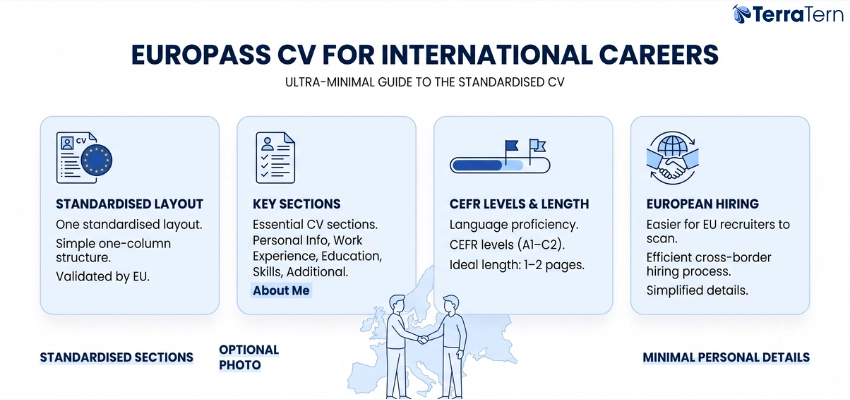
The Europass CV format has a standardised layout that is validated and accepted by the EU to be recognised in other countries.
-
Simplified layout (default) into one column as standardised sections for EU employers; One column, standardised sections for EU employers
-
The following is an expanded list of Standard Sections to view: Personal Information, Work Experience, Education & Training, Skills (Language, Digital, Other), and then Additional.
-
In the 2020 redesign, I added the "About Me" field, so the personal statement is now located in the upper part of the Text block.
-
Compared with typical Indian CVs, Europass usually contains fewer personal details, and a photo is optional. You can add CEFR language levels (A1–C2) if relevant, and the recommended length is typically 1–2 pages focused on your most important skills and experience.
-
Many European recruiters find the Europass CV format easier to scan than traditional Indian biodata-style resumes, especially for cross-border hiring, but preferences can vary by country and sector.
|
Aspect |
Europass CV Format |
Traditional Indian Resume |
|
Structure |
Fixed single-column |
Flexible multi-column |
|
Length |
1-2 pages strict |
1-3 pages flexible |
|
Customisation |
Standardized sections |
Customizable layout |
|
Usage |
EU jobs/visas only |
India/general use |
|
ATS Compatibility |
High (EU-standard) |
Variable |
Expert Tip: Unlike an Indian resume, the Europass CV format uses CEFR levels (A1–C2) to rate language skills. Always convert your English, French, or German proficiency to the CEFR format before submitting to EU employers.
Also Read: Jobs in Europe for Indian 12th Pass: Pay, Visa & More
What Are the Key Sections of the Europass CV Format?
The Europass CV contains five core sections: personal information, work experience (reverse chronological), education and training, skills (language, digital, and professional), and additional information. Each section follows a fixed structure recognised across all EU member states.
What Should You Include in the Personal Information Section?
The personal information section should include:
-
Full Contact Details: Name, international address format, phone with +91 (India), professional Gmail/Outlook email
-
Professional Photo: Often expected in Germany and Austria, and still common in parts of France, but generally discouraged for applications to the UK and Ireland unless specifically requested by the employer.
-
Optional Details: Date of birth, nationality, gender (not mandatory)
-
Indian Mobile Number: Include +91 country code; add WhatsApp number if available
-
Avoid Nicknames: Use formal email addresses to maintain professionalism in your Europass CV.
Important Note: Indian applicants should always include their nationality and international phone code; European recruiters need to confirm right-to-work status at first glance at your CV.
How Do You List Work Experience on a Europass CV?
The work experience should be listed in the following manner:
-
Reverse Chronological Order: Most recent job first in your Europass CV
-
Role Details: Job title, employer name, city/country, start–end dates for each position
-
3–6 Bullet Points: Responsibilities/achievements using strong action verbs (managed, developed, increased)
-
Quantify Achievements: "Reduced processing time by 20%" for Europass impact
-
Indian Employers: Full company name + sector; avoid acronyms unknown to EU recruiters.
Expert Advice: European employers value measurable results over job descriptions and replace generic duty lists with impact statements that use numbers and percentages.
How Should Indian Applicants List Education and Qualifications?
The Indian applicants' list of education and qualifications should be listed in the following way:
-
Reverse Chronological: Degree name, institution, city, country, start–end year
-
EQF Conversion: Convert CGPA/percentage to the European Qualifications Framework equivalent level
-
Anabin Database: Note if your university is H+ (fully recognised by Germany)
-
Additional Credentials: Vocational certifications, MOOCs, and professional training listed here
-
Evaluation Bodies: ZAB (Germany), ENIC-NARIC for general EU recognition on Europass CV
Important Tip: Indian applicants must check whether their university is rated H+ in Germany's Anabin database before applying for the EU Blue Card; an unrecognised degree can block an otherwise strong application.
How Do You Fill in the Skills Section, Including Language and Digital Skills?
Complete the skills section by listing your language skills with CEFR levels, digital skills (software and tools), and key professional competencies.
-
Language Skills: Mother tongue first; foreign languages with CEFR levels (A1–C2) across 5 dimensions for Europass CV
-
CEFR Certification: Support with IELTS, TOEFL, DELF, and Goethe certificates for digital skills Europass
-
Digital Skills: Specific software, programming languages, tools (MS Office, Python, AutoCAD, SAP)
-
English Level: List English explicitly with CEFR C1–C2; add Hindi/regional languages for multilingual EU
-
Professional Skills: Brief free-text boxes; concise entries relevant to the target job in Europass CV
What Can You Add in the Additional Information Section?
In the Additional Information section, you can add the following:
-
Volunteering & Community Work: Relevant experience demonstrating soft skills for Europass CV
-
Publications & Awards: Academic papers, recognitions, and achievements related to the career
-
Hobbies & Interests: Career-relevant activities showing personality fit
-
Memberships: Professional associations, union memberships for Europass CV credibility
-
No Blank Sections: Remove unfilled sections rather than leaving empty fields unprofessional
As per TerraTern Expert: An empty volunteering or publications section is worse than no section at all. Remove any Europass section you cannot fill with relevant, genuine content.
How Do You Create a Europass CV Step by Step?
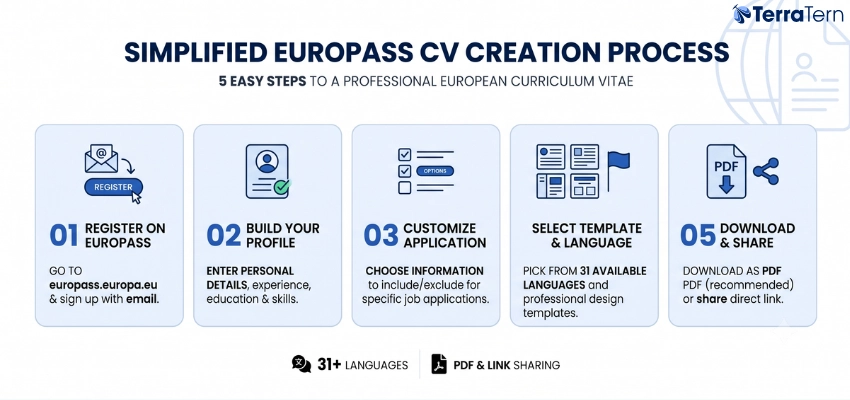
Creating a Europass CV takes 30–60 minutes using the official free builder at europass.europa.eu. Register, build your Europass profile, then generate tailored CVs in any of 31 languages with a few clicks.
What Is the Step-by-Step Process to Build Your Europass CV Online?
The step-by-step process is:
-
Step 1: Go to europass.europa.eu and register with your email address for Europass CV
-
Step 2: Build your Europass Profile, enter personal details, work experience, education, and skills
-
Step 3: Choose which information to include/exclude for a specific application on the Europass CV
-
Step 4: Select a design template and language (31 options available)
-
Step 5: Download as PDF (recommended) or share the direct link with employers/EURES
Pro Tip: Always keep an editable version of your Europass CV and update your Europass profile after every new role, certification, or language milestone. European hiring happens fast, and outdated CVs cost candidates top opportunities.
Also Read: Civil Engineering Jobs in Europe: Updated Guide
Should You Use the Official Europass Website or a Third-Party Builder?
Use the official Europass CV builder for EU institutions; use ATS-enhanced builders for private-sector roles due to parsing issues with the official XML format.
|
Method |
Pros |
Cons |
Best For |
|
Official Europass builder |
Free, EU-standard, 31 languages, EURES-compatible |
ATS parsing issues in private software, XML format limits |
EU institutions, EURES, Erasmus+, public sector |
|
Microsoft Word template |
Editable, familiar interface, no registration |
Not EU-standard, manual formatting required |
|
|
Third-party ATS builder |
ATS-optimised, private sector compatible, modern designs |
Paid, may not be EU-standard |
Private sector, tech companies, multinational corporations |
Key Note: The standard Europass PDF can trigger parsing errors in many private-sector ATS platforms. If applying to tech or multinational companies, use an ATS-optimised European-style template rather than the raw Europass download.
What Are the Country-Specific Rules for the Europass CV Format in Europe?
While the Europass CV format is standardised across the EU, individual countries have specific expectations around photos, CV length, language, and personal details. Indian applicants must tailor their to the target country.
What Are the Europass CV Rules for Germany?
The Europass CV rules for Germany are:
-
Photo: Expected (professional headshot, neutral background) for Germany
-
German "Tabular CV": Some employers prefer traditional signed format; Europass is widely accepted for international roles and the EU Blue Card
-
Language: German mandatory for many roles; English sufficient for IT/tech/multinational roles
-
EU Blue Card 2026 Salary: In Germany, recent Blue Card updates set minimum gross annual salary thresholds around the low-€50,000 range for general occupations and lower thresholds in the mid-€40,000s for certain shortage professions such as IT and engineering; applicants should always confirm the latest figures on official German government websites.
-
Credential Recognition: ZAB for Indian degrees; Anabin H+ status; convert CGPA to German 1.0–4.0 scale
As per our TerraTern Expert, Shreya, for Germany specifically, always convert your Indian CGPA to a German grade equivalent (GPA on a 1.0–4.0 scale or percentage equivalent to German grading). German HR teams are unfamiliar with the 10-point Indian grading system.
What Are the Europass CV Rules for Other EU Countries?
Each EU country has specific expectations for Europass CV beyond Germany’s standards:
-
France: Photo expected; maximum 2 pages; formal, detailed tone with emphasis on education
-
Netherlands: No photo; concise 1–2 pages; results-focused with quantifiable achievements
-
Scandinavian countries (Sweden, Denmark, Norway): No photo; very concise; emphasis on work-life balance, teamwork, and soft skills
-
Austria/Switzerland: Photo expected; detailed education section including grades and thesis titles
-
Ireland: No photo; similar to UK style; 1–2 pages; achievements and competencies-focused
Expert Tip: There is no single "one-size-fits-all" Europass CV for all EU countries; always research the hiring norms of your specific target country before finalising your CV, even within the EU.
How Do Indian Professionals Adapt Their Europass CV Format for the EU Job Market?
Indian professionals should adapt their Europass CV format by replacing traditional biodata-style resumes, converting academic qualifications into internationally understood formats, rating language proficiency using CEFR standards, and tailoring the CV to country-specific hiring expectations across Europe. These adjustments make the CV easier for EU recruiters to evaluate and improve the chances of securing interviews.
How Do You Convert Indian Academic Qualifications for a Europass CV?
When creating a Europass CV, present Indian qualifications in a format that European employers can easily understand:
-
Avoid listing only percentages or CGPA (e.g., 73% or 8.2 CGPA) without explanation.
-
Convert grades to a 4.0 GPA scale where possible.
-
Add a comparison statement such as “Equivalent to a First Class Degree” or “Equivalent to a 2:1 Honours Degree.”
-
For Germany, verify your university's recognition status through the Anabin database and mention recognised qualifications when relevant.
-
Use credential evaluation services through the ENIC-NARIC network for EU-wide academic recognition.
-
For Erasmus+ and postgraduate applications, convert Indian credit hours into ECTS (European Credit Transfer System) credits.
How Should You Rate Your English Language Skills on a Europass CV as an Indian Applicant?
Language skills should be presented using the CEFR framework in every Europass CV:
-
Rate English proficiency using CEFR levels such as C1 (Advanced) or C2 (Proficient).
-
Include recognised test scores such as IELTS, TOEFL, or PTE as supporting evidence.
-
Mention English as your first foreign language if you are not a native speaker.
-
If English was the primary language of instruction throughout your education, you may indicate this in the language section.
-
Use a clear format such as: English – C1 (Advanced), IELTS 7.5 (2025).
-
Keep language ratings consistent with the official CEFR scale used across Europe.
-
A properly structured language section strengthens your CV by showing European recruiters exactly how fluent you are in English and other languages, using CEFR levels and recognised test scores.
Important Note: Indian professionals are among the world's strongest English communicators, yet many European recruiters underestimate this. Explicitly listing an IELTS band score of 7.5+ or a CEFR C1/C2 rating, with supporting evidence, eliminates this bias in the first screening round.
What Are the Common Mistakes to Avoid in a Europass CV?
The most common Europass CV mistakes include using the Indian biodata format, leaving sections incomplete, failing to use CEFR language levels, listing responsibilities instead of achievements, and submitting the same CV for every country or job application.
-
Using an Indian Biodata Format Instead of a Europass CV: Follow the official Europass structure and section order.
-
Listing Percentages or CGPA Without Explanation: Convert grades to a GPA scale or provide an EU-equivalent qualification statement.
-
Leaving Skills Sections Blank or Overly Generic: Include technical, digital, language, and transferable skills with specific examples.
-
Omitting CEFR Language Proficiency Levels: Use standardised levels, such as A1–C2, for all language entries.
-
Using a Photo Where it is not Expected: Avoid photos for applications in Ireland, the UK, and the Netherlands unless specifically requested.
-
Not including the International Dialling Code: Use a complete phone number format such as +91 XXXXX XXXXX.
-
Writing Job Duties Instead of Achievements: Highlight measurable results, outcomes, and accomplishments.
-
Leaving Empty Europass Sections in the Final Document: Remove all unused sections before exporting the CV.
-
Uploading the CV in Word or Other Editable Formats: Submit your Europass CV as a PDF unless an employer requests otherwise.
-
Sending the Same CV for Every Country and Role: Tailor content to local hiring expectations and job requirements.
-
Not Updating your Europass Profile Before Generating the CV: Review and refresh all information before creating the final document.
Expert Advice: European recruiters spend fewer than 10 seconds on initial CV screening; a single blank Europass section or unformatted qualification immediately disqualifies an otherwise strong Indian candidate.
Also Read: How to Get Job in Europe From India? Experts Latest Guide
How Is a Europass CV Used for Visa Applications and the EU Blue Card?
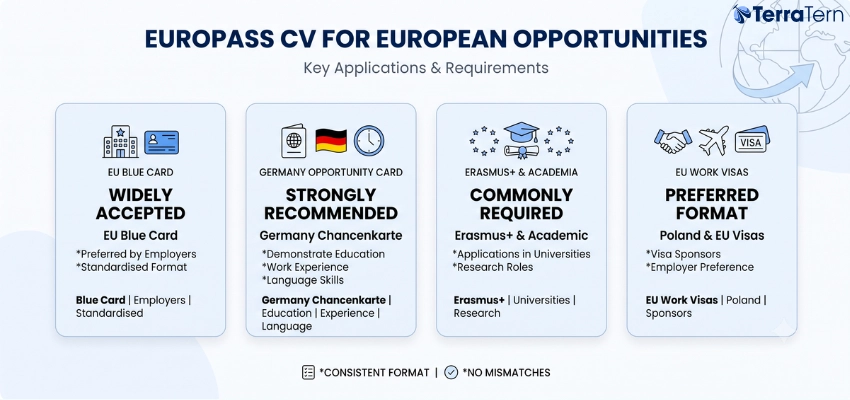
A Europass-style CV is strongly recommended for some European immigration and academic pathways, such as Erasmus+ and certain public-sector or research roles,and is commonly accepted for EU Blue Card or Opportunity Card applications, but in many cases a clear European CV in another format is also acceptable. A poorly formatted or inconsistent CV can negatively affect the application review process.
1. EU Blue Card Applications
-
Widely accepted and often preferred by EU employers, immigration authorities, and the EURES network.
-
Helps present qualifications in a standardised European format.
2. Germany Opportunity Card (Chancenkarte): The Europass CV format is strongly recommended to clearly demonstrate education, work experience, and language skills.
3. Erasmus+ Scholarships and Academic Programs: The Europass CV is commonly required or expected for applications across European universities.
4. Poland and Other EU Work Visas: Many employers and visa sponsors prefer applicants to submit a Europass-based CV.
5. Qualification Verification:
-
Visa officers compare the CV with employment contracts, educational credentials, and supporting documents.
-
Any mismatch in dates, qualifications, or work history may lead to delays or rejection.
Pro Tip: Submitting an Indian-style resume instead of a Europass CV to EU Blue Card or Germany Opportunity Card applications is one of the top avoidable reasons Indian professionals face visa rejection. Always align your CV format with the official EU standard before submission.
What Are the Pros and Cons of Using the Europass CV Format?
The Europass CV format offers universal recognition across Europe, multilingual support, and a standardised structure. However, its rigid design and limited customisation may not be ideal for all private-sector applications.
|
Pros |
Cons |
|
Officially recognised across Europe and accepted in 36+ countries. |
Limited design flexibility and limited customization options. |
|
Free to create and download with 31 languages available. |
Can produce longer CVs than necessary if not edited properly. |
|
Standardised format that European recruiters are highly familiar with. |
Less visually distinctive; may feel generic for competitive roles. |
|
ATS-friendly section headings simplify automated tracking. |
Some private ATS systems may have parsing issues with official XML exports. |
|
Easy digital sharing through profile links. |
Not always preferred by startups and tech companies. |
|
Integrates directly with the EURES job portal. |
Can contain unnecessary sections if you don't actively prune them. |
Key Note: Think of the Europass CV as a passport photo, universally accepted as an official document, but not the best choice for every occasion. Know when to use the official format and when to flex to a modern, ATS-optimised European CV.
2026 Industry Context Section
Some of the latest industry context facts are:
-
Europass has surpassed 10 million registered users as of late 2026 (Source: European Commission, Europass Statistics 2026)
-
The platform has been available since 2004, with a major redesign in 2020, adding the "About Me" personal summary field
-
Since December 2026, Europass has integrated with EURAXESS, enabling researchers to import profiles directly
-
The EU Blue Card, which frequently requires a Europass CV, now has a minimum salary threshold of €50,700/year (general) and €45,934.20 (shortage occupations) as of 2026 in Germany
-
75% of European recruiters now use ATS systems, making ATS-compatible formatting critical (source: Interactive CV research, 2026)
-
36+ European countries recognise the Europass CV format, including non-EU EEA members
-
The Europass CV can be created and downloaded in 31 languages for free
Conclusion
A well-structured Europass CV remains one of the most effective tools for professionals, students, and job seekers applying across Europe. Its standardised format helps recruiters, universities, and immigration authorities evaluate qualifications consistently. By tailoring content for each country, using CEFR language levels, highlighting measurable achievements, and avoiding common mistakes, applicants can significantly improve their chances of success.
Contact TerraTern for more information on Europass CV: The Complete Guide for Indian Professionals (2026).




 AI Summary