Key Highlights
- What Is the Overview of Doctor Jobs in Australia in 2026?
- What Types of Doctor Jobs Are Available in Australia?
- What Salary Can You Expect from Doctor Jobs in Australia?
- What Are the Requirements to Get a Doctor Job in Australia?
- What Is the International Medical Graduate Pathway to Doctor Jobs in Australia?
- How to Apply for a Doctor Job in Australia?
- What Is Work-Life Balance Like in Australian Medical Careers?
- What Are the Differences Between Urban and Rural Doctor Jobs in Australia?
- How Does Public vs. Private Practice Compare for Doctor Jobs in Australia?
- What About Jobs for Homoeopathic Doctors in Australia?
- What Challenges Do International Doctors Face in Australia, and How Can You Address Them?
- What Is the Future Outlook for Doctor Jobs in Australia?
- Conclusion
Australia's healthcare environment is indeed a marvel, and it offers excellent career opportunities for foreign medical practitioners. The search for doctor jobs in Australia requires knowledge of the competition for pay, the process of registering, and particular routes that blend clinical expertise into the system. Whether it's looking at the big money jobs, the many permanent medical opportunities in big cities, or looking for job opportunities for doctors in Australia in a particular job role, the opportunities are growing exponentially in 2026.
Also, there are niche fields that are changing, and it is important to consider other career options, such as jobs for homoeopathic doctors in Australia, and specifically how to apply for a doctor job in Australia.
What Is the Overview of Doctor Jobs in Australia in 2026?
Below is an overview of Doctor Jobs in Australia for 2026:
-
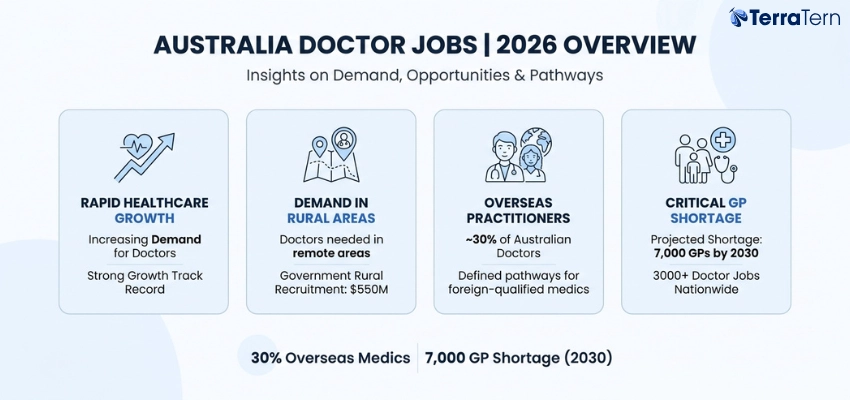
Healthcare in Australia continues to boast rapid growth, resulting in substantial demand for healthcare providers and, in particular, doctors, especially in rural and remote areas.
-
This now amounts to about 30% of medical practitioners in Australia, with a strong track record and a pathway clearly outlined for overseas-qualified medical practitioners, albeit a challenging one.
-
Demand for GPs continues to grow, and Australia will be short of 7,000 GPs by 2030.
-
More than 3000+ doctor jobs exist throughout the country.
-
$550 million from the government to recruit doctors to rural areas.
As per TerraTern Expert Divyansh, the scale of the projected GP shortage means rural and regional roles, specifically, are where the fastest, most receptive hiring is happening, worth prioritising over a strict preference for a major city if speed of placement matters to you.
Also Read: Skilled Jobs in Australia for Indians: Pay, Growth & More
What Types of Doctor Jobs Are Available in Australia?
Doctor jobs in Australia can include general practitioners, specialists (such as cardiologists, anaesthesiologists, radiologists, and medical researchers), emergency doctors, paediatricians, surgeons, and a new class of traditional doctor jobs due to the growth of telehealth.
Job opportunities for doctors in Australia offer a wide variety of opportunities for employment, and they can find fulfilling positions in either urban or rural locations, supporting a range of clinical specialities and in both public and private sectors of health.
|
Job Type |
Description |
|
General Practitioners (GPs) |
Acute shortage, particularly in rural and regional settings. |
|
Specialists |
Very high demand across cardiology, anaesthesia, and radiology, in both public and private sectors. |
|
Emergency Medicine Doctors |
Strong presence in both metropolitan hospitals and regional clinics. |
|
Paediatricians |
Growing demand in Sydney, Melbourne, and Brisbane, specifically. |
|
Surgeons |
Highly competitive remuneration with strong career prospects across surgical specialities. |
|
Medical Researchers |
University-based lecturer and research roles. |
|
Telehealth Doctors |
An emerging category: telehealth consultations have increased 70% since 2020. |
Important Note: Telehealth is quietly becoming a genuine entry point for doctors still completing supervised practice requirements, worth investigating early in your registration journey rather than treating it as a niche, later-career option.
What Salary Can You Expect from Doctor Jobs in Australia?
Doctor salaries in Australia range from AUD 70,000–120,000/year for junior doctors (interns/residents) to AUD 300,000–700,000+/year for senior surgeons and specialists. Doctors' jobs in Australia have great opportunities, and it depends on whether they have recently graduated or are at the mid- or high-end of their career, the specialisation where they practise, and whether their practice is public or private.
|
Medical Role |
Average Annual Salary (AUD) |
|
Junior Doctor (Intern/Resident) |
$70,000–120,000 |
|
Entry-Level GP |
$80,000–150,000 |
|
Established GP |
$250,000–365,000 |
|
Senior GP / Practice Owner |
$300,000–436,000+ |
|
General Practice Physician (average) |
$150,000–300,000 |
|
Paediatrician |
$180,000–350,000 |
|
Emergency Medicine Doctor |
$180,000–400,000 |
|
Psychiatrist |
$200,000–450,000 |
|
Specialist Doctor (general) |
$200,000–500,000 |
|
Radiologist |
$250,000–500,000 |
|
Senior Consultant |
$250,000–500,000 |
|
Surgeon |
$250,000–600,000 |
|
Anaesthetist |
$300,000–600,000 |
Expert Tip: The gap between an entry-level GP ($80K–$150K) and a senior GP/practice owner ($300K–$436K+) is enormous. Building toward practice ownership, not just years of clinical experience alone, is where the real long-term earning ceiling sits for GPs specifically.
What Are the Requirements to Get a Doctor Job in Australia?
Carefully following these steps provides labour opportunities that will create job opportunities for doctors in Australia to practice safely and effectively within the healthcare system in Australia.
-
For Overseas Graduates: They need an overseas medical qualification from an overseas medical school plus certification as an intern at a registered hospital.
-
International Medical Graduates (IMGs): Recognition of an overseas medical degree or successful completion of the Australian Medical Council (AMC) exams or another suitable supervised training programme. Specialist IMGs may apply for direct registration with the Medical Board of Australia or undertake extra training.
AHPRA Registration process:
-
Preferable Primary Source Verification (PSV) through Electronic Portfolio International Credentials (EPIC).
-
Previous AMC exams with passing results or via a competent authority (the UK's General Medical Council (GMC) or Canada's Medical Council of Canada (MCC)).
-
Provisional or limited registration with supervised practice (based on the number and type of experiences gained) before the issuance of full registration.
Expert Advice: The Competent Authority pathway (UK GMC, Canada MCC) can be significantly faster than the standard AMC exam route if your qualifications and prior registration history make you eligible. It is worth checking this option before committing to the full exam pathway by default.
Also Read: Jobs in Australia for Indians: Salary, Visa & Documents
What Is the International Medical Graduate Pathway to Doctor Jobs in Australia?
The IMG pathway to doctor jobs in Australia involves qualification assessment, primary source verification, AMC examination, provisional registration with supervised practice, and finally full AHPRA registration, typically taking 12 to 24 months. Understanding this timeline is a crucial part of learning how to apply for a doctor job in Australia.
-
Assessment of Qualifications: Submit your medical degree and training records for verification via the AMC or a Competent Authority pathway. LearnMedicine
-
Primary Source Verification: Credential verification through the EPIC system.
-
AMC Examination: Pass the AMC MCQ and Clinical Exams, or qualify via the Competent Authority pathway.
-
Provisional Registration: Apply for provisional or limited registration with AHPRA and complete a period of supervised practice.
-
Full Registration: Once requirements are met, apply for full registration to practise independently.
-
Timeline and Challenges: The typical timeline is 12–24 months, depending on individual circumstances. Common challenges include delays in credential verification, adapting to Australian clinical practice conventions, and securing a supervised practice position.
-
Success Rates: Over 70% of international medical graduates who complete the AMC process achieve full registration within two years, a genuinely strong success rate for those who commit to the full process.
Important Tip: Securing a supervised practice position is consistently the hardest step in this pathway. Not the exams themselves; start networking with IMG support organisations and hospital contacts well before you've finished the AMC exams, not after.
How to Apply for a Doctor Job in Australia?
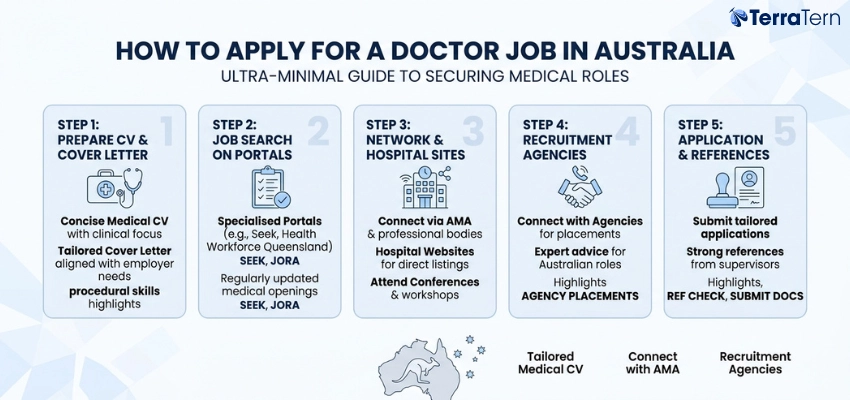
Applying for a doctor job in Australia involves preparing a tailored medical CV and cover letter, searching specialised job portals and recruitment agencies, and building professional connections through medical networking bodies. Mastering these elements is the foundation of how to apply for a doctor job in Australia successfully and secure the best doctor jobs in Australia.
Preparing your application:
-
Medical CV: Concise and professional, focused on clinical experience, qualifications, and procedural skills.
-
Cover Letter: Tailored to each specific role, highlighting your fit and alignment with the employer's needs.
-
References: Strong professional references, ideally from a supervisor or colleague, are essential.
Finding job opportunities:
-
Job Portals: Seek, Jora, and Health Workforce Queensland regularly posts specialised medical openings.
-
Recruitment Agencies: Global Medics, Wavelength International, and Skilled Medical specialise in placements for Australian hospitals and clinics.
-
Hospital and Health Network Websites: Most public and private hospitals post openings directly.
-
Professional Networking: Connect through bodies like the Australian Medical Association (AMA) and attend relevant conferences and workshops.
As per TerraTern Expert: Recruitment agencies specialising in medical placements (like Global Medics or Skilled Medical) are worth engaging early in your process; they often have visibility into supervised practice openings before they're posted publicly, which is exactly the bottleneck IMGs face most.
What Is Work-Life Balance Like in Australian Medical Careers?
Work-life balance for doctors in Australia varies by role. GPs typically work 38–40 hours per week with flexible options, while hospital specialists may work longer shifts, including on-call duties, offset by structured leave entitlements. This supportive environment is a major draw for professionals exploring doctor jobs in Australia and researching how to apply for doctor jobs in Australia.
-
General Practitioners: Typically 38–40 hours per week, with part-time and flexible arrangement options.
-
Hospital Specialists: May involve longer hours and on-call shifts, balanced by structured leave entitlements.
-
Rural Doctors: Often more flexible schedules and a broader scope of practice, with additional incentives for rural service.
-
Annual Leave: 4–6 weeks per year, depending on employer and contract.
-
Sick and Parental Leave: Generous entitlements consistent with Australian workplace standards.
-
Wellbeing Support: Access to counselling, peer support groups, and professional development programmes.
Pro Tip: Rural positions consistently offer the best combination of pay incentives and genuine work-life balance. In this list, the trade-off is smaller-community life, which is worth weighing honestly against career and lifestyle priorities before assuming a major city is the default best choice.
Also Read: What is the MBBS Doctor Salary in Australia? Update
What Are the Differences Between Urban and Rural Doctor Jobs in Australia?
Urban doctor jobs in Australia offer placements in large metropolitan hospitals with specialised clinics, access to cutting-edge research, and extensive specialist support. Conversely, rural doctor jobs provide higher financial remuneration through government incentives, greater clinical autonomy, and a broader scope of practice.
|
Aspect |
Urban Medical Positions |
Rural Medical Positions |
|
Work Environment |
Large hospitals, highly specialised clinics |
Community clinics, regional general hospitals |
|
Salary & Incentives |
Competitive base salary, standard benefits |
Higher salary, significant government incentives |
|
Work-Life Balance |
Fast-paced, structured schedules and shifts |
Flexible schedules, broader clinical scope |
|
Career Growth |
Access to cutting-edge research and technology |
Greater leadership roles, high clinical autonomy |
|
Patient Demographics |
Diverse urban population, specialised cases |
Close-knit communities, generalist patient care |
Key Note: Fewer specialists in rural areas isn't just a staffing gap; it genuinely accelerates leadership opportunity for doctors willing to relocate, often years faster than an equivalent urban career path would allow.
How Does Public vs. Private Practice Compare for Doctor Jobs in Australia?
When exploring doctor jobs in Australia, public practice offers structured career progression, extensive research opportunities, and predictable leave entitlements, though often with a lower base salary. Private practice, however, provides substantially higher earning potential and greater clinical autonomy.
While public sector roles involve high patient volumes and shift work, private practitioners benefit from controlling their workload, balanced against the responsibility of managing business, tax, and insurance obligations.
|
Aspect |
Public Practice |
Private Practice |
|
Employment Model |
Government-funded hospitals and clinics |
Privately owned clinics, hospitals, and practices |
|
Financial Consideration |
Lower base salary, robust standard benefits |
Higher earning potential, variable income, autonomy |
|
Career Progression |
Structured training pathways, research |
Entrepreneurial growth, business ownership |
|
Workload |
High patient volume, structured shift work |
More control over patient load and scheduling |
|
Patient Demographics |
Diverse populations, underserved groups |
Often a more affluent or privately insured base |
As per our TerraTern Expert, Shreya, many doctors use public practice as a stable foundation early in their Australian career, building local registration, references, and clinical confidence before transitioning to private practice once they're established. It's a genuinely common and low-risk sequencing strategy worth considering rather than choosing one path exclusively from the outset.
What About Jobs for Homoeopathic Doctors in Australia?
Homoeopathy in Australia operates as a self-regulated complementary therapy entirely outside the AHPRA medical system. Practitioners cannot legally use the protected title "doctor".
Consequently, the career path, job market, and earning potential are fundamentally different from mainstream medicine, presenting unique realities when exploring jobs for homoeopathic doctors in Australia compared to standard doctor jobs in Australia.
-
Regulation: Homoeopathy is not registered or regulated under AHPRA or the Medical Board of Australia.
-
Title Restrictions: The title "doctor" is legally reserved for AHPRA-registered medical practitioners, homoeopaths cannot use it to describe themselves professionally.
-
Accreditation: Professional standing comes through voluntary bodies like the Australian Register of Homoeopaths (AROH).
-
Work Environment: Practitioners typically work in private wellness clinics, integrative health centres, or self-employed practice, rather than the mainstream hospital system.
-
Market Reality: This is a smaller, less structured job market. Income is generally lower, less predictable, and closer to that of a private wellness practitioner.
-
Job Hunting: Success on this path requires networking through natural therapy associations and checking alternative medicine-specific job boards.
Pro Tip: If you're an Indian-qualified homoeopathic doctor (BHMS) considering Australia, go in with accurate expectations: you won't be able to use the "doctor" title, and this is a self-employed, wellness-sector career path rather than a parallel route into Australia's mainstream healthcare system. It can still be a viable move for the right person, but it's a fundamentally different decision than pursuing AHPRA-registered medical practice.
Also Read: Top Job Opportunities in Australia: New Pay, Scope & More
What Challenges Do International Doctors Face in Australia, and How Can You Address Them?
International candidates seeking doctor jobs in Australia commonly face AHPRA registration complexities, heavy metropolitan competition, and clinical adaptation hurdles. While mainstream physicians manage these clinical transitions, those exploring alternative routes, like jobs for homoeopathic doctors in Australia, face separate voluntary accreditation hurdles.
-
AHPRA Registration: Understand your specific country's requirements early and use the AHPRA website to avoid assessment delays.
-
Limited Metropolitan Availability: Focus your search on regional and rural areas, where medical demand is consistently higher and competition is lower.
-
Visa Requirements: Most international medical graduates pursue employer-sponsored routes, such as the Skills in Demand (SID) visa, which officially replaced the Temporary Skill Shortage (TSS) visa in December 2024.
-
Cultural Adaptation: Take time to understand how Australian hospitals, multidisciplinary medical teams, and the Medicare system operate day-to-day.
-
Professional Support: Join IMG support networks and orientation courses to connect with professionals who have successfully navigated the same career transition.
Key Note: IMG-specific orientation courses aren't just a formality; they cover practical, day-to-day differences in clinical documentation and team communication norms that genuinely affect how quickly you integrate, and skipping them tends to show up as friction in your first few months on the job.
What Is the Future Outlook for Doctor Jobs in Australia?
The outlook for doctor jobs in Australia remains exceptionally strong through 2026, driven by an ageing population, telehealth expansion, and sustained government funding. Whether pursuing high-demand traditional specialist roles, regional GP positions, or niche private wellness paths like jobs for homoeopathic doctors in Australia, the rapidly evolving healthcare sector offers robust, long-term professional security and growth.
-
Telemedicine: Continued growth in remote care access has permanently created new virtual and flexible care roles.
-
AI in Healthcare: The integration of AI in diagnostics and patient care is opening new roles in health informatics and data analysis.
-
Government Investment: Continued state and federal funding is heavily focused on service enhancement and expanded healthcare hiring across the country.
-
Rural Incentives: Ongoing, lucrative incentive-based programmes strongly reward medical professionals who commit to regional and remote postings.
-
Growing Demand: With severe projected shortages, including a deficit of 7,000 GPs by 2030, long-term job security in the Australian medical sector is virtually guaranteed.
Important Tip: Health informatics and AI-adjacent clinical roles are a genuinely under-the-radar growth area for doctors with a technical inclination worth exploring if you want to differentiate your profile beyond standard clinical practice.
Also Read: Doctor Salary in Australia: New Pay, Scope & More
Conclusion
Technological innovations and shifting government policies are changing the Australian medical job market, with many doctor jobs in Australia. The nation is slowly adopting telemedicine and AI and creating new job opportunities for both domestic and foreign doctors. There are many visas, a strong focus on the integration of the workforce, and an effective healthcare system that makes Australia a destination of choice for doctors.
Ready to take a step further on your medical journey? Check through the doctor visas available and explore how you, too, can be an integral part of Australia's action-packed healthcare setup. Contact TerraTern today for top advice on winning your medical employment in Australia.




 AI Summary