

Key Highlights
- What Is the Difference Between Apostille and Attestation?
- What's New in Apostille and Attestation for Indian Documents in 2026?
- What Is an Apostille?
- What Is Attestation?
- Which Countries Need Apostille and Which Need Attestation?
- How Does the Apostille and Attestation Process Work in India?
- Which Documents Need Apostille or Attestation for Visa and Immigration Purposes?
- How Much Do Apostille and Attestation Cost in India?
- How Long Does Apostille or Attestation Take?
- What Common Mistakes Delay Apostille or Attestation Approval?
- Do You Need an Apostille or Attestation for Your Visa Application?
- Conclusion
The process of international document legalisation can be a little confusing, particularly when deciding on the document legalisation procedure. There are basically two distinct differences between apostille and attestation, which depend solely on the country to which you are going.
An apostille is a streamlined, one-step verification valid in Hague Convention member countries. By contrast, attestation is a multi-step embassy legalisation process required by non-member countries; knowing how each works guarantees that your Indian records are recognised the world over for work, study, or ventures.
What Is the Difference Between Apostille and Attestation?

The basic difference between apostille and attestation lies in how your document is legalised for use abroad. For Hague Convention countries, legalisation is a single-step MEA apostille, while for non-Hague countries it is a multi-step, multi-authority attestation process.
|
Parameter |
Apostille |
Attestation |
|
Applicable for |
Hague Convention member countries (130+) |
Non-Hague countries (e.g., UAE, Qatar, Saudi Arabia) |
|
Process |
Single-step certificate from MEA |
Multi-step: notary → state → MEA → embassy |
|
Issuing authority |
MEA (India) only |
MEA + destination country's embassy/consulate |
|
Typical timeline |
~15–20 working days via e-Sanad (eligible docs) |
Several weeks, depending on embassy processing |
|
Government fee |
INR 50 per document/page (apostille sticker) |
No separate MEA fee for normal attestation; embassy fees vary by country |
|
Format |
Square apostille sticker/stamp with unique ID |
Stamps/seals from multiple authorities |
|
Recognition |
Automatically accepted in all Hague member states |
Only valid for the specific attesting embassy's country |
As per our TerraTern Expert Divyansh, if you're unsure which applies, check the destination country against the current HCCH Hague Convention member list first; that single lookup resolves 90% of "apostille or attestation" confusion.
Also Read: How to Get a Job in Spain from India? New Pay, Scope & More
What's New in Apostille and Attestation for Indian Documents in 2026?
The biggest change in 2026 is that the MEA is continuing to roll out its e-Sanad digital apostille system, which typically reduces processing time for eligible documents to about 15–20 working days in straightforward cases.
-
January 2005: India's membership in the Hague Apostille Convention was officially declared.
- Official MEA cost: The official MEA fee for each apostille sticker remains INR 50 per document/page.
-
No Individual Submission: The MEA does not accept documents directly from individuals; all apostille and attestation requests must be submitted via authorised outsourced agencies or the e-Sanad portal.
-
Apostille vs Attestation: The key difference is that Apostilles are valid only in Hague Convention member countries, whereas Attestation is required for non-members.
Important Note: Because Hague Convention membership and e-Sanad's document coverage both expand periodically, add a visible "last verified" date to this section and revisit it quarterly. This is a freshness signal that both Google and AI systems reward.
What Is an Apostille?
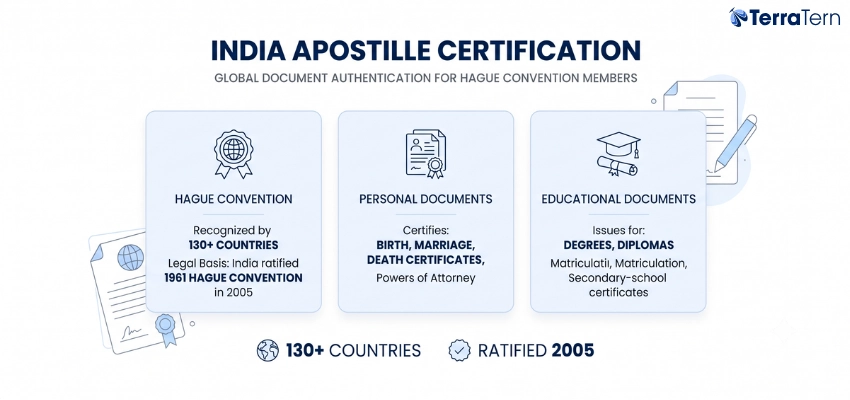
India's Ministry of External Affairs issues an apostille certificate to authenticate certain public documents for use in any of the 130+ countries that are members of the Hague Apostille Convention. One of the major differences between Apostille and Attestation is that Apostilles are recognised only by Hague Convention member countries.
-
Legal Basis: India ratified the Hague Convention of 1961 in 2005.
-
Certifies: Birth, marriage and death certificates, as well as powers of attorney and similar public documents.
-
Education Categories: Apostilles can also be issued for degrees, diplomas and matriculation/secondary-school certificates, once they are properly pre-authenticated.
Who Issues an Apostille in India?
The documents cannot be submitted directly to the MEA; they must first be pre-authenticated by the appropriate state authority and then submitted via an authorised outsourced centre or e-Sanad. It is important to distinguish between state-level pre-authentication authorities and the MEA, which only performs the final apostille or attestation step.
-
Outsourced Submission Rule: MEA will not accept individual submissions; they must go through authorised outsourced agencies.
-
Pre-Authentication Prerequisites: Personal documents must be cleared by the State Home Department before processing by MEA, and educational documents must be cleared by HRD/State Education Department.
Expert Tip: An apostille only confirms the document is genuine; it does not guarantee the receiving country will accept it for a specific purpose; always confirm requirements with the receiving institution or embassy first.
What Is Attestation?
Attestation is a multi-step authentication chain typically requiring a notary, state authority, MEA, and the destination country's embassy, required for Indian documents used in non-Hague Convention nations like the UAE, Qatar, Saudi Arabia, and Kuwait.
-
The Contrast: While an apostille is a simplified certificate for Hague members, attestation involves a longer chain of approvals.
-
The Key Distinction: This procedural difference between apostille and attestation fundamentally dictates your document's international legalisation route.
What Are the Different Types of Attestation in India?
Indian document attestation typically involves up to four stages depending on the document type:
-
Notary Attestation: Initial legal verification by a local public notary.
-
State Attestation: Educational documents are routed through the State HRD department, whereas personal documents must be routed through the Home Department or the SDM.
-
MEA Attestation: Central government authentication by the Ministry of External Affairs.
-
Embassy Attestation: Final legalisation by the destination country's embassy.
Expert Advice: Skipping the correct state-level pre-attestation step (HRD vs Home Department) is the single most common cause of MEA rejecting an attestation application. Verify the right department for your document type before submission.
Which Countries Need Apostille and Which Need Attestation?
Apostille applies to all 130+ Hague Convention member countries (including the US, UK, most of the EU, Australia, and Canada); attestation applies to non-member countries, most notably the UAE, Qatar, Saudi Arabia, Kuwait, and other GCC nations. Your destination determines whether you need an apostille or an attestation.
|
Apostille-Required Countries |
Attestation-Required Countries |
|
Canada, Australia, Germany, UK, Austria |
UAE, Qatar |
|
Sweden, Portugal, USA, Japan, Ireland |
Saudi Arabia, Kuwait |
Which Countries Are Members of the Hague Apostille Convention?
TerraTern's primary outbound markets require only an apostille and include Canada, Australia, Germany, the UK, Austria, Sweden, Portugal, the USA, Japan, Ireland, and Singapore. Travelling to these nations eliminates the complex difference between apostille and attestation by bypassing embassy legalisation completely.
Which Countries Still Require Embassy Attestation?
Key Gulf and Middle East employment hubs, such as the UAE, Qatar, Saudi Arabia, Kuwait, and other non-Hague destinations, still require full embassy legalisation. Relocating to these regions means you must navigate the multi-authority differences between apostille and attestation workflows.
Important Tip: Always verify against the destination country's current Hague status before your appointment; a handful of countries have joined the Convention only in the last two years, and older blog posts (including competitors') may list them incorrectly as attestation-only.
How Does the Apostille and Attestation Process Work in India?
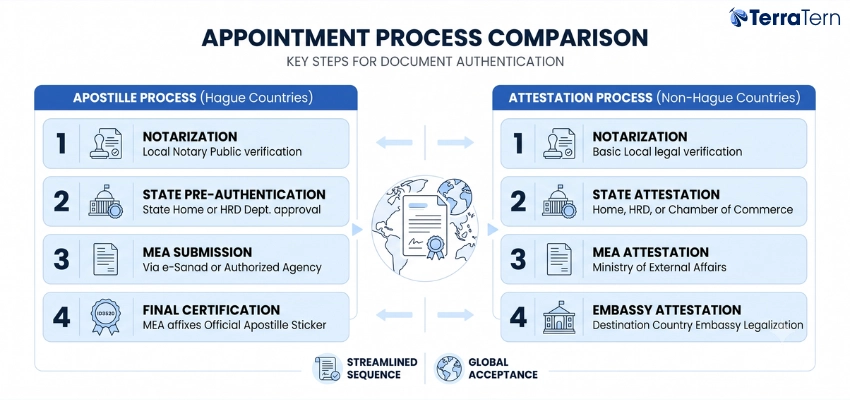
In India, both processes begin with notarization and state-level pre-authentication, then diverge. This fundamental difference between apostille and attestation means an apostille ends with a single MEA certificate, while attestation continues to the destination country's embassy after MEA verification.
What Is the Step-by-Step Apostille Process?
The streamlined sequence below minimises the procedural difference between apostille and attestation
-
Notarization: Initial verification by a local notary public.
-
State Pre-authentication: Approval by the State Home Department (for personal documents) or HRD/state education department (for educational documents).
-
MEA Submission: Processed via an authorised outsourced agency or the e-Sanad portal.
-
Final Certification: The MEA affixes the official apostille sticker containing a unique verifiable ID.
What Is the Step-by-Step Attestation Process for Non-Hague Countries?
Understanding this sequence is key to grasping the difference between apostille and attestation. The step-by-step attestation process is:
-
Notarization: Basic legal verification locally.
-
State Attestation: Processing via the Home Department, HRD, or Chamber of Commerce, depending on the document type.
-
MEA Attestation: Authentication by the Ministry of External Affairs.
-
Embassy Attestation: Unlike the apostille route, this process mandates final legalisation by the destination country's embassy or consulate in India.
What Is e-Sanad and How Does Digital Apostille Work in 2026?
e-Sanad is MEA's official online portal for contactless, paperless attestation and apostille of documents issued by integrated authorities, reducing processing time to roughly 15–20 working days for eligible documents.
-
Eligibility: Applies exclusively to documents from Document Issuing Authorities (DIAs) integrated with e-Sanad's digital depository.
-
Traditional Route: Non-integrated documents must still follow the physical submission pathway.
-
Global Access: NRIs can initiate the process entirely from abroad using e-Sanad.
-
Universal Platform: The system securely manages both workflows, whether your document ultimately requires an apostille or full embassy attestation.
As per TerraTern Expert: Before starting any process, check whether your specific document's issuing authority is integrated with e-Sanad. If it is, you can save 15–25 days versus the traditional physical route.
Which Documents Need Apostille or Attestation for Visa and Immigration Purposes?
The most commonly apostilled or attested documents for Indian visa and immigration applications are birth, marriage, and police clearance certificates (personal), degree and diploma certificates (educational), and power-of-attorney or incorporation papers (commercial). Categorising your paperwork early helps clarify the difference between apostille and attestation workflows for your specific visa scenario.
Personal Documents (Birth, Marriage, and Police Clearance Certificates)
The personal documents that are commonly apostilled or attested are:
- Birth Certificate: Needed for OCI, PR, and dependent visas; must be apostilled or attested depending on the country.
-
Marriage Certificate: Required for spouse/dependent visas; verify before embassy attestation.
-
Police Clearance Certificate: State police verification is required before MEA apostille/attestation.
Educational Documents (HRD Attestation for Degrees and Diplomas)
Degree, diploma, matriculation and transcripts: educational documents must first be verified by the State HRD (or university, where applicable) before MEA apostille/attestation; this HRD step is mandatory for study visa and credential recognition.
Commercial Documents (Power of Attorney, Company Papers)
Power of attorney, certificate of incorporation, commercial invoices: commercial documents usually require Chamber of Commerce attestation (or notary) before MEA apostille/attestation; essential for investor, business, and company-registration visas.
Pro Tip: Start document authentication as early as possible in your visa timeline; HRD and state-level pre-verification alone can take 2–3 weeks before the document even reaches MEA.
How Much Do Apostille and Attestation Cost in India?
MEA charges INR 50 per document for the apostille sticker; normal attestation carries no separate MEA government fee. Both routes involve additional state-level and outsourced-agency handling charges that vary by location. Understanding this multi-layered cost structure highlights a highly practical difference between apostille and attestation
|
Cost Layer |
Apostille |
Attestation |
|
1. State/Notary Pre-authentication |
Varies by state and document type |
Varies by state and document type |
|
2. MEA Government Fee |
INR 50 per document/page |
No separate MEA fee |
|
3. Outsourced Agency Charge |
Service/handling markup varies |
Service/handling markup varies |
|
4. Destination Embassy Fee |
Not applicable |
Set independently by each embassy; varies widely |
Key Note: Ask any agency for an itemised quote (state fee + MEA fee + agency service charge) before booking; bundled "all-inclusive" quotes can obscure which portion is the government fee versus the service markup.
How Long Does Apostille or Attestation Take?
Apostille through e-Sanad typically takes 15–20 working days for eligible documents (versus 30–45 days via the traditional physical route). Attestation for non-Hague countries generally takes longer due to the added embassy step, often several weeks. The core difference between apostille and attestation timelines also relies on state-level pre-authentication, a frequently underestimated variable adding 2–3 weeks to both processes.
What Can Delay Your Apostille or Attestation Timeline?
Several variables can disrupt your processing speed, regardless of the difference between apostille and attestation requirements:
-
Incomplete Pre-authentication: Missing necessary state-level clearances.
-
Incorrect Routing: Sending documents to the wrong authority (e.g., HRD instead of the Home Department).
-
Embassy Backlogs: Delays at destination consulates during peak visa seasons.
-
e-Sanad Limitations: Processing documents not yet integrated with the digital system.
Important Tip: Build in at least a 4–6 week buffer before your visa deadline for attestation-route documents; embassy processing time is outside MEA's or any agency's control.
What Common Mistakes Delay Apostille or Attestation Approval?
The most frequent causes of rejection or delay are applying for the wrong process (apostille when attestation is needed, or vice versa), skipping state-level pre-authentication, and applying directly to the MEA instead of through an authorised agency or e-Sanad.
-
Wrong Process: Misunderstanding the core difference between apostille and attestation for your specific destination country.
-
Missing Notarization: Skipping the foundational local notary verification step.
-
Incorrect Routing: Sending educational documents to the SDM instead of the mandatory HRD department.
-
Laminated Originals: Submitting laminated certificates, which physically cannot receive the MEA authentication sticker, will be rejected.
-
Hague Status: Failing to verify the destination country's current Hague Convention membership before applying.
-
Underestimating Timelines: Overlooking the added weeks required for final embassy clearance during the full attestation process.
Key Note: Never laminate an original certificate before authentication; MEA and most state authorities will reject laminated documents outright, forcing you to request a fresh copy from the issuing authority.
Do You Need an Apostille or Attestation for Your Visa Application?
You need an apostille if your destination is a Hague Convention country (most of TerraTern's core markets: Canada, Australia, Germany, UK) and an attestation if it's a non-Hague country such as the UAE ,but the exact document list still depends on your specific visa category.
-
Hague Destinations: Require an apostille.
-
Non-Hague Destinations: Require full embassy attestation.
-
Your Next Step: Knowing the difference between apostille and attestation is just the beginning. TerraTern's immigration experts can seamlessly manage this authentication process as part of your comprehensive visa application checklist.
Key Note: Document authentication is just one part of a complete visa file; cross-check your destination country's specific document checklist (through the embassy or your immigration consultant) before finalising which certificates to apostille or attest.
Conclusion
Understanding the difference between apostille and attestation comes down to your destination's legal requirements. Hague Convention members require a single MEA apostille certificate, whereas non-member nations mandate a multi-step embassy attestation process.
In India, both routes require state-level pre-authentication before MEA processing via authorised agencies or the e-Sanad portal. Because state and embassy timelines can span several weeks, verify your destination's Hague status today and begin document preparation early.
Contact Terra Tern for more information on the Difference between Apostille and Attestation for Indian documents.




 AI Summary