


Key Highlights
- What is the Difference Between a 189 and 190 Visa?
- What Are the 2025–26 Industry Updates on the 189 and 190 Visa?
- What Is the Subclass 189 Visa and Who Is It Best For?
- What Is the Subclass 190 Visa and Who Is It Best For?
- What Is the Key Difference Between 189 and 190 Visa Across 6 Critical Factors?
- What Are the Documents Required for Both 189 and 190 Visa Applications?
- What Is the Application Process for 189 vs 190 Visa Step by Step?
- 189 vs 190 Visa, Which One Should You Choose as an Indian Professional?
- Conclusion
The difference between 189 and 190 visa lies in the fact that the former, Subclass 189, is an independent skilled PR visa with no state nomination, whereas the latter, Subclass 190, is subject to state or territory nomination. They are both permanent residence options, with 190 granting 5 additional points, and typically, an expectation of temporary residence and work in the nominating state.
What is the Difference Between a 189 and 190 Visa?
State sponsorship is the difference between 189 and 190 visa. Subclass 189 is a Skilled Independent Visa that requires no nomination; hence, you can live and work anywhere in Australia. Subclass 190 is a Skilled Nominated Visa that requires nomination by a state or territory and also adds 5 points to your points test. They are both permanent residency visas of the GSM program.
|
Feature |
Subclass 189 |
Subclass 190 |
|
Visa Type |
Skilled Independent |
Skilled Nominated |
|
Sponsorship Required |
No |
Yes, state/territory |
|
Minimum Points |
65 |
65 points |
|
Work/Live Freedom |
Anywhere in Australia |
Must stay in the nominating state for 2 years |
|
Occupation List |
MLTSSL |
State/Territory Occupation List (MLTSSL + STSOL) |
|
Invitation Frequency |
Quarterly, federal |
State-dependent, varies |
|
Extra Points |
None |
+5 for nomination |
As per TerraTern Expert, Shreya, if you have 80+ points, target the 189 visa for full geographic freedom. If you're below 80 points, the 190 visa's 5-point bonus and state occupation lists can help you reach Australian PR faster.
Also Read: Difference Between 189 and 190 Visa: Trusted Insights
What Are the 2025–26 Industry Updates on the 189 and 190 Visa?
The difference between 189 and 190 visa updates are:
-
The 189 visa has become more linked with quarterly rounds of invitation; applicants will be less likely to get an invitation in a year.
-
The recent 189 rounds have had significantly higher point cutoffs on selected occupations, particularly IT and accounting, than the trades and priority sectors.
-
State and territory: 190 programs remain in operation, with nomination volumes varying depending on budget, occupation lists, and state priorities.
-
The 190 visa is becoming increasingly appealing to many Indian applicants whose points scores are too low to secure a 189 invitation, particularly in saturated occupations like ICT and accounting.
Important Note: For Indian IT professionals in 2025–26, the competitive 189 invitation environment means the 190 state nomination route is no longer just a backup; it may be the smarter primary strategy.
What Is the Subclass 189 Visa and Who Is It Best For?
The difference between 189 and 190 visa begins with the 189, which is a Skilled Independent permanent visa for applicants who do not require state or employer sponsorship.
-
Ideal candidates have a highly competitive points score, an occupation listed on the MLTSSL, strong English proficiency, a suitable age, and a positive skills assessment from the relevant authority.
-
It is appropriate for applicants who desire complete freedom to live and work in any part of Australia without being bound by a state.
-
Depending on occupation, Indian applicants usually depend on the ACS, Engineers Australia, ANMAC, or TRA tests.
-
It is best suited to individuals who want direct PR and maximum mobility.
What Are the Eligibility Requirements for the 189 Visa?
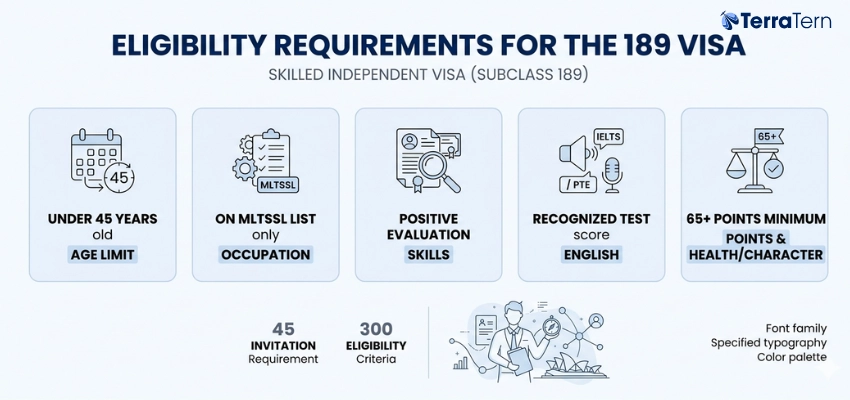
The eligibility requirements of the 189 visa are:
-
Age: Less than 45 years at the time of invitation.
-
Occupation: Has to be on the MLTSSL.
-
Skills Evaluation: A good evaluation given by the appropriate authority.
-
English: IELTS, PTE or any other recognised test to demonstrate competence.
-
Points and Checks: 65 points or more, health and character requirements.
What Are the Benefits of Holding a Subclass 189 Visa?
You receive permanent residence immediately.
-
You have the option to live and work in Australia.
-
You are eligible to sponsor qualified family members.
-
You become eligible for Medicare after the normal waiting period.
-
You are eligible to apply for citizenship once you have met the residency requirements.
Expert Advice: The 189 visa is the "gold standard" of Australian skilled migration, but only those with highly competitive points scores will receive invitations, especially in ICT and accounting occupations.
What Is the Subclass 190 Visa and Who Is It Best For?
The difference between the 189 and 190 visa is also nomination-based, since the 190 visa requires a state or territory sponsor.
-
It awards 5 bonus points that applicants who cannot reach the 189 level of competition can use.
-
Skilled workers with 65–79 points, especially those whose occupations qualify under a state occupation list rather than the federal MLTSSL, are better placed to pursue the 190 visa than the 189.
-
It is also appropriate for applicants who are willing to reside in a particular state or territory for at least 2 years following the grant.
-
With numerous invitations of 189 being very competitive, many candidates consider it the more realistic PR pathway.
What Are the Eligibility Requirements for the 190 Visa?
The eligibility criteria for the 190 Visa are:
-
Age: Under 45 years.
-
Occupation: Requires being on the state occupation list.
-
Nomination: Need to be nominated by a state or territory.
-
Skills and English: Applicants must provide proof of a positive skills assessment and English language test results, usually through IELTS or PTE.
-
State Requirements: A variety of states require working experience, research, a resume, and funding evidence.
Which States Are Easiest to Get a 190 Nomination From?
The difference between 189 and 190 visa issues is most critical here, as various states are more liberal than others, and South Australia, Tasmania, and the Northern Territory are perceived as less difficult. The occupation sector is also of particular importance to applicants in Victoria's health, construction, education, and advanced manufacturing sectors.
|
State/Territory |
General Profile |
Nomination Notes |
|
New South Wales |
Competitive |
Strong demand, occupation-specific selection. |
|
Victoria |
Selective |
Uses ranking factors like age, education, income, and sector priority. |
|
Queensland |
Moderate |
Often favours in-demand occupations and local ties. |
|
South Australia |
More accessible |
Historically, broader coverage of occupations and lower thresholds. |
|
Western Australia |
Moderate |
Varies by occupation and stream. |
|
Tasmania |
More accessible |
Often favourable for onshore applicants and smaller occupation lists. |
|
Northern Territory |
More accessible |
Can be open for candidates willing to live regionally. |
|
ACT |
Competitive but structured |
The Canberra Matrix system rewards strong local ties and commitment. |
Expert Tip: State nomination is not a consolation prize. For Indian professionals in construction, healthcare, and education in 2025–26, the 190 visa via SA or NT can deliver faster PR than waiting years for a 189 invitation in competitive occupations.
Also Read: Immigration Australia: Everything You Need To Know
What Is the Key Difference Between 189 and 190 Visa Across 6 Critical Factors?
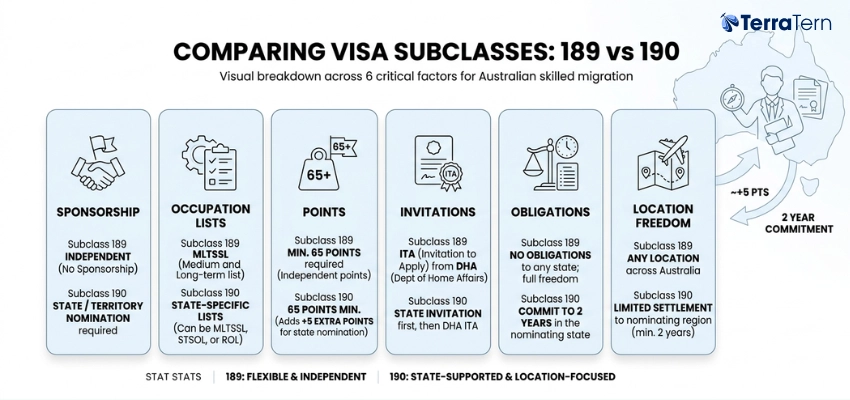
The difference between 189 and 190 visa comes down to six things: sponsorship, occupation lists, points, invitations, obligations, and location freedom. Subclass 189 is independent and more flexible, while Subclass 190 adds state nomination in exchange for extra points and a more limited settlement condition.
How Does Sponsorship Differ Between 189 and 190 Visa?
189 has no sponsorship requirement and is fully independent.
-
190 requires nomination from an Australian state or territory before visa processing.
-
The 190 nomination is a separate application from the visa itself.
-
Applicants must first meet the state’s criteria before proceeding to the federal visa stage.
-
This is one of the clearest parts of the difference between 189 and 190 visa.
How Do the Occupation Lists Differ for 189 and 190 Visa?
189 requires your occupation to be on the MLTSSL.
-
190 uses a state or territory occupation list, which can be broader.
-
Some occupations not available for 189 may still qualify for 190.
-
This is important for Indian applicants in engineering and IT.
-
Check the Department of Home Affairs occupation lists for the latest eligibility.
How do the Points Test Differ Between 189 and 190?
Both visas require at least 65 points.
-
For 190, state nomination automatically adds 5 points.
-
That means applicants often need only 65 points of their own.
-
Real-world cutoffs are much higher for 189 in many occupations.
-
A simple points test includes age, English, work experience, education, and partner skills.
How do the invitation processes differ for 189 vs 190?
189 invitations come from the federal government.
-
From 2026, these are issued in quarterly rounds.
-
189 selection is based mainly on points and date of effect.
-
190 is run by each state or territory under its own rules.
-
A 190 pathway usually starts with state nomination, followed by a federal invitation.
What Are the Post-Grant Obligations for 189 vs 190?
189 has no post-grant settlement obligation.
-
You can live and work anywhere in Australia immediately.
-
190 applicants should live and work in the nominating state for at least 2 years from the date of visa grant.
-
They are also expected to live and work there for at least 2 years.
-
Breaking the 190 expectation is usually not a criminal issue, but it may matter in future applications.
How Does Geographic Flexibility Differ Between 189 and 190?
189 gives full freedom to settle in any city or state.
-
190 limits you to the nominating state for the required period.
-
After meeting the obligation, you can relocate freely.
-
If you want Sydney or Melbourne, an NSW or VIC 190 can make the restriction easier to manage.
-
This final point often determines the practical difference between 189 and 190 visa.
Important Tip: The 190 visa's 2-year residency obligation is often the deciding factor, if you're genuinely open to living in South Australia, Tasmania, or Queensland, the 190 pathway can be significantly faster and less competitive than the 189 route.
What Are the Documents Required for Both 189 and 190 Visa Applications?
The difference between 189 and 190 visa is reflected in the document set: both need a passport, skills assessment, English test results, EOI confirmation, points evidence, and health/character documents.
-
For 190, you must also include state nomination proof, a state-specific resume, evidence of research into that state or territory, proof of funds if requested, and work experience letters.
-
Indian applicants usually need certified copies, English translations where required, and police clearance documents, along with consistent dates across education and employment records.
-
Skill assessment authorities vary by occupation: ACS for IT, Engineers Australia for engineering, ANMAC for nursing, and TRA for trades.
-
A clean, well-organised file matters because the difference between 189 and 190 visa often comes down to whether you can prove both general eligibility and, for 190, the state’s extra requirements.
What Skills Assessments Do Indian Professionals Need for 189 and 190 Visas?
The difference between 189 and 190 visa does not change the need for a valid skills assessment; both visas rely on it as a core eligibility document.
-
ACS: For IT roles like software engineer, developer, and business analyst.
-
Engineers Australia: For civil, mechanical, electrical, and other engineering roles.
-
ANMAC: For nursing and many allied health pathways.
-
AHPRA: For regulated medical and health professions.
-
TRA: For trade occupations such as electrician, cook, or carpenter.
-
Vetassess: For many professional and general skilled occupations.
As per TerraTern Expert: Getting your skills assessment right is the single most critical step; an incorrectly assessed authority or assessment category is one of the top reasons Indian applicants face delays or rejections.
What Is the Application Process for 189 vs 190 Visa Step by Step?
The difference between 189 and 190 visa begins at the same point: both start with a SkillSelect EOI.
-
For 189, you only wait for a federal invitation after meeting the points and eligibility rules.
-
For 190, you must first secure a state or territory nomination before the federal invitation.
-
After the invitation, both visas proceed to the full application stage, including documents, health checks, and character checks.
-
The 190 process usually takes longer because of the extra nomination step.
How Do You Apply for the 189 Visa Step by Step?
Choose an occupation on the MLTSSL.
-
Complete a skills assessment with the relevant authority.
-
Meet English language requirements, usually through IELTS or PTE.
-
Submit an Expression of Interest through SkillSelect.
-
Wait for a DHA invitation, which is now generally tied to quarterly rounds from 2026.
-
Receive the invitation and lodge the full visa application within 65 days.
-
Submit supporting documents, complete health and character checks, and wait for the grant.
How Do You Apply for the 190 Visa Step by Step?
Choose an occupation on the relevant state’s skilled occupation list.
-
Complete a skills assessment with the relevant authority.
-
Meet English language requirements.
-
Submit an EOI through SkillSelect and show interest in the 190 nomination.
-
Apply separately for state or territory nomination through that government’s portal.
-
Receive a nomination, which adds 5 points to your EOI.
-
Wait for the federal invitation, then lodge the full visa application within 65 days.
-
Submit documents, complete health and character checks, and wait for the grant.
How Long Does It Take to Process a 189 vs 190 Visa?
Processing times vary based on completeness, the number of documents, and case complexity.
-
The 189 timeline depends primarily on the timing of invitations and federal processing after lodgment.
-
The 190 timeline is usually longer because state nomination comes first.
-
State nomination can add weeks or months before the federal invitation.
-
The difference between 189 and 190 visa is therefore not just eligibility, but also timing.
Pro Tip: Once invited, you have only 65 days to lodge your visa application. Having your documents fully prepared before you receive the invitation can save you from missing this critical window.
Also Read: Best Consultancy for Australia PR: Top Picks for Indians
189 vs 190 Visa, Which One Should You Choose as an Indian Professional?
Choose the 189 visa if you have a very high points score and want complete freedom to live anywhere in Australia. Choose the 190 visa if your points are moderate, your occupation matches a state list, or you are open to settling in one state; this is the practical difference between 189 and 190 visa for many Indian applicants.
Best fit for 189
-
Your occupation is on the MLTSSL.
-
Your score is highly competitive, often 80+; in IT and accounting, 90–110+ is common in recent rounds.
-
You want to live in any Australian city without state restrictions.
-
You prefer a simpler process without state nomination steps.
-
You are aiming for the cleanest independent PR route.
Best fit for 190
-
Your score is 65–79, and you need the 5-point nomination boost.
-
Your occupation appears on a state list but not necessarily on the federal list.
-
You are open to living in states such as South Australia, Tasmania, the NT, or Queensland for the required period.
-
You want access to more invitation opportunities through state programs.
-
Your preferred city is already in the nominating state, such as Sydney under NSW or Melbourne under Victoria.
Is the 189 or 190 Visa Easier to Get for Indian Applicants in 2025–26?
For many Indian professionals, yes, 190 is generally easier to secure in competitive occupations because states can invite applicants with lower effective scores.
-
The November 2025 189 round showed that trades could be invited at around 65 points, while professional roles such as accounting and ICT often needed about 90–110+ points.
-
State nomination can also create multiple pathways, which improves the odds compared with waiting for a federal 189 round.
-
This makes the 190 visa especially strategic for Indian applicants working in IT, healthcare, and education sectors.
-
The difference between 189 and 190 visa is therefore not just freedom versus obligation, but also competition level and realistic invitation chances.
Key Note: There is no universally "better" visa; the right choice depends entirely on your points score, occupation, and willingness to commit to a specific state. Always get a personalised assessment before submitting your EOI.
Conclusion
The difference between 189 and 190 visa is simple: 189 gives independent permanent residency with full freedom, while 190 adds state nomination in exchange for 5 extra points and some settlement expectations. For Indian professionals, 189 suits high scorers seeking flexibility, while 190 is often the smarter route for moderate points or state-listed occupations. Choosing the right pathway depends on your score, occupation, and preferred destination in Australia.
Contact TerraTern for more information on the Difference Between 189 and 190 Visa: Complete 2026 Guide.




 AI Summary