



Key Highlights
- What Are the Canada PR Renewal Requirements in 2026?
- What Is the 730-Day Residency Obligation for Canada PR Renewal?
- What Documents Are Required for Canada PR Card Renewal?
- How to Apply for Canada PR Card Renewal Step by Step?
- What Is the Canada PR Renewal Processing Time in 2026?
- What Is the Canada PR Card Renewal Fee in 2026?
- What Are the Common Mistakes to Avoid in Canada PR Renewal?
- How Does Canada PR Renewal Work If You Don't Meet the 730-Day Rule?
- What Is Urgent Processing for Canada PR Card Renewal?
- Conclusion
Canada PR renewal requirements simply revolve around the fact that you do not cease to satisfy the Canada residency requirement and remain a valid permanent resident by 2026. You should, as a rule, demonstrate at least 730 days of physical presence in Canada within the past 5 years, not have a removal order and be an applicant inside Canada through the online PR portal. Good supporting documents and a complete application help prevent delays in the PR card renewal process.
What Are the Canada PR Renewal Requirements in 2026?

A Canada PR card is a wallet-sized document confirming your permanent resident status. A valid PR card (or a Permanent Resident Travel Document, if abroad) is required to board a commercial carrier returning to Canada. Although your PR status does not lapse when the card expires, you still need a valid PR card to travel and re-enter Canada easily.
-
In order to fulfil Canada PR renewal requirements, you should:
-
Be a valid permanent resident and not be subject to a removal order.
-
Be physically present in Canada for at least 730 days in the past 5 years.
-
You must be physically in Canada at the time of filing the renewal application.
-
You must provide a valid Canadian mailing address where the new PR card can be delivered.
As per TerraTern Expert, Shreya, your PR status does not expire when your card does, but without a valid card, you cannot board a commercial carrier (plane, bus, train) to re-enter Canada after international travel.
Also Read: Canada PR Visa: Eligibility, Fees, Processing Time & More
What Is the 730-Day Residency Obligation for Canada PR Renewal?
The 730-day requirement of qualifying presence means that you must have at least 730 days (2 years) of qualifying presence in the 5-year period just before the IRCC receives your PR card renewal application. The 5-year window is rolling and not fixed to calendar years, and the 730 days do not have to be continuous. IRCC will take into consideration the actual days of physical presence (or certain exceptions), rather than your plans or intention to reside in Canada.
To take an example, under the canada PR renewal requirements, IRCC requires at least 730 days of qualifying physical presence within the 5-year rolling window immediately before the application is received. If you fail to reach 730 days, IRCC might examine your file more closely, query whether you continue to fulfil the residency requirement, and may initiate action that could result in the loss of PR status and an order to remove.
|
Scenario |
Counts Toward 730 Days? |
|
Living in Canada |
Yes |
|
Accompanying a Canadian citizen spouse abroad |
Yes (exception) |
|
Employed by a Canadian business outside Canada |
Yes (exception) |
|
Studying abroad |
No (time spent studying outside Canada generally does not count toward the 730-day obligation) |
|
Visiting family outside Canada |
No |
Important Note: Never estimate your days from memory alone; review every passport stamp, flight itinerary, and entry record. Being even a few days short of 730 can trigger a residency investigation.
What Are the Exceptions to the 730-Day Residency Rule?
Time spent accompanying a Canadian citizen spouse or parent abroad may count toward the residency obligation under specific conditions, but only to the extent that they are the legal spouse, common-law partner, or dependent child of their spouse, partner or parent abroad.
-
Full-time work outside Canada for a legitimate Canadian business or the Canadian public service can count toward the 730-day obligation, provided you have employment letters, contracts, and pay records to support the claim.
-
Accompanying a non-citizen spouse or parent abroad may count toward the residency obligation if you are the dependent child of a permanent resident who themselves meets the 730-day residency requirement.
Expert Advice: If you believe you qualify for an exception, provide strong supporting documents upfront; IRCC will not automatically apply an exemption without evidence.
What Documents Are Required for Canada PR Card Renewal?
To renew your PR card in 2026, you will have to file a full, well-documented PR card application package through the IRCC online portal. This incorporates the key forms, identity documents, photos, evidence of payment, and powerful evidence that you have met the 730-day residency requirement. An easy checklist makes sure you will not lose time, writing documents, or a potential residency inquiry in the course of Canada PR renewal requirements processing.
|
Document |
Details |
|
Form IMM 5444 |
Main PR card application form fully completed, signed, and dated |
|
Document Checklist IMM 5644 |
Completed checklist uploaded with your online application |
|
Current/expired PR card |
Clear copy of the front and back of your existing or expired PR card |
|
Valid passport or travel document |
Copy of all pages with identity details and entry/exit stamps (5 years) |
|
2 passport-style photos |
50mm x 70mm, plain white background, neutral expression, no shadows |
|
Fee receipt, CAD $50 |
Online payment receipt; the fee is per applicant and non-refundable |
|
Proof of physical presence |
Tax returns, NOA, employment letters, utility bills, lease, bank records |
|
Legal documents (if applicable) |
Marriage certificate, name change certificate, court orders, etc. |
Expert Tip: Never submit photocopies of documents that require original verification. Scan all documents at high resolution (300 DPI minimum) and ensure file sizes meet IRCC's portal upload requirements.
What Proof of Residency Documents Does IRCC Accept?
In order to meet Canada PR renewal requirements of the 730-day rule, IRCC usually accepts:
-
CRA, Notice of Assessment (NOA) and Canadian tax returns that show that you were filing as a resident.
-
A provincial health insurance card and usage/claim records that prove that you resided in a province.
-
Employment records job offer letters, job contracts, pay stubs, T4 slips, ROEs, and work schedules.
-
Housing evidence lease agreements, rent receipts or property tax statements in your name.
-
Utility bills and bank/credit card statements with frequent activity at an address in Canada.
-
School enrolment and attendance of you or your dependent children.
Important Note: Indian-origin permanent residents should maintain a dedicated folder with annual tax returns, T4 slips, and health insurance records; these form the strongest evidence of physical presence for IRCC.
How to Apply for Canada PR Card Renewal Step by Step?
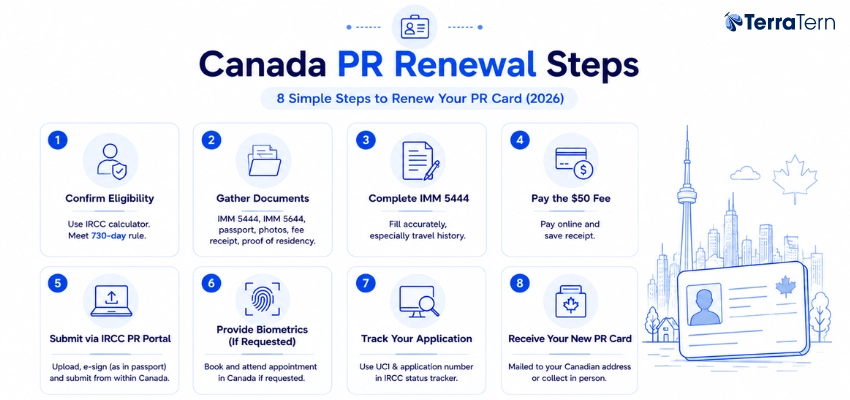
To follow Canada PR renewal requirements in 2026, submit your application online through the IRCC Permanent Residence Portal using a clear step-by-step approach:
-
Step 1 — Confirm Eligibility: Use the IRCC physical presence calculator and ensure you meet the 730-day residency obligation.
-
Step 2 — Gather All Documents: Collect IMM 5444, IMM 5644, passport copies (last 5 years), photos, the fee receipt, and proof of residency.
-
Step 3 — Complete Form IMM 5444: Fill out all sections accurately, especially the travel history section, and review for errors.
-
Step 4 — Pay the $50 fee: Pay online and save the receipt for upload to the PR portal.
-
Step 5 — Submit via IRCC PR Portal: Upload all documents, sign electronically exactly as in your passport, and submit from within Canada.
-
Step 6 — Provide Biometrics (If Requested): If IRCC issues a biometrics instruction letter, book and attend an appointment in Canada.
-
Step 7 — Track Your Application: Use your UCI and application number in the online status tracker to monitor Canada PR renewal requirements processing.
-
Step 8 — Receive Your New PR Card: IRCC will mail it to your Canadian address, or may ask you to collect it in person for quality assurance.
As per TerraTern Expert: Apply at least 6–9 months before your card expires. If you plan international travel, a card in process does not allow you to board a commercial flight back to Canada
Can You Apply for Canada PR Renewal While Outside Canada?
You cannot apply for a PR card renewal from outside Canada; Canada PR renewal requirements clearly state you must be physically in Canada when you submit the application.
-
If your PR card expires while abroad, you should apply for a Permanent Resident Travel Document (PRTD) at a Canadian visa office in the country where you are staying.
-
A PRTD is a single-journey document issued at a Canadian visa office abroad, allowing a permanent resident to board a commercial carrier and return to Canada one time.
-
After re-entering Canada with the PRTD, you can then apply for PR card renewal normally through the online PR portal, following all standard Canadian PR renewal requirements.
-
PRTD processing times vary by office, but many cases take roughly a few weeks, so travel plans should be made with possible delays in mind.
Pro Tip: If your card expires while abroad, do not wait; apply for a PRTD immediately at the nearest Canadian consulate to avoid being stranded.
Also Read: How Many Years for PR in Canada? Experts Insights
What Is the Canada PR Renewal Processing Time in 2026?
For most applicants who meet canada PR renewal requirements and file a complete application, the Canada PR card renewal processing time in 2026 is typically a few weeks to a couple of months. Processing times are updated regularly on IRCC’s official processing-time tool and can fluctuate based on application volume and security checks; they are always estimates, not guarantees. Applicants planning international travel should build in a buffer and avoid last-minute renewal.
|
Application Type |
Estimated Processing Time (2026) |
|
PR Card Renewal / Replacement |
~30–63 days |
|
First-time PR Card |
~61 days |
|
Urgent Processing (if eligible) |
Minimum ~3 weeks (not guaranteed) |
Key Note: Processing times are estimates, not guarantees. Always apply with full documentation; any incomplete submission resets your clock and causes significant delays.
What Is the Canada PR Card Renewal Fee in 2026?
Under canada PR renewal requirements, the standard Canada PR card renewal fee in 2026 is set at a flat amount per person and must be paid before submitting the online application. This fee applies equally to both renewals and replacements (for lost, stolen, or damaged cards) and is non-refundable, even if IRCC refuses your application or you later withdraw it. Biometrics, if required, are charged separately.
|
Fee Type |
Amount (2026) |
|
PR Card Renewal / Replacement Fee |
CAD $50 (non-refundable) |
|
Biometrics Fee (if required, per person) |
CAD $85 |
|
Total typical cost (renewal + biometrics) |
CAD $135 (if biometrics requested) |
As per TerraTern expert Divyansh, since the $50 fee is non-refundable regardless of the outcome, ensure your application is complete, and your residency obligation is met before submitting.
What Are the Common Mistakes to Avoid in Canada PR Renewal?
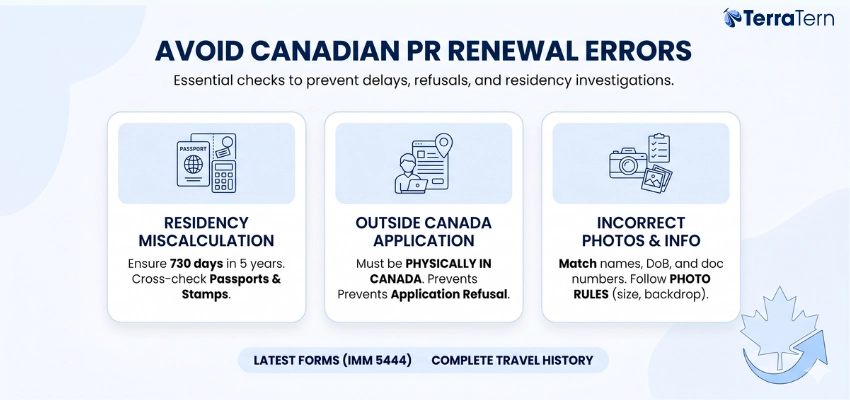
The biggest risk with Canadian PR renewal requirements is making avoidable mistakes that cause delays, refusals, or even a residency investigation. Here are the most common errors to avoid:
-
Miscounting Residency Days: Not correctly adding up 730 days in the rolling 5-year window; always cross-check passports, entry/exit stamps, and flight records against IRCC’s calculator.
-
Applying from Outside Canada: You must be physically in Canada; otherwise, your application can be refused, and you may need a PRTD first.
-
Incorrect or Outdated Form IMM 5444: Using an old version or incomplete form; always download the latest version directly from IRCC.
-
Non-Compliant Photographs: Wrong size, coloured background, visible shadows, or photos older than 6 months frequently cause returns.
-
Incomplete Travel History: Missing trips or incorrect dates can make IRCC doubt whether you meet Canada PR renewal requirements.
-
Mismatched Personal Information: Names, dates of birth, or document numbers that don’t exactly match your passport or legal documents lead to extra checks.
-
Missing Proof of Residency: Thin or inconsistent evidence is especially dangerous if you have spent long periods outside Canada.
-
Waiting Too Long to Apply: Leaving renewal until the last few months before expiry increases the risk of travel disruptions.
Pro Tip: The single costliest mistake is misunderstanding the "rolling 5-year window"; verify your exact application receipt date and calculate backwards precisely.
Also Read: Canada Immigration: Visa Types, Costs, Process & More
How Does Canada PR Renewal Work If You Don't Meet the 730-Day Rule?
If you apply for renewal without clearly meeting the 730-day rule under canada PR renewal requirements, you can trigger a formal residency review instead of a simple card renewal. Key points:
IRCC may open a “residency obligation determination” to check whether you still qualify as a permanent resident.
- If you are found non-compliant, IRCC can issue a departure order that may eventually result in the loss of PR status if not successfully appealed.
- Some time outside Canada can still count if you qualify for exceptions, such as:
- Working full-time for a genuine Canadian business or public service abroad.
- Accompanying a Canadian citizen spouse or parent abroad.
- If you still fall short of 730 days even with exceptions, you may request consideration on Humanitarian and Compassionate (H&C) grounds, explaining compelling personal circumstances (health, family hardship, etc.).
- It is strongly recommended to speak with a Regulated Canadian Immigration Consultant (RCIC) or an immigration lawyer before applying when you are short on time.
- Indian-origin PRs who split time between India and Canada should calculate their days very carefully and assemble strong documentation before triggering canada PR renewal requirements.
Key Note: If you suspect you are below 730 days, do not submit without professional guidance. A rushed application could trigger a status review that leads to losing your permanent residency.
What Is Urgent Processing for Canada PR Card Renewal?
In limited situations, IRCC may process a PR card renewal faster than normal if you meet canada PR renewal requirements and have a genuine urgent need. Important points:
1. Typical qualifying reasons include:
- Imminent work-related travel where your physical presence is required abroad, and you can show an employer's letter.
- Medical emergencies requiring urgent travel for treatment or to support a close family member.
- Death or serious illness of an immediate family member outside Canada.
- Other clearly documented compassionate grounds.
2. Process for urgent handling:
- Submit a standard PR card renewal application through the online PR portal, ensuring all Canada PR renewal requirements and documents are complete.
- Add a cover letter that clearly explains why you need urgent processing, including exact travel dates.
- Attach supporting documents, such as tickets, employer letters, medical reports, or death certificates.
- After submission, contact IRCC via the official web form or by phone to request urgent consideration, referencing your application number) and reference your application number when requesting urgent consideration.
3. Even in approved urgent cases, the practical minimum is around 3 weeks, and this is never guaranteed; IRCC can refuse urgent treatment if documentation is weak or travel is optional.
4. If you must leave Canada before the renewed PR card arrives, you may need to rely on a Permanent Resident Travel Document (PRTD) from abroad to re-enter, while still respecting Canada PR renewal requirements and travel risks.
Conclusion
Meeting canada PR renewal requirements in 2026 comes down to three pillars: accurately satisfying the 730-day residency obligation, submitting the correct documents and fees, and applying from inside Canada with a complete, error-free file. When you plan ahead, keep strong proof of residency, and avoid common mistakes like miscounted days or non-compliant photos, PR card renewal is usually straightforward. Understanding canada PR renewal requirements early also helps you plan safe international travel.
Contact TerraTern for more information on Canada PR Renewal Requirements: Complete 2026 Guide.




 AI Summary