



Key Highlights
- Can Indian Teachers get Canada PR?
- Why is Canada PR for Teachers from India the Best Move in 2026?
- What Are the NOC Codes for Teachers Applying for Canada PR?
- What Are the Eligibility Requirements for Canada PR for Teachers?
- What Are All the Immigration Pathways for Canada PR for Teachers?
- What Is the Step-by-Step Process to Apply for Canada PR as a Teacher?
- How Can Indian Teachers Boost Their CRS Score for Canada PR?
- Which Canadian Provinces Are Best for Indian Teachers to Settle In?
- What Documents Are Required for Canada PR Application as a Teacher?
- What Are the Benefits of Canada PR for Indian Teachers?
- 2026 Industry Context Section
- Conclusion
With the increasing demand for teachers in Canada in 2026, the road ahead is now more open for Indian teachers. A Canada PR for teachers is obtained through avenues such as Express Entry and Provincial Nominee Programs (PNPs). From early years education to high school and special education, this guide details the eligibility, documentation, and application processes for a successful move to Canada as a teacher.
Can Indian Teachers get Canada PR?

Indian teachers can obtain Canadian permanent residency through several well-established pathways, like
-
Express Entry Education Category: In this 2026 priority category, you must have 6 months of full-time teaching experience in eligible occupations (e.g., NOC 41220 or 41221).
-
Strong CRS Scores: The most recent education-category Express Entry draw (Draw 367, September 17, 2025) had a CRS cut-off of 462, significantly lower than general Express Entry draws, demonstrating the accessibility of the education pathway for Indian teacher applicants.
-
Job Offer Optional: Although optional, it adds a considerable number of points.
-
Alternative Pathways: Rural Community Immigration Pilot (RCIP), the successor to the former RNIP, is a community-based pathway for skilled workers, including teachers, who are willing to live and work in designated rural and remote communities across Canada. Check the IRCC RCIP community list for currently participating towns.
Also Read: Teaching Jobs in Canada for Indian: Latest Guide
Why is Canada PR for Teachers from India the Best Move in 2026?
Teachers from India can earn a high salary, get permanent residency with a low CRS cut-off, enjoy free health care and get respect, which is often undervalued in India - all in Canada - making 2026 may present strong opportunities for qualified teacher applicants.
|
Metric |
Teaching in India |
Teaching in Canada |
|
Salary Range |
INR 35,000 – INR 60,000 / month |
CAD 55,000 – 110,000 / year |
|
Healthcare |
Out-of-pocket or private |
Universal, government-funded |
|
Career Benefits |
High workload, varied benefits |
Excellent pensions, paid vacations |
|
Social Standing |
Respected, but often undercompensated |
High professional respect & compensation |
As per TerraTern Expert, Shreya, Indian teachers with a B.Ed. or Master's degree, Canada's 2026 education category essentially created a dedicated immigration lane. The combination of lower CRS cut-offs and high teacher demand means qualified applicants have a significantly better shot than even 2 years ago.
What Are the NOC Codes for Teachers Applying for Canada PR?
Five NOC codes for teaching occupations are under the Express Entry Education Category in Canada. Choosing the correct NOC code for your occupation is paramount to your PR application. The TEER levels indicate training levels: TEER 0 is for managers, and TEER 5 is for minimum training. For teachers, this will usually be TEER 1, 2 or 3.
|
NOC Code |
Occupation |
TEER Level |
|
41220 |
Secondary School Teachers (high school, ESL, vocational) |
TEER 1 |
|
41221 |
Elementary School & Kindergarten Teachers |
TEER 1 |
|
42202 |
Early Childhood Educators & Assistants (daycare, preschool) |
TEER 2 |
|
42203 |
Instructors for Persons with Disabilities (Braille, sign language) |
TEER 2 |
|
43100 |
Elementary & Secondary School Teacher Assistants |
TEER 3 |
- Important Warning: You cannot count experience from multiple NOC codes to meet the required work experience; you must have 6 months of work experience for one single code.
-
Crucial Warning: Don't be fooled by your job titles. Your code is determined by your job duties and responsibilities.
How Do You Find and Confirm the Right NOC Code for Your Teaching Job?
Here's how to confirm the information you provide for a canada PR for teachers is accurate:
-
Go to the Government of Canada's NOC page.
-
Type in your occupation in the Keyword or Filter field.
-
Make a note of the TEER level and NOC code.
-
Navigate to the ESDC NOC page, search for the code and ensure that the "main duties" list includes your job descriptions.
-
Check if it is one of the five NOC codes from the list of eligible education occupations.
Important Note: IRCC does not assess your job title; they assess whether your actual daily duties match the NOC description. Before applying, write out your key responsibilities and compare them line by line to the NOC's "main duties" section. A mismatch here can result in rejection even with a strong CRS score.
What Are the Eligibility Requirements for Canada PR for Teachers?
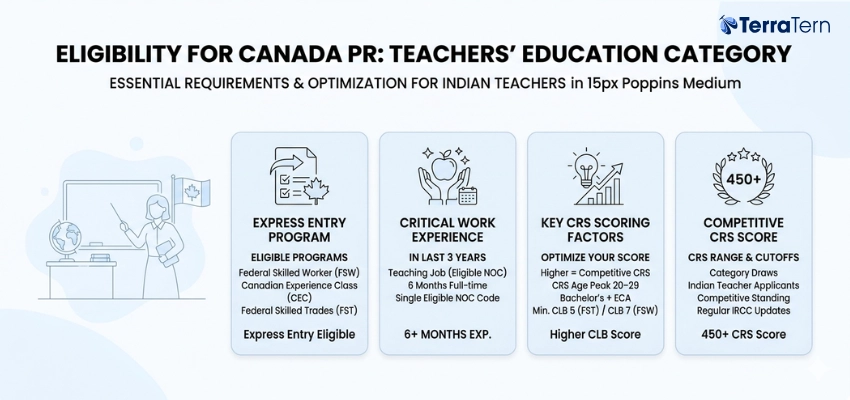
To be eligible for a canada PR for teachers under the Express Entry Education Category, Indian teachers must have at least 6 months full-time in an eligible NOC code teaching job in the last 3 years, be eligible for the Express Entry programs and have a competitive Comprehensive Ranking System (CRS) score (usually 450+ to be considered in the category-based draws).
-
Eligibility for Express Entry: Meet the requirements for Federal Skilled Worker (FSW), Canadian Experience Class (CEC) or Federal Skilled Trades (FST) programs.
-
Work Experience: 6 months full-time (or more part-time experience) in a single eligible NOC code in the past 3 years.
-
Language Proficiency: Minimum CLB 5 required for the Federal Skilled Trades Program (FSTP); CLB 7 required for the Federal Skilled Worker Program (FSWP). Higher scores, particularly CLB 9 or above, significantly improve CRS points and competitive standing in education-category draws.
-
Educational Qualifications: A minimum of a bachelor's degree (3-4 years, preferably B.Ed.) with an Educational Credential Assessment (ECA) for non-Canadian degrees.
-
Financial: Required to demonstrate funds (IRCC updates the amount annually), unless you have a Canadian job offer or Canadian work experience.
-
Age Considerations: CRS age points peak between ages 20–29 and decrease progressively from age 30 onwards, reaching zero points for applicants aged 45 and above. Reaching age 45 eliminates age-based points, but does not make an applicant ineligible; other CRS factors like language scores, education, and job offers still apply.
Expert Tip: Many Indian teachers mistakenly believe they need a year of Canadian work experience to apply, but under the FSW Program, 100% foreign teaching experience counts. The key is ensuring your overseas employment letters clearly describe duties that match your NOC code.
Also Read: Canada PR Visa: Eligibility, Fees, Processing Time & More
What Are All the Immigration Pathways for Canada PR for Teachers?
Teachers from India have four main pathways for Canada PR for teachers: Express Entry, Provincial Nominee Programs (PNPs), the Atlantic Immigration Program (AIP), and the Rural and Northern Immigration Pilot (RNIP). Each route fits a different profile.
How Does the Express Entry Education Category Work for Teachers?
Express Entry's education category allows IRCC to conduct targeted draws specifically for education-sector NOC codes. These draws typically have lower CRS cut-offs than general draws; the September 2025 education draw, for example, had a cut-off of 462 compared to general draws frequently requiring 490–530. Candidates with eligible teaching NOC codes are automatically considered for these draws once their profile is active in the Express Entry pool, without needing to take any additional action.
Which Provincial Nominee Programs Are Best for Indian Teachers?
PNPs are one of the strongest options for Canada PR for teachers because a provincial nomination adds 600 CRS points, which almost guarantees an ITA. The best provinces are usually those facing teacher shortages or active recruitment in schools. In 2026, there were no dedicated teacher-only PNP draws, so employer-driven nominations remained the main route.
|
Province |
PNP Stream |
Teacher Demand |
Regulatory Authority |
|
Ontario |
OINP Employer Job Offer stream |
Very high, especially STEM and French |
Ontario College of Teachers |
|
British Columbia |
BC PNP Skilled Worker stream |
High, especially in rural areas |
BC Teachers' Council |
|
Alberta |
AAIP Express Entry stream |
High, especially secondary STEM |
Alberta Education / ATA pathways |
|
Saskatchewan |
SINP Occupation in Demand |
High, if willing to relocate |
Saskatchewan Professional Teachers Regulatory Board |
|
Nova Scotia |
NSNP Demand: Express Entry |
Moderate, rural shortages |
Nova Scotia Teacher Certification |
|
New Brunswick |
NB PNP |
Active teacher recruitment |
New Brunswick Teacher Certification Branch |
|
Manitoba |
MPNP Skilled Worker stream |
Moderate |
Manitoba Education and Early Childhood Learning |
What Is the Atlantic Immigration Program for Teachers?
Designed for skilled workers who want to live in Nova Scotia, New Brunswick, PEI, or Newfoundland and Labrador.
-
You need a job offer from a designated employer in Atlantic Canada.
-
It is often a smooth PR pathway, with processing usually around 6 to 8 months.
-
It suits teachers open to smaller communities and regional schools.
-
Demand is especially strong in French immersion and STEM subjects.
How Does RNIP Help Teachers?
RNIP is a community-based pathway for Canada PR for teachers.
-
Specific towns and rural communities sponsor skilled workers.
-
It works best for teachers who are flexible about location.
-
Smaller communities often recruit teachers because of serious shortages.
-
Securing a job offer from a designated RCIP community employer is the primary requirement for community recommendation, after which the PR application pathway is structured and relatively predictable.
-
For official community details, check IRCC’s RNIP community list.
Expert Advice: If your CRS score is below 450, the PNP route, specifically securing an employer-driven nomination, is the most reliable path to an ITA. A single PNP nomination adds 600 CRS points, making the Express Entry pool cut-off irrelevant for most candidates.
What Is the Step-by-Step Process to Apply for Canada PR as a Teacher?
For Canada PR for teachers, the process usually takes 7 core steps, from confirming your pathway to starting provincial certification once you land in Canada.
-
Confirm your NOC code and pathway eligibility, such as 41220 or 41221
-
Get your educational credentials assessed through ECA, usually via WES or another approved body.
-
Take your language test, such as IELTS General, CELPIP-General, PTE Core, TEF, or TCF.
-
Calculate your CRS score and create your Express Entry profile.
-
Enter the pool and improve your score while waiting for draws.
-
Receive an ITA and submit your PR application within 60 days.
-
Land in Canada and begin teacher certification in your province.
Important Tip: The most common and costly mistake Indian teacher applicants make is submitting an ECA before confirming their NOC code. If the assessed degree doesn't align with the NOC requirements, the ECA result may not be sufficient, wasting both time and money.
How Can Indian Teachers Boost Their CRS Score for Canada PR?
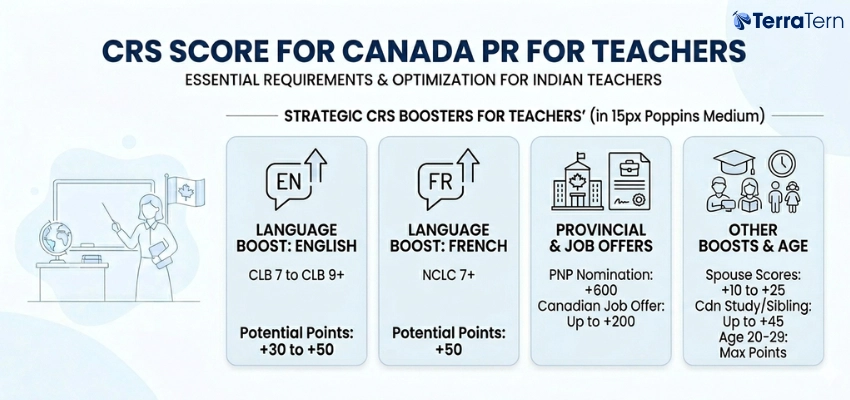
For Canada PR for teachers, the fastest way to improve CRS is usually stronger language scores, especially moving from CLB 7 to CLB 9+. French can add a major bonus, too.
|
CRS Booster Strategy |
Potential Points Added |
|
IELTS/CELPIP improvement, CLB 7 to CLB 9 |
+30 to +50 |
|
French proficiency, NCLC 7+ |
+50 |
|
PNP nomination |
+600 |
|
Canadian job offer |
Up to +200 |
|
Spouse’s language score |
+10 to +20 |
|
Spouse’s Canadian education |
Up to +5 |
|
Canadian post-secondary study |
Up to +30 |
|
Sibling in Canada |
+15 |
|
Age 20 to 29 |
Maximum age points |
As per TerraTern Expert: For Indian teachers aged 30–39 whose CRS scores fall in the 440–460 range, investing 3–4 months in intensive French language preparation (even basic conversational French on the TEF Canada) can add 50 CRS points and push them above the education draw cut-off, often a faster ROI than any other strategy.
Also Read: Canada Issues 2500 Express Entry Invitations for Education Workers - CRS Score Drops to 462
Which Canadian Provinces Are Best for Indian Teachers to Settle In?
Ontario, British Columbia, Alberta, and Saskatchewan are the strongest options for Canada PR for teachers because they offer strong demand, competitive salaries, and PNP access. Atlantic provinces can also be attractive if you want faster PR through AIP.
|
Province |
Teacher Demand |
Average Salary CAD |
Key Subjects |
PNP Option |
PR Route |
|
Ontario |
Very high |
72,000–96,000 |
STEM, French, Special Ed |
OINP employer stream |
EE + PNP |
|
British Columbia |
High |
65,000–90,000 |
French immersion, rural |
BC PNP |
EE + PNP |
|
Alberta |
High |
62,000–85,000 |
STEM, vocational |
AAIP |
EE + PNP |
|
Saskatchewan |
Moderate to high |
58,000–80,000 |
Rural, special ed |
SINP |
EE + PNP / Direct |
|
Nova Scotia |
Moderate |
55,000–78,000 |
General |
NSNP |
AIP / EE |
|
New Brunswick |
Moderate |
52,000–72,000 |
French, rural |
NB PNP |
AIP / EE |
Pro Tip: Indian teachers fluent in French or willing to invest 6 months in learning French are disproportionately in demand in New Brunswick, Manitoba, and Ontario's French immersion programs. This combination of language skills + teaching qualification can result in a direct employer hire and PNP nomination within months.
What Documents Are Required for Canada PR Application as a Teacher?
For Canada PR for teachers, you need a complete set of documents that prove your identity, education, work experience, language proficiency, finances, and medical eligibility.
-
Valid passport with at least 6 months’ validity.
-
Birth certificate and marriage certificate, if applicable.
-
Police clearance certificates from India and any country where you lived for 6+ months in the last 10 years.
-
Educational Credential Assessment
-
ECA from WES or another IRCC-approved body.
-
Language test results, such as IELTS General Training, CELPIP, PTE Core, TEF Canada, or TCF Canada.
-
Employment reference letters, salary slips, and supporting proof matching your NOC duties.
-
Proof of funds and Immigration Medical Exam results from an IRCC-approved doctor.
Key Note: The employment reference letter is the most frequently rejected document in teacher PR applications. It must explicitly state that your duties matched the NOC description , generic letters saying "she was a good teacher" are insufficient. Prepare detailed duty-specific reference letters before submitting your profile.
What Are the Benefits of Canada PR for Indian Teachers?
Canada PR for teachers offers strong financial, family, and career benefits, making it one of the most attractive migration options for Indian educators.
-
Much higher salary potential, often far above typical teacher pay in India.
-
Free universal healthcare for you and your family.
-
Free public schooling for children up to Grade 12.
-
Freedom to work for any employer anywhere in Canada.
-
Access to pension plans, paid holidays, and summer breaks.
-
A pathway to Canadian citizenship after meeting residency rules.
-
Ability to sponsor eligible family members after becoming a PR.
Important Note: Beyond the salary jump, the pension and healthcare benefits for Canada PR teachers are often overlooked. A Canadian teacher's total compensation package, including a defined-benefit pension, medical, dental, and union protections, regularly exceeds CAD 120,000 in total value, making it one of the most financially secure career paths available to skilled Indian professionals.
Also Read: Express Entry Canada | Apply Now with TerraTern
2026 Industry Context Section
Indian Teachers Must Know:
-
Canada's Express Entry education category, introduced as part of category-based selection draws in 2023, has continued to invite education occupations in 2025–26. The most recent education-specific draw (Draw 367) was held on September 17, 2025, with a CRS cut-off of 462 and 2,500 ITAs issued. Indian teachers should monitor IRCC's draw schedule at canada.ca for new education-category rounds. (Source: CIC News, March 2026)
-
The most recent education-category Express Entry draw (Draw 367) was held on September 17, 2025, with a CRS cut-off of 462 and 2,500 ITAs issued. A prior education draw (Draw 354) on May 1, 2025, issued 1,000 ITAs at a CRS cut-off of 479. No education-specific draw has been confirmed in 2026 as of May 2026. Indian teachers should monitor the IRCC draws page for updates.(Source: pa-ic.com, December 2026)
-
Canada needs 52,100 new teachers by 2031: The national teacher shortage is especially acute in STEM subjects, French immersion, and rural/northern communities (Source: getgis.org, September 2026)
-
Teachers: Teaching occupations appear on the in-demand lists of multiple provincial PNP streams across Canada. Indian teachers should check individual provincial nomination programme websites for current occupation lists, as demand varies by province and is updated periodically.
-
Average annual salary for teachers in Canada: CAD 45,000–95,000 compared to INR 35,000–60,000/month in India; gap exceeds 10x on a purchasing-power basis (Source: elaarimmigration.com, May 2026)
Conclusion
Securing a canada PR for teachers in 2026 presents an incredible opportunity for Indian educators seeking better salaries, professional respect, and an exceptional quality of life. By accurately identifying your NOC code, meeting the minimum experience requirements, and maximising your CRS score through Express Entry or Provincial Nominee Programs, your dream of teaching in Canada is highly achievable. Start your journey today by assessing your eligibility and gathering your essential documents.
Contact TerraTern for more information on Canada PR for Teachers: Complete 2026 Guide for Indians.




 AI Summary