Key Highlights
- What is Austria Golden Visa?
- What Exactly Is the Austria Golden Visa and Why Is It Different From Other EU Golden Visas?
- What Is the Austria Private Residence Program, the "Entry-Level" Golden Visa?
- What Is the Austria Citizenship by Investment Program Under Article 10(6)?
- What Are the Differences Between Austria's Two Golden Visa Programs?
- What Are the Benefits of the Austria Golden Visa for Indian Investors?
- What Is the Step-by-Step Application Process for the Austria Golden Visa?
- How Does Austria's Golden Visa Compare to Portugal, Spain, Greece, and Malta?
- What Are the Tax Implications of Austria Golden Visa for Indian Investors?
- Conclusion
As the ideal European home for investors from India in 2026, Austria presents an unbeatable combination of economic security, leading healthcare, and world-class quality of life. The Austria golden visa pathways, the Financially Independent Person visa and direct Citizenship by Investment as outlined in Section 10(6), offer unique ways to gain EU residency.
Austria does not have a traditional real estate scheme; however, top routes to EU residency include all that the Financially Independent Person visa has to offer along with direct Citizenship by Investment outlined in Section 10(6).
What is Austria Golden Visa?
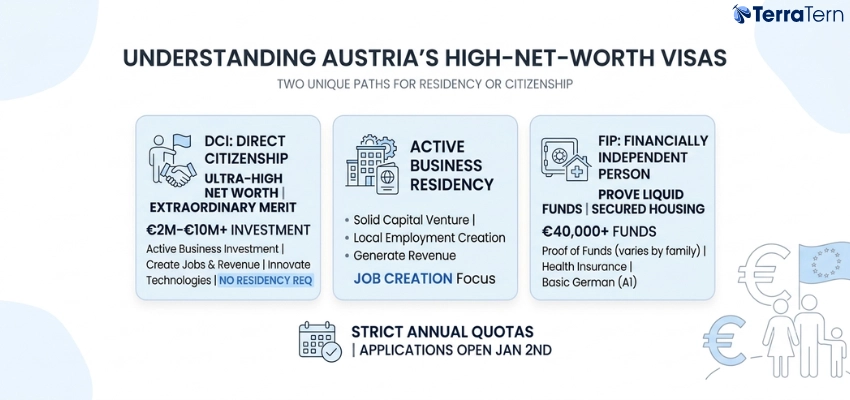
In Austria, there isn't such a thing as a passive real estate program like there is in other European countries, but there are two unique schemes that are highly selective for high-net-worth individuals to be granted residency or direct citizenship: the Austria golden visa.
-
Not a Real Estate Scheme: While traditional schemes allow one to purchase a house, it is not possible with this type of scheme. The golden visa issued by Austria is either for a business investment that creates jobs, or for an independent business venture with solid capital.
-
Article 10, Section 6 – Direct Citizenship by Investment (DCI): The upgrade for the ultra-high net worth investor. Direct citizenship (no residency requirements) may be given to those with "extraordinary merit" to the Commonwealth of Austria.
-
Active Business Investment: For direct citizenship, a large financial investment of various amounts, between €2 million and €10 million+, is necessary for a business in Austria. The investment should be job- and revenue-creating or introduce innovative technologies to the country.
-
Financially Independent Person (FIP) Residency: Residency-by-investment for individuals who don't want to work locally. Requires proof of substantial liquid funds (usually €40,000 and upwards depending on family size), secured housing (either rented or owned), private health insurance and a basic level of German (A1 level).
-
Strict Annual Quotas: The FIP residency pathway is a very competitive process with annual quotas; applications typically begin on January 2nd every year.
-
Benefits of having an appointment to come to the country with family: visa-free access to the EU Schengen Zone, excellent healthcare and education facilities and a standard of living in one of the safer financial systems in Europe.
What Exactly Is the Austria Golden Visa and Why Is It Different From Other EU Golden Visas?
The fundamental difference between the Austria golden visa and other golden visa programs in Europe is that it is not an EU program. The Austria golden visa is not a EU program.
-
Not a Standard Program: The Austria golden visa is not a single product; rather, it is an umbrella term that covers two options - Financially Independent Person (FIP) residency and direct Citizenship by Investment.
-
No Passive Real Estate: Property investment in Austria doesn't plan to lead to passive income like in Portugal, Spain or Greece. It is a requirement of proof of personal liquid wealth or a large amount of active business investment.
-
Standard EU programs provide TWP for five-plus years of residency before granting citizenship; Under Austria's Article 10(6) program, one can get immediate, automatic EU citizenship and the #1 place in the rankings for citizenship by passport.
-
The amount of the investments required to obtain a traditional golden visa ranges from €250,000 to €500,000. The citizenship path required in Austria is very discretionary, requiring €3M – €10M+ to be invested in a working (business) entity that continually generates employment.
-
Accessible southern European alternatives to the two paths do not exist (nor ever existed), and both have rigorous scrutiny, are extremely discretionary, and are capped at about 300 applicants per year.
Pro Tip: Most Indian investors who search for "Austria Golden Visa" are seeking a program comparable to Portugal or Greece, and are then surprised to find either a very low-cost passive residency (Private Residence Program) or an ultra-high-investment direct citizenship route. Neither fits the standard €250,000–€500,000 "buy residency" mould. Understanding this distinction before beginning any Austrian investment immigration conversation is essential.
What Is the Austria Private Residence Program, the "Entry-Level" Golden Visa?
The Austria Private Residence Program (Niederlassungsbewilligung Ausgenommen Erwerbstätigkeit) is often viewed as the entry-level Austria golden visa.
-
No Passive Investment: You simply prove personal wealth and ongoing passive income; no property purchase, real estate investment, or state donation is necessary.
-
Strict Annual Quotas: Capped at approximately 300 global spots annually, making early Q1 application submission critical.
-
Zero Local Work Rights: You are explicitly forbidden from taking up gainful employment or running a business in Austria.
-
Language Prerequisite: Applicants must provide an A1-level German language certificate before the initial application is approved.
-
Standard Citizenship Path: Leads to permanent residency (PR) after 5 years and citizenship after 10 years, which requires renouncing your Indian passport (Austria rarely allows dual citizenship on this standard route).
-
2026 Financial Minimums for Independent Residence
|
Household Type |
Monthly Income (€) |
Monthly Income (INR ) |
Annual Proof (€) |
Annual Proof (INR ) |
|
Single adult |
€2,547.98 |
INR 2.29L |
€30,575 |
INR 27.5L |
|
Married couple |
€4,019.70 |
INR 3.62L |
€48,236 |
INR 43.4L |
|
+Each child |
+€393.14 |
+INR 35,400 |
+€4,718 |
+INR 4.25L |
Key Note: The 300-quota constraint is the most underestimated barrier for Indian applicants targeting the Private Residence Program. Unlike investment-threshold programs where meeting the financial requirements guarantees consideration, Austria's quota means even fully qualifying applicants may be turned away in a given year if the 300 slots are already filled. Work with an immigration specialist who can time the application for the earliest slot submission window in January of the target year.
What Is the Austria Citizenship by Investment Program Under Article 10(6)?
Unlike traditional programs, the Austria golden visa pathway under Article 10(6) of the Austrian Citizenship Act is not a standard residence-by-investment scheme, but a direct route to immediate EU citizenship.\
-
Direct EU Citizenship: Grants an Austrian passport immediately upon approval, bypassing the standard 10-year physical residency and German language requirements.
-
No Residency Required: You can live anywhere in the world; there is no obligation to relocate to or maintain a home in Austria before or after citizenship is granted.
-
Dual Citizenship Exception: While Austria strictly prohibits dual nationality on standard routes, the government can issue a special waiver under Article 10(6) allowing you to keep your original passport. (Note: India automatically revokes citizenship upon acquiring a foreign passport, so Indian applicants should verify current OCI policies).
-
Extreme Exclusivity: This is not a fast, off-the-shelf program. It is highly discretionary, requiring a multi-stage approval process that includes the Austrian Federal Cabinet.
-
Generational Family Inclusion: Spouses and eligible dependent children receive citizenship simultaneously, gaining the lifelong right to live, work, and study anywhere in the European Union.
-
Article 10(6) Discretionary Investment Thresholds
|
Investment Route |
Minimum Amount (€) |
Minimum Amount (INR) |
Key Condition |
|
Direct business investment |
€10,000,000 |
INR 90 Cr |
Must create substantial local employment and demonstrate lasting economic impact. |
|
Government development fund |
€3,000,000 |
INR 27 Cr |
Non-refundable contribution; approval remains entirely discretionary. |
|
Strategic Combination |
€3,000,000–€10,000,000 |
INR 27 Cr–INR 90 Cr |
Case-by-case assessment combining business operations and strategic regional projects. |
As per TerraTern Expert: The Article 10(6) dual citizenship exception is the single most significant advantage the Austrian CBI pathway offers Indian investors it is one of very few EU citizenship programs where Indian nationality can potentially be retained. However, the waiver is discretionary and not guaranteed. Indian investors pursuing the CBI route must obtain written legal opinion from both an Austrian immigration lawyer AND an Indian citizenship law specialist before making the investment, to fully understand the dual passport implications.
What Are the Differences Between Austria's Two Golden Visa Programs?
The two pathways under the Austria golden visa umbrella serve entirely different investor profiles. They differ fundamentally in required capital, legal outcomes, physical residency mandates, work rights, and dual citizenship eligibility.
|
Feature |
Private Residence Program |
CBI — Article 10(6) |
|
Investment type |
Passive income / liquid bank funds |
Active business / government fund |
|
Minimum financial requirement |
~€50,000 liquid + €2,548/month income |
€3,000,000–€10,000,000+ |
|
Minimum in INR |
~INR 45 Lakhs liquid + INR 2.29L/month income |
INR 27 Cr–INR 90 Cr+ |
|
Outcome |
Temporary residence → PR (5 years) → Citizenship (10+ years) |
Immediate citizenship |
|
Residency required? |
Yes — 183 days/year minimum |
No residency required |
|
Work rights |
No (gainful employment excepted) |
Full EU work rights (immediate citizenship) |
|
Annual quota |
~300 permits |
~300 considered (highly selective) |
|
Processing time |
2–6 months for permit; 5 years to PR |
12–36 months to citizenship |
|
Dual citizenship |
No (standard passport surrender on eventual citizenship) |
Possible — waiver can be granted discretionarily |
|
Family inclusion |
Spouse + children → same permit |
Spouse + minor children → citizenship |
|
Suitable for |
Income-rich individuals, families wanting European lifestyle |
UHNW investors seeking EU passport without relocation |
Important Note: For the vast majority of Indian HNW families, those with investable assets of INR 10–INR 50 crore the Private Residence Program is the only realistic Austrian option. The CBI pathway at €3–10M+ (INR 27–90 Cr) is specifically designed for ultra-HNW investors with a long-term vision for an EU passport, not for first-generation wealth builders. Being honest about which tier your investment capacity reaches is the first decision in Austrian investment immigration planning.
What Are the Benefits of the Austria Golden Visa for Indian Investors?
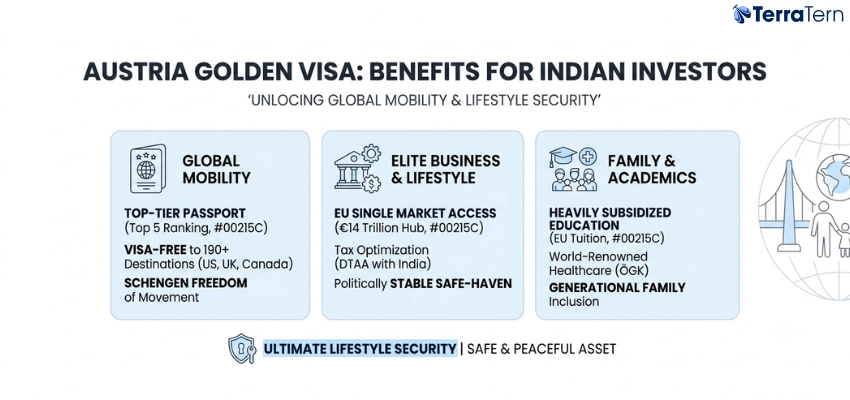
For Indian investors, the Austria Golden Visa unlocks far more than just European residency—it provides a strategic gateway to global mobility and elite lifestyle security.
-
Top-Tier Global Passport: Austrian citizenship grants you one of the world's most powerful passports (consistently ranked in the global top 5), unlocking visa-free or visa-on-arrival travel to over 190 destinations, including the US, UK, and Canada.
-
Schengen Freedom of Movement: Even before citizenship, the Private Residence permit provides a resident card allowing you to travel freely across all 27 Schengen Area nations without constantly applying for short-stay visas.
-
Strategic EU Business Hub: Operating from Austria provides unfettered access to the €14 trillion EU single market, complemented by a Double Taxation Avoidance Agreement (DTAA) with India that optimises your global tax exposure.
-
Elite Healthcare & Education: Families gain access to Austria’s world-renowned ÖGK public healthcare system and globally ranked universities at heavily subsidised domestic EU tuition rates.
-
Ultimate Safe-Haven Asset: Consistently ranked among the top five most peaceful countries globally, Austria offers robust property rights, political stability, and unparalleled physical security for your family and capital.
-
Generational Family Inclusion: Both pathways cover your spouse and dependent children. Notably, the CBI route allows the government to grant a rare waiver to the dual-citizenship ban, highly advantageous for international business families.
-
Mobility & Lifestyle: Indian vs. Austrian Credentials
|
Benefit |
Indian Passport Holder |
Austrian Citizen / Resident |
|
US visa |
B1/B2 visa required (~6 months wait) |
ESTA (visa-free, 90 days) |
|
UK visa |
Standard visa required |
Visa-free access |
|
Schengen travel |
Schengen visa required |
Resident card free movement |
|
EU business setup |
Complex; non-EU restrictions |
Full EU market access |
|
Children's education |
International student fees |
EU domestic rates |
|
Healthcare in Europe |
Travel insurance only |
ÖGK public insurance |
Expert Tip: The most significant financial benefit of Austrian citizenship/residency for Indian HNW families is often not the visa-free travel it is eliminating the US B1/B2 visa bottleneck. Indian business families with regular US travel requirements spend months and thousands of rupees on visa applications; Austrian citizenship or residency eliminates this. For active deal-makers who travel to the US multiple times a year, this convenience value alone can be compelling.
What Is the Step-by-Step Application Process for the Austria Golden Visa?
Applying for the Austria Golden Visa involves strictly defined, multi-stage procedures that differ drastically depending on your chosen route
Path A: Private Residence Program (Financially Independent)
1. Confirm Financial Eligibility:
-
Verify liquid funds of €50,000–€75,000 in an accessible bank account and an ongoing passive income of €2,548+/month (single) or €4,020+/month (couple). You must not plan to work locally.
2. Secure Austrian Accommodation:
-
Purchase or sign a lease for an Austrian residential property suitable for your family size. You need these documents before applying.
3. Obtain Comprehensive Health Insurance:
-
Secure international health insurance valid for the Schengen Area that covers all applying family members.
4. Prepare and Authenticate Documents:Police clearance must be under 6 months old.
-
Gather your passport, authenticated bank statements, lease/purchase documents, and an apostilled Indian police clearance certificate.
5. Submit at the Austrian Embassy in India:
-
Apply in person at the Embassy in New Delhi or Consulates in Mumbai/Bangalore for biometrics. Processing takes 2–6 months based on quota availability.
6. Relocate and Register: Register your address within 3 days of arrival.
-
Once approved, collect your Niederlassungsbewilligung card, register your Meldezettel upon arrival, and begin your mandatory 183-day annual stay.
Path B: Direct Citizenship by Investment (Article 10(6))
1. Engage a Licensed Austrian Intermediary:
-
Article 10(6) applications cannot be submitted directly. You must hire an authorized intermediary or specialist law firm with an established federal track record.
2. Structure the Investment Proposal:
-
Work with your legal team to construct a €3M–€10M+ investment that demonstrably benefits Austria (e.g., substantial job creation, export growth, or strategic innovation).
3. Submit to the Federal Ministry: Ministry of Economics and Labour.
-
Submit the formal business plan, CV, references, and investment documentation. Ministry officials will rigorously examine the economic benefit and size of the injection.
4. Undergo Security and Background Checks:
-
Simultaneously, the Austrian Interior Ministry (BMI) conducts deep background checks, including Interpol clearance and source-of-wealth investigations.
5. Await Federal Cabinet Decision: Processing takes 12 to 36 months.
-
The Austrian government will issue a completely discretionary approval or rejection. If approved, you receive immediate citizenship and (potentially) a dual-citizenship waiver.
Processing Time Comparison
|
Stage |
Private Residence |
CBI (Article 10(6)) |
|
Document preparation |
4–8 weeks |
6–12 months |
|
Ministry / Embassy processing |
2–6 months |
12–24 months |
|
Total time to outcome |
3–8 months |
18–36 months |
Important Tip: The CBI application intermediary selection is the highest-stakes decision in the entire Article 10(6) process. The Austrian government does not publish a list of approved intermediaries, and the investment migration industry includes firms with varying levels of genuine Ministry access. Before engaging any intermediary for an Austrian CBI application, verify their track record with documented successful Austrian CBI approvals, not just general European residency programs.
How Does Austria's Golden Visa Compare to Portugal, Spain, Greece, and Malta?
Austria's golden visa programs are significantly more exclusive and capital-intensive than popular alternatives in Portugal, Spain, Greece, or Malta.
Comparison of EU Residency & Citizenship Pathways
|
Country |
Program Type |
Min. Investment (€) |
Min. Investment (INR) |
Outcome |
Wait for Citizenship |
Dual Citizenship (India) |
Passport Rank |
|
Portugal |
Golden Visa (residency) |
€250,000 (fund) |
INR 2.25 Cr |
Residency → Citizenship |
5 years residency |
Yes (Portugal allows dual) |
#5 |
|
Greece |
Golden Visa (residency) |
€250,000 (property) |
INR 2.25 Cr |
Residency → Citizenship |
7 years residency |
Yes (Greece allows dual) |
#3 (tied) |
|
Malta |
Citizenship by Investment |
€600,000–€750,000 |
INR 5.4 Cr–INR 6.75 Cr |
Citizenship (after 12–36 mths) |
12–36 months |
Yes (Malta allows dual) |
#8 |
|
Spain |
Golden Visa (residency) |
€500,000 (real estate) |
INR 4.5 Cr |
Residency → Citizenship |
10 years residency |
No (Spain requires renounce) |
#3 (tied) |
|
Austria (Private Residence) |
Residency (passive income) |
~€50,000 liquid + €2,548/mth |
INR 4.5L liquid + INR 2.29L/mth |
Residency → Citizenship |
10 years residency |
No (standard route) |
#3 |
|
Austria (CBI — Article 10(6)) |
Citizenship by Investment |
€3,000,000–€10,000,000 |
INR 27 Cr–INR 90 Cr |
Immediate citizenship |
No wait |
Discretionary waiver possible |
#3 |
Expert Advice: For most Indian investors with an INR 2–INR 10 crore budget who want European residency and eventual citizenship, Malta (INR 5–INR 7 crore, citizenship in 12–36 months, Indian dual passport retained) currently offers the best combination of investment efficiency, speed, and passport strength relative to Austria's CBI pathway. Austria's CBI becomes compelling only at the INR 27 crore+ level, where its #3 passport rank, no-residency-required citizenship, and Vienna's prestige justify the significantly higher investment.
What Are the Tax Implications of Austria Golden Visa for Indian Investors?
Understanding the Austria Golden Visa tax framework is crucial for Indian high-net-worth investors:
-
Progressive Income & Flat Capital Gains: Austrian tax residents face a progressive income tax scaling up to 50% (reaching 55% for income exceeding €1 million), while investment returns including dividends, interest, and capital gains are taxed at a flat rate of 27.5%.
-
Zero Wealth and Inheritance Tax: Austria offers an exceptional environment for asset protection and generational wealth transfer, as the country imposes no annual wealth tax and fully abolished its inheritance tax in 2008.
-
Austria-India DTAA Protections: An active Double Taxation Avoidance Agreement (DTAA) prevents double taxation on cross-border earnings, capping withholding limits at 15% for Indian-source dividends and 10% for interest and royalties.
-
Private Residence Tax Reality: If you utilise the Private Residence permit and reside in Austria for 183 days or more annually, you become an Austrian tax resident subject to worldwide income taxation (though you must still pay for separate private health insurance).
-
CBI Flexibility and CRS Reporting: Securing citizenship via the Article 10(6) pathway does not require physical relocation and therefore does not automatically trigger Austrian tax residency, offering massive tax planning flexibility; however, under the Common Reporting Standard (CRS), Austrian banks will report your account data back to Indian tax authorities.
Pro Tip: Austrian CBI citizenship's most powerful tax planning feature is that citizenship WITHOUT Austrian residency creates no Austrian tax obligation; an Indian UHNW investor who holds an Austrian passport but maintains Indian residency (fewer than 183 days/year in Austria) pays no Austrian income tax while still holding an EU passport. This structure, Austrian citizenship + Indian tax residency, is a legitimate and commonly utilised planning framework for UHNW Indians with CBI; it must be implemented with advice from both Austrian and Indian tax professionals.
Conclusion
Navigating the Austria golden visa requires aligning your capital strategy with your long-term lifestyle goals. Whether you choose the Financially Independent Person permit for an accessible European base or the elite Article 10(6) Citizenship by Investment pathway for an immediate passport, Austria offers unmatched global mobility and security. For Indian investors, understanding these distinct 2026 routes is the crucial final step toward securing a legacy in Europe's most stable economy.
Contact TerraTern for more information on Austria Golden Visa: Your Gateway to EU Residency Through Investment.




 AI Summary