Key Highlights
- What is the Australia 190 Visa Processing Time?
- What Are the Key Stages of the Australia 190 Visa Processing?
- What is the Current 190 Visa Australia Processing Time in 2026?
- What are the Priority vs Non-Priority Occupations in 2026?
- Comparison Table: Average Processing Times by Occupation for 190 Visa Australia
- What are the 6 Factors Affecting 190 Visa Processing Time Australia? Updated 2026
- What Are the Most Common Reasons for 190 Visa Processing Delays?
- How to Speed Up Your 190 Visa Processing Time Australia in 2026?
- State-by-State Australia 190 Visa Processing Time Comparison for 2026
- What are the Common Delays and How to Avoid Them in 2026?
- What is the Step-by-Step Guide for the Australia 190 Visa Processing Time?
- When Should 190 Visa Applicants Seek Professional Help for Processing Delays?
- 2026 INDUSTRY CONTEXT SECTION
- Conclusion
The Australia Subclass 190 Skilled Nominated visa is one of the most sought-after visa categories for skilled migrants who get a nomination from the Australian state or territory government. The median processing time for skilled permanent visas (including the 190) in 2026 is approximately 10 months, although processing times will vary greatly based on the processing time for the applicant's occupation, the completeness of their visa application, health checks, character checks and ministerial directions, which will prioritise applications to processors based on the occupation and whether the visa application is complete or not. Health checks, character checks and application processing times will vary depending on who the applicant is.
Knowing these Australia processing realities is essential because for some 190 visas, the application may take between 6.5 months and more than a year to be processed due to incomplete applications, delays in verification, and the annual cap on migration. This guide will help you understand what affects your unique timeline, how to monitor your application and what measures you can take to make sure that there is no wastage of time while awaiting a response.
What is the Australia 190 Visa Processing Time?

Below is a summary of the Australia 190 Visa processing time in 2026, summarised in a point-by-point fashion.
-
According to the Department of Home Affairs, the median processing time for skilled permanent visa (including subclass 190 visa) applications is approximately 10 months, though this is not an assured processing time.
-
For the Subclass 190, most applicants will hear back in about 6 to 10 months, but there are varying estimates as to how long it takes under normal circumstances, which range from 6.5 to 8 months.
-
About 75% of 190 applications are processed within about 8-11 months, and the slowest 10% can take 13-18 months or longer, depending on the complexity of the application and the workload.
-
It may take 12-20 months or more if there is a backlog, the documentation is incomplete, or there are additional checks (health, character, verification).
-
Priority sectors (such as healthcare, teaching and some regional occupations) may be processed sooner than general stream applicants as a result of ministerial directions, which are based on government policy.
-
The exact timeframe will largely rely on variables such as accurate state nomination, documentation, timely responses to requests, and the demand from the migration programme year.
What is the Eligibility Criteria for the Australia 190 Visa Processing Time?
Here is the eligibility criteria for the Australia 190 Visa processing time:
-
At the time you receive your invitation, you must be no older than 45 years old
-
Demonstrate that you have been favourably evaluated in your recommended profession
-
Succeed on the Skilled Migration Points Test with a minimum of 65 points
-
Demonstrate that your English language skills are at the level required by the mentioned threshold
-
Be chosen by the government of one of the Australian states or territories
-
Apply for an Expression of Interest application through the SkillsSelect Obligations
-
Work and live in the given state or territory that sponsored your application
-
Notify the relevant state organisation of any changes to your job details/ address
-
Use your gifts to serve the community in an economically sustainable way
-
Ensure you receive all the conditions with your visa and follow local and regional agreements
For skilled migrants who want to settle as permanent residents and contribute to regional or state development, this visa is an appropriate choice.
Also Read: Australia Visitor Visa Processing Time from India
What Are the Key Stages of the Australia 190 Visa Processing?
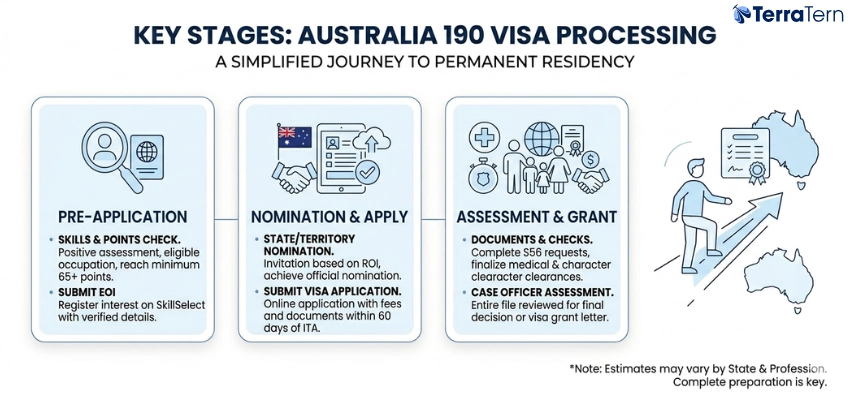
The following are the basic stages of the Australia subclass 190 visa processing in simple points:
-
Check eligibility and occupation - Ensure occupation is on the eligible skilled‑occupation list and that age, English, character and health requirements are met.
-
Full Skills Assessment - Have a positive skills assessment for your occupation from the relevant assessment authority.
-
Collect points and submit EOI - Once you have collected enough points, typically 65 or more, then submit an Expression of Interest (EOI) through SkillSelect.
-
Be made an Australian state/territory nomination - Be nominated by a state/territory that has invited you to apply for nomination based on your ROI (Registration of Interest) and eligibility.
-
Make your Subclass 190 visa application online - you must submit your application within 60 calendar days of invitation with all required documents and fees.
-
Preliminary checks and requests for information - the department verifies documents, can obtain further information (e.g. S56 requests), and can seek further evidence or clarification.
-
Medical and character checks - Medical and police checks are done, which may take a long time if reports take time or are incomplete.
-
Case officer assessment and decision - A case officer examines your entire file, and if he or she is satisfied, he or she grants the 190 permanent visa and sends you a visa grant letter.
-
Bridging visa (if onshore) - If you apply for your 190 visa from Australia, you will typically be granted a bridging visa to be lawfully present in Australia until you have your 190 visa approved.
Expert Advice: Many Indian applicants underestimate the state nomination stage, which can add 2 - 8 weeks to the overall timeline before DoHA even begins processing your visa application.
How Long Does Each Stage of the 190 Visa Take?
Typical Process (Skills- Assessment, EOI, Nomination, Lodgement, Health/ Character, Department Decision) takes 1 - 2 years in total, with half about 10 - 13 months after lodgement, and more if there are delays for requests, medical reports or backlogs.
-
Learning outcomes can be achieved in 3-8 weeks for most occupations, depending on the availability of the necessary documents, which may take longer to be assessed if they are not ready or are assessed slowly.
-
EOI to invitation: Weeks to many months, depending on points, occupation demand and frequency of state nominations rounds.
-
State nomination wrap-up: 1-3 months after nomination to receiving the 190 invitation.
-
Lodgement of document(s): 1 - 2 weeks after collation of documents and payment of fees.
-
Postâ€ÂÂÂlodgement (DoHAâ€ÂÂÂhandling): The average is 10-15 months, with the longest being 20-23 months in the slowest 10% of cases, based on workload and checks.
What Is the 190 Visa Processing Time After Lodgement With DoHA?
Typically, applicants who lodged a visa application with DHAH receive feedback on the visa within 10-13 months; however, delays are often due to the missing documents, slow health report and character check bottlenecks, or backlogs within the Department of Home Affairs.
-
Document Review and RFI (if applicable): 1-3 months, longer if required to answer additional info requests.
-
Health-check stage: 1 - 4 months, depending on your clinic and results.
-
Character-check phase: 1-3 months and possibly more for various police checks.
-
Case Officer evaluation: 6 - 10 + months, majority of final evaluations in the 10 - 15 month range.
-
Priority-occupation cases: Healthcare or teaching-related 190 files - can be decided in less than 10 months, depending on the current ministerial priorities.
What is the Current 190 Visa Australia Processing Time in 2026?
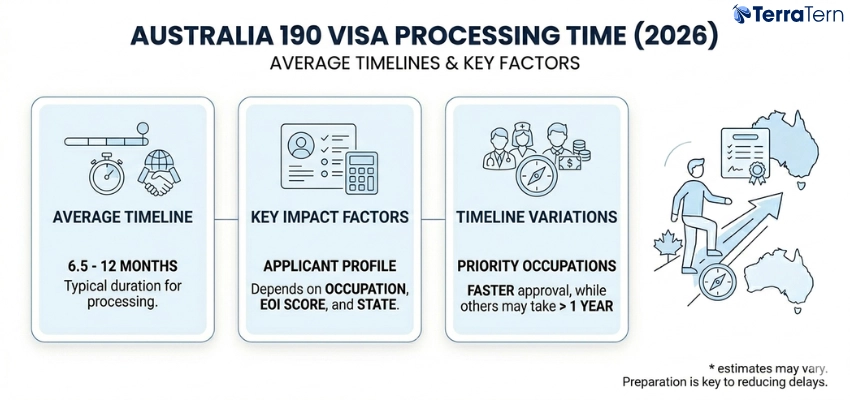
How much is the average 190 visa Australia processing time in 2026?
-
These aspects, your occupation, EOI score, and state, may also affect how long it will take to process your visa application
-
The average time to process a 190 visa is between 6.5 and 12 months
-
That is not the whole picture. Certain prioritised occupations are approved far more quickly than others
-
There are also professions where applicants can wait more than a year
General Timeline in 2026:
Here’s a general timeline for the 190 visa Australia processing time 2026:
-
Priority Occupations: 1 to 3 months
-
Standard Occupations: 6.5 to 12 months
-
Non-Priority Occupations: 14 to 22 months
These projections include the significant stages of state nomination, invitation and visa approval.
Breakdown of Processing Stages:
Here’s a breakdown of the processing stages in the Australia 190 visa processing time:
-
State Nomination: The period can range from 1 to 6 months, depending on the state's busyness and processing capacity
-
Invitation to Apply (ITA): 1-12 months: The speed of the application process becomes faster if it is a high-demand position or you have a greater EOI score.
-
Visa Application Processing: 4-12 months: Processing begins after your application materials are given to you
Quick Tip:
If your EOI has 80 points or above, you usually get a response first. The more points an applicant has, the higher the probability of early selection.
What are the Priority vs Non-Priority Occupations in 2026?
The Department of Home Affairs (DHA) specialises in certain occupations. They are currently in high demand and are urgently required, which leads to reduced Australia 190 visa processing time:
Fast-Tracked (Priority Occupations):
Here are the fast-tracked occupations for Australia 190 visa processing time:
-
Healthcare professionals (e.g., nurses, doctors)
-
Educators, particularly those who are handling students going through STEM or early childhood education
-
Construction and trade workers
-
Aged care and disability support employees
Such applicants usually get invitations and grants within a few months.
Slower Timelines (Non-Priority Occupations):
Here are the ones that have slower timelines for Australia 190 visa processing time:
-
Marketing professionals
-
Business analysts and consultants
-
Administrative and clerical workers
Many states require only a minimal need for these positions. Processing applications tends to take longer, regardless of EOI results.
Also Read: How to Move to Australia from India? Jobs & Immigration
Comparison Table: Average Processing Times by Occupation for 190 Visa Australia

Here’s a comparison table for Australia 190 visa processing time based on occupation:
|
Occupation Type |
Average Processing Time |
|
Healthcare |
1 - 3 months |
|
Education |
2 - 4 months |
|
Engineering |
4 - 8 months |
|
Business/Marketing |
10 - 22 months |
This table helps you set realistic expectations based on your profession.
How Does 190 Visa Processing Time Compare to 189 and 491 Visas?
The Subclass 190 usually takes around 6.5–10 months (median 10 months) after lodgement, which is similar to the 189 (often 8–9 months), and the 491 tends to be slightly faster due to the lower complexity PR path checks later and lower requirements.
-
Both 189 and 190 visas are permanent skilled visas, and both of the timelines are quite similar, with many firms estimating 8–10 months each for both visas.
-
491 vs 190: 491 is provisional, and so visa-grant is likely to finish sooner than 190, but visa via 191 later is also an additional overall time.
-
Nomination factor: 190 and 491 are both state-nominated based states, and state processing time is independent of DoHA visa processing time.
Which Australian States Have the Fastest 190 Visa Nomination Processing?
While there may not be a “fastest” state overall, Western Australia (WA), South Australia (SA) and Queensland (QLD) tend to have earlier rounds for certain priority and high-demand occupations compared to other states. When demand is high, NSW and Victoria may be more competitive and slower.
-
WA: For the 190 invitations, particularly those that are in demand in the region and priority positions, it has been cited as a fast turnaround.
-
SA: Needs to conduct regular nomination rounds, which can reduce the time lag from EOI to 190 invite.
-
QLD: May be competitive, but can be quicker in nominated priority occupations.
-
NSW / Vic: Naturally slower during peak periods as there are large numbers of applicants and tougher criteria.
What are the 6 Factors Affecting 190 Visa Processing Time Australia? Updated 2026
Several variables will influence the length of your visa application process:
-
State Nomination Speed: Some states provide faster service than others
-
Occupation Demand: High-demand jobs move quickly
-
EOI Points: Higher scores = faster invitations
-
Document Completeness: Missing papers = delays
-
Case Officer Requests: More queries = more time
-
DHA Prioritisation: Priority roles get special attention
Careful planning of your application can speed up processing.
How Do Health and Character Checks Impact the 190 Visa Processing Timeline?
The 190 timeline may be extended by health and character checks, which can take a few weeks or months to complete, depending on the visa application. Slow medical reports, expired or missing police checks, or extra‑screening requests directly delay the final decision.
-
In points:
-
The medical exam is normally clear in a couple of weeks, and Home Affairs will not issue the visa until the results are approved.
-
The longer one delays health checks, or if the results are still pending when the processing is completed, another round of health checks may be required, further increasing the time.
-
Several police clearance checks and/or checks from other countries can also cause a delay and extend the total processing time to 190.
Does a Higher Points Score Speed Up the 190 Visa Processing?
A higher points score does not necessarily mean the 190 visa processing time after lodgement is quicker; it does increase the likelihood of being nominated and invited to apply sooner, which means your 190 visa application is in the processing queue quicker and may be processed sooner.
-
In points:
-
The points have a major impact on the selection of those who will be invited, rather than on the speed with which DoHA processes each 190 file after they are submitted.
-
Strong-point applicants will be nominated and invited to state-190 programs earlier, particularly in competitive programs.
-
Lodging early due to high points does not increase overall wait time as much as it seems, because, as a per-application processing window, it's much like the other 190 places.
What Does "Received Further Information" Mean for 190 Visa Processing?
If you are marked with "Received Further Information", the Department of Home Affairs has accepted your written response to a Request for Further Information (RFI), and your 190 file is on its way back to be assessed. Does not guarantee approval; it will resume the process from there, so your processing time could be longer, but your case is still active.
-
The status will indicate that your RFI documents or explanations have been received and are “complete” in the system.
-
Following this, your 190 is sent to be considered further with a case officer, which may lead to a further processing time.
-
Note that even after “Received Further Information”, there may be delays if additional verification (health, character) is required or if there is complex verification.
-
It does not indicate that the visa was granted. Continue to watch on ImmiAccount and also your email for another update about the visa decision.
What Are the Most Common Reasons for 190 Visa Processing Delays?
The following are the most typical scenarios that result in delays to 190 visa processing, in points:
-
Incomplete or unclear documents – If forms are not complete or if not properly uploaded, or if the evidence is unclear, it will lead to additional information requests, and the clock will be pushed.
-
Delayed health checks – When a medical examination is slow, results are not available, or the turnaround time at clinics is longer than usual, the final decision is delayed.
-
Delayed character checks – Police clearances from various countries, or whether they are a slow-issuing agency, add weeks or months.
-
Delayed response to RFIs – When you don't respond to a request for more information from the Department of Home Affairs, the process slows down.
-
Long queue – Many 190 applications and a cap on migration programs increase overall queue times.
-
Complex personal circumstances – If family members change, there is a gap in employment history, or more than one country has been lived in, it takes longer to assess.
-
Paper applications or applications that are poorly submitted – Online applications are processed more quickly than paper applications or applications that are not well structured.
-
Priority‑policy changes – files from outside of priority 190 may be sent further back in the queue because of a change in priority policy, such as a Ministerial Direction or priority‑occupation rules.
Expert Advice: If you've lived or worked in multiple countries (common for Indian IT professionals who've worked in the UK, UAE, or Singapore), each country requires a separate police clearance, dramatically extending your character check timeline.
How Long Does the 190 Visa Take for Indian Applicants Specifically?
The average processing time for Indian passport holders who have lodged their applications is 10-13 months, with most applications completed within 8-12 months, but some may take as long as 18-23+ months due to delays in police clearance, health checks, or any other documents required.
-
Median range estimate: Current timelines for processing median range estimate Indian-190 files are about 10-13 months after filing.
-
Quick decisions: Indian 190 visas are processed in around 8-10 months, particularly when documents are complete, and checks are processed promptly.
-
Longer-tail cases: Those that take 18-23+ months are because of slow police clearance, health exam resubmissions, or complicated family situations, and may constitute about 10-20% of all cases.
-
Processing after invitation (PSM): If your nomination is from a busy state (NSW, Vic, etc.) as opposed to a state that processes quicker rounds, it can feel like it takes longer.
-
No citizenship‑based quota: The 190 timeline for “Skilled (Permanent)” visa is applicable to all countries, including Indian citizens, and if the personal factors slow the visa applicant, then they will be placed in the 10-month median band.
How to Speed Up Your 190 Visa Processing Time Australia in 2026?
Want to sponsor the 190 visa processing time Australia at a faster rate? The readiness of your application also plays a significant role in when your visa can be approved.
Top 6 Tips to Reduce the Australia 190 Visa Processing Time
Here are some tips to reduce the Australia 190 visa processing time:
-
Supply all essential and correct information during your first application
-
Be sure to fill out all your EOI and visa forms correctly
-
Respond in a timely way to all communications from the case officer
-
Target immigration streams with greater speed-of-processing rates
-
Make sure that your documents are presented in the exact format required
-
Ensure you refresh your EOI document with new scores/job experience, as well as any other helpful information
A casual mistake may stagnate your application. A forward-looking strategy may save you several months in the visa processing.
Quick Checklist: How to Speed Things Up?
Here’s a quick checklist on how to speed up the 190 visa processing time in Australia:
-
When you submit, take your time to ensure that your documents have been appropriately verified
-
Ensure your Expression of Interest (EOI) is current and complete
-
Check your email account for a notification from DHA
-
Upload everything clearly and correctly
-
Choose your nominating state wisely
Also Read: How to Go to Australia from India for Job? Experts Guide
State-by-State Australia 190 Visa Processing Time Comparison for 2026
Nomination procedures vary from state to state and territory to territory. Australia 190 visa processing time can be quicker or slower due to the applicant's needs, the preferred occupation type, or the capacities of state and territory departments.
Here’s a quick comparison for 2026:
|
State/Territory |
Nomination Time |
Total Visa Processing Time |
|
South Australia |
2 - 8 weeks |
6.5 - 10 months |
|
Victoria |
1 - 3 months |
8 - 12 months |
|
New South Wales |
1 - 4 months |
8 - 14 months |
|
Queensland |
2 - 5 months |
10 - 15 months |
|
Western Australia |
2 - 4 months |
9 - 13 months |
Some regions offer faster nomination processing, especially in critical sectors.
What are the Common Delays and How to Avoid Them in 2026?

Likewise, qualified profiles may take longer than the anticipated Australia 190 visa processing time before being considered. Numerous impediments can hamper the process; here is how to stay on track and avoid the risk.
Common Issues
Here are some common issues regarding Australia 190 visa processing time:
-
Incomplete or inconsistent applications
-
To do without essential documents, including skills assessments
-
Unreasonable delays in responding to the DA or the case office's communications
-
Wrong information provided on EOI (such as an incorrect ANZSCO code)
Avoid Delays By
Here is a quick guide to avoiding delays in Australia 190 visa processing time:
-
Double-checking uploads before submitting
-
Replying promptly to any queries
-
Ensure you send your medical and police paperwork in before the deadline. Consistency in your information on each form offered
To the greatest extent, staying organised is the best way of reducing waiting periods.
Also Read: New Requirements By the Australia Government On English Language Test For Visas
What is the Step-by-Step Guide for the Australia 190 Visa Processing Time?
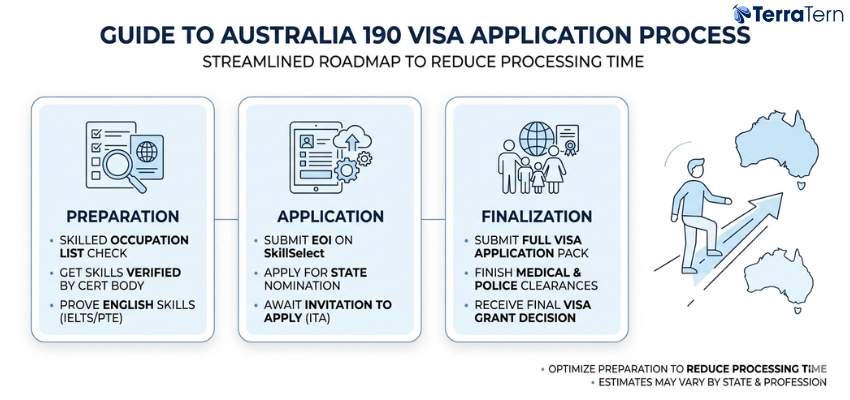
Need to know how to reduce your Australia 190 visa processing time? Here’s a simple step-by-step roadmap:
-
Check the skilled occupation list to see whether your profession is listed
-
Go and get the skills verified by the recognised certification body
-
Prove your English language skills by scoring the required level in IELTS, PTE, and so on
-
Register your interest by completing the Expression of Interest (EOI) on SkillSelect
-
Apply for nomination in the state or territory of your choice
-
Commence waiting for your Invitation to Apply (ITA)
-
Present your full visa application pack to the immigration authorities
-
Ensure you’ve finished the medical examination and provided the police clearance certificates
-
Expect the final decision or your visa grant letter to be given
Be careful in each aspect of the process. Any step omission will lead to delays or visa denial.
Also Read: Skilled Labour Visa Australia: Latest Process, Jobs, Fees
What Documents Are Needed for a Decision-Ready 190 Visa Application?
A decision-ready 190 application consists of your passport, positive skills assessment, evidence of English, certified academic certificates and transcripts, evidence of employment, state nomination approval, 12-month stay police clearance, health-check confirmation and all family member documents uploaded as clear colour PDFs. If you do not submit the necessary documents or if they are not correct, Home Affairs can't finalise your 190 promptly.
-
Identity: Passport bio‑page, Birth certificate, ID card, Marriage certificate/Decree (if applicable), Death certificate (if applicable).
-
Skills: Positive skills assessment letter, Skills required English proof – IELTS/PTE/TOEFL/OET and all NAATI and professional year certificates (if applicable for skill points).
-
Education and work evidence: Degree certificate, employment reference, Transcript, CV, payslips, bank statements or tax records for claimed experience.
-
State nomination form and any visa-specific forms: Approved 190 nomination from your state, completed main visa forms and any ministerial-direction declarations.
-
Health and character documents: Medical Examination confirmation, AFPC or police clearance copy from the state and police clearance from overseas countries that you have lived in for 12 months or more.
-
Family member documents (if adding dependants): Passports, birth certificates, proof of relationship and any skills and/or English records – if scoring points.
When Should 190 Visa Applicants Seek Professional Help for Processing Delays?

If you are a 190 visa applicant, you may want to look for professional assistance with visa processing delays when:
-
You are waiting significantly longer than the published median waiting time, e.g. 10 months for 190 (Further Assessment) or Request for Information.
-
Home Affairs is giving you complicated or ambiguous Requests for Information (RFI), S56 or additional requirements, and you are not sure what to do without getting it wrong.
-
Your health check/ police clearance has been delayed or refused, and you require clear guidance on how to resolve the problem.
-
You have a complicated case (gap-filled work history, many countries lived, criminal history concerns, health concerns, etc.), which you think you would not be able to present yourself confidently.
-
You are nearing a nomination or visa expiry (e.g., 190 invitation expiry or state‑nomination expiry) and wish to see if your case can be fast-tracked or protected by an agent.
-
You realise there are mistakes or inconsistencies in your initial application and are not certain if and how you should correct them, and avoid a fresh delay.
-
You are stressed, confused or out of control and want someone to communicate effectively and take follow-ups on your behalf, who is registered with the Migration Agents Registration Authority (MARA).
Key Note: If your application has exceeded the published 90% processing timeframe with no communication from DoHA, it's no longer a "normal wait" — this is the threshold at which professional intervention becomes genuinely valuable.
2026 INDUSTRY CONTEXT SECTION
Latest Statistics (2025–2026):
-
As of April 2026, Subclass 190 processing times have improved from 25 months to 16 months compared to February 2026 figures.
-
FOI data (January 2026) shows 1,596 primary applicants received 190 visa grants in a single month, with only 22 refusals.
Industry Developments (2026 Trends):
-
Australia's 200,000+ annual migration program continues to drive high 190 application volumes, keeping backlogs active.
-
Processing is increasingly case-by-case, with two applications lodged on the same day finishing months apart.
Expert Insight:
"A professionally managed 190 visa application is often a faster application. Robust documentation and strategic RFI responses make a real difference," Navneet Kaur, MARN 1801703, Leading Edge Migration.
Conclusion
Australia Subclass 190 Skilled Nominated visa continues to be one of the important permanent residence visa categories for skilled visa holders sponsored by state nomination, and, in 2025-2026, processing times have settled at approximately 8-10 months for many applicants, depending on the quality of documents, health/character assessment and backlog levels. Priority sector assignments, such as healthcare, teaching, and ministerially directed assignments, typically receive quicker resolution; cases that lack all documentation, police clearance, or that involve complicated circumstances tend to be in the long tail of resolution. Overall, a well‑prepared, decision‑ready application lodged early in the migration year, combined with prompt responses to requests, gives Indian and other applicants the best chance of landing within or close to the current median band, instead of deep in the outer range.
Contact TerraTern to get assistance and help reduce your Australia 190 visa processing time!


 AI Summary