

Key Highlights
- How Can You Apply For Jobs In Germany?
- How Do You Apply for Jobs in Germany From India Specifically?
- What Is the Best Time to Apply for Jobs in Germany?
- How Can You Apply for a Job in Germany Online?
- What Should Your CV and Cover Letter Look Like for German Employers?
- Which Application Channels Work Best for Foreign Applicants?
- What is the Latest Market Update on Jobs in Germany?
If you plan to apply for jobs in Germany, success comes down to combining the right channels with the right documents at the right time not just submitting applications everywhere. Most of the articles about how to apply for a job in Germany only mention online job boards, but there's much more. You have to know how to format your CV in PDF for ATS and create a great CV profile on StepStone, Indeed, and LinkedIn in order to apply for a job in Germany online.
It's equally important to know when to apply for jobs in Germany, which is in January - March and September October when there is maximum hiring activity and minimum competition from other job seekers.
How Can You Apply For Jobs In Germany?
Getting a job in Germany requires knowing how the recruitment process is structured and using the platforms appropriately. The German job market follows specific protocols, and the differences between other international job markets are notable; therefore, proper preparation is necessary to ensure success.
Apply for jobs in Germany via recruitment agencies, company applications and job portals, and use a German-style CV and cover letter.
-
Do Research: Find the sectors lacking in the market and aim for companies that are in need of staff before applying for employment in Germany.
-
Create Documents: Create a CV (Lebenslauf) in accordance with German standards and a cover letter for the job.
-
Search Multiple Channels at Once: This is the core of how to apply for jobs in Germany effectively don't rely on one portal
-
Tailor Every Application: Generic submissions are easy for German recruiters to spot and reject
-
Prepare for Remote Interviews: Most first rounds for foreign candidates happen via video call
-
Move to Visa Steps: Once an offer is secured, the best time to apply for jobs in Germany becomes less relevant than acting quickly on the visa process
-
Consider the Online-first Standard: Nearly every step to apply for job in Germany online now happens digitally, from PDF submission to e-signature contracts
Important Tip: Treat the job search and the visa process as two parallel tracks, not strictly sequential ones; understanding your visa options early (Job Seeker Visa vs. Opportunity Card) shapes how and when you should start applying.
Also Read: Top Job Opportunities in Germany: Experts Insights
How Do You Apply for Jobs in Germany From India Specifically?
The principles for applying for jobs in Germany from India are the same for any overseas candidats but there are a few nuances to be kept in mind for document recognition, working from a remote interview to the visa application process and post-offer visa applications.
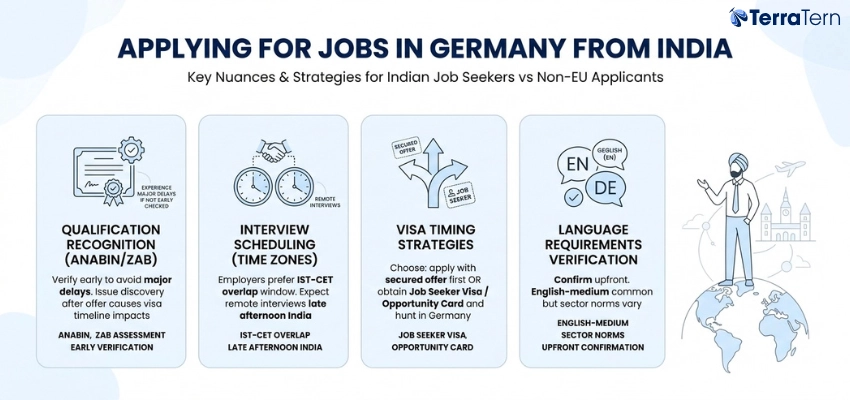
- Obtain Qualifications' Recognition Status Early: For regulated occupations: check recognition with Anabin database, or obtain a ZAB assessment.
-
Consult with Time Zones: If the employer in Germany is interviewing the Indian candidate, it's common practice that they schedule their times in the IST-CET overlap (a bit late in the afternoon in India).
-
Choose between the Visa Timing Strategy: Apply for jobs in Germany while having an offer secured or apply under the Job Seeker Visa/Opportunity Card and conduct your job search while you are in Germany.
-
Understand this is Central to How to Apply for Jobs in Germany from India: their job-search process and visa proceedings are a sequence vastly different from someone coming from the EU.
-
Verify Language Requirements Upfront: Many roles list English-medium eligibility, but sector norms vary widely
Expert Tip: Get your qualifications checked against Germany's Anabin database or via a ZAB assessment early;y discovering a recognition issue after receiving a job offer can significantly delay your visa timeline.
What Is the Best Time to Apply for Jobs in Germany?
The best time to apply for jobs in Germany is best done in January-March as well as after summer holidays (September-October) when the hiring process re-starts after the implementation of the annual budgets.
-
The best time to apply for jobs in Germany aligns closely with fiscal and cultural hiring cycles, not just general market demand
-
Shortage-occupation sectors IT, healthcare, and engineering, hire more consistently year-round, so this timing matters less if you're in one of them
-
Applying just before a strong window (e.g., early January or late August) can put your application at the top of a fresh review cycle
Expert Advice: If you have flexibility in your timeline, avoid submitting your strongest applications in late July or August; even a great application can sit unreviewed until German offices are back at full staffing in September.
How Can You Apply for a Job in Germany Online?
Applying for a job in Germany online generally involves creating profiles on portals like StepStone, Indeed, and LinkedIn, submitting PDF applications with a German-style CV and cover letter, and increasingly completing initial screening through ATS-compliant formatting.
-
Build Complete Portal Profiles First: Set up detailed profiles on StepStone, Indeed, and LinkedIn before you apply for jobs in Germany. Incomplete profiles are often filtered out before a human ever reviews them
-
Submit a Single, Well-formatted PDF: Combine your CV and cover letter into one document, since this remains the expected standard when you apply for job in Germany online
-
Format for ATS Compatibility: Use clear section headings, standard fonts, and avoid complex tables, graphics, or columns that applicant tracking systems can misread
-
Apply Directly through Company Career Pages where Possible: Many mid-sized German employers prioritize direct applicants over those sourced through aggregator portals
-
Expect Digital-first Screening: Initial shortlisting increasingly happens through automated keyword and formatting checks before a recruiter reads the application manually
-
Keep File Naming and Sizes Clean: Simple, professional file names and reasonable PDF sizes prevent submission errors on portal upload systems
-
Note the Pace of Change: Online submission standards are becoming more automated each hiring cycle, so formatting discipline matters more than ever
Important Note: Keep your portal profiles (StepStone, LinkedIn, XING) consistently updated alongside your CV; many German recruiters search these platforms directly rather than waiting for applications to come in.
Also Read: How to Apply for Jobs in Germany Online? Updated Process
What Should Your CV and Cover Letter Look Like for German Employers?
German employers expect a detailed, formally structured CV (Lebenslauf) often using the Europass template paired with a genuinely tailored cover letter for each application, rather than a generic international-style resume.
-
Use a Strict Chronological Format: List work history in reverse-chronological order with exact start and end dates; unexplained gaps stand out negatively to German recruiters
-
Include a Professional Photo: Still standard practice in Germany, unlike in the US, UK, or many other markets where photos are actively discouraged
-
Follow the Europass Structure: Many German employers are familiar with this template and expect a similar level of detail and organization
-
Keep a Formal, Factual Tone throughout: Avoid the casual, achievement-headline style common in international resumes; German CVs favor precision over self-promotion
-
Stick to 1–2 Pages: Detailed enough to show depth, but every entry should be directly relevant to the role
-
List Education and Certifications Thoroughly: Include institution names, dates, and qualification levels, since formal credentials carry significant weight
-
Sign and Date the Document: A small but expected formality that signals familiarity with German application norms
-
Write a Genuine, Role-specific Cover Letter: This is where most people who apply for jobs in Germany fall short. Recruiters can spot a templated letter within seconds, and it actively hurts an application more than submitting none at all
-
Match the Cover Letter's Tone to the CV: Formal, specific to the employer, and focused on why you're a fit, not a restated summary of your resume
-
Align Document Language with the Job Posting: German for most traditional roles, English acceptable for international, tech, or startup positions
As per TerraTern Expert: Don't skip the professional photo out of habit from other job markets while optional, a professional headshot is still a normalized and often expected element of a German CV.
Which Application Channels Work Best for Foreign Applicants?
Job portals, direct company applications, recruitment agencies, and professional networking each work differently for foreign applicants, and combining multiple channels consistently outperforms relying on just one when you apply for jobs in Germany.
|
Channel |
Strength |
Best For |
How to use it effectively |
|
Job Portals (StepStone, Indeed, Make it in Germany, LinkedIn Jobs, XING Jobs) |
Broad reach, high visibility; good for market scanning |
Casting a wide net across sectors; understanding demand, titles, and German-level expectations |
Use portals to study 30–50 real vacancies first: note skills, cities, employers, and required German; then apply selectively with tailored CV/cover letter in one PDF. job200+3 |
|
Direct Company Applications (career pages, “Karriere/Stellenangebote”) |
Signals genuine interest; avoids aggregator competition; some roles never hit job boards |
Larger, internationally-minded employers; English-speaking roles filled via talent pools before public posting |
Build a target-company list; monitor career pages; submit spontaneous applications to talent pools where allowed; track separately from portal applications. proforg+3 |
|
Recruitment / Zeitarbeit Agencies (e.g., Robert Half for IT, sector-specific staffing firms) |
Local market knowledge, faster placement; access to contract/temp-to-perm pipelines |
Healthcare, IT, engineering, logistics; roles where speed and local compliance matter |
Identify 3–5 reputable agencies in your field; send a German-style CV; clarify visa status and language level upfront; treat Zeitarbeit as a bridge if needed. roberthalf+2 |
|
Networking (LinkedIn, XING, alumni, associations, events) |
Builds direct recruiter/hiring-manager relationships; underused by most international applicants |
Mid-to-senior roles; niche fields; getting referrals that bypass heavy competition |
Optimize profiles in German and English; turn on “Open to Work”; engage with industry posts; message recruiters/hiring managers with a short, role-specific pitch; attend sector events and career fairs. adriaveza+2 |
Pro Tip: Don't underestimate networking; many roles, especially at mid-sized German companies (the Mittelstand), are filled partly through referrals and professional connections before ever appearing on a job portal.
Also Read: MBA Jobs in Germany: Jobs, Salaries, Scope & More in 2026
What is the Latest Market Update on Jobs in Germany?
Germany's skilled worker shortage remains substantial in 2026, with the Make It in Germany portal alone listing over 1.3 million vacancies, particularly in IT, healthcare, and engineering
-
Application processes are now almost entirely digitized; PDF submissions through portals and career pages have replaced traditional postal applications
-
German employers continue to favor structured, detailed documents; a properly formatted CV consistently outperforms international-style resumes in early screening, which is central to understanding how to apply for jobs in Germany successfully
-
Multiple visa pathways now support job searching before or after an offer, including the Job Seeker Visa (6 months to search, no work permitted) and the Opportunity Card (search while already in Germany)
-
Networking via XING, still dominant in German-speaking markets alongside LinkedIn, meaningfully improves response rates for foreign candidates
-
English-medium roles remain concentrated in tech, startups, and multinationals, while most other sectors still expect at least basic German proficiency
-
Experienced applicants recommend fewer, better-tailored applications over mass-applying, since German employers can distinguish generic submissions almost immediately
Key Note: Don't spread yourself across dozens of generic applications a smaller number of carefully tailored applications, each with a genuinely customized cover letter, consistently performs better with German employers than high-volume, templated submissions.
Also Read: Job Vacancies in Germany for Indians: Latest Experts Guide
Conclusion
Successfully applying for jobs in Germany comes down to combining the right channels, presenting a genuinely German-standard application, and timing. Understanding how to apply for jobs in Germany starts with recognizing that no single channel works alone: job portals, direct company applications, and recruitment agencies each surface different opportunities, and candidates who use all three consistently outperform those who rely on just one.
Documentation matters just as much as strategy a detailed, formally structured German-style CV paired with a genuinely tailored cover letter will always outperform a generic international application, regardless of how strong the candidate's background is. Whether you choose to apply for job in Germany online through a portal profile or a direct company career page, the underlying formatting and ATS-compliance expectations remain the same.
Connect with TerraTern to get help on your job search directly to the right visa pathway, so the momentum you've built doesn't stall at the paperwork stage!




 AI Summary