


Key Highlights
- What Is the UK Visa Success Rate for Indian Applicants in 2026?
- How Does the UK Visa Success Rate Vary by Visa Category?
- Why Did the UK Visa Success Rate for India Change in 2026?
- What Factors Determine Your UK Visa Success Rate?
- What Are the Most Common Reasons for UK Visa Refusal Among Indian Applicants?
- How Can You Improve Your UK Visa Success Rate From India?
- How Does India's UK Visa Success Rate Compare to Other Countries?
- What Should You Do If Your UK Visa Application Is Refused?
- How Can TerraTern Help Improve Your UK Visa Success Rate?
- 2026 Industry Context Section
- Conclusion
The UK visa success rate from India in 2026 is favourable, although it may differ depending on the type of visa you apply for, with greater chances of approval for student visas than visitor visas. When Indian applicants submit complete, well-prepared files with correct fees and clear travel intentions, their chances of UK visa approval improve significantly. As a result, for Indians, the success rate of getting a UK visitor visa is around 81.89%, and the success rate for a student visa is around 96%, based on recent 2026 data.
What Is the UK Visa Success Rate for Indian Applicants in 2026?

The first-time UK visa success rate for Indian citizens has been reported as significantly different across visa categories, with about 82% of people being granted visas for tourism or other visitor visa categories; 96% for students; 92% for Skilled Worker visa categories; and 92% for spouse/partner visa categories, according to the Home Office data for the past 12 months, up to March 2026.
|
Visa Category (India) |
Grant Rate |
Applications (YE Mar 2026) |
YoY Change |
|
Visitor / Tourist |
81.89% |
648,802 |
Down from ~91% |
|
Sponsored Study |
96.16% |
96,079 |
Broadly stable |
|
Worker (Skilled Worker) |
92.26% |
46,259 |
Up 4 points |
|
Family: Partner (Spouse) |
~92% (national avg.) |
— |
Stable |
As per TerraTern Expert Divyansh, Don't quote a single "UK visa success rate for India"; the category you're applying under changes your odds by more than 14 percentage points, so always specify the route before comparing numbers.
What Is the UK Visitor Visa Success Rate for Indians?
The visitor (tourist) visa grant rate for Indian nationals has decreased to 81.89% for YE 2026, down from around 91% in the previous year, while the visa refusal rate has been 18.11% across 648,802 applications filed by Indian nationals within a year.
-
Grant rate: 81.89%, refusal rate: 18.11% (YE March 2026)
-
A significant drop from ~91% year on year due to the work carried out by the Home Office to examine financial documentation, travel history and links with India.
-
A drop of about 11 percentage points in the grant rate is significant: in the year ending March 2026, around 119,850 Indian visitor visa applications were refused, which represents 18.11% of all Indian visitor applications. This is an annual figure, not a weekly number, and highlights how many applicants are affected when financial or credibility evidence is weak.
-
Indian nationals are unable to apply for the Electronic Travel Authorisation (ETA) in the UK and must still obtain a Standard Visitor visa.
-
It therefore makes the UK visa success rate for visitor visas the most dynamic among all the major categories and the most tied to the quality of the visa application.
Important Note: If you're applying on the visitor route from India, treat the "genuine visitor test" as the single biggest hurdle in 2026; strong, consistent financial and travel-history evidence matters more than it did two years ago.
What Is the UK Student Visa Success Rate for Indians?
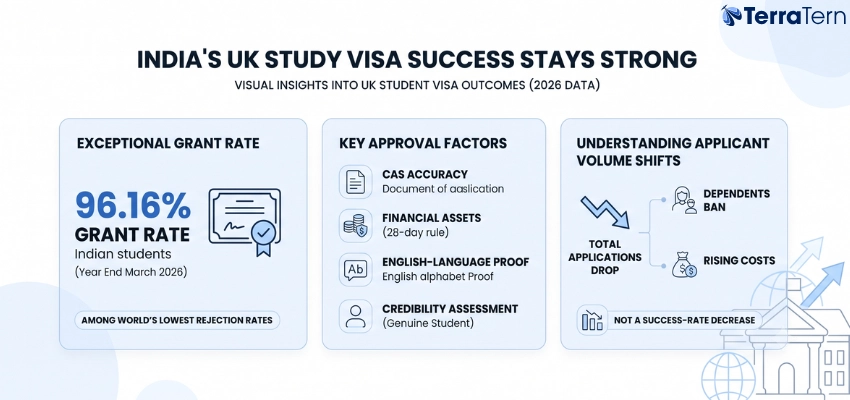
The study visa rejection rate for Indian nationals has consistently remained low, with the UK having one of the lowest rejection rates (3.84%) among major countries of origin during the same period (Year End March 2026).
-
The 96.16% grant rate corresponds to a very low 3.84% rejection rate for Indian students, which ranks among the strongest outcomes for major source countries, ranking among the strongest 1% of all rejection rates for major source countries.
-
The main contributing factors for approval include CAS accuracy, evidence of maintaining financial assets under the 28-day rule, English-language proof, the credibility assessment, and Genuine Student.
-
The decline in the number of student visas processed is mainly due to the dependents ban and rising costs; it reflects a drop in total applications, not a decrease in approval rates. Some competitor pages confuse volume changes with success-rate changes, which is misleading.
-
With overall visa application figures changing, India's success rate in securing UK visas for study remains among the best in the world.
-
India's UK visa success rate for study remains one of the strongest globally, even as total applicant numbers shift
Expert Tip: India's student visa grant rate is nearly 100 points above its visitor visa rate for the same nationality, proof that eligibility-based routes with objective criteria (CAS, funds, English score) are far more predictable than discretionary ones.
What Is the UK Work Visa Success Rate for Indians?
Despite the increase in the salary requirement, the grant rate for UK work visas for Indian nationals increased by 4 percentage points to 92.26% for the year ending March 2026.
-
The grant rate was up 4 points year-on-year to 92.26%.
-
Overall application volume has fallen since the £41,700 Skilled Worker salary threshold took effect on 8 January 2026, but the quality of applications has improved as sponsors filter out weaker cases before submission.
-
Some weaker cases have been pre-filtered by tighter sponsor-licence audits before being submitted to UKVI for approval, thereby raising the success rate for genuine applicants.
-
The success rate for genuine applicants has improved by filtering out weaker cases before they reach UKVI, thanks to tighter sponsor licence audits.
-
Further, India continues to be the top origin of the Worker visa applications to the UK.
-
The upward trend here shows the success rate for work routes, rewarding preparation even as eligibility bars rise
Expert Advice: The Skilled Worker route's rising approval rate is a selection effect, not an easier process. Fewer, better-qualified applicants are applying since the salary floor rose, so a genuinely eligible applicant's odds are stronger than the headline suggests.
What Is the UK Spouse and Family Visa Success Rate for Indians?
These spouse and partner visa statistics are drawn from national-level Home Office data for the year ending March 2026.
-
The Family Partner (spouse) visa category saw an 11% decline in total applications between May 2025 and May 2026, with the national grant rate at about 92.38%, largely due to the new minimum income threshold of £29,000.
-
National grant rate (up-rated same): 92.38% (17% decline in volume due to the addition of a minimum income threshold of £29,000).
-
Approval depends on two factors: the needs test and the relationship evidence.
-
Most spouse-visa refusals carry full appeal rights on Article 8 (family and private life) grounds, unlike many other visa categories where applicants usually have only Administrative Review rights. This broader appeal route is one reason family visas often have higher overall success rates over time.
-
This appeal route is one of the many drivers behind the visa success rate being generally higher for family visas than for other visa categories at first decision, although this success partly depends on the success rates for study and work visas.
Important Tip: If you're near the £29,000 income line, strengthening the financial evidence, not the relationship evidence, is usually the higher-leverage fix, since income-threshold refusals are the most common single cause on this route.
Also Read: UK Visitor Visa Fees Checklist for India Students & Fees
How Does the UK Visa Success Rate Vary by Visa Category?
The UK visa success rate varies widely by route, from very high approval rates on business, talent, and study categories to much lower outcomes on visitor and EU Settlement routes. Across all nationalities, the year-ending March 2026 Home Office data shows the strongest approval for
|
Visa Category |
Grant Rate |
Notes |
|
BN(O) |
98% |
Very high approval rate |
|
Investor / Business / Talent |
98% |
Very high approval rate |
|
Sponsored Study |
96% |
Strong approval rate |
|
Temporary Worker |
93% |
High approval rate |
|
Family/Partner |
92% |
High approval rate |
|
Work total |
92% |
High overall approval rate |
|
Skilled Worker |
92% |
Strong approval rate |
|
Visitor |
79% |
More selective route |
|
Ukraine schemes |
77% |
Lower than work/study routes |
|
Family/Child |
75% |
Moderate approval rate |
|
EU Settlement Scheme |
38% |
Lowest among listed categories |
As per TerraTern Expert: Category matters more than nationality in most cases; a genuinely eligible Indian Skilled Worker applicant (92%) has a meaningfully better shot than a borderline visitor applicant from any country, India included.
Why Did the UK Visa Success Rate for India Change in 2026?
UK visa success rates fell by about 9 percentage points year-on-year, mainly due to tougher scrutiny of financial documents, travel history, and ties to India. The underlying immigration rules did not materially change, so the shift is better understood as a change in the intensity of assessment rather than a new legal standard.
-
Visitor visas were affected most, not student or work routes.
-
Student and Skilled Worker outcomes stayed stable or improved.
-
The change reflects the quality of case assessment, not a blanket policy against Indian applicants.
-
Applicants in 2026 need clearer evidence and stronger consistency across all documents.
Pro Tip: Don't read the visitor visa dip as "the UK is rejecting more Indians"; read it as "the UK is asking Indian visitor applicants for stronger proof," which is a solvable documentation problem, not a closed door.
What Factors Determine Your UK Visa Success Rate?
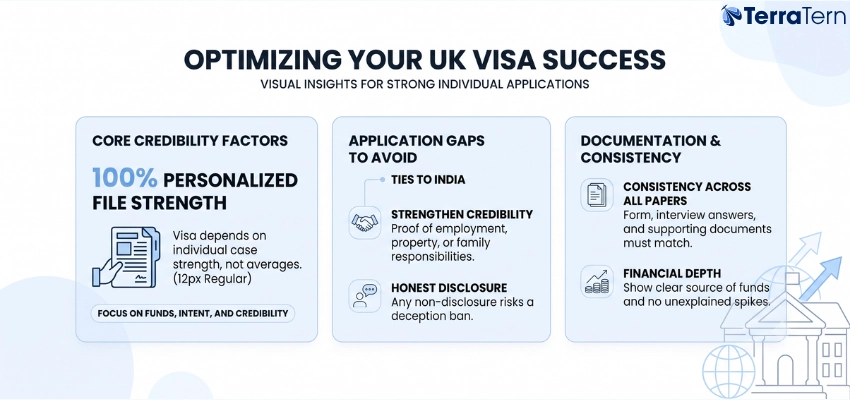
Your UK visa success rate depends less on country-level averages and more on how well your file proves funds, intent, and credibility. Strong applications usually fail only when there are avoidable gaps, inconsistencies, or missing route-specific evidence.
-
Financial evidence depth matters most: Show at least 6 months of bank statements where required, with a clear source of funds and no unexplained spikes.
-
Ties to India strengthen credibility: Employment, property, family responsibilities, or ongoing studies help show you will return.
-
Consistency across all documents is crucial: Your form, interview answers, and supporting papers must match exactly.
-
Honest disclosure protects your case: Any non-disclosure can trigger refusal and, in serious cases, a long deception ban under the rules.
-
Meet the route-specific threshold: Salary, income, CAS, and English score requirements must be satisfied exactly for the visa type you choose.
Key Note: Aggregate success rates tell you the base rate for your category; your actual odds move up or down from there based almost entirely on documentation quality, which is the one variable fully within your control.
What Are the Most Common Reasons for UK Visa Refusal Among Indian Applicants?
The most common reasons for refusal are usually documentation and credibility issues, not nationality itself.
-
Visitor Route: Insufficient or unclear funds. Fix: Show clean, traceable bank statements and explain any large deposits.
-
Visitor Route: Weak travel purpose or weak ties to India. Fix: Provide proof of itinerary, accommodation, job, family, or property.
-
Student Route: CAS or financial evidence problems. Fix: Match every detail with your offer letter and maintenance funds.
-
Work Route: Salary, CoS, or sponsor issues. Fix: Verify role, pay, and sponsorship details before filing.
-
Family Route: Missing evidence of relationship or income. Fix: Include strong proof of relationship, income, and living arrangements.
-
All Routes: Non-disclosure of past refusals or immigration history. Fix: Declare everything honestly and consistently.
Important Note: Roughly 40% of visitor visa refusals in this market stem from financial evidence issues alone; reviewing your bank statement history before submission can catch the single biggest risk factor.
How Can You Improve Your UK Visa Success Rate From India?
You can improve your UK visa success rate by making your file complete, consistent, and route-specific. The strongest applications usually succeed because they answer every question clearly and avoid preventable errors.
-
Financial Evidence: Show 6+ months of consistent statements, with a clear source for every major deposit.
-
Ties to India: Add employer letters, property documents, family records, or proof of studies demonstrating your intent to return.
-
Visitor Route: Include itinerary, hotel bookings, return plan, and a clear explanation of your trip.
-
Student Route: Ensure CAS, funds, and English proof all match exactly.
-
Work Route: Check salary, CoS, and job title details before submitting.
-
Family Route: Provide evidence of relationship, proof of income, and any required cohabitation documents.
-
Consistency: Keep your form, documents, and interview answers fully aligned.
-
Disclosure: Mention all refusals, visa history, and travel history honestly.
-
Timing: Apply early so you have time to address any gaps in the documents.
-
Review: Have a professional or experienced adviser check the file before submission.
Expert Tip: The single highest-leverage improvement is starting your financial documentation 3–6 months before you apply, not the week before. Most preventable refusals trace back to rushed, inconsistent bank records.
How Does India's UK Visa Success Rate Compare to Other Countries?
India’s UK visitor visa grant rate of 81.89% sits in the middle of the global range for the year ending March 2026. It is stronger than several South Asian source countries, but weaker than countries such as South Africa, China, and Ukraine. This is why route type matters more than nationality alone when judging the visa success rate
|
Country |
Visitor Visa Grant Rate |
Refusal Rate |
|
South Africa |
96.10% |
3.90% |
|
Ukraine |
93.28% |
6.72% |
|
China |
91.82% |
8.18% |
|
India |
81.89% |
18.11% |
|
Sri Lanka |
71.17% |
28.83% |
|
Pakistan |
55.12% |
44.88% |
|
Bangladesh |
45.93% |
54.07% |
Important Note: India's global position looks less favourable on the visitor route alone, but zoom out to student and work visas, and India is a top-tier performer, so route selection genuinely changes the comparison.
What Should You Do If Your UK Visa Application Is Refused?
If your UK visa is refused, you can usually reapply immediately, ask for an Administrative Review where allowed, or appeal spouse-visa refusals through the Tribunal. The visa success rate improves most when you fix the exact refusal reason before submitting again.
-
Reapply Anytime: There is no mandatory waiting period, but the new application must correct the original problem.
-
Administrative Review: Available only for some routes, usually when the refusal is due to a caseworker error.
-
Visitor Visas: No Administrative Review right; your options are usually to reapply or, in rare cases, seek judicial review.
-
Skilled Worker Reviews: Often succeed when the refusal involved calculation or procedural mistakes.
-
Student Reviews: These can work, but success is lower than with work-route reviews.
-
Spouse Visas: Many refusals can be appealed to the Tribunal, especially on relationship or Article 8 grounds.
-
Be honest: Always disclose the previous refusal in any new application.
-
Fix the Cause: Do not resend the same file; address the exact gap in funds, documents, credibility, or eligibility.
Pro Tip: Reapplying with the same documents that got you refused rarely works; a second application should specifically and visibly address the stated grounds for refusal, not just resubmit a slightly updated file.
How Can TerraTern Help Improve Your UK Visa Success Rate?
TerraTern can help Indian applicants improve their UK visa success rate by reviewing documents, organising financial evidence, and matching the file to the right visa route. The goal is to reduce the risk of preventable refusal before the application is submitted.
-
Visitor Visas: Help with itinerary, funds, ties to India, and travel purpose documentation.
-
Student Visas: Support with CAS checks, funds, English evidence, and statement consistency.
-
Work Visas: Help verify salary, sponsor details, and the accuracy of the CoS.
-
Family Visas: Support with relationship proof, income evidence, and supporting documents.
-
Refusal Fixes: Review past refusal reasons and rebuild the case before reapplying.
-
Route Guidance: Match the evidence to the specific visa category instead of using a generic checklist.
Key Note: The applicants with the strongest outcomes are typically those who get their financial and ties documentation reviewed before submission, not after a first refusal.
2026 Industry Context Section
Here are some of the facts:
-
Latest Statistic: The UK granted 3,040,475 entry clearance visas in the year ending March 2026 (from 3,666,088 applications), an overall 81.83% grant rate, per Home Office Immigration System Statistics published 21 May 2026.
-
India Visitor Visa Shift: The grant rate for Indian visitor visa applicants fell from ~91% to 81.89% year-on-year, with the refusal rate roughly doubling to 18.11% — the single largest print-worthy trend in this market.
-
India Student/Work Visas Remain Strong: 96.16% grant rate on sponsored study (96,079 applications) and 92.26% on Worker visas (46,259 applications, up 4 percentage points).
-
Policy Driver, Not Blanket Refusal Driver: Volume declines in Worker (-30%) and Family Partner (-17%) routes are linked to threshold changes (£41,700 Skilled Worker salary floor from 8 January 2026; £29,000 family income floor), not stricter individual refusals. India is among the largest source countries globally for UK visitor, student and work visa applications.
-
Expert insight (quotable): Industry commentary attributes the decline in visitor visas to intensified Home Office scrutiny of financial documentation, travel history, and economic ties among Indian applicants, not to a change in the underlying rules.
-
Trend Pattern: Category-level grant rates have remained stable or improved (student, work) even as overall visitor volume has grown, indicating that eligibility-based routes are more predictable than the discretionary genuine-visitor assessment.
Expert Advice: The 2026 headline number to lead with in conversation or content is the India visitor visa decline (91% → ~82%); it is the most newsworthy, specific, and citable data point in this space right now.
Conclusion
In 2026, the UK visa success rate for Indian applicants remains strong overall, especially for student, work, and family routes, but visitor visas stay more selective. Your chances depend far more on document quality, financial proof, consistency, and honest disclosure than on nationality alone. If you prepare a clean, route-specific file and address refusal risks early, your approval odds can improve significantly.
Contact TerraTern for more information on UK Visa Success Rate 2026: What Are Your Chances From India.




 AI Summary