

Key Highlights
- What is the Subclass 771 Visa in Australia?
- Who Needs a Subclass 771 Transit Visa From India?
- How Do You Apply for the Subclass 771 Visa in Australia?
- What Documents Do You Need for the Australia Transit Visa?
- How Much Does the Subclass 771 Visa Australia Cost?
- How Long Does the Subclass 771 Visa Processing Time Take?
- How Long Can You Stay in Australia on a Transit Visa?
- Subclass 771 vs Visitor Visa 600: Which Do You Need for Your Layover?
- Can Maritime Crew Use the Subclass 771 Transit Visa?
- What Common Mistakes Cause Subclass 771 Visa Rejections?
- 2026 Industry Context Section
- Conclusion
The subclass 771 visa for Australia is what you need as your important travel document. It is a free visa that allows you to stay in Australia for up to 72 hours while transiting to another country, or up to 5 days if you are a maritime crew member joining a non‑military ship and you hold a valid Maritime Crew Visa. The visa is strictly for transit, not tourism; it legally allows you to enter the country until you board your next flight. In our 2026 guide, we have everything you need about processing times (ranging from 10 to 19 days), eligibility criteria, and how to apply online.
What is the Subclass 771 Visa in Australia?

The subclass 771 visa australia is a free and temporary travel visa that allows travellers to remain in Australia for up to 72 hours while transiting to another destination country. This visa has been verified through the Australian government department of Home Affairs and is prepared by the experts at TerraTern on migration:
-
Dual Use Cases: Intended either for ordinary air transit or travel to board a ship as a crew member, other than as a military crew member (see section on maritime below).
-
Not a Tourist Visa: It does not entitle travellers to conduct any business or leisure activities, but allows them to leave the airport area during their stay.
-
Completely Electronic: The visa will be attached to your passport electronically, without any physical stamp.
Pro Tip: Don’t confuse ‘free’ with ‘optional’; if you do not already hold another valid Australian visa, the Subclass 771 transit visa is effectively mandatory for Indian passport holders whenever they transit Australia.
Also Read: Australia Transit Visa Processing Time: Complete Guide
Who Needs a Subclass 771 Transit Visa From India?
Most Indians travelling on an ordinary passport must obtain the Subclass 771 transit visa unless they already hold another valid Australian visa that covers their transit. This means that even if your layover is under 8 hours and you stay in the international transit lounge, Indian ordinary‑passport holders still need a Subclass 771 transit visa because India is not eligible for Transit Without Visa (TWOV).
What Is Transit Without Visa (TWOV)?
Transit Without Visa (TWOV) lets certain nationalities transit Australia for up to 8 hours without a visa, provided they stay in the airport transit lounge, do not clear immigration or collect baggage, and have a confirmed onward flight within that 8‑hour window. However, Indians need to hold a subclass 771 visa in Australia because:
-
Exclusion: Indians with ordinary passports cannot take advantage of TWOV according to Home Affairs.
-
Exception: Indian diplomats/officials travelling with their passports do not require transit visas.
Key Note: If you're Googling "do I need a transit visa for a 6-hour Australia layover," the answer for an Indian passport is yes; TWOV doesn't apply to you.
Do You Need It If You Never Leave the Airport?
Yes. The airline would not board travellers with no valid subclass 771 visa for Australia, even if they never leave the airport premises. Standard Indian passport holders need the subclass 771 visa for Australia for all airport layovers.
How Do You Apply for the Subclass 771 Visa in Australia?
You make your application online through an ImmiAccount before leaving India; note that there is no such thing as a visa-on-arrival and that most applicants do not have a face-to-face requirement. The entire process to obtain the subclass 771 visa in Australia is entirely virtual.
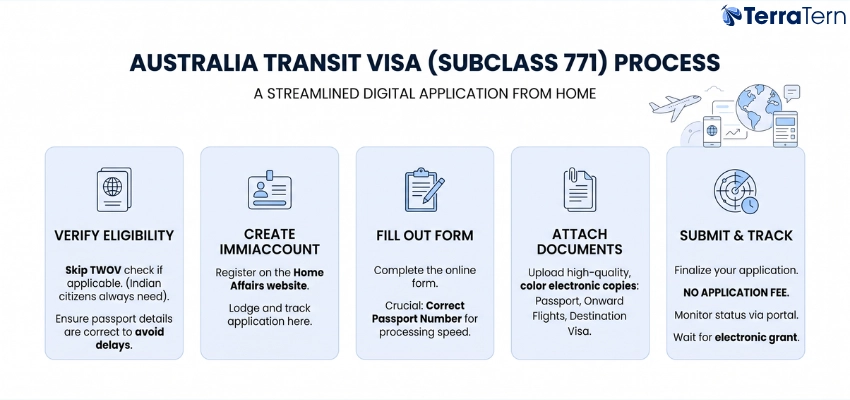
Securing your transit visa for Australia is designed to be a straightforward digital process that can be completed from home.
-
Make Sure you Actually Need the 771: Exclude TWOV eligibility at the beginning. Even though Indian citizens always require a visa, verifying eligibility eliminates unnecessary documentation for dual citizens.
-
Make an ImmiAccount: Register on the Department of Home Affairs website. It is the place where your ImmiAccount visa application is lodged and tracked.
-
Fill out the Application: Complete the online form (Form 876 for offline applicants). Make sure you provide the correct passport number; typos are the most common reason for delays.
-
Attach Documentation: Attach the electronic copies (high-quality, in colour) of your passport, onward flights, and destination visa. Ineligible documents automatically delay your process.
-
Finish the Application: Complete your application process. Note that no fee is required for the visa application.
-
Track your Process and Wait: Track your application through the portal and wait for your electronic grant of the visa.
As per TerraTern Expert: Apply at least 4–6 weeks before travel; with processing estimates ranging from days to several weeks depending on volume, early lodgment is the only lever you fully control.
What Documents Do You Need for the Australia Transit Visa?
You will need a passport valid for at least six months, a recent passport photo, tickets showing you will leave Australia within 72 hours, and a visa for your final destination country if required. The preparation of the right documents is very crucial, as this is a crucial part of the subclass 771 visa in Australia.
-
Valid Passport: It must be valid for at least six months, along with some blank pages.
-
Passport Photo: Only one picture is needed.
-
Proof of Onward Travel: This document should prove that you will leave Australia within 72 hours.
-
Airline: Ticket bookings are acceptable evidence.
-
Destination Visa: This should be a valid visa or an entry permit for the country where you will make your final destination.
-
Proof of Financial Resources: Your bank statement showing you have enough funds to sustain yourself on the way.
-
Travel/ Health Insurance: Although it is highly recommended that you purchase an insurance plan, it is not a compulsory condition.
-
Maritime Crew Letters: These letters must be submitted by seafarers who intend to join a non-military ship.
Important Note: The single most common documentation error is an unclear or incorrectly sized scanned photo; check specs before uploading, not after rejection.
How Much Does the Subclass 771 Visa Australia Cost?
The subclass 771 visa in Australia has no government visa application charge; it is completely free to lodge. However, applicants should budget for VFS Global biometric or service fees, document translations, and optional travel insurance. While many sources highlight the free application and gloss over the hidden expenses of transit, it is important to be realistic about the ancillary costs you might incur outside the Department of Home Affairs:
-
Government Application Fee: $0 (Free).
-
Biometrics Collection: If the department requests biometrics, you will need to pay a standard service fee directly to the local VFS Global centre for fingerprinting and photography.
-
Document Translation: Any supporting documents not written in English must be translated by an accredited professional, which comes at a cost.
-
Health and Character Checks: Complex applications might require police clearances or panel physician medical exams, bearing out-of-pocket expenses.
-
Travel Insurance: While entirely optional, purchasing a short-term policy is a smart investment that adds a small amount to your overall trip budget.
Expert Tip: "Free" refers only to the government fee; factor in biometric/service charges so there are no surprises at the VFS appointment.
How Long Does the Subclass 771 Visa Processing Time Take?
Processing time varies significantly. Many transit applications are decided within 2–14 business days, but some can take up to 17–19 days in busy periods or complex cases. Always check the official Home Affairs processing‑time tool before booking non‑refundable tickets. Always check the official Home Affairs processing-time tool before booking non-refundable tickets.
While some simple, fully complete cases are finalised in just 4 to 5 business days, it is safest to plan for the standard 10 to 19-day window. Common factors that push applications toward the longer end of the spectrum include:
-
Incomplete Documents: Blurry passport scans, missing onward flight itineraries, or minor typos on your digital application will immediately stall the assessment.
-
Application Volume: Lodging your visa request during peak international travel seasons naturally extends the queue and wait times.
-
Additional Requests: If the department asks you to provide biometrics, health checks, or further character evidence, processing can easily be pushed out to 70 days or more.
Expert Advice: Don't book a same-week connecting flight around visa approval; build in buffer time.
How Long Can You Stay in Australia on a Transit Visa?
You can stay for up to 72 hours for standard air transit, or up to 5 days if you are a maritime crew member joining a non-military ship on the subclass 771 visa in Australia.
-
The Countdown: Your allowed time begins the moment you clear immigration and arrive in Australia, not on the date the visa is granted.
-
No Extensions: The maximum duration is absolute. The visa cannot be extended or converted into another visa type if your flight is delayed.
-
Leaving the Airport: Unlike some transit rules that confine you to the terminal, this visa allows you to exit the airport to sleep in a hotel, grab a meal in the city, or briefly visit family, provided you leave the country within the 72-hour window.
Important Tip: If your realistic layover, including buffer for delays, might exceed 72 hours, apply for a Visitor Visa (600) instead of the 771 from the outset.
Subclass 771 vs Visitor Visa 600: Which Do You Need for Your Layover?
Choose the subclass 771 visa for Australia for layovers under 72 hours with no plans beyond transiting. However, if your stay will exceed 72 hours or you want to actively holiday and explore the country during a longer stopover, you will need a Visitor Visa (subclass 600).
|
Feature |
Subclass 771 Transit |
Visitor Visa (Subclass 600) |
|
Primary Purpose |
Passing through to a third country |
Tourism, seeing family, or business visitor activities |
|
Max Stay |
72 hours (5 days for maritime crew) |
3, 6, or 12 months |
|
Cost |
Free ($0) |
Starts from AUD 195 |
|
Activities Allowed |
Transit, hotel stay, brief sightseeing |
Extensive tourism, study up to 3 months |
|
Processing Time |
10 to 19 business days |
14 to 30+ days |
As per our TerraTern Expert Divyansh, when in doubt about your exact layover length, apply for the 600; overstaying a 771 by even a few hours is a compliance risk the 600 avoids entirely.
Can Maritime Crew Use the Subclass 771 Transit Visa?
Yes, maritime crew joining a non-military ship in Australia can use the subclass 771 visa australia to remain in the country for up to 5 days, which provides more flexibility than the standard 72-hour allowance.
-
Prerequisite Visa: To use this 5-day provision, you must already hold or have concurrently applied for a valid Maritime Crew Visa (subclass 988).
-
Required Documentation: Your application must include your seafarer's identity document and an official letter from the ship's agent or your employer confirming the vessel's name, your arrival date, and the date you will join the crew.
-
Target Audience: This specific use case is vital for commercial seafarers, cruise line staff, and yacht delivery crews who must fly into an Australian airport to begin their sea contracts, giving them adequate time to travel from the airport to their designated seaport.
Pro Tip: Crew changeovers need the shipping company's letter with exact dates and names; missing this is the top rejection cause in this category.
What Common Mistakes Cause Subclass 771 Visa Rejections?
The common mistakes are:
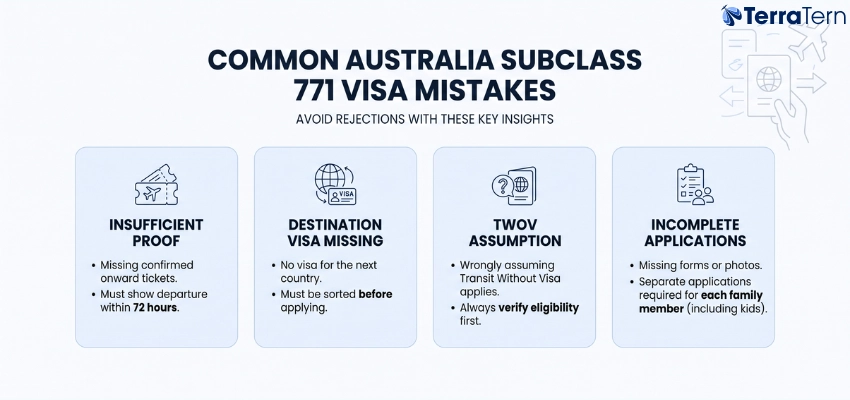
- Insufficient proof of onward travel – no confirmed onward tickets showing you'll leave within 72 hours
- No visa for your final destination – if your next country requires one and you don't have it sorted
- Wrongly assuming TWOV applies – not everyone qualifies for Transit Without Visa; always verify eligibility first
- Incomplete applications – missing photos, form fields, or separate applications for each family member (including kids)
- Character/health issues or undisclosed history – past refusals, cancellations, or criminal history not properly declared
- Inconsistent itinerary or unpaid Australian government debts – mismatched booking details, or outstanding debts not arranged for repayment
Key Note: Cross-check your visa category before submitting; applicants sometimes apply for a Visitor Visa when they only need (and qualify faster for) the free 771, or vice versa.
2026 Industry Context Section
Some of the current facts are:
-
Latest Data Point: Multiple 2026 industry sources (visa-assistance and travel-insurance providers) cite processing of roughly 19 business days for the majority of applications, though official guidance and some agency reports describe faster turnarounds; the range itself is the honest, citable fact.
-
Fee Stability: The Subclass 771 has remained fee-free through 2026 even as several other Australian visitor-category visas have seen fee increases a genuinely differentiating, quotable fact.
-
Expert Insight (Quotable, TerraTern POV): The most common cause of transit disruption for Indian travellers isn't the visa process; it's the false assumption that airport-only layovers don't require one.
-
Regulatory Point: TWOV exemptions for Indian passport holders remain narrow, limited to official/diplomatic passport holders as of this writing; confirm against the official TWOV page before publishing, since eligible-country lists are reviewed periodically.
-
Cost Reality: Although the visa itself is free, applicants should budget for VFS Global biometric/service charges in India and, where relevant, travel insurance. The "zero cost" framing used by most competitors is technically true but incomplete.
-
Route Trend: Layovers through Sydney, Melbourne, and Perth on the way to New Zealand and the Pacific Islands remain a common itinerary shape for Indian travellers. Writer to insert a current, sourced passenger/route statistic here if available rather than an estimated figure.
-
Consequence Trend: Airlines increasingly enforce transit-visa checks at the origin airport (India) before boarding, meaning a missing 771 can mean denied boarding before the traveller ever reaches Australia, not just a problem on landing.
Conclusion
Securing your subclass 771 visa for Australia is the final, crucial step in planning a seamless journey through one of the world's busiest travel hubs. While the application is free and fully digital, processing delays can disrupt even the best-laid plans. To ensure a stress-free layover, verify your TWOV eligibility, gather your required documents, and lodge your ImmiAccount application at least three weeks before departure. Safe travels.
Contact TerraTern for more information on the Subclass 771 Visa Australia: Complete 2026 Transit Guide.




 AI Summary