

Key Highlights
- What Is the Spouse Visa for Germany from India?
- Who Is Eligible for the Spouse Visa for Germany from India?
- What Documents Are Required for the Spouse Visa for Germany from India?
- How to Apply for the Spouse Visa for Germany from India: Step-by-Step
- How Long Does Spouse Visa Processing Take from India?
- What Is the Spouse Visa Fee for Germany from India?
- What Are the Rights and Benefits After Getting the Spouse Visa for Germany?
- What Are the Common Reasons for Spouse Visa Rejection from India?
- How Does the Blue Card Spouse Visa for Germany Work for Indians?
- What Happens After You Arrive in Germany on a Spouse Visa?
- Conclusion
The family reunification visa, also referred to as the spouse visa for Germany from India, allows married or civil partners of German citizens to accompany their spouses to Germany. This national D visa requires evidence of lawful marriage, elementary A1 German language proficiency, the sponsor's financial backing, and housing sufficiency. In 2026, applications from India are processed via VFS Global centres, with processing times of 2-6 months amid stable policies.
What Is the Spouse Visa for Germany from India?
Family Reunion Visa, also known as a spouse visa to Germany or a family reunion visa, the spouse visa for Germany from India is a Germany Type D long-stay visa on the condition of a family reunion with a partner. It provides family reunification and improved access compared to a short-term Schengen tourism visa, which serves as the initial entry visa and then converts to a residence permit on arrival at the local Ausländerbehörde, with address registration. This visa is always required by Indian nationals who do not have any visa exemptions.
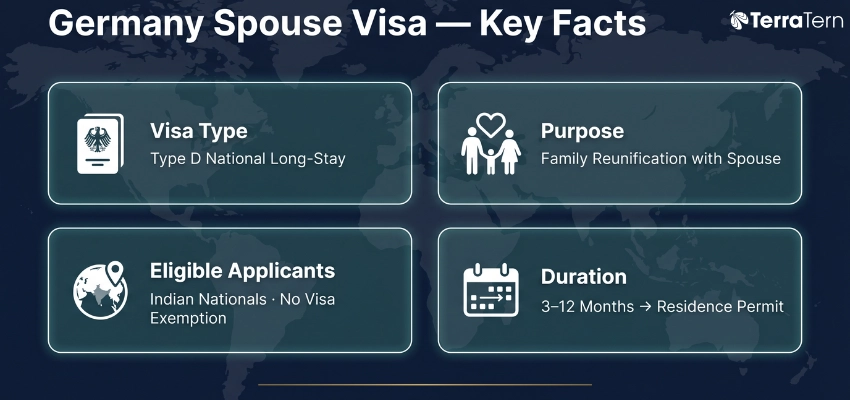
A spouse visa for Germany from India is a national D visa, which, following a two-stage procedure (entry visa, unknown residence title), allows marriage partners with legal status to live and work in Germany and integrate into society.
|
Aspect |
Details |
|
Visa Type |
Type D National (long-stay, 3-12 months) |
|
Purpose |
Family reunification with spouse in Germany |
|
Process |
Apply in India → Enter → Get a residence permit |
|
Applies To |
Spouses of German/EU/EEA citizens or persons with valid permits. |
As per TerraTern Expert, Shreya, Indian nationals cannot enter Germany without a spouse visa first , unlike citizens of the US, Canada, or Australia. Planning at least 6 months ahead is essential due to appointment backlogs at German consulates in India.
Also Read: Family Reunion Visa Germany: Latest Experts Guide
Who Is Eligible for the Spouse Visa for Germany from India?
To qualify for a spouse visa for Germany from India, both partners must be legally married overseas, both must be aged 18 and above, and the sponsor must be a German national, a citizen of an EU/EEA country, or a German permit (such as a work visa, Blue Card). The sponsor will have to demonstrate enough money (generally, 1200 euros net/month and more), coverage (health insurance), and decent accommodation (12m 2 and more per grown-up). Proxy/religious marriages are lawful if recognised.
|
Eligibility Scenario |
Key Conditions |
|
German Citizen Spouse |
Valid marriage; sponsor finances/housing |
|
EU/EEA Resident Spouse |
A sponsor legally residing in Germany |
|
Third-Country Permit Holder |
Sponsor has work/Blue Card/student visa |
|
General Rules |
18+ age; A1 German (exemptions apply); stable marriage proof |
What Are the German Language Requirements for Indian Applicants?
The spouse visa for Germany nationals from India has to show an A1 level of German proficiency to indicate the ability to integrate minimally according to the provision of the AufenthG at Section 30. This includes basic forms of communication, such as greetings and daily living. Testers: Goethe-Institut "Start Deutsch 1," telc "Start Deutsch 1" and ÖSD "Grundstufe Deutsch 1" correspond to ALTE standards.
|
Exemptions for A1 German |
Applies When Sponsor/Applicant... |
|
EU Blue Card Holder |
Sponsor holds EU Blue Card (§18b AufenthG) |
|
Skilled Employment Visa |
Sponsor has §§18a/18b permit |
|
ICT Card |
Sponsor holds an ICT Card |
|
Researcher Status |
Sponsor under §§ 18d/18f AufenthG |
|
Employable Degree |
Applicant has a degree for good German job prospects |
Important Note: If your spouse holds an EU Blue Card in Germany, you are fully exempt from the A1 German language requirement. This is one of the most overlooked privileges that can save months of preparation time.
What Documents Are Required for the Spouse Visa for Germany from India?
All spouse visa for Germany from India out of Indianapolis or out of India start with core documents that guarantee identity, marriage, money and readiness to integrate. The attestation is required to be under strict rules of marriage proofs in India and must be done according to religious/civil rites and hence follows:
1. Part A Core Documents (All Applicants)
-
Valid passport (not older than 10 years, not out of date)
-
Two biometric photos (German specs, <3 months old)
-
Signed VIDEX form + accuracy declaration.
-
German certificate A1 (or German exemption certificate)
-
Marriage certificate (India-specific below)
-
A copy of the spouse's passport/ID + residence permit.
-
Meldebescheinigung (<6 months old)
-
Rental agreement/lease
-
3 recent payslips, employment contract.
-
Travel health insurance
2. Part B: India-Specific Marriage Certificates.
-
Registration cert + his priest cert + his Pferas/Saptapadi photos; apostille + his German/English translation, Hindu Marriage Act.
-
Special Marriage Act: Cert + photos of the special marriage acts; apostille + translation.
-
Islamic/Sharia: Nikahnama and registration, qazi/witness photos, apostille, and translations.
-
Christian: Church cert + conversion in case of necessity, apostille + translation.
3. Part C: Mumbai/Kolkata/Chennai Extra.
-
Invitation letter by the bride.
-
Employment contract
-
3 months' salary slips
Expert Advice: The marriage certificate section is where Indian applications most commonly face delays. If your marriage was conducted under the Hindu Marriage Act, ensure you have photographs from the actual ceremony rituals (Pheras, Saptapadi), not just a registration certificate. Embassies in India specifically verify these.
How to Apply for the Spouse Visa for Germany from India: Step-by-Step
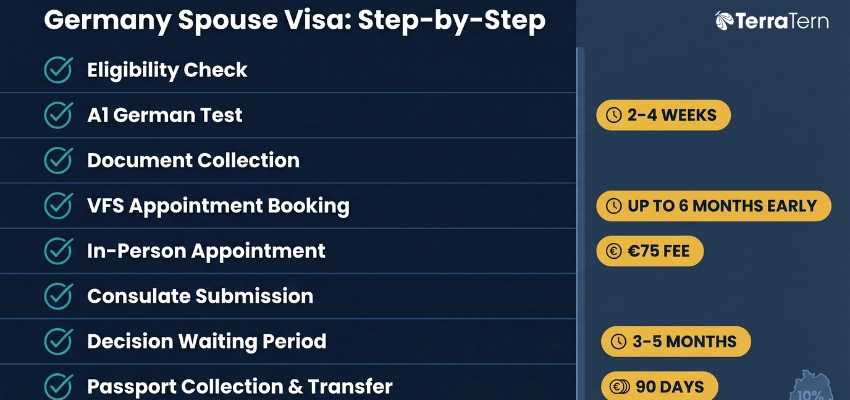
The criteria for the spouse visa for Germany from India follow a systematic 8-step procedure through VFS Global, which entails rigorous scrutiny.
-
Establish eligibility (legal marital status, sponsor status).
-
Goethe-Institut German test A1 (2-4 weeks to be certified).
-
Collect/sign documents according to the checklist.
-
Booking VFS (vfsglobal.com, up to 6 months beforehand; Delhi/Mumbai/etc).
-
Meet personally: Present documents, biometrics, €75 payment, and interview.
-
VFS sends to the consulate / Auslaendert.
-
Wait for the decision (3-5 months average).
-
Gather a passport; transfer to a residence permit in Germany within 90 days.
Expert Tip: One of the most underutilised strategies: if both you and your spouse are in India at the time of application, apply simultaneously. Couples who apply together (when the sponsoring spouse is travelling to Germany for skilled work) have reported approval within days rather than months, a massive advantage over sequential applications.
Also Read: How to Apply for a Germany Visa from India: Expert Guide
How Long Does Spouse Visa Processing Take from India?
The spouse visa for Germany from India usually takes 5-7 months in total, according to the German Embassy's rules, with at least 3 months for embassy scrutiny. VFS wait times are up to 8 weeks during peak seasons (May-Aug, Dec-Jan). No follow-up standard online tracking; follow up using the reference number. Simultaneous skilled-worker apps are made by fast tracks.
|
Phase |
Estimated Duration |
|
A1 Test Prep/Exam |
4–8 weeks |
|
Document Prep |
2–4 weeks |
|
VFS Appointment Wait |
2–8 weeks |
|
Embassy Processing |
10–14 weeks |
|
Extra Verification |
+8–12 weeks |
|
Total (Typical) |
5–7 months |
Important Note: From India, the German Embassy explicitly states a minimum processing time of 3 months, with verification adding another 2–3 months. Start the A1 exam and document collection process the moment your spouse's German work visa is confirmed, not after they depart.
What Is the Spouse Visa Fee for Germany from India?
The spouse visa for Germany from India carries a standard non-refundable fee of €75, payable in INR equivalent at VFS Global appointments. Additional costs include VFS service charges and optional services, bringing the total to INR 15,000–35,000, including translations and attestations. Fees are set by the German Embassy and VFS; always verify current rates on official sites.
|
Cost Item |
Estimated Amount |
|
Visa Fee |
€75 (~INR 6,700) |
|
VFS Service |
INR 1,500–2,500 |
|
Premium Lounge (Optional) |
INR 5,000+ |
|
Translations |
INR 500–1,500/page |
|
Apostille/Attestation |
Varies by state |
|
Total |
INR 15,000–35,000 |
As per TerraTern Expert: The €75 visa fee is fixed and non-refundable regardless of outcome. Factor in hidden costs, marriage certificate translation, apostille, A1 exam fees (approx. INR 3,000–5,000), and VFS service charges, which can add INR 20,000–30,000 to your total application cost.
What Are the Rights and Benefits After Getting the Spouse Visa for Germany?
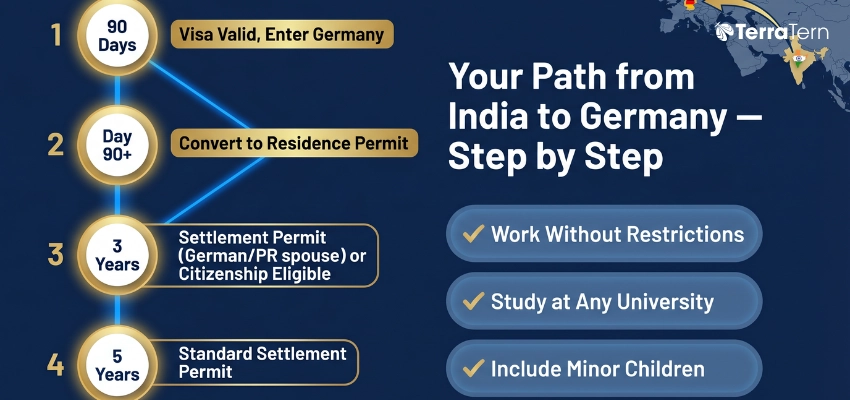
Holders of the spouse visa for Germany from India gain immediate family unity benefits upon residence permit issuance. These include unrestricted employment, access to public services, and pathways to long-term settlement.
-
Full work rights without a separate permit.
-
Study at universities without a student visa.
-
Public health insurance via a sponsor.
-
Settlement permit after 3 years (German/PR spouse) or 5 years standard.
-
Citizenship is eligible after 3 years of marriage to a German (B1 German required).
-
90-day visa validity; convert to a residence permit locally.
-
Include minor children via family reunification.
Pro Tip: One of the most valuable benefits of Germany's spouse visa is the ability to work without restrictions. From day one of receiving the residence permit, you can work in any field, for any employer, at any salary. This is significantly more flexible than many other countries' spouse visa systems.
Also Read: Visa for Germany from India Price: All Fees
What Are the Common Reasons for Spouse Visa Rejection from India?
Rejections for a spouse visa for Germany from India often stem from evidentiary gaps, with sham marriage suspicions leading. Post-2026 rules limit appeals to reapplication or the courts. Strong documentation prevents most issues.
-
Sham marriage: Build evidence folder (photos, chats, joint finances).
-
Weak Relationship Proof: Include wedding/current photos, call logs.
-
Invalid Marriage Cert: Ensure apostille, certified translation.
-
Low Sponsor Income: Provide 3 payslips showing net pay of €1,200+.
-
Poor Housing Proof: Submit rental contract (12m²+/adult).
-
No A1 German: Secure Goethe/telc cert or exemption.
-
Form Inconsistencies: Double-check VIDEX entries.
-
Missing Local Docs: Follow Mumbai/Chennai rules exactly.
Key Note: Since July 1, 2026, the administrative appeal process (Remonstration) has been abolished for visa rejections worldwide. If your application is rejected after this date, your only recourse is to reapply with improved documentation or file a legal action in a German administrative court, making a well-prepared first application more critical than ever.
How Does the Blue Card Spouse Visa for Germany Work for Indians?
Indians married to EU Blue Card citizens receive privileged treatment with a spouse visa for Germany from India, bypassing the A1 German obstacle. The Blue Card is aimed at proficient specialists with incomes over 2026 levels (€48,300 general; €43,759.80 shortage area such as IT/engineering). Parallel applications expedite clearance.
-
No A1 German required.
-
Goods/products: Apply from India (Indians non-exempt).
-
Immediate full working rights upon obtaining the residence permit.
-
Faster timeline: 8–12 weeks.
-
The sponsor should comply with the minimum wage.
As per TerraTern Expet, Divyansh, If your spouse is applying for or holds a German EU Blue Card, applying for the spouse visa simultaneously can cut processing time to just a few working days in some cases a dramatic reduction from the standard 3–5 month wait. Do not wait for the Blue Card to be approved before starting the spouse visa process.
What Happens After You Arrive in Germany on a Spouse Visa?
After entering Germany on your spouse visa for Germany from India, prioritise these six steps to legalise your stay and access services. The initial Type D visa lasts only 90 days, so act swiftly amid potential backlogs at authorities in cities like Berlin or Munich. Book appointments 4–6 weeks before expiry.
-
Register at the Einwohnermeldeamt within 2 weeks: Bring passport, visa, and rental contract for Meldebescheinigung (address certificate).
-
Apply for Residence Permit at Ausländerbehörde: Submit passport, visa, marriage cert, spouse's docs, address proof, financial means—before visa ends.
-
Enrol: in health insurance via spouse's provider (e.g., AOK, TK) for full coverage.
-
Obtain Tax ID (Steuer-ID): from Finanzamt or the Elster online portal.
-
Open a Bank Account: at Sparkasse, Commerzbank, or N26 using registration docs.
-
Optional integration Course: Free BAMF program for B1 German and orientation.
Pro Tip: Book your Ausländerbehörde appointment within the first week of arriving in Germany; waiting lists in cities like Berlin, Munich, and Frankfurt can stretch 6–8 weeks, and your entry visa is only valid for 3 months.
Also Read: Family Reunion Visa Germany
Conclusion
Getting a spouse visa for Germany from India requires an A1 German (Blue Card exempt), marriage certificates, financial proof of the sponsor, and an accessible VFS filing providing work permits and immigration trails. Expect 5-7 months processing; begin with checklists. Residence registration is completed immediately upon arrival to ensure a smooth entry into German life. Consult VFS/Embassy for 2026 updates.
Contact TerraTern for more information on Spouse Visa for Germany from India: Complete 2026 Guide.