


Key Highlights
- What Is the Skilled Occupation List Australia, and Why Does It Matter for Indians?
- What Are the Different Types of Skilled Occupation Lists in Australia?
- Which Occupations Are on Australia's Skilled Occupation List? Top Jobs for Indians in 2026
- How Do You Check If Your Occupation Is on Australia's Skilled Occupation List?
- What Visas Can You Apply for Through Australia's Skilled Occupation List?
- How Do You Get a Skills Assessment for Australia's Skilled Occupation List?
- How Can Indian Professionals Apply for Australia PR Using the Skilled Occupation List?
- 2026 Industry Context — Key Facts About the Skilled Occupation List Australia
- Conclusion
The skilled occupation list Australia provides a list of jobs in demand to facilitate visa applications, such as subclass 189, subclass 190, subclass 491, and the new sub-class 482, for skilled people from India to migrate to Australia. It is broken down into streams, including lists such as the Core Skills Occupation List, Medium and Long-term Strategic Skills List, Short-term Skilled Occupation List, and Regional Occupation List, and each occupation list provides a set of ANZSCO codes that cater to a specific visa stream.
What Is the Skilled Occupation List Australia, and Why Does It Matter for Indians?

The DoH oversees the skilled occupation list Australia, which is the official authority of the list of jobs that are eligible for skilled visa in Australia.
-
Eligible professions in the points-based immigration (PBS) process are listed here; only eligible professions can be included in your application for skilled visa points and an EOI.
-
On the other hand, Indians are the first group of people on the PR checklist to Australia; if they do not work on the skilled occupation list, then they can't get the main skilled visas.
-
Many skilled posts in Indian IT, engineering, healthcare, and finance are closely related to these lists, as India is consistently among the top source countries for skilled migrants.
-
There are four sublists in the framework: CSOL, MLTSSL, STSOL, and ROL Core Skills, medium–long term, short term, and regional, respectively, which release different subclasses of accompanying visas and PR Depths.
-
Currently, more than 456 occupations are covered in the CSOL (as of December 2024), providing extensive coverage of popular professions in India.
-
Then it also helps to dissect those sub-lists to see exactly where your title fits within the appropriate PR path.
How Does the Skilled Occupation List Affect Your Australia PR Eligibility?
Once you get an occupation on the skilled occupation list Australia), you can aim to apply for a skilled visa that can grant you PR.
-
The usual PR pathway is as follows: check SOL, receive a positive skills assessment, submit an EOI to SkillSelect, obtain an invitation, and apply for a visa.
-
Where employment is not in any skilled occupation list in Australia, you might consider an alternative pathway or a DAMA agreement, depending on your region and/or employer needs.
What Changed in 2026? The CSOL Update Indian Migrants Must Know
The new Core Skills Occupation List (CSOL) replaced the previous PMSOL framework in the Skilled Occupation List Australia in December 2024.
-
The broader scope of CSOL is now extended to a larger number of occupations, including approximately 456.
-
Authorities for 2026 were consulted on the next changes to the CSOL, including which skills will remain on the Core List over the next few years.
-
The new visa (subclass 482), for skilled occupations (Skills in Demand visa), has superseded the old TSS visa and has a new structure with three streams.
-
For Indians, these changes imply greater pathway stability, transparency, and opportunities in tech, healthcare, and engineering and more pathways to transition from temporary status to permanent (PR).
As per TerraTern Expert Divyansh, Indian applicants who were eligible under the old PMSOL should re-verify their occupation under the new CSOL. The lists are not identical, and assuming unchanged eligibility is a common and costly mistake.
Also Read: Skilled Visa Australia: Eligibility, Costs & Updates
What Are the Different Types of Skilled Occupation Lists in Australia?
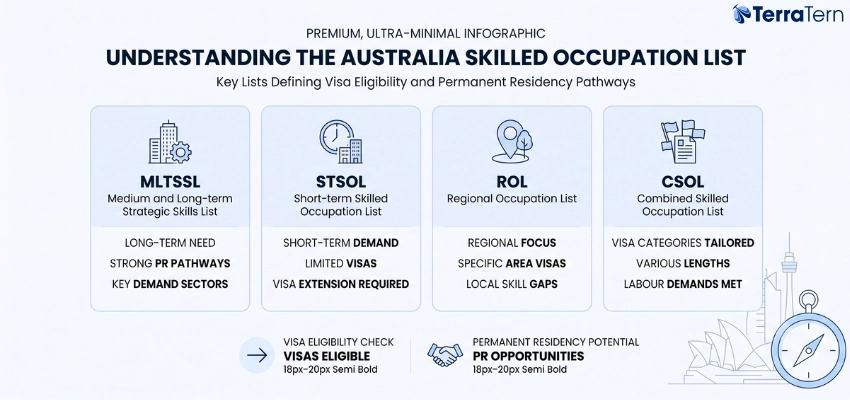
The Skilled Occupation List Australia is a collection of four key lists: MLTSSL, STSOL, ROL, and CSOL, tailored for the various visa categories, visa length and regional labour demands. Familiarise yourself with these lists, as others determine whether your occupation is eligible for these types of skilled visas or whether it offers a strong permanent residency (PR) pathway.
What Is the MLTSSL (Medium and Long-Term Strategic Skills List)?
Some very high-ranked positions in the skilled occupation list Australia, which is around 212 long-term demand occupations.
-
The visas that are eligible include subclasses 189, 190, 491, and 482 (Core Skills stream).
-
One of the most straightforward routes to permanent residency is via subclass 189 visas, which are issued on a state-nominated basis.
-
Popular job positions here in India: Software Engineer, Civil Engineer, Registered Nurse, Accountant, Medical Practitioner.
-
A good understanding to use for self-sponsored PR via the skilled occupation
What Is the STSOL (Short-Term Skilled Occupation List)?
Skilled Occupation List Australia, which is a short list of occupations with a substantial projected demand for immigration, is segmented into approximately 215 short-term occupations.
-
Visas such as the subclass 190 visa and the subclass 491 visa generally require being state- or territory-nominated for PR.
-
The PR pathway is less direct and subject to state requirements and occupation-specific ceiling limits.
-
Surveyor, Chef, Marketing Specialist, and Architect are common jobs in India.
-
Still provides some PR opportunities but are often subject to qualifying conditions such as those related to the or lived in a region.
What Is the ROL (Regional Occupation List)?
Australia committed to addressing approximately 77 occupations within the skilled occupation list that are related to regional Australia.
-
Mostly relates to subclass 491 (regional provisional) visa.
-
There are 3 Year "PR path" and quicker invitations to come with 15 additional points on the regional routes.
-
Automotive Technician, Agricultural Scientist, and Baker/Pastrycook are relevant Indian jobs.
-
Australia covers key “regional” cities such as Newcastle, Adelaide, Geelong and Canberra.
What Is the CSOL (Core Skills Occupation List) — Australia's Newest List?
PMSOL replaced with the newest section in the Skilled Occupation List Australia (SOL); launched Dec 2024, covering 456 occupations.
-
Welcomes the new Skills in Demand visa (subclass 482) regime designed by the employer.
-
Organised into three streams: Specialist Skills, Core Skills and Essential Skills.
-
It is important for Indians because it offers more jobs in IT, healthcare, engineering, and trade.
-
Usually provides easier pathways of employment sponsorship to PR through ENS 186 in the program.
Comparison Table: MLTSSL vs STSOL vs ROL vs CSOL at a Glance
By reading these four under the skilled occupation list Australia, what list do you think your occupation is considered under (MLTSSL, STSOL, ROL or CSOL) and why?
|
List Name |
No. of Occupations |
Eligible Visas |
PR Pathway |
Best For |
Updated By |
|
MLTSSL (Medium & Long-Term) |
212 |
189, 190, 491, 482 |
Direct PR via 189 |
Long-term skilled migrants |
Dept. of Home Affairs |
|
STSOL (Short-Term) |
215 |
190, 491 |
PR via state/territory nomination |
State-nominated migrants |
Dept. of Home Affairs |
|
ROL (Regional Occupation List) |
77 |
491 |
PR after 3 years in regional areas |
Regional settlers and families |
Dept. of Home Affairs |
|
CSOL (Core Skills) |
456 |
482 (Skills in Demand) |
PR via employer nomination (ENS 186) |
Employer-sponsored Indian workers |
Jobs & Skills Australia |
Important Note: The CSOL is not a replacement for MLTSSL or STSOL; it operates alongside them for employer-sponsored migration. An Indian applicant could be eligible for multiple lists simultaneously, unlocking more visa options.
Which Occupations Are on Australia's Skilled Occupation List? Top Jobs for Indians in 2026
The 2026 skilled occupation list in Australia includes over 456 occupations under the new Core Skills Occupation List (CSOL), alongside legacy categories like the MLTSSL, STSOL, and ROL. For Indian professionals, the highest-demand occupations consistently lie in healthcare, information technology, engineering, construction trades, and education. Here is a breakdown of these top sectors offering robust career opportunities and migration pathways.
Which Healthcare Occupations Are on Australia's Skilled Occupation List?
Healthcare remains a massive priority for Australia, presenting immense opportunities for qualified professionals aiming to migrate.
|
Occupation |
ANZSCO Code |
List |
Assessing Body |
Eligible Visas |
Avg. AUD Salary |
|
Registered Nurses |
254411 |
CSOL/MLTSSL |
ANMAC |
186, 189, 190, 482/SID, 491 |
$85,000 - $115,000 |
|
General Practitioners |
253111 |
CSOL/MLTSSL |
MedBA |
186, 189, 190, 482/SID, 491 |
$150,000 - $250,000 |
|
Midwives |
254111 |
CSOL/MLTSSL |
ANMAC |
186, 189, 190, 482/SID, 491 |
$85,000 - $110,000 |
|
Aged Care Workers |
423111 |
Labour Agmt |
ACIA/NMBA |
482/SID (Aged Care) |
$55,000 - $70,000 |
|
Psychologists |
272399 |
CSOL/MLTSSL |
APS |
186, 189, 190, 482/SID, 491 |
$90,000 - $120,000 |
|
Occupational Therapists |
252411 |
CSOL/MLTSSL |
OTC |
186, 189, 190, 482/SID, 491 |
$80,000 - $105,000 |
|
Physiotherapists |
252511 |
CSOL/MLTSSL |
APC |
186, 189, 190, 482/SID, 491 |
$80,000 - $105,000 |
|
Pharmacists |
251511 |
CSOL/MLTSSL |
APC |
186, 189, 190, 482/SID, 491 |
$85,000 - $110,000 |
|
Dentists |
252312 |
CSOL/MLTSSL |
ADC |
186, 189, 190, 482/SID, 491 |
$120,000 - $180,000 |
Which IT and Technology Occupations Are on Australia's Skilled Occupation List?
With an incredible 22.6% projected growth in software engineering by 2028, securing IT jobs Australia skilled occupation list pathways is highly achievable.
|
Occupation |
ANZSCO Code |
List |
ACS Assessment |
Eligible Visas |
Avg. AUD Salary |
|
Software Engineers |
261313 |
CSOL/MLTSSL |
Yes |
186, 189, 190, 482/SID, 491 |
$100,000 - $140,000 |
|
Cybersecurity Analysts |
262112 |
CSOL/MLTSSL |
Yes |
186, 189, 190, 482/SID, 491 |
$110,000 - $150,000 |
|
Data Scientists |
224999 |
CSOL/MLTSSL |
Yes |
186, 189, 190, 482/SID, 491 |
$110,000 - $145,000 |
|
Database Administrators |
262111 |
CSOL/MLTSSL |
Yes |
186, 189, 190, 482/SID, 491 |
$90,000 - $125,000 |
|
Systems Analysts |
261112 |
CSOL/MLTSSL |
Yes |
186, 189, 190, 482/SID, 491 |
$95,000 - $130,000 |
|
ICT Project Managers |
135112 |
CSOL/MLTSSL |
Yes |
186, 189, 190, 482/SID, 491 |
$130,000 - $170,000 |
|
Network Engineers |
263111 |
CSOL/MLTSSL |
Yes |
186, 189, 190, 482/SID, 491 |
$95,000 - $135,000 |
Which Engineering Occupations Are on Australia's Skilled Occupation List?
Due to an ongoing national infrastructure boom, securing PR pathways for engineering occupations in Australia is an excellent option for Indian graduates.
|
Occupation |
ANZSCO Code |
List |
EA Assessment |
Eligible Visas |
Avg. AUD Salary |
|
Civil Engineers |
233211 |
CSOL/MLTSSL |
Yes |
186, 189, 190, 482/SID, 491 |
$95,000 - $130,000 |
|
Mechanical Engineers |
233512 |
CSOL/MLTSSL |
Yes |
186, 189, 190, 482/SID, 491 |
$90,000 - $125,000 |
|
Electrical Engineers |
233311 |
CSOL/MLTSSL |
Yes |
186, 189, 190, 482/SID, 491 |
$95,000 - $135,000 |
|
Environmental Engineers |
233915 |
CSOL/MLTSSL |
Yes |
186, 189, 190, 482/SID, 491 |
$90,000 - $130,000 |
|
Mining Engineers |
233611 |
CSOL/MLTSSL |
Yes |
186, 189, 190, 482/SID, 491 |
$120,000 - $170,000 |
|
Structural Engineers |
233214 |
CSOL/MLTSSL |
Yes |
186, 189, 190, 482/SID, 491 |
$100,000 - $140,000 |
Which Construction and Trade Occupations Are on Australia's Skilled Occupation List?
With Skill Level 3 (trades) fill rates dropping to just 54.3%, this sector is facing the highest shortages nationally. Finding trades on Australia's skilled occupation list is increasingly common.
|
Occupation |
ANZSCO Code |
List |
TRA Assessment |
Eligible Visas |
Avg. AUD Salary |
|
Electricians |
341111 |
CSOL/MLTSSL |
Yes |
186, 189, 190, 482/SID, 491 |
$85,000 - $110,000 |
|
Plumbers |
334111 |
CSOL/MLTSSL |
Yes |
186, 189, 190, 482/SID, 491 |
$80,000 - $105,000 |
|
Carpenters |
331212 |
CSOL/MLTSSL |
Yes |
186, 189, 190, 482/SID, 491 |
$75,000 - $100,000 |
|
Bricklayers |
331111 |
CSOL/MLTSSL |
Yes |
186, 189, 190, 482/SID, 491 |
$75,000 - $95,000 |
|
Construction Managers |
133111 |
CSOL/MLTSSL |
VETASSESS |
186, 189, 190, 482/SID, 491 |
$120,000 - $160,000 |
|
Welders |
322313 |
CSOL/MLTSSL |
Yes |
186, 189, 190, 482/SID, 491 |
$75,000 - $100,000 |
Which Education Occupations Are on Australia's Skilled Occupation List?
Due to severe teacher shortages in STEM subjects and regional areas, qualified educators are heavily prioritised.
|
Occupation |
ANZSCO Code |
List |
AITSL Assessment |
Eligible Visas |
Avg. AUD Salary |
|
Secondary School Teachers |
241411 |
CSOL/MLTSSL |
Yes |
186, 189, 190, 482/SID, 491 |
$80,000 - $110,000 |
|
Primary School Teachers |
241213 |
CSOL/STSOL |
Yes |
190, 482/SID, 491 |
$75,000 - $105,000 |
|
Early Childhood Educators |
241111 |
CSOL/MLTSSL |
Yes |
186, 189, 190, 482/SID, 491 |
$70,000 - $95,000 |
|
University Lecturers |
242111 |
CSOL/MLTSSL |
VETASSESS |
186, 189, 190, 482/SID, 491 |
$100,000 - $140,000 |
Which Accounting and Finance Occupations Are on Australia's Skilled Occupation List?
Accounting and finance remain the backbone of corporate infrastructure, maintaining a solid presence on skilled migration lists.
|
Occupation |
ANZSCO Code |
List |
Assessing Body |
Eligible Visas |
Avg. AUD Salary |
|
Accountants (General) |
221111 |
CSOL/MLTSSL |
CPA/CA ANZ/IPA |
186, 189, 190, 482/SID, 491 |
$75,000 - $110,000 |
|
Management Accountants |
221112 |
CSOL/MLTSSL |
CPA/CA ANZ/IPA |
186, 189, 190, 482/SID, 491 |
$85,000 - $120,000 |
|
External Auditors |
221213 |
CSOL/MLTSSL |
CPA/CA ANZ/IPA |
186, 189, 190, 482/SID, 491 |
$80,000 - $115,000 |
|
Financial Planners |
222311 |
CSOL/STSOL |
VETASSESS |
190, 482/SID, 491 |
$90,000 - $130,000 |
Expert Tip: Indian professionals often have their exact job title mapped to a slightly different ANZSCO code than they expect. An incorrect ANZSCO code can lead to a negative skills assessment or a visa refusal. Always verify with a registered migration consultant before submitting your EOI.
How Do You Check If Your Occupation Is on Australia's Skilled Occupation List?
You can check if your occupation is on Australia's skilled occupation list using the official SkillSelect portal at immi.homeaffairs.gov.au or the Jobs and Skills Australia Occupation Shortage List tool. Search by job title or your 6-digit ANZSCO code to see which list(s) your occupation appears on and which visas you're eligible for.
-
Step 1: Visit immi.homeaffairs.gov.au and navigate to "Skill Occupation List" under Work in Australia.
-
Step 2: Search by your occupation name or your 6-digit ANZSCO code (the classification system for occupations).
-
Step 3: Note which list(s) your occupation appears on, and download the official CSOL PDF directly from homeaffairs.gov.au.
-
Step 4: Cross-check the JSA Occupation Shortage List for your shortage status.
-
Common Mistake: Confusing a similar job title with a different ANZSCO code can derail your application.
-
Final Step: Confirm your pathway by speaking with a registered migration agent at TerraTern
What Is an ANZSCO Code and Why Does It Matter for Your Australia PR?
The ANZSCO codes are summaried below:
-
What it is: ANZSCO stands for the Australian and New Zealand Standard Classification of Occupations.
-
How it Works: It is a 6-digit code classifying every occupation by skill level, daily tasks, and required qualifications.
-
Why it Matters: Your ANZSCO code dictates which skilled list you belong to, which assessing body reviews your application, and the exact visa subclasses you can apply for.
-
How to Find it: Use the official search tool on abs.gov.au.
-
Common Mismatches: Indian applicants often misclassify IT roles; for example, "Software Engineer" and "Software Developer" have different ANZSCO codes and distinct requirements.
What Are the State-Specific Occupation Lists for Australia, and Which States Suit Indian Migrants Best?
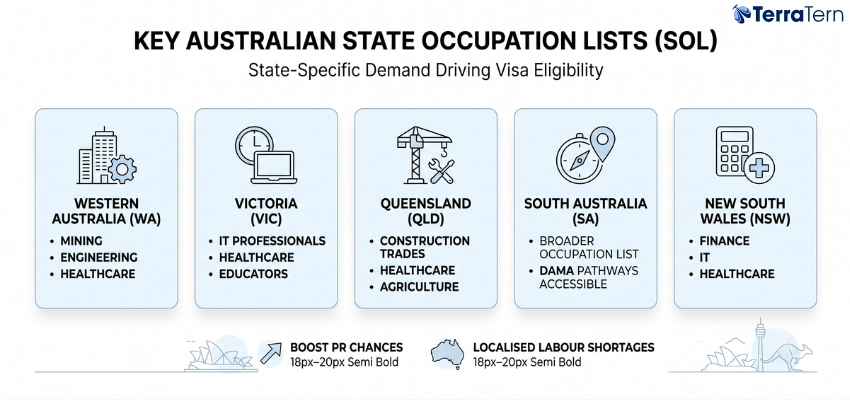
Each state maintains its own occupation list, in addition to the national SOL, to address localised labour shortages. Targeting the right state can significantly boost your PR chances.
-
Western Australia (WA): Exceptional demand for mining, engineering, and healthcare. Review the Western Australia Skilled Occupation List.
-
Victoria (VIC): Strong demand for IT professionals, healthcare workers, and educators.
-
Queensland (QLD): Prioritises healthcare, construction trades, and agriculture.
-
South Australia (SA): Features a broader occupation list, often accessible via DAMA pathways.
-
New South Wales (NSW): High demand for finance, IT, and healthcare.
Expert Advice: Checking only the national SOL is a common mistake; some Indian professionals miss out on PR pathways because their occupation is on a state-specific list that isn't in the national MLTSSL or STSOL.
Also Read: Skilled Worker Visa Australia: Complete Guide
What Visas Can You Apply for Through Australia's Skilled Occupation List?
Your occupation's position on Australia's skilled occupation list determines which visa subclasses you can apply for. MLTSSL occupations unlock the most pathways, including Subclass 189 (independent PR), 190 (state-nominated), 491 (regional), and 482 (employer-sponsored). STSOL occupations qualify for 190 and 491. ROL occupations qualify for 491 only.
-
Subclass 189 (Skilled Independent): Widely considered the "gold standard" for Indian IT and healthcare professionals because it requires no state nomination or employer sponsorship.
-
Subclass 190 (Skilled Nominated): Requires state sponsorship but grants immediate PR.
-
Subclass 491 (Skilled Work Regional): A provisional visa requiring you to live and work in a designated regional area.
-
Subclass 482 (Skills in Demand): This visa recently replaced the TSS and directly links your eligibility to the new Core Skills Occupation List (CSOL).
|
Visa Subclass |
List Required |
PR or Temporary |
Points Needed |
Best For Indian Applicants |
|
189 Independent |
MLTSSL |
Permanent |
Yes (65+) |
IT, Nursing, Engineering |
|
190 Nominated |
MLTSSL / STSOL |
Permanent |
Yes (65+) |
Finance, Education, Trades |
|
491 Regional |
All Lists |
Provisional |
Yes (65+) |
Applicants needing bonus points |
|
482 Skills in Demand |
CSOL |
Temporary (PR Pathway) |
No |
Corporate transfers, tech specialists |
What Is the Difference Between Subclass 189 and 190 for Indian Applicants?
Choosing the right visa on the skilled occupation list Australia is crucial for your PR strategy.
-
Subclass 189: Offers immediate, independent PR anywhere in Australia. It requires an MLTSSL occupation and is highly competitive, often demanding 85+ points.
-
Subclass 190: Grants immediate PR but requires state nomination, adding 5 bonus points to your score. You must live and work in the nominating state for 2–3 years. It accepts both MLTSSL and STSOL occupations.
-
Which is better for Indians: The 189 offers supreme freedom, but the 190 provides a vital points boost and broader occupation eligibility for Indian applicants facing intense competition.
How Does the Australia PR Points System Work With the Skilled Occupation List?
To apply for a points-tested visa under the Skilled Occupation List Australia, you must lodge an Expression of Interest (EOI). Your score determines your ranking.
-
How it Works: Points are awarded based on age, English proficiency, work experience, qualifications, and state nomination.
-
Competitive Benchmark: While 65 is the legal minimum, highly sought-after Indian occupations often require 85+ points to secure an invite.
-
Indian Considerations: Ensure your Indian degrees are recognised by the relevant assessing body. Maximise your points by targeting superior English scores (IELTS 8.0 or PTE 79).
Important Note: Many Indian applicants are surprised to find that even a well-paying job in India, with 3+ years of experience in an MLTSSL occupation, can contribute up to 20 points before English scores and qualifications are even counted. Start your points audit early.
How Do You Get a Skills Assessment for Australia's Skilled Occupation List?
A skills assessment is mandatory before submitting your Expression of Interest (EOI) for any Australian skilled visa. It validates your foreign qualifications and work experience against strict Australian standards. The assessing body depends on your occupation
-
Step 1: Identify your exact ANZSCO code and its designated assessing body on the Skilled Occupation List Australia.
-
Step 2: Gather all required documents, including academic transcripts, detailed employment references, and English test results.
-
Step 3: Submit your application and pay the required fee through the assessing body's official online portal.
-
Step 4: Wait for your assessment outcome, which typically takes anywhere from 6 to 12 weeks.
-
Step 5: Once you receive a positive assessment letter, use it to submit your EOI in SkillSelect.
|
Assessing Body |
Occupations Covered |
Cost (AUD) |
Processing Time |
|
Engineers Australia (EA) |
Engineering |
$900 - $1,350 |
8-12 weeks |
|
Australian Computer Society (ACS) |
IT & Tech |
$575 - $1,498 |
6-10 weeks |
|
VETASSESS |
General (Mgmt, Science) |
$900 - $1,100 |
10-14 weeks |
|
AHPRA/ANMAC |
Healthcare & Nursing |
Varies |
6-12 weeks |
|
TRA |
Trades |
Varies |
120 days |
What Documents Do Indian Applicants Need for a Skills Assessment?
To secure a positive outcome for an occupation on the skilled occupation list Australia, your documentation must be flawless.
-
Core Requirements: You must provide high-resolution colour copies of your degree certificates, full academic transcripts, detailed employment letters outlining specific duties, payslips, and valid English test results.
-
India-Specific Considerations: Unlike in Canada, WES-style verification is not typically required in Australia. However, any non-English documents must be accompanied by notarised, NAATI-certified translations.
-
Crucial Warning: Fake experience certificates are a serious red flag and will result in an immediate ban. Always ensure your employment history is 100% genuine and verifiable.
As per TerraTern Expert: For Indian IT professionals, the ACS assesses based on task matching, not just job title. A "Technical Lead" may be assessed as a "Software Engineer (ANZSCO 261313)"; always get professional guidance on ANZSCO categorisation before submitting to ACS.
How Can Indian Professionals Apply for Australia PR Using the Skilled Occupation List?
Indian professionals can apply for Australian PR through the General Skilled Migration (GSM) program by following a structured six-step process. Navigating the Skilled Occupation List Australia effectively requires following these six critical steps:
-
Confirm Your Occupation: Search the latest Core Skills Occupation List (CSOL), MLTSSL, STSOL, or ROL to ensure your job is eligible for migration.
-
Complete a Skills Assessment: Submit your academic transcripts and employment records to your designated assessing body (e.g., ACS, Engineers Australia, VETASSESS).
-
Take an English Proficiency Test: Sit for the IELTS or PTE Academic test to prove your language skills.
-
Submit Your EOI in SkillSelect: Create a profile on the Australian Government's online SkillSelect portal, detailing your age, English proficiency score, and skills assessment results.
-
Receive an Invitation to Apply (ITA): Wait for the Department of Home Affairs or a state government to issue an invitation during an upcoming round.
-
Lodge Your Visa Application: Once invited, you have exactly 60 days to submit your final visa application. You must attach all police clearances, medical exam results, and updated employment evidence at this stage to avoid delays.
-
Processing Timelines (2026 Estimates): Subclass 189 visas generally take 5 to 9 months, while state-nominated Subclass 190 visas take 6 to 8 months.
-
Take Action: Book a free consultation with TerraTern's Australia immigration experts to kickstart your application today.
What IELTS or PTE Score Do You Need for Australia's Skilled Occupation List Visas?
Securing maximum points for your English proficiency is the most effective way to rank higher on the skilled occupation list australia EOI pool.
-
Minimum Requirements: For Subclass 189, 190, and 491 visas, you must demonstrate at least "Competent English" (IELTS band score of 6.0 in each band). However, because the system is competitive, this baseline score awards zero points and is rarely enough to secure an invite.
-
Healthcare Exceptions: Assessing bodies like AHPRA require stricter minimums just to pass your skills assessment, typically IELTS 7.0 (or PTE equivalent) in every band, regardless of your visa subclass.
|
English Level |
IELTS Score (per band) |
PTE Academic Score (per section) |
PR Points Awarded |
|
Competent |
6.0 |
50 |
0 Points |
|
Proficient |
7.0 |
65 |
10 Points |
|
Superior |
8.0 |
79 |
20 Points |
What Are the Benefits of Australia PR for Indian Professionals?
Securing a visa linked to the Skilled Occupation List Australia unlocks a lifetime of economic and social advantages.
-
Unrestricted Work and Residency: Live, work, and study anywhere in Australia on a permanent basis without relying on employer sponsorship.
-
Medicare Access: Gain immediate access to Australia’s world-class public healthcare system, which heavily subsidises medical and hospital costs.
-
Education Entitlements: Your children can access free or heavily subsidised public schooling, and you can access domestic university tuition rates.
-
Citizenship Pathway: After living in Australia for four years (including at least one year as a PR holder), you become eligible to apply for Australian citizenship and a globally powerful passport.
-
Family Sponsorship: Once established, you hold the right to sponsor eligible relatives, including parents and partners, for their own permanent visas.
-
Social Security: Gain access to certain social security benefits and payments after an initial waiting period.
-
The Salary Advantage: For top SOL occupations, the salary gap between India and Australia is transformative.
Expert Takeaway: Indian applicants with 85+ points and an MLTSSL occupation are typically invited within 3–6 months. Those with 65–75 points should strongly consider state nomination (Subclass 190) or regional pathways (Subclass 491) to boost their score by 5–15 points and dramatically reduce wait times.
Also Read: Immigration Australia: Everything You Need To Know
2026 Industry Context — Key Facts About the Skilled Occupation List Australia
Some of the latest facts:
-
456+ occupations are on the CSOL (Core Skills Occupation List) as of December 2024, the most comprehensive occupation list in Australian immigration history (Source: Department of Home Affairs, December 2024)
-
National vacancy fill rate 70.2%, meaning nearly 30% of skilled vacancies go unfilled, underscoring the demand for migrants (Source: Jobs and Skills Australia, September 2026 Occupation Shortage Report)
-
Skill Level 3 (Trades) fill rate 54.3%, the lowest of any skill level, making tradespeople the hardest category for Australian employers to recruit (Source: JSA, September 2026)
-
27% projected growth in software engineering jobs over the next 5 years in Australia, with ~58,000 new positions expected by 2028 (Source: Jobs and Skills Australia)
-
Regional areas have a 67.1% fill rate vs 71.5% in metro areas. Indian professionals willing to settle in regional Australia face less competition and earn more points (Source: JSA, September 2026)
-
India ranks among the top 3 source nations for Australian skilled migration, with thousands of Indian nationals receiving invitations annually through SkillSelect (Source: Department of Home Affairs)
-
The 2026 CSOL consultation closed in September 2026. The updated 2026 CSOL is expected to reflect changes in healthcare, clean energy, and technology priorities (Source: Jobs and Skills Australia, August 2026)
Conclusion
Navigating the Skilled Occupation List Australia is your first step toward a successful migration journey. Whether you are an IT expert, nurse, engineer, or tradesperson, understanding your ANZSCO code, securing a positive skills assessment, and maximising your PR points are crucial to unlocking your pathway. Don't leave your future to chance. Connect with the experts at TerraTern today to evaluate your eligibility and start your Australian dream in 2026.
Contact TerraTern for more information on the Skilled Occupation List Australia: Complete Guide for Indians.




 AI Summary