

Key Highlights
- What Is MS Finance in Australia and Is It Worth It in 2026?
- Why Indian Students Choose Australia for MS Finance?
- What Are the Latest Different Types of MS Finance Programs in Australia?
- Which Are the Current Best Colleges in Australia for MS in Finance?
- What Is the Latest Eligibility Criteria for MS Finance in Australia?
- How Do You Apply for Current MS Finance in Australia From India?
- How Much Does MS Finance in Australia Cost in 2026?
- What Latest Scholarships Are Available for MS Finance in Australia?
- Popular Scholarships for MS Finance in Australia
- What Are the Current Career Opportunities and Salaries After MS Finance in Australia?
- Can MS Finance in Australia Lead to PR or a Post-Study Work Visa in 2026?
- Conclusion
Among the top postgraduate degrees in Australia for Indian students looking to launch their careers in the world of banking, investment banking, corporate finance, and financial consulting, MS Finance in Australia is one of the most popular courses. International finance students still flock to Australia with its world-class universities, industry-specific courses, strong employment prospects after graduation, and promising permanent residency options.
From universities and qualifications to costs, scholarships, work experience, and career and PR opportunities, this guide covers everything you need to know about MS Finance in Australia in 2026.
What Is MS Finance in Australia and Is It Worth It in 2026?
MS Finance in Australia is a postgraduate course of study that can take 1.5 to 2 years and concentrates on theoretical financial concepts, financial analysis of investment, quantitative methods, corporate finance, risk management, and financial decision-making. MS Finance in Australia is a program tailored for students looking to pursue careers in the international financial world, offering both academic rigor and real-world experience.
-
Duration: Typically 1.5–2 years
-
Tuition Fees: Around AUD 30,000–70,000 (₹17–40 lakhs)
-
Top Universities: The University of Melbourne, UNSW Sydney, and Australian National University are the top universities in Australia.
-
Requirements: Bachelor's degree and English language skills
-
Key Documents: SOP, LORs, transcripts, IELTS/PTE/TOEFL score.
-
Post-Study Work Visa: Up to 2-6 years based on eligibility
-
Professional Pathways: There are several universities that are aligned with CFA and CPA Australia frameworks.
The degree is especially valuable for Indian students as Australia boasts some of the world's top universities, strong ties with leading financial institutions, and appealing post-study work opportunities. MS Finance in Australia offers the knowledge and practical skills that employers demand, irrespective of your objective – investment banking, financial consulting, wealth management or fintech.
Why Indian Students Choose Australia for MS Finance?
-
International rankings of universities with finance degrees.
-
Good links with financial institutions, investment companies and multinational corporations.
-
Financial modelling, access to Bloomberg terminals and industry projects.
-
Good post-study visa options and visa opportunities in the skilled visa category.
-
English medium education in a big Indian community.
-
Exposure to financial markets of Asia-Pacific and global investment trends.
What Are the Latest Different Types of MS Finance Programs in Australia?
MS Finance in Australia comes in various formats, and students can select the right program that will suit their educational background and future career goals. All finance master's programs include financial management and analysis as their core, but each concentration trains students for specific careers and fields.
1. Master of Finance
-
MS Finance in Australia offers the following options: Master of Finance is the most popular. It focuses on investment analysis, corporate finance, portfolio management, financial markets, derivatives,s and valuation methods.
-
Ideal for investment Banking, Asset Management, Corporate Finance, and Financial Consulting.
2. Master of Applied Finance
-
A Master of Applied Finance concentrates on the use of financial theories in real business scenarios. Students learn to create financial models, analyze risk, perform mergers and acquisitions, manage treasury, and understand the capital markets.
-
Ideal for corporate finance, commercial banking, financial planning, and project finance.
3. MBA with a Finance Specialization
-
An MBA in Finance is a program that is popular for professionals with work experience. In addition to finance, students learn about leadership, marketing, operations and strategic management, enabling them to apply these skills to higher levels of leadership.
-
Ideal for finance managers, business leaders, consultants and executives.
4. Master of Financial Planning
-
Students in this specialization will be ready to counsel individuals and businesses regarding wealth building, retirement planning, taxation, insurance and investment planning.
-
Ideal for financial advisors, wealth managers, insurance consultants and private banking professionals.
5. Master's Degree in Quantitative Finance
-
Quantitative Finance is the most mathematical of all MS Finance in Australia programs. Students get training in high-level statistics, econometrics, machine learning, derivatives pricing, and computational finance.
-
Perfect for Quantitative Analysts (Quants), Risk Analysts, algorithmic traders, and Financial Data Scientists.
Which Are the Current Best Colleges in Australia for MS in Finance?
One of the most important decisions while opting for the best colleges in Australia for an MS in finance. Australia's top universities offer high-quality education, industry connections, internships, state-of-the-art research, and excellent career prospects. MS in Finance in Australia is a good investment for Indian students, as several institutions make it onto lists of the best Accounting and Finance institutes worldwide.
More important than rankings are the following aspects to consider when choosing the best universities for MS in finance in Australia: curriculum, tuition fees, internship opportunities, global rankings, alumni network, and professional accreditation.
Best Universities for MS in Finance in Australia (2026)
The table below compares some of the best universities for MS in Finance in Australia based on program duration, estimated tuition fees, and global reputation.
|
University |
Program |
Duration |
Tuition Fees (AUD) |
Approx Fees (INR) |
QS Accounting & Finance Reputation |
|
University of Melbourne |
Master of Finance |
2 Years |
62,000- 68,000 |
35-39 lakhs |
Top-ranked globally |
|
UNSW Sydney |
Master of Finance |
1.7 Years |
58,000- 65,000 |
33-37 lakhs |
Globally recognized |
|
Australian National University |
Master of Finance |
2 Years |
50,000- 58,000 |
28- 33 lakhs |
Highly ranked |
|
University of Sydney |
Master of Commerce (Finance) |
1.5–2 Years |
54,000- 60,000 |
31- 34 lakhs |
Internationally reputed |
|
Monash University |
Master of Banking and Finance |
2 Years |
49,000- 56,000 |
28- 32 lakhs |
Well regarded |
|
University of Queensland |
Master of Commerce (Finance) |
2 Years |
47,000- 53,000 |
27-30 lakhs |
Leading research university |
|
University of Technology Sydney |
Master of Finance |
2 Years |
43,000- 49,000 |
24- 28 lakhs |
Industry-focused |
|
Macquarie University |
Master of Applied Finance |
1.5–2 Years |
45,000- 52,000 |
25- 30 lakhs |
Finance specialization |
|
RMIT University |
Master of Finance |
2 Years |
40,000- 46,000 |
23- 26 lakhs |
Career-oriented |
|
Deakin University |
Master of Financial Planning |
2 Years |
37,000- 44,000 |
21- 25 lakhs |
Professional accreditation |
Do Any Universities Offer CFA or CPA Exam Exemptions With MS Finance in Australia in 2026?
Some universities that provide MS Finance in Australia develop their programs to match internationally recognised professional qualifications like the Chartered Financial Analyst (CFA) Program and CPA Australia.
While the CFA designation is not offered at the university level, many finance master's programs include substantial amounts of the CFA curriculum in their curriculum. This will assist students in preparing for professional certification during their degree program.
Likewise, accounting and finance courses that are accredited by the CPA Australia can offer exemption from several foundation-level requirements based on the course structure and a student's academic history.
What Is the Latest Eligibility Criteria for MS Finance in Australia?
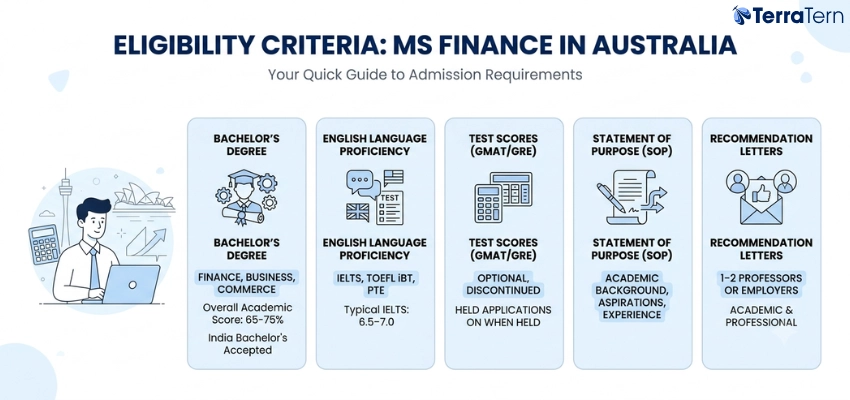
Before you start your application, you should know if you are eligible or not foran MS in Finance in Australia. All universities have different admission requirements, but most of them consider academic achievement, proficiency in the English language, and supporting documents.
1. Bachelor's Degree
Most applicants will have a bachelor's degree in one of the following areas:
-
Finance
-
Commerce
-
Business Administration
-
Accounting
-
Economics
-
Mathematics
-
Statistics
-
Engineering (accepted by some universities)
Most universities require an overall academic score of about 65-75% in the Bachelor's degree program (in India), while some universities are more competitive and will require higher academic performance.
2. English Language Proficiency
International students are required to provide proof of English proficiency by taking approved language tests.
Typical exams accepted are:
-
IELTS
-
TOEFL iBT
-
PTE Academic
The overall score in IELTS is largely between 6.5 and 7.0 in most universities, but it varies from university to university.
3. GMAT or GRE Scores
Several universities that provide MS Finance in Australia have discontinued the requirement for GMAT or GRE.
But, if you do submit a competitive score, it can help your application, especially when:
-
Your GPA is less than the preferred.
-
You're applying to very competitive schools.
-
You have a bachelor's degree from a less well-known school.
Some finance programs may still require GMAT or GRE scores from top universities.
4. Statement of Purpose (SOP)
A good Statement of Purpose will provide information on:
-
Why you chose MS Finance in Australia
-
Your academic background
-
Career aspirations
-
Justifications for choosing a particular university.Justifications for choosing a particular university.
-
Internships or work experience that are relevant
A good SOP can make a huge difference in the admissions process.
5. Letters of Recommendation
The majority of universities require a Letter of Recommendation from 1 to 2 professors or employers who will be able to speak about your academic performance, leadership, and professional background.
6. Work Experience (Optional)
Typically, there is no work experience requirement for most traditional Master's in Finance programs.
But MBA programs in finance typically look for candidates with 2–5 years of work experience.
Applicable banking, finance, accounting, investment, and consulting internships are also good to have.
How Do You Apply for Current MS Finance in Australia From India?
If you start early, it is easy to apply for an MS Finance in Australia. Whether it's choosing the right institution, preparing your documentation, or applying for a student visa, it requires careful planning and proper documentation. The majority of universities admit students several months in advance before the term begins, so it is advisable for Indian students to prepare at least 8–12 months in advance before the term.
By following a structured application process, you can enhance your prospects of getting into one of the top universities in Australia for an MS in Finance.
Step 1: Shortlist Universities and Programs
The initial step to embarking on an MS Finance in Australia is to find universities that align with your academic background, financial constraints, and professional goals.
When it comes to narrowing down the choices of universities to consider, make sure to take into account:
-
QS World University Rankings
-
Tuition fees
-
Course curriculum
-
Internship opportunities
-
Industry partnerships
-
Scholarship availability
-
Graduate employment outcomes
-
Rent and price of property
Step 2: Determine Eligibility Requirements
Make sure to check the admission requirements of each university before applying.
Typical eligibility includes:
-
Bachelor's degree in a related field.
-
English language proficiency
-
Academic transcripts
-
Statement of Purpose (SOP)
-
Letters of Recommendation (LORs)
-
Resume/CV
-
GMAT/GRE (where applicable)
Step 3: Prepare Your Documents
There are several supporting documents you will need for your application to an MS Finance in Australia.
These generally include:
-
Awards, diplomas, and degrees: Academic Transcripts and Degree Certificates.
-
Valid passport
-
The IELTS, TOEFL or PTE scorecard.
-
Statement of Purpose
-
Letters of Recommendation
-
Updated Resume/CV
-
Work experience certificates (if applicable)
-
GMAT/GRE (if applicable)
Step 4: Apply Online
The majority of Australian universities have an online admissions system.
While filling out your application:
-
Submit all necessary paperwork.
-
Double-check personal information.
-
Submit the Application fee (if any).
-
Keep checking the progress of your application.
Step 5: Acceptance of Offer Letter
Now that you've received your offer letter, you'll need to decide whether to accept it.
If successful, you will be offered either a conditional or unconditional offer.
Once you have been offered:
-
Enroll in the school.
-
Make the necessary tuition deposit.
-
Get a Confirmation of Enrolment (CoE).
Step 6: Apply for Your Student Visa
After obtaining your CoE, you can apply for an Australian student visa.
You'll generally need:
-
Confirmation of Enrolment
-
Valid passport
-
Evidence of financial ability.
-
Overseas Student Health Cover (OSHC)
-
The test scores of English language tests
-
Documentation – Genuine Student (if applicable)
How Much Does MS Finance in Australia Cost in 2026?
When it comes to your MS Finance costs in Australia, the total price is comprised of tuition fees, living expenses, food, travel, health insurance, course books, and other personal costs. Australia is home to world-class education, but with careful financial planning, students can manage their expenses well.
The average tuition fees for MS Finance in Australia vary from AUD 30,000 to AUD 70,000 per year, depending on the university and specialization. On average, living costs will also be an additional AUD 21,000–35,000 per year.
What Latest Scholarships Are Available for MS Finance in Australia?
The MS Finance in Australia is made considerably more affordable for international students with the assistance of scholarships. Financial support is available through Australian universities, government agencies, and private organizations, based on academic merit, leadership potential, financial need, or research achievements.
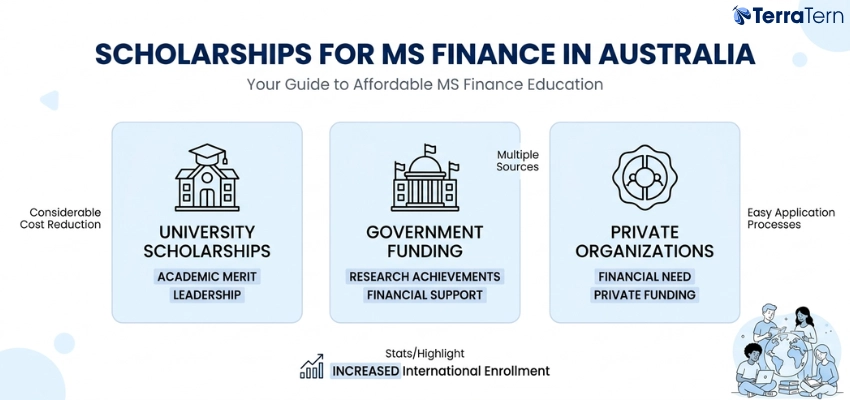
There are many scholarships available that are automatically considered for admission, and others that require an application.
Popular Scholarships for MS Finance in Australia
|
Scholarship |
Coverage |
Eligibility |
|
Australia Awards Scholarships |
Full tuition, living expenses, travel |
Outstanding international students |
|
Destination Australia Scholarship |
Partial tuition support |
Eligible regional university students |
|
University Merit Scholarships |
Partial tuition fee waiver |
High academic achievement |
|
Vice-Chancellor's International Scholarships |
Tuition discounts |
Excellent academic record |
|
ANU Chancellor's International Scholarship |
Partial tuition support |
International students with strong academics |
|
Westpac Future Leaders: Full tuition, living expenses, travel |
Tuition and leadership funding |
Exceptional postgraduate students |
What Are the Current Career Opportunities and Salaries After MS Finance in Australia?
Students who choose to study MS Finance in Australia will be able to pursue a wide range of job opportunities in the banking, investment, consulting, insurance, fintech and corporate finance sectors. Graduates are highly sought after due to their analytical ability, financial modelling skills and knowledge of the global markets. Australia's robust financial sector and its presence of multinational businesses can offer students with an MS Finance in Australia the opportunity to pursue successful careers both within its own borders and abroad.
The demand for finance professionals is unchanged, whether in investment banks, commercial banks, consulting firms, or fintech start-ups. MS Finance in Australia is an excellent course due to the blend of industry-focused learning, internships, and real-life exposure.
Can MS Finance in Australia Lead to PR or a Post-Study Work Visa in 2026?
Yes. MS Finance in Australia can offer a route to employment after graduation and long-term migration for those who qualify. Upon completion of their degree, international students could be eligible to apply for Australia's Temporary Graduate Visa (Subclass 485) to get some work experience in Australia.
The length of the post-study work rights varies according to the level of qualification, place of study, and the immigration policy that was in force at the time of application.
Students who have finished their MS Finance in Australia can get the following benefits:
-
Right to work full-time upon completion of education.
-
Australian professional experience
-
Opportunity to improve PR eligibility
-
Time to get a job that requires some skill
-
Boosted international employment opportunities.Improved employment opportunities abroad.
Graduating and working in Australia will also broaden students' professional connections and provide them with experience that is desired by employers globally.
Conclusion
MS Finance in Australia is still one of the best postgraduate options for Indian students with a career in mind. Australia has the best universities in the world, career-oriented courses, great internship programs, and post-study work prospects, making it an ideal place to pursue a career in finance.
Selecting the right MS Finance in Australia program is as significant as picking the right University. It is important to match your coursework with your career objectives: a Master of Finance, a Master of Applied Finance, an MBA with a Finance specialization, or a Quantitative Finance program are all courses that can help you get ahead in your career.
Planning is essential when studying MS Finance in Australia, but there are a number of other ways to maximise your ROI through scholarships, part-time work and professional association pathways such as CFA and CPA Australia.
Contact TerraTern for more information on MS finance in Australia.




 AI Summary