

Key Highlights
- What Is the Standard Germany Work Permit Processing Time in 2025?
- The Fast-Track Procedure: Cut Your Germany Work Permit Processing Time in Half
- How Does the Fast-Track Procedure Reduce Processing Time For Germany Work Permit in 2026?
- What Factors Affect Germany Work Permit Processing Time For Indians in 2026?
- How Long Does EU Blue Card Processing Take Compared to Standard Work Permits For Indians in 2026?
- What Is the Step-by-Step Timeline for Germany Work Permit Processing?
- How Can You Expedite Your Germany Work Permit Application in 2026?
- What Are Common Delays For Germany Work Permit and How to Avoid Them in 2026?
- How Has Germany's 2026 Online Application System Affected Processing Times?
- What Should Indian Skilled Workers Know About Germany Work Permit Timelines in 2026?
- When Should You Start Your Germany Work Permit Application in 2026?
- How Do Regional Processing Times Vary Across German States in 2026?
- Common Mistakes That Delay Germany Work Permit Processing
- How Can TerraTern Help With Germany Work Visa for Skilled Workers?
- Conclusion
Thinking about working in Germany as a skilled professional? You're not alone. Germany's shortage of workers means the country actively wants you. But here's what most people don't know: processing times vary wildly depending on which visa path you choose. This article breaks down exactly how long Germany work permit processing takes, reveals the secret fast-track option that cuts waiting time in half, and shows you the exact steps to speed up your approval. Whether you're an IT specialist, engineer, or healthcare worker, you'll find the timeline facts you need right here.
What Is the Standard Germany Work Permit Processing Time in 2025?
The normal Germany work permit processing time in 2025 is 6-12 weeks from application submission to approval by the above, which means an average of 6-8 weeks normal work permit processing time for most skilled worker applications.If you ask yourself How long does the Germany work permit processing take for skilled workers, it usually works in a two-phase protocol, which is: 4 - 8 weeks at preliminary approval in the Foreigners Authority in Germany, followed by 2 -4 weeks for visa issuing at the German embassy abroad.
|
Visa Category |
Estimated Processing Time |
Notes |
|
EU Blue Card |
4–8 Weeks |
Expedited due to high qualifications. |
|
General Employment Visa |
6–12 Weeks |
Standard timeline for most applicants. |
|
Regulated Professions |
8–12 Weeks |
Includes time for qualification recognition (e.g., Healthcare). |
|
Recognition Partnership |
8–16 Weeks |
Longer due to parallel recognition processes. |
Pro Tip: While official processing averages 6-8 weeks, Indian applicants should budget 10-12 weeks to account for embassy appointment wait times and potential document verification delays at consulates in India.
Also Read: Germany Work Permit from India: Complete Expert's Guide ...
The Fast-Track Procedure: Cut Your Germany Work Permit Processing Time in Half
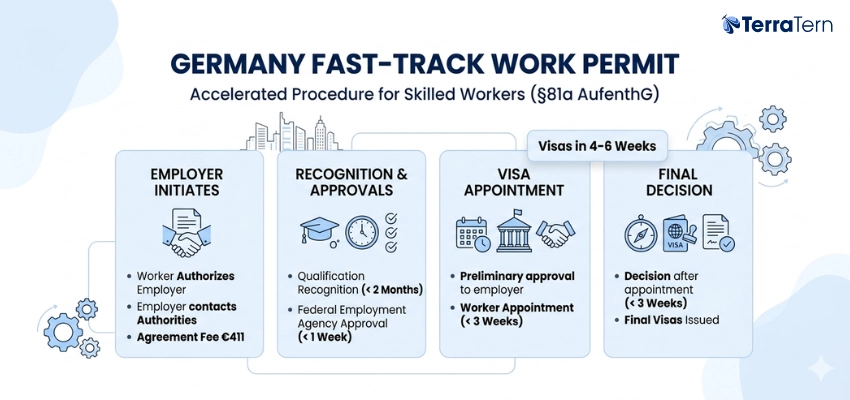
Here's the game-changer that most applicants don't know about. The Beschleunigtes Fachkräfteverfahren (fast-track procedure for skilled workers under §81a AufenthG) can now deliver work-and-residence visas in 4-6 weeks.
-
Step 1: Skilled worker authorizes employer with power of attorney
-
Step 2: Employer contacts foreigners authority in their federal state
-
Step 3: Agreement concluded with foreigners authority (fee: €411)
-
Step 4: Recognition procedure starts competent offices must decide within 2 months
-
Step 5: Federal Employment Agency approval within 1 week (or automatic consent)
-
Step 6: Preliminary visa approval issued to employer
-
Step 7: Worker gets visa appointment within 3 weeks
-
Step 8: Decision made within 3 weeks after appointment
As per TerraTern Expert, Divyash, The fast-track procedure is particularly valuable for Indian IT professionals and engineers in shortage occupations, as it provides predictable timelines and reduces uncertainty in relocation planning—a €411 investment that typically saves 2-3 months.
How Does the Fast-Track Procedure Reduce Processing Time For Germany Work Permit in 2026?
The fast-track procedure for skilled workers, also known as Beschleunigtes Fachkrafteverfahren, cuts the total processing time down to a fast 2-3 months (8-12 weeks) due to coordinated processing and the deadline requirement mandated by the law, compared with the 4-6+ month processing time for a standard procedure. This process has increased significantly in terms of how long does the Germany work permit processing take for skilled workers, as the employer can make the application for a fee of EUR411.
-
Qualification Recognition: Legally Limited, Maximum 2 Months (Standard 3-4 Months)
-
Federal Employment Agency Approval: Must be completed within 1 week max. (as opposed to 2-4 weeks).
-
Preliminary Approval: Estimated months to complete (from date of issuance Junta Pro Afor reusable and mission-critical components ) 1. December.
-
Embassy Visa Appointment: Assured within 3 weeks of receiving preliminary approval.
-
Visa Decision: Issued 3 weeks after the appointment at the embassy.
-
Eligibility: Needs a valid job offer, an employer based in Germany, and a non-employed worker who takes power of attorney from their employer.
As per TerraTern Expert, Divyash, the fast-track procedure is particularly valuable for Indian IT professionals and engineers in shortage occupations, as it provides predictable timelines and reduces uncertainty in relocation planning—a €411 investment that typically saves 2-3 months.
What Factors Affect Germany Work Permit Processing Time For Indians in 2026?
Factors influencing the processing time for German work permits: application completeness, the need for qualification recognition, the workload of the federal employment agency, the Embassy's capacity, the applicant's nationality, fluctuations in demand over the year, and requirements by occupation. To precisely estimate how long does the Germany work permit processing take for skilled workers, consider the following variables:
-
Application Completeness: Incomplete applications or missing translations on the application form can delay the timeline by 2-6 weeks due to document verification.
-
Qualification Recognition: This is the most significant variable, with standard recognition at 3-4 months, and IT Professionals frequently face this. Healthcare requires strictness with licenses.
-
Embassy Capacity: High-volume consulates (e.g. India, Turkey) may have wait times to get an appointment of 2-8 weeks, which are substantially longer than in smaller regions.
-
Review of application by Federal Employment Agency (BA): Standard review period up to 2-4 weeks, priority review in case of shortage occupations up to 1-2 weeks.
-
Seasonal Variations: Peak season (June - September) often brings 8-12-week delays, with a window between these two input reasons: student visa influx/winter, which is the quickest of the two!
-
Applicant Nationality: While most experience standard 1-2 week background checks, stronger security background checks for certain nationalities may take 3-6 weeks.
Key Note: Indian skilled workers in non-regulated IT and software roles have the shortest processing times (4-6 weeks) as they bypass qualification recognition, while healthcare professionals should expect 12-16 weeks due to mandatory licensing procedures.
How Long Does EU Blue Card Processing Take Compared to Standard Work Permits For Indians in 2026?
EU Blue Card processing typically takes 4–8 weeks, which is 20–30% faster than standard work permits (6–12 weeks). This expedited track is the primary reason why how long does the Germany work permit processing take for skilled workers varies significantly based on salary and qualification levels.
|
Permit Type |
Qualification Check |
BA Approval |
Embassy Processing |
Total Estimated Time |
|
EU Blue Card |
2–3 Weeks |
Not Required* |
2–4 Weeks |
4–8 Weeks |
|
Standard Work Permit |
3–4 Weeks |
2–4 Weeks |
2–4 Weeks |
6–12 Weeks |
Important Note: For Indian IT professionals earning above €50,700, the EU Blue Card offers not only faster processing (4-6 weeks) but also simplified family reunification and a pathway to permanent residency in just 21-27 months with German language skill
Also Read: Germany Work Visa Requirements for Indians
What Is the Step-by-Step Timeline for Germany Work Permit Processing?
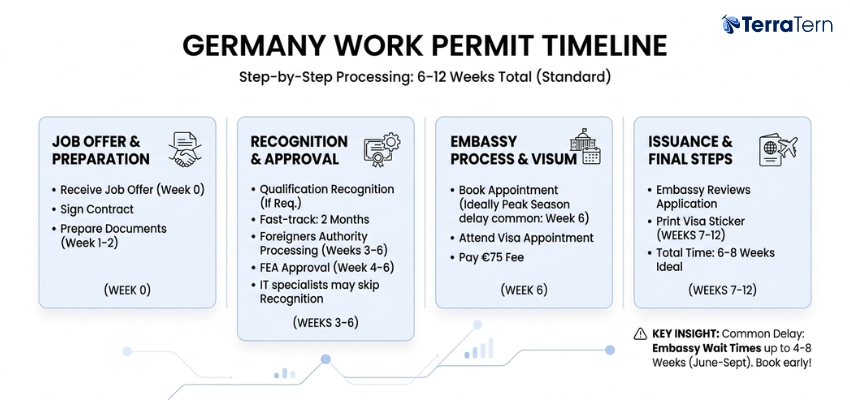
The Germany work permit process follows 7 key stages over 6–12 weeks. It begins with accepting the job offer (Week 0), moves through document preparation and authority approvals (Weeks 1–6), and concludes with the visa appointment and final issuance (Weeks 7–12). Understanding these stages helps clarify exactly how long does the Germany work permit processing take for skilled workers in your specific situation.
Here is the week-by-week breakdown of the process:
Stage 1: Job Offer & Contract (Week 0)
- Receive a formal job offer and sign the employment contract.
- Employer prepares the "Declaration of Employment" form.
Stage 2: Document Preparation (Weeks 1–2)
- Gather passport, degrees, CV, and health insurance proof.
- Obtain certified translations and Apostille/legalisation for documents (e.g., from MEA in India).
Stage 3: Qualification Recognition (Weeks 3–10)
- If required: Submit to ZAB or the relevant body. The standard process takes 3–4 months; the fast-track takes 2 months.
- Note: IT specialists often skip this step; it runs parallel to other steps.
Stage 4: Foreigners' Authority Processing (Weeks 3–6)
- Employer/Applicant submits documents to the local authorities in Germany.
- Authority reviews and coordinates preliminary approval.
Stage 5: Federal Employment Agency Approval (Weeks 4–6)
- The agency reviews salary and employment conditions.
- Timeline 2–4 weeks (Standard) vs. 1 week (Fast-track).
Stage 6: Visa Application at Embassy (Week 6)
- Book and attend an appointment at the German Embassy/Consulate.
- Submit biometric data and pay the €75 visa fee.
Stage 7: Embassy Processing & Issuance (Weeks 7–12)
- Embassy reviews the complete application and prints the visa sticker.
- Total Time 6–8 weeks (Ideal) to 16+ weeks (Complex cases).
As per TerraTern Expert Shreya, the most common delay point for Indian applicants occurs at Stage 6 (embassy appointment booking), where wait times can extend to 4-8 weeks during peak season (June-September). Apply for appointments immediately after receiving preliminary approval to avoid bottlenecks.
How Can You Expedite Your Germany Work Permit Application in 2026?
You can expedite your Germany work permit application by utilising the fast-track procedure (saves 2–3 months), ensuring 100% complete documentation to prevent verification delays, applying during off-peak seasons (October–March), and pursuing EU Blue Card eligibility to bypass certain agency approvals. Here are 10 actionable strategies to reduce your processing time and answer the question of how long does the Germany work permit processing take for skilled workers with the shortest possible timeframe:
-
Utilise the Fast-Track Procedure: Employer-initiated process (fee €411) that legally caps processing at 8–12 weeks, saving 2–3 months.
-
Ensure Perfect Documentation: Use official embassy checklists; missing financial proofs or signatures can add 2–6 weeks of delay.
-
Apply Off-Peak: Submit applications between October and March to avoid the June–September student visa rush (improves appointment availability by ~50%).
-
Leverage the EU Blue Card: If the salary allows (€50,700+), this route bypasses Federal Employment Agency approval, saving 2–4 weeks.
-
Start Recognition Immediately: Don't wait for the visa phase; begin ZAB qualification recognition immediately after the job offer.
-
Target Shortage Occupations: Roles in IT, engineering, and healthcare often receive priority review and have lower salary thresholds.
-
Hire Immigration Consultants: Professional review prevents errors that lead to rejections or resubmissions, saving potentially 2–4 weeks.
-
Book Appointments Early: Secure a slot immediately upon receiving preliminary approval; check multiple consulates (e.g., Delhi vs. Mumbai) for faster slots.
-
Prepare thoroughly for the Interview: bring originals, copies, and translations organised to avoid a "pending document" status.
-
Maintain Proactive Communication: regularly check status and respond instantly to document requests from the Foreigners' Authority.
Important Tip: Combining strategies 1, 2, and 4 (fast-track procedure + complete documentation + EU Blue Card) can reduce total processing time from 16 weeks to just 6-8 weeks for qualified Indian professionals, though this requires upfront employer investment and salary threshold eligibility.
What Are Common Delays For Germany Work Permit and How to Avoid Them in 2026?
The five most common Germany work permit processing delays are incomplete documentation (adds 2–6 weeks), qualification recognition issues (adds 3–6 months), embassy appointment backlogs (adds 4–8 weeks), Federal weeks). Minimising these delays is critical to reducing the time it takes to process Germany work permits for skilled workers.
|
Delay Type |
Time Added |
Common Issues |
Prevention Strategy |
|
Incomplete Documentation |
2–6 Weeks |
Missing financial proof, unsigned forms, and incorrect photo specs. |
Use official checklists; get professional review; prepare backup copies. |
|
Qualification Recognition |
3–6 Months |
Partial recognition, missing transcripts, unrecognised degrees. |
Start the ZAB process immediately; use the "Recognition Partnership" visa if eligible. |
|
Embassy Backlogs |
4–8 Weeks |
High demand (June-Sept), limited appointment slots. |
Book immediately after preliminary approval; apply Oct-Mar (off-peak). |
|
Agency (BA) Review |
2–4 Weeks |
Salary verification concerns, labour market tests. |
Ensure the job matches the qualifications; use Fast-track to limit the review to 1 week. |
|
Translation Issues |
1–3 Weeks |
Non-certified translators, missing Apostille stamps. |
Use only sworn translators; get an Apostille from the home country (e.g., MEA) early. |
Expert Advice: The single most effective delay prevention strategy is hiring a certified immigration consultant to review your application before submission—applicants who use professional review services experience 60-70% fewer delays and processing time 20% faster on average.
Also Read: Germany Cuts Visa Time for Indian Workers to 2 Weeks
How Has Germany's 2026 Online Application System Affected Processing Times?
Germany's mandatory online application system, fully implemented in April 2026, has reduced processing times by 15–20% for EU Blue Cards and skilled worker permits in key hubs like Berlin. The digitalisation initiative, led by Berlin's Landesamt für Einwanderung (LEA), has fundamentally changed how long does the Germany work permit processing take for skilled workers by streamlining the submission process for Blue Cards, researcher visas, and permanent residence applications.
-
Automated Verification: The system now performs instant completeness checks, reducing incomplete application rates by ~30% and saving 1–2 weeks of back-and-forth communication.
-
Digital Status Tracking: Applicants receive real-time updates and email notifications, eliminating the uncertainty of the "black box" waiting period.
-
Legal Stay Extension: Submitting the online form instantly generates a downloadable PDF confirmation. This document legally extends your existing residence status without requiring a separate "Fiktionsbescheinigung" appointment—saving roughly 1 week of administrative hassle.
-
Reduced Admin Burden: While biometric appointments are still required in the future, the initial "no-show" digital submission allows authorities to process the file before you even enter the building.
Pro Tip: While the online system reduces internal processing, it does not bypass embassy appointment wait times. Indian applicants should check if their specific Foreigners' Authority (Ausländerbehörde) accepts digital submissions, as this can shave 1–2 weeks off the total wait.
What Should Indian Skilled Workers Know About Germany Work Permit Timelines in 2026?
Indian skilled workers should plan for a total timeline of 10–14 weeks from job offer to visa-in-hand. This duration accounts for India-specific bottlenecks, such as high demand at German missions in Mumbai and Delhi (3–6 week appointment waits) and the mandatory document legalisation (Apostille) process.
For Indian applicants, the timeline is heavily influenced by jurisdiction and qualification recognition:
-
Embassy/Consulate Variations:
- Delhi: Highest volume; appointment wait times often hit 4–8 weeks.
- Mumbai: Moderate volume; waits average 3–6 weeks.
- Bangalore & Chennai: Generally faster, with waits often between 2–5 weeks.
-
Document Legalisation: Unlike some other nationals, Indian degrees must often be Apostilled by the MEA (Ministry of External Affairs) in India, which adds 1–2 weeks to the prep phase.
-
Qualification Recognition: Graduates from "Institutions of National Importance" (IITs/NITs) often see faster recognition (H+) in the Anabin database, whereas degrees from other universities may trigger a longer ZAB review (2–3 months).
Realistic Timeline for Indian Professionals
|
Professional Profile |
Visa Type |
End-to-End Timeline |
Primary Factors |
|
IT Specialist |
EU Blue Card |
8–12 Weeks |
How long does the Germany work permit processing take for skilled workers in IT? Fast. Often, no ZAB needed; priority embassy slots. |
|
Mechanical Engineer |
Skilled Worker |
12–16 Weeks |
Requires ZAB recognition; standard embassy processing lanes. |
|
Nurse (Kerala/General) |
Recognition Partnership |
16–24 Weeks |
Most extended duration due to language tests, Deficit Notification, and licensing. |
As per TerraTern Expert: Indian IT professionals applying through the Bangalore consulate during off-peak months (October-February) with EU Blue Card eligibility can achieve the shortest possible timelines of 8-10 weeks, while those in regulated professions should realistically plan for 4-5 months from job offer to Germany arrival.
When Should You Start Your Germany Work Permit Application in 2026?
You should start your Germany work permit application 4–5 months before your desired start date. This buffer allows you to comfortably navigate the 10–14 week processing average while managing your current notice period and potential "peak season" delays at German consulates.
Ideal Germany Work Permit Application Timeline Breakdown:
|
Phase |
Timing (Months Before Start) |
Key Activities |
|
Preparation |
Month -5 |
Sign the contract; Check the Anabin database; Apply for a university degree certificate (if missing). |
|
Documentation |
Month -4 |
Start MEA Apostille process; Translate documents; Employer requests "Fast-Track" (if applicable). |
|
Submission |
Month -3 |
Submit online application (where available); Book embassy appointment immediately. |
|
Processing |
Month -2 |
Attend a biometric interview. How long does the Germany work permit processing take for skilled workers here? 2-4 weeks for decision. |
|
Relocation |
Month -1 |
Resign from current job (serve notice); Book flights; Secure temp housing. |
Key Note: The golden rule for Indian professionals is to start the process the same month you receive a job offer—even if your desired start date is 6-8 months away—because early submission during off-peak months dramatically reduces delays and provides flexibility if complications arise.
Also Read: Job Seeker Visa Germany From India: Exclusive Experts
How Do Regional Processing Times Vary Across German States in 2026?
Processing times vary drastically by region. Berlin has improved to 6–8 weeks post-digitalisation, but Munich and Hamburg remain competitive at 5–8 weeks. Smaller cities like Leipzig can process applications in as few as 4–6 weeks due to lower application volumes, while industrial hubs in the West may still lag.
Regional Processing Times Comparison
|
City / Region |
Average Processing Time |
Digital System Status (2026) |
Notes |
|
Leipzig / Dresden |
4–6 Weeks |
Fully Active |
Fastest due to lower volume and high-tech focus. |
|
Hamburg |
5–7 Weeks |
Fully Active |
"Hamburg Welcome Centre" efficiently expedites skilled workers. |
|
Munich (Bavaria) |
6–8 Weeks |
Active |
High volume but very efficient staffing; strict on documentation. |
|
Berlin |
6–8 Weeks |
Mandatory Online |
Improved from 10+ weeks. How long does the Germany work permit processing take for skilled workers here? Much faster now. |
|
Frankfurt |
6–8 Weeks |
Active |
High volume of finance/business visas; moderate speed. |
|
Stuttgart |
8–10 Weeks |
Partial |
Slower due to high demand in the automotive sector and complex cases. |
As per TerraTern Expert, Shreya, if you're an Indian IT professional with job offers from multiple German cities, choosing Leipzig or Hamburg over Berlin could save you 2-4 weeks in processing time, though Berlin's new online system (post-April 2026) is closing this gap and offers more job opportunities.
Common Mistakes That Delay Germany Work Permit Processing
Many skilled workers unknowingly cause their own delays by making preventable mistakes. Avoiding these common errors can save you weeks of waiting time.
-
Submitting Incomplete Documentation: Each missing paper adds 1-2 weeks; always use the official consulate checklist before applying
-
Applying During Peak Seasons (March–June, September–December): Processing times increase 30% during busy periods, turning 6 weeks into 8-10 weeks.
-
Not using Fast-track When Employer-sponsored: Many eligible workers miss the 4-6 week fast-track option that saves 4-6 weeks versus standard processing.
-
Waiting too Long to Schedule Visa Appointment: Consulates have 4-6 week appointment backlogs; book 6 months in advance once you have a job offer.
-
Ignoring Qualification Recognition Requirements: Non-EU degrees need equivalence assessment adding 2-4 weeks; check Anabin database before applying.
How Can TerraTern Help With Germany Work Visa for Skilled Workers?
TerraTern streamlines your migration journey by offering specialised support tailored to the latest 2026 regulations:
-
Eligibility Assessment: We evaluate your profile to identify the optimal visa category (Blue Card vs. Skilled Worker) to ensure you choose the fastest route.
-
Document Perfection: Our team reviews every document for compliance and completeness, preventing errors that typically extend how long does the Germany work permit processing take for skilled workers.
-
Application Management: We handle the complexities of form-filling and embassy appointment scheduling, reducing administrative burdens.
-
Post-Approval Support: From travel insurance to initial relocation advice, we assist you even after the visa is granted
Conclusion
Germany work permit processing takes 6-12 weeks for skilled workers under standard procedures, but the fast-track option reduces this to 4-6 weeks for employer-sponsored candidates. The 2026 reforms have cut processing times dramatically from the 14-20 week averages of 2023, with AI pilots now delivering some cases in just 15 days. If you're a skilled worker planning your move, prepare complete documents, apply outside peak seasons (March–June, September–December), and ask your employer about the fast-track procedure. With Germany targeting over 400,000 skilled workers by 2026, now is the best time to start your application.
Contact TerraTern for more information on How Long Does the Germany Work Permit Processing Take for Skilled Workers.




 AI Summary