


Key Highlights
- What Is a Fake Canada Visa and Why Is It a Growing Crisis in India?
- What Are the Physical Signs of a Fake Canada Visa?
- How Can You Check If a Canada Visa Is Real or Fake Online?
- What Are Canada Visa Fake Documents and How Are They Used?
- What Are the Consequences of Using a Fake Canada Visa?
- How Can You Avoid Getting a Fake Canada Visa? (Prevention Guide for Indian Applicants)
- What Should You Do If You Have Received a Fake Canada Visa?
- How Can TerraTern Help You Get a Genuine Canada Visa?
- Conclusion
Using a fake Canada visa may seem convincing, but it can get you into serious trouble, including travel bans, fines and even criminal charges if the visa is discovered. Never get a Canada visa fake documents, and always check on the official websites, such as Immigration, Refugees and Citizenship Canada (IRCC) online services to verify the visa.
To ensure a smooth and hassle-free travel experience in 2026, this guide outlines the steps for checking if your visa is real or fake, the process of matching your visa details, and how it can be verified through IRCC's portal.
What Is a Fake Canada Visa and Why Is It a Growing Crisis in India?
A fake Canada visa is a fake immigration document or a tampered or altered document to deceive the applicant and/or the Immigration Officer in Canada.
- Altered Genuine Visas: Real visas with dates, names, or visa types changed are fake Canada visas.
- Completely Fabricated Visas: visa documents that are entirely fabricated and do not have any official stamp from IRCC.
- Stolen Blank Visa Foils: Genuine blank visa stickers that have been stolen and filled in with false applicant information.
- Indian Applicants Alerted by IRCC About Visa Fraud: More than 10,000 bogus student acceptance letters were identified, many of them from Gujarat and Punjab.
- Applicants from India who target Canada visas are easily at risk because of third-party agents, language barriers and lack of knowledge on how to check Canada visa real or fake.
- Fake agents’ tactics: social-media ads promising “guaranteed” visas, no advance fees, or “15-day processing” are major red flags indicating a fake Canada visa scam.
As per TerraTern Expert, Shreya, India-based scam agents often advertise on Instagram and YouTube, showing stacks of passports with Canadian visas. This is a criminal red flag, not a success story. IRCC has never authorised any private agent to guarantee visas.
Also Read: How to Check if a Canada Visa is Original or Fake
What Are the Physical Signs of a Fake Canada Visa?
It is easy to see with a careful look if a Canada visa is fake. Here are five neat indications:
-
Genuine vs Fake Canada Visas: fonts and layout: Genuine visas employ a single clean font, fake Canada visas use multiple fonts or have uneven spacing between “Canada.”
-
Bilingual (French): official visas are issued, but fake Canada visas frequently contain incorrect French text or “Document No.” errors.
-
The Watermark Test: If a light is shone on the visa, the real visa's name should be visible above the watermark, whereas the fake visa's name is usually obscured by the watermark.
-
Holograms and Microprinting: True Canadian visas will have shifting holograms and fine microprinting; fake Canada visas will either lack microprinting or have poor microprinting.
-
Paper, Ink, and Stamp: real visas are printed on special paper and are no more smudgeable than cheap printouts and often do not have an official Canada visa stamp or signature.
A quick comparison table to tell the difference between real and fake Canada visas.
|
Feature |
Genuine Canada Visa |
Fake Canada Visa |
|
Font & spacing |
Uniform font, correct spacing under “Canada” |
Mixed fonts, too-narrow spacing |
|
French text |
Correct Canadian-French wording |
Misspellings, wrong “Document No.” |
|
Watermark |
Surname over watermark when held to light |
Watermark over surname or missing |
|
Hologram/microprinting |
Visible shifting emblem and microprint |
Flat logo or no microprint |
|
Paper/ink/stamp |
Thick security paper, no smudge, official stamp |
Thin paper, smudging, weak or missing stamp/signature |
Important Note: The watermark test is the single fastest physical check. If the watermark sits on top of your name instead of behind it, stop, do not travel, and contact IRCC immediately.
What Does a Genuine Canada Visa Sticker Look Like?
A genuine Canada visa is not a PDF sent to you by email, but a sticker inside your passport. Key traits:
-
A bilingual label in both English and French at the top, a clear applicant photo and “Canada” at the top.
-
Visa number, visa valid dates, type of visa (single/multiple) and a visa category code (V-1), etc.
-
Always sent with a sticker, if it is sent by email (as an attachment), it is a fake “visa”.
-
You can confirm your visa status and number by logging into the IRCC portal at secure.canada.ca.
-
Security paper of good quality with holograms and microprinting, which indicates that it is authentic and not a fake Canada visa.
How Can You Check If a Canada Visa Is Real or Fake Online?
You can verify a Canada visa online by logging in to your IRCC account via GCKey or Sign-In Canada, then cross-checking that your visa number, status, and approval match the physical sticker. Here’s how to quickly check for a fake Canada visa and confirm how to check Canada visa real or fake in a few steps:
-
Log in to secure.canada.ca using your GCKey; if you used a consultant who refuses to share your login credentials, it may indicate a fake Canada visa.
-
Go to “View My Submitted Applications” and ensure your status shows “Decision Made” with approval matching your document.
-
Match the unique visa number on your sticker with the one in IRCC; any mismatch or missing entry strongly suggests a fake Canada visa.
-
Confirm that approval emails come only from @gc.ca or @canada.ca domains; Gmail/Yahoo “IRCC” emails are a red flag.
-
Confirm that your visa expiry date matches the dates on your official IRCC approval letter. Do not rely on a single formula to calculate expected validity.
-
If unsure, call IRCC at +1-613-944-4000, visit a Canadian High Commission (New Delhi, Mumbai, Chandigarh), or use IRCC’s Contact Us web form to safely verify how to check Canada visa real or fake.
Expert Tip: If your immigration consultant refuses to share your GCKey login details or claims they "handle it for you," demand access. Your GCKey account belongs to you, not your agent.
How to Verify a Canada Visa Without a GCKey Account?
If you applied through an agent and never created a GCKey, you can still confirm whether your visa is a fake Canada visa:
-
Create a GCKey retrospectively using your UCI (Unique Client Identifier) and application reference number.
-
Call IRCC directly with your UCI and application number to confirm your visa status and number.
-
Visit the nearest Canadian High Commission or Consulate in India (New Delhi, Mumbai, Chandigarh) for in-person verification.
-
Approach the Canadian VAC operated by VFS Global India; staff can guide you on how to check Canada visa real or fake through official channels.
-
You can create your own GCKey account retroactively using your UCI and application number, giving you direct access to your application status without relying on your agent.
What Are Canada Visa Fake Documents and How Are They Used?
Canada visa fake documents include forged acceptance letters, fraudulent approval emails, counterfeit visa stickers, and altered financial or identity documents submitted as part of a visa application, used by scam agents to deceive both applicants and immigration authorities.
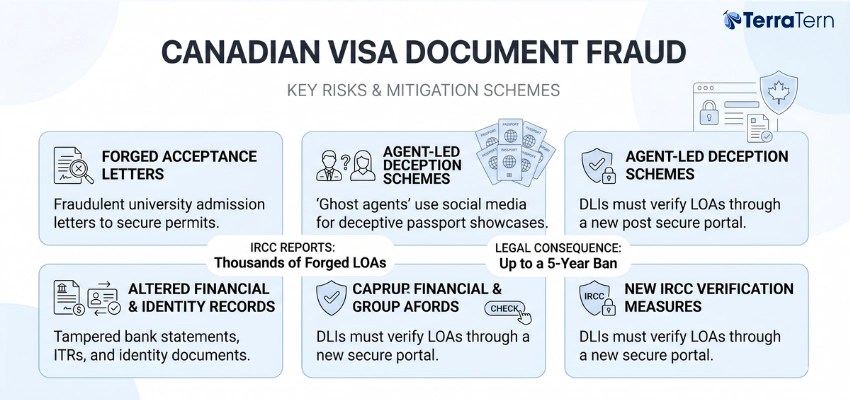
1. The ecosystem for a fake Canada visa relies on sophisticated deception. IRCC has publicly reported thousands of forged Letters of Acceptance in recent years. For the most current figures, refer to official IRCC enforcement communications.
2. In regions like Punjab and Gujarat, "ghost agents" use social media to showcase stacks of passports with counterfeit stickers.
3. Multiple high-profile prosecutions in 2023–24 have involved agents defrauding hundreds of Indian students through forged acceptance letters. Hundreds of students faced deportation due to these fraudulent schemes.
4. To combat Canada visa fake documents, the IRCC’s 2024 verification system now requires Designated Learning Institutions (DLIs) to verify every LOA through a secure portal.
5. Despite these safeguards, the legal burden remains on the applicant; submitting forged paperwork, even unknowingly, can result in a five-year ban from Canada.
-
Forged LOAs: Fraudulent university admission letters used to secure student permits.
-
Spoofed Emails: Messages from lookalike domains mimicking IRCC letterheads.
-
Counterfeit Stickers: Non-genuine visa foils physically placed in passports by agents.
-
Altered Financials: Tampered bank statements or ITRs used to inflate proof of funds.
-
Fabricated Employment: Fake job letters used to prove "ties" to the home country.
|
Type of Fake Document |
How It's Used? |
How to Detect It? |
|
Acceptance Letters |
To bypass student visa entry requirements. |
Cross-check the DLI number on the official IRCC website. |
|
Visa Stickers |
To convince victims that their "visa" is ready for a fee. |
Check for missing security features/watermarks under UV light. |
|
Approval Emails |
To trick applicants into paying "courier" or "biometric" fees. |
Verify the sender’s address ends strictly in @gc.ca or @canada.ca |
|
Bank Statements |
To meet strict financial capacity thresholds. |
Confirm balances directly with the bank’s official portal/branch. |
|
Employment Letters |
To falsely demonstrate a stable career back home. |
Call the listed employer using a verified public number. |
Expert Advice: Since December 2023, Canadian post-secondary institutions have been legally required to verify all acceptance letters via IRCC's online portal. Any agent claiming to "guarantee" admission without this step is engaging in fraud.
Also Read: SEO Jobs in Canada: Latest Pay, Scope, Tips & More
What Are the Consequences of Using a Fake Canada Visa?
Presenting a fake Canada visa or Canada visa fake documents triggers severe penalties across two jurisdictions. In Canada, the CBSA may detain and deport you, and then impose a five-year ban for misrepresentation
-
Immediate CBSA Action: Detention at the port of entry followed by a formal removal or deportation order.
-
Five-Year Ban: A finding of misrepresentation by the IRCC bars you from all Canadian immigration programs and travel.
-
Criminal Prosecution: Criminal prosecution may also occur under relevant sections of India's Bharatiya Nyaya Sanhita (BNS) relating to forgery and fraud. Verify the applicable section with a qualified Indian legal professional.
-
Permanent Fraud Record: A digital "red flag" in the IRCC system that alerts authorities globally to previous fraud attempts.
-
Total Financial Loss: Forfeiture of all visa fees, tuition, and airfare, alongside the high costs of legal defence for deportation.
-
Indian Enforcement: Indian authorities may take action against unlicensed visa agents under applicable consumer protection and fraud statutes. The Emigration Act governs overseas employment recruitment separately.
Important Tip: If you are a genuine student who unknowingly received fake documents from an agent, report immediately to IRCC Canada, which has explicitly stated it will not penalise non-complicit victims. Waiting only worsens your position.
How Can You Avoid Getting a Fake Canada Visa? (Prevention Guide for Indian Applicants)
To avoid a fake Canada visa, always apply through IRCC's official portal, verify your consultant's credentials on the CICC public register, never pay fees via informal channels, and insist on receiving your GCKey login credentials.
Protect yourself from document fraud and unauthorised agents by following this strict prevention checklist:
-
Apply Directly Through the Official IRCC Portal: The only legitimate gateway is ircc.canada.ca. Avoid third-party sites charging for free application forms.
-
Verify Consultant Registration: Ensure your agent is listed on the College of Immigration and Citizenship Consultants (CICC) public register at college-ic.ca, and registered with the MEA in India.
-
Never Pay Informally: IRCC only accepts payments to the "Receiver General for Canada." Refuse requests via Western Union, UPI, or personal bank transfers.
-
Demand Your GCKey Details: Your IRCC account is personal. An agent refusing to share your login credentials is a major red flag.
-
Check IRCC Emails and DLI Status: Legitimate emails end strictly in @canada.ca or @cic.gc.ca. Students must also verify their college is on the official Designated Learning Institution (DLI) list.
-
Reject "Guaranteed Visa" Claims: IRCC states that no one can guarantee a visa; legitimate consultants charge for services, not the visa itself.
Pro Tip: The single biggest red flag in India's Canada visa scam ecosystem is the "no advance, all payment on reach" promise. This model only works if the agent is confident you won't check the visa's authenticity until you're already at the airport.
What Should You Do If You Have Received a Fake Canada Visa?
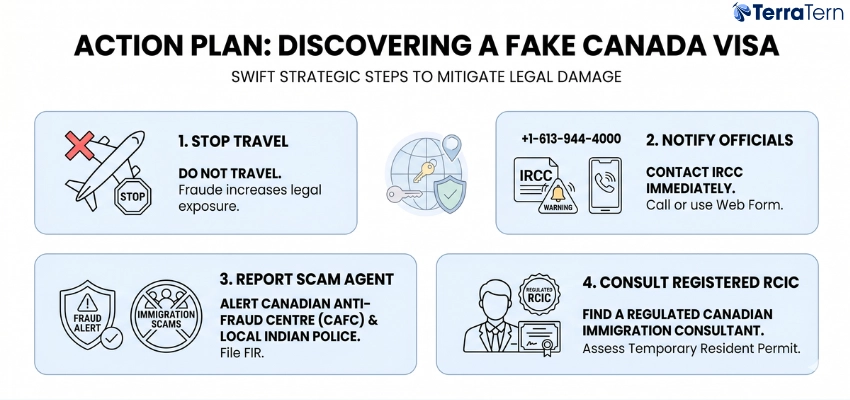
Discovering that you are holding a fake Canada visa can be terrifying, but taking swift, structured action can mitigate the legal damage.
-
Step 1: Do Not Travel. Attempting to enter Canada with a fraudulent document significantly increases your legal exposure.
-
Step 2: Contact IRCC Immediately. Use the official IRCC Web Form online or call +1-613-944-4000 from India. Alternatively, visit your nearest Canadian High Commission or Consulate (e.g., 7/8 Shantipath in New Delhi, Tower 2 in One BKC Mumbai, or Elante Office Complex in Chandigarh).
-
Step 3: Report to the Canadian Anti-Fraud Centre (CAFC). File a report online at antifraudcentre-centreantifraude.ca. The CAFC uses this crucial intelligence to track and shut down immigration fraud networks operating out of India.
-
Step 4: Report to Your Local Police in India. File an FIR against the scam agent immediately. This establishes a legal paper trail proving you are a victim, which is essential for your defence under Indian law and subsequent IRCC proceedings.
-
Step 5: Alert the CBSA Border Watch Line. If you have information about an agent defrauding multiple people, call the CBSA Border Watch at 1-888-502-9060 to report their operations.
-
Step 6: Consult a Registered RCIC. Find a Regulated Canadian Immigration Consultant (RCIC) via college-ic.ca. They can assess your unique situation and determine whether you qualify for a Temporary Resident Permit despite unknowingly being defrauded.
Key Note: Reporting fraud, even if embarrassing, protects your future immigration prospects. IRCC's task force has confirmed that non-complicit victims will not be removed from Canada. Silence, however, offers no protection.
Also Read: Canada Tourist Visa from India: Fees, Eligibility, Time
How Can TerraTern Help You Get a Genuine Canada Visa?
TerraTern provides end-to-end Canada visa assistance through registered immigration consultants, ensuring all applications are submitted directly through official IRCC channels with full transparency and document verification. We protect our clients from the severe dangers of a fake Canada visa by maintaining absolute transparency throughout the entire process.
-
Direct IRCC Submissions: We process all applications exclusively through the official IRCC portal, eliminating any risk of Canada visa fake documents entering your file via unverified third-party systems.
-
Transparent Fee Structure: All our service charges are clearly outlined up front, with no requests for informal payments or hidden transactions.
-
Full GCKey Access: We provide you with your personal GCKey login credentials, allowing you to track your real-time status so you never have to guess how to check canada visa real or fake.
-
Rigorous Document Verification: Our experts thoroughly authenticate every letter, statement, and certificate before submission to prevent unintentional misrepresentation.
-
CICC-Registered Consultants: Your application is handled by authorised professionals legally recognised by the Canadian government to provide immigration services.
As per TerraTern Expert: A genuine immigration consultant's value lies not in "getting you a visa," but in ensuring your application is so complete and accurate that no visa officer has reason to doubt it.
Conclusion
Falling victim to a fake Canada visa can permanently derail your international career. Navigating the risks of Canada visa fake documents requires extreme vigilance and adherence to official IRCC procedures. If you are uncertain how to check canada visa real or fake, always rely on registered consultants who prioritise transparency. By choosing a trusted partner like TerraTern, you ensure your application remains authentic, secure, and fully compliant with 2026 regulations.