

Key Highlights
- What are F1 Visa Interview Questions With Answers?
- What Changed in F1 Visa Interviews for 2026?
- How Do Visa Officers Decide Whether to Approve or Refuse an F1 Visa?
- What F1 Visa Interview Questions Are Asked About Your Study Plan?
- What F1 Visa Interview Questions Are Asked About Your University Choice?
- What F1 Visa Interview Questions Cover Your Academic Background?
- What F1 Visa Interview Questions Focus on Your Financial Status?
- What F1 Visa Interview Questions Ask About Your Plans After Graduation and Ties to India?
- What Other F1 Visa Interview Questions Should You Prepare For?
- What Documents Should You Carry to Your F1 Visa Interview?
- What Should You Wear and How Should You Behave in the Interview?
- What Are the Best Tips to Answer F1 Visa Interview Questions Confidently?
- What Happens If Your F1 Visa Is Rejected Under Section 214(b)?
- Conclusion
Getting a student visa to the USA in 2026 isn’t just about receiving an admission letter. For Indian applicants, the F-1 refusal rate hit around 61% in 2025, the highest in recent years. Your approval depends on a 3-minute interview with the consular officer during which you must demonstrate in a confident manner your non-immigrant intent and financial stability.
We prepared the ultimate guide to attending your F1 visa interview with answers for Indian students, so you can know the most common F1 visa interview questions with answers to sail through this high-stakes process.
What are F1 Visa Interview Questions With Answers?

Practising with F1 visa interview questions with answers will aid you in demonstrating your true non-immigrant intent. Section 214(b) of the U.S. immigration law legally assumes you are going to immigrate. The questions are always the same and fall into five basic categories:
-
Study Plans: What motivated you to take this particular degree in the US?
-
University Preferences: Detailed information on the university that accepted you.
-
Academic Background: What experiences and education make you a good fit for this program?
-
Funds: Your specific and documented sources of funding to meet all costs.
-
Post-Graduation Intentions: Steps towards a specific career that you need to take back home.
Also Read: Nursing Jobs in USA: Experts Latest Jobs & Salaries
What Changed in F1 Visa Interviews for 2026?
Reportedly, one of the most frequent questions in this section of the F1 visa interview, with answers, is why the candidate selected her/his course, field of study and the United States in particular , establishing the intent of selecting a specific course and a specific geographic location, not a generic one.
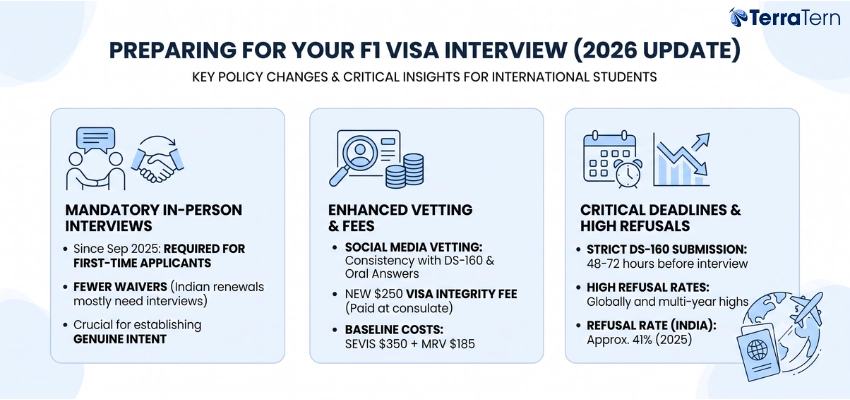
It is crucial to prepare genuine responses to F1 visa interview questions to ensure that you do well in this stringent setting. The following are some of the major policy changes affecting the F1 visa interview questions in 2026.
From 2 September 2025, US consulates effectively require in-person interviews for all first-time and almost all renewal F-1 applicants, especially in India. Only a narrow group of same-category renewals with very recent prior visas can still qualify for an interview waiver in some countries.
-
Enhanced Social Vetting: Public accounts are vetted for consistency with your DS-160 and the answers given orally since June 2025.
-
Visa Integrity Fee: Since 1 October 2025, most temporary US visas, including F-1, carry an additional $250 ‘Visa Integrity Fee’, collected at the consulate when your visa is issued, on top of the $185 MRV fee.
-
Baseline Costs: The SEVIS I-901 fee for F-1 is $350, and the MRV visa application fee is $185 (around INR 18,500).
-
Strict Deadlines: DS-160 must be submitted 48-72 hours before the interview date.
-
High Refusals: State Department data shows refusal rates are at multi-year highs around the world, and industry data for India puts the rate at 41% for 2025.
As per TerraTern Expert Divyansh, Every F1 applicant interviewing in 2026 should assume a fully in-person process with social media review baked in." Hoping for a waiver is no longer a viable strategy, so budget real prep time.
How Do Visa Officers Decide Whether to Approve or Refuse an F1 Visa?
All applicants are presumed to be intending to immigrate pursuant to INA Section 214(b) by law. This makes all your F1 visa interview questions with answers , irrespective of their content, essentially about your "credible intention to return to India after completing your studies!"
Officers evaluate your case using five core pillars:
-
Academic credibility
-
Financial credibility
-
Relations with the native country
-
Consistency (across your DS-160, documents and verbal answers)
-
Clarity and brevity of your answers.
A 214(b) refusal is usually mistaken by the applicant as a 221(g) hold. They are clearly different results:
|
Feature |
214(b) |
221(g) |
|
Definition |
Final visa refusal at the interview |
Temporary "administrative processing" hold |
|
Next Steps |
Reapply anytime with a new fee |
Wait for case-specific clearance |
|
Action Required |
Submit a new application; no formal appeal |
May require submitting additional documents |
Important Note: Don't try to guess "the right answer"; focus every response on being specific, consistent with your documents, and honestly tied to a plan to return to India.
What F1 Visa Interview Questions Are Asked About Your Study Plan?
Reportedly, one of the most frequent F1 visa interview questions with answers is why the candidate selected her/his course, field of study and the United States in particular, establishing the intent of selecting a specific course and a specific geographic location, not a generic one.
Why do you want to study in the USA?
Identify 1-2 learning strengths of US universities that you'd like to have access to, particularly with respect to a component of your academic program that you're not getting at home; don't cite any “oh-this-might-be-a-good-idea” learning attributes.
-
Whether your reasoning is US-wide rather than a straight-out-of-the-books threat that might be applicable in any other country, one of the most commonly asked F1 visa interview questions with answers for a reason: vague answers mean that your application is not, well, prepared.
Why did you choose this specific course/specialisation?
Connect the course in practical terms to an academic or work experience that brought you to the program and, finally, reference one particular part of the program that attracted you (a module, lab, or specialisation track of a program).
-
What Officers are Looking At: Alignment of your background provided in your statement (transcripts, work experience) with your course selection.
-
If the Answers are not Consistent, it is a huge red flag when it comes to F1 visa interview questions with answers, and therefore is the section that provides the most opportunity to delve into the answers in more detail.
Why not Pursue this Course in India?
Specify a particular measurable challenge identified, narrow the scope of specialisations, lack of research living labs, lack of industry exposure, etc., in India, but do not denigrate institutions globally.
-
What Officers are Asking: That you are making a sound educational choice; we plug them in because this is one of our ‘catch and check' questions with US visa answers during the interview, when we need to see if you just want to go to a US university for the sake of going, or if you've made a sensible educational decision.
How does this course connect to your career goals?
State a clear, specific career goal (role/industry) and then connect the course content/skills to that goal; avoid any leaps such as "better opportunities.
-
What Officers are Looking for: Genuine desire and intent to return to India and use those skills, as immigrant intent is one of the toughest F1 visa interview questions with answers, and there's a strong case for it being a clear and logical career development that makes the officer feel comfortable, meaning no intent but clearly promises to return to India.
Expert Advice: Avoid generic praise of the US education system; anchor every study-plan answer to one specific, checkable detail (a module, a professor, a lab, a ranking metric relevant to your field).
Also Read: How Many Types of Visa in USA? New Full Expert Guide
What F1 Visa Interview Questions Are Asked About Your University Choice?
These questions confirm you researched and chose your university deliberately rather than applying broadly and accepting whichever offer arrived first. Reviewing these F1 visa interview questions with answers helps demonstrate that your decision aligns with your academic goals:
-
Academic intent: Evaluating whether your choice is driven by program quality.
-
Application logic: Verifying consistency in your university shortlist.
-
Diligence: Confirming you thoroughly evaluated the program before committing.
Why did you choose this university?
Cite 2–3 specific reasons like specialised research labs, a renowned professor's work, or a unique curriculum structure. Avoid generic statements about high rankings.
-
What Officers are Checking: Proof that you selected this institution for distinct academic merits rather than prestige or location alone.
How many universities did you apply to, and how many accepted you?
State your exact numbers clearly (e.g., "I applied to four universities, was accepted by three, and rejected by one").
-
What Officers are Checking: Transparency, realistic academic self-assessment, and consistency with your SEVIS record.
Where is your university located, and why does that matter for your field?
Connect the city or region to academic advantages or relevant industry presence, completely avoiding mentions of climate, lifestyle, or tourist attractions.
-
What Officers are Checking: A strictly academic focus rather than a desire to live in a specific US region.
How did you research and shortlist this university?
Detail your methodology, such as attending university webinars, analysing course modules, comparing faculty publications, or reaching out to current students.
-
What Officers are Checking: Proactive effort and genuine initiative as a serious international student.
Expert Tip: If you applied to 8–10 universities, be ready to explain briefly why this one won, not just that it did.
What F1 Visa Interview Questions Cover Your Academic Background?
Officers check whether your prior education, test scores, and academic record credibly prepare you for the program level you're entering. Reviewing these F1 visa interview questions with answers helps demonstrate your academic readiness and credibility:
-
Academic Foundation: Verifying required prerequisite coursework
-
Testing Integrity: Validating language and aptitude scores.
-
Study Progression: Ensuring a clear, logical academic trajectory.
What are your test scores (IELTS/TOEFL/GRE/GMAT)?
State your exact scores clearly (e.g., "I scored 320 on the GRE and 7.5 on IELTS"). If waived, state the official institutional waiver policy.
-
What Officers are Checking: Academic readiness and alignment with the admitting university’s minimum entrance standards.
What was your previous academic performance/percentage/CGPA?
State your CGPA or percentage directly, highlighting strong grades in core, field-relevant subjects or a positive upward trend over time.
-
What Officers are Checking: Past performance consistency to ensure you are capable of handling rigorous US coursework.
How is this course different from or a progression from your previous studies?
Explain how this degree builds directly on your bachelor's by adding advanced technical depth or specialised research training unavailable in your prior studies.
-
What Officers are Checking: A coherent, logical educational progression rather than an abrupt, unexplained pivot in study fields.
How will you manage studying and living in English?
Point to your official language test scores and highlight your complete educational background in English-medium schools and universities in India.
-
What Officers are Checking: Fluency to ensure you can actively participate in lectures without academic failure or language barriers.
How do you explain an academic gap year if you have one?
Account for the time directly by detailing productive activities like relevant work experience, professional certifications, research, or exam preparation.
-
What Officers are Checking: Purposeful, documented use of time rather than unaccounted periods or passive waiting.
Important Tip: State your scores and percentages exactly as they appear on your official documents; a verbal answer that doesn't match your transcript raises a credibility flag even when the underlying number is fine.
What F1 Visa Interview Questions Focus on Your Financial Status?
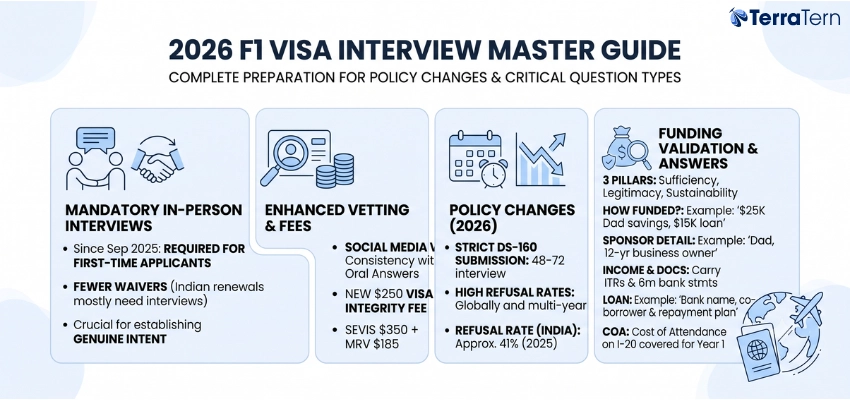
Financial questions verify that your funding is sufficient, legitimate, and traceable, not just that a number on paper covers the cost. Preparing your F1 visa interview questions with answers around finances ensures you can prove financial stability:
-
Sufficiency: Can you genuinely afford the full I-20 cost?
-
Legitimacy: Are your liquid funds real and traceable?
-
Sustainability: Can your sponsor maintain this support without forcing you to work illegally?
How will you fund your education in the USA?
Explicitly state the combination of your funding sources, such as family savings, an approved education loan, and any university scholarships, mentioning exact figures for each.
-
What Officers are Checking: A clear, immediate command of your financial strategy; vague answers about family wealth instantly trigger red flags.
Who is sponsoring you, and what do they do?
Name your sponsor (ideally parents or immediate family), their specific job title, and their employer or business duration. For example, "My father, a civil engineer running his own firm for 12 years..."
-
What Officers are Checking: They are verifying the legitimacy of the sponsor and ensuring their professional background logically aligns with the wealth they are providing.
What is your sponsor's income, and how is it documented?
State the exact annual income, and mention that you carry the last six months of original bank statements and recent Income Tax Returns (ITRs) to prove it.
-
What Officers are Checking:: Consistency between the claimed income and the accumulated savings; massive liquid assets from a low-income sponsor will immediately trigger a visa denial.
What is the total cost of your program, and how is it fully covered?
State the exact first-year Cost of Attendance (CoA) printed on your I-20, which includes tuition and living expenses. Confirm your liquid funds cover this, with a plan for year two.
-
What Officers are Checking: That you actually reviewed your I-20 and possess readily available, easily convertible liquid funds for all immediate financial obligations.
If you have an education loan, how much is sanctioned and disbursed?
State the bank's name, the officially sanctioned amount, the collateral used, and your co-borrower. Briefly mention how your expected career in India will allow you to repay the EMI.
-
What Officers are Checking: That the loan is from a recognised institution, formally sanctioned, and supported by a realistic repayment plan tied to returning to your home country.
As per TerraTern Expert: A smaller, fully documented and consistent funding picture is stronger than a larger amount you can't clearly explain the source of.
What F1 Visa Interview Questions Ask About Your Plans After Graduation and Ties to India?
This is the category most directly tied to Section 214(b). Officers want a specific, credible reason you will return to India, not a vague promise. Mastering these F1 visa interview questions with answers helps you demonstrate strong home-country ties:
-
Career Ties: Explicit job roles waiting for you in India's growing market.
-
Financial Ties: Family assets or inherited property in India.
-
Social Ties: Immediate family obligations requiring your return.
What are your plans after completing your degree?
Name a specific target role, industry sector, or even 2–3 target companies in India, explaining how this degree uniquely qualifies you for that career back home. You can mention utilising OPT for practical experience, but emphasise that your long-term plan is in India.
-
What Officers are Checking: Concrete post-graduation intent that mandates your physical return to India rather than staying in the US to hunt for an H1B sponsorship.
Do you intend to return to India after your studies?
State a firm "Yes," and back it up by citing specific career opportunities, market growth in the Indian sector you are targeting, or personal/family commitments (like joining a family business).
-
What Officers are Checking: Convincing, non-scripted proof of non-immigrant intent, showing your ultimate long-term future is strictly in India.
What job or career do you see yourself in after graduation?
State the exact job title (e.g., "Data Architect at a fintech firm in Bangalore") and mention the realistic expected starting salary range for US-educated candidates in India.
-
What Officers are Checking: A realistic career plan grounded in current Indian market demands to ensure your Return on Investment (ROI) calculations justify returning home instead of working illegally.
Do you have close relatives or friends currently in the USA?
Answer with direct honesty. State who they are, their legal visa status, and where they live, emphasising that your program choice is completely independent of their location.
-
What Officers are Checking: Truthfulness and potential pull factors; lying about relatives listed in your DS-160 leads to an immediate 214(b) or fraud refusal.
Pro Tip: Keep your LinkedIn and other public profiles consistent with your stated return plan before your interview; officers now factor this in as part of the same intent assessment as your verbal answers.
What Other F1 Visa Interview Questions Should You Prepare For?
Beyond the five core categories, officers may ask background-verification questions about your family, past travel, or any prior visa refusals. Reviewing these F1 visa interview questions with answers is crucial:
-
Address your personal history smoothly.
-
Provide accurate background details.
-
Prevent minor discrepancies from derailing your academic presentation.
Do you have siblings studying or working abroad?
State the absolute truth. If they reside in the US, clearly specify their exact location and legal visa status.
-
Why Practice F1 Visa Interview Questions With Answers : Officers evaluate pull factors; family in the US increases your presumed overstay risk.
Have you travelled internationally before?
List your past destinations. If you have not travelled, simply state that this will be your first trip abroad.
-
Why Practice F1 Visa Interview Questions With Answers :: Previous travel without overstays establishes a positive track record, proving you comply with international immigration laws.
Have you ever been refused a US visa before?
Answer truthfully. Explain the substantial changes since your last application, like improved finances or higher scores.
-
Why Practice F1 Visa Interview Questions With Answers: Officers verify your transparency and evaluate if you have successfully resolved the reasons behind your previous refusal.
Key Note: There's no penalty for a sibling studying in the US or a past refusal on its own. Inconsistency or evasiveness about it is what raises concern.
What Documents Should You Carry to Your F1 Visa Interview?
Carry a compact, organised set: passport, DS-160 confirmation, signed I-20, SEVIS fee receipt, visa appointment letter, financial proof, and academic documents. Proper documentation validates the claims made in your F1 visa interview questions with answers:
-
Mandatory: Valid passport, DS-160 confirmation page, appointment letter, signed I-20, and SEVIS I-901 receipt.
-
Academic: Original transcripts, degree certificates, and standardised test scores (GRE/GMAT/TOEFL/IELTS).
-
Financial: Six months of bank statements, sponsor Income Tax Returns (ITR), and official loan sanction letters.
Important Tip: Organise documents in the order an officer is likely to ask for them, not the order you collected them; it visibly signals preparedness in the first 30 seconds.
What Should You Wear and How Should You Behave in the Interview?
Dress in simple, formal or smart-casual attire, arrive early, and keep answers to 2–3 sentences unless asked to elaborate. Confidently delivering your F1 visa interview questions with answers requires strong interpersonal discipline:
-
Dress Code: Professional, smart-casual attire; avoid flashy clothing or heavy perfumes.
-
Arrival: Reach the consulate exactly 15 minutes early.
-
Body Language: Maintain steady eye contact, stand straight, and actively listen.
-
Brevity: Keep responses strictly to 2–3 sentences to avoid rambling.
Expert Advice: Interviews often run 3–5 minutes total; over-explaining is a more common mistake than under-explaining.
What Are the Best Tips to Answer F1 Visa Interview Questions Confidently?
Understand your own application well enough to speak naturally about it, memorised, scripted answers are one of the most common reasons responses sound rehearsed and raise follow-up questions. Top F1 visa interview tips for delivering your F1 visa interview questions with answers include:
-
Practice Out Loud: Build vocal confidence by speaking answers rather than just reading them.
-
Review your DS-160: Know every line so your verbal answers match your written form perfectly.
-
Clean Social Media: Ensure your public profiles align professionally with your academic story.
-
Structured Mock Interviews: Run simulated interviews to build conversational reflexes and overcome anxiety.
Pro Tip: Practising against realistic follow-up questions, not just the first question in a list, is what actually builds interview-day confidence.
What Happens If Your F1 Visa Is Rejected Under Section 214(b)?
A 214(b) refusal is not permanent; there's no formal appeal, but you can reapply at any time once your circumstances or documentation genuinely address the original concern. Before practising new F1 visa interview questions with answers, remember:
-
No Formal Appeal: You must pay the fee and submit a fresh application.
-
Same Application Repeats Refusal: Applying with unchanged circumstances almost always yields the same rejection.
-
Demonstrate Changed Circumstances: Present stronger financial assets, improved test scores, or clearer ties to India.
-
Dig Deeper: For a complete breakdown on overcoming denials, read TerraTern's dedicated rejection-reasons guide.
Key Note: Reapplying quickly with the identical application almost always produces the identical result; address the specific gap first.
Also Read: High-Demand Jobs in USA for Indians: Top Careers
Conclusion
Securing your US study permit in 2026 demands more than good grades; it requires proving your genuine intent. By thoroughly reviewing these F1 visa interview questions with answers, gathering impeccable documentation, and communicating your post-graduation plans clearly, you significantly improve your chances of approval. Remember, officers are looking for consistency, academic focus, and unshakeable ties to India. Start your mock interviews early, stay confident, and your visa success will follow.
Contact TerraTern for more information on F1 Visa Interview Questions With Answers: 2026 Guide for India.




 AI Summary