



Key Highlights
- What Exactly Is the Canada Tourist Visa 10 Years?
- Who Is Eligible for a Canada Tourist Visa 10 Years from India?
- What Documents Are Required for a Canada Tourist Visa 10 Years?
- What Are the Canada Tourist Visa 10 Years Fees from India in 2026?
- What Is the Canada Tourist Visa 10 Years Processing Time from India in 2026?
- How Do You Apply Step-by-Step for a Canada Tourist Visa 10 Years in 2026?
- What Is the Difference Between a Canada Tourist Visa 10 Years and a Super Visa in 2026?
- What Are the Common Reasons for Canada Tourist Visa Rejection from India in 2026?
- Comparison: Single-Entry vs. 10-Year Multiple-Entry Canada Tourist Visa
- What Are the Latest 2026 Policy Updates for the Canada Tourist Visa 10 Years?
- What Tips Help Indian Applicants Get a 10-Year Canada Tourist Visa in 2026?
- Conclusion
A Canada tourist visa 10 years (TRV) is a visa valid for a maximum of 6 months for tourism, business and family visits per entry and extends on a case-by-case basis by IRCC officers. The fees in 2026 are CAD 185; the average processing time is 88 days, and in 2026, stays can be 1 year long in CBSA. Applicants may be rejected if they fail to document correctly; in this case, TerraTern experts can assist with filling out the applications and provide applicants with confidence.
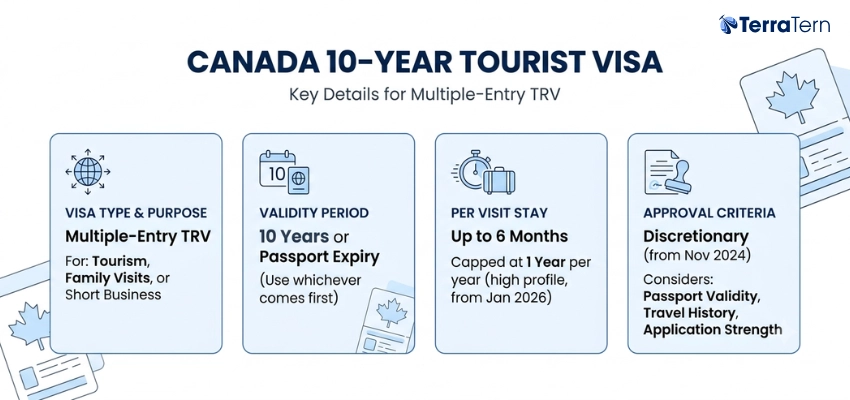
The canada tourist visa 10 years, also known as a Temporary Resident Visa (TRV), is a multiple-entry type of visa for the Canada country where Indian nationals can visit Canada for tourist and/or family visits or for a period of time for short business visits.
-
Validity: 10 years or till passport expires.
-
Per Visit Stay: Up to 6 months per entry, capped at 1 year from January 2026 for users with high profile.
-
Major Caveat: This 10-yr duration is NOT automatic but discretionary; depending on the elements of the case, IRCC officers will apply this principle from November 2024 onward and will consider passport validity, travel history, and the strength of the visa application in each case.
-
Documentation is more important than ever for achieving the maximum 10-year validity.
What Exactly Is the Canada Tourist Visa 10 Years?
A Canada tourist visa 10 years or Temporary Resident Visa (TRV) is a multiple-entry visa granted to all Indian nationals to access Canada for tour or business (short-term) or family visits.
Key Points:
-
What It Is: It is a "Canada tourist visa", or a "visitor visa", compared to a single-trip pass or a multiple-entry visa; it is a temporary resident visa or TRV.
-
Validity: The visa may be valid for up to 10 years (or until the passport expires) unless a shorter validity is determined by refusal of admission, or until the refugee no longer holds a valid visa. Stay: Strong applicants may be granted a stay of up to 6 months per period, for up to 1 year from January 2026.
-
TRV vs eTA: Indian passport holders should apply for a TRV, not an eTA, unless they have a valid Green Card issued by the United States of America, in which case they are eligible for an eTA.
-
Visa Stamp ≠ Guaranteed Entry: A 10-year TRV will not guarantee visas; the CBSA officer at the port of entry will decide on the entry each and every time.
-
But discretion, not automatic: the full 10-year duration has been only at the officer's discretion since November 2024 – it is not automatically given to all approved applications.
-
SEVME 10 Years: Single Entry vs. Multiple Entry (10 Years):
|
Feature |
Single Entry |
Multiple Entry (10 Years) |
|
Entries Allowed |
Once, only IRCC. |
Unlimited within validity |
|
Typical Validity |
Up to 6 months |
Up to 10 years/passport expiry |
|
Per-Visit Stay |
Up to 6 months |
Up to 6 months (up to 1 year from Jan 2026) |
|
Fee |
CAD 100 |
CAD 100 (same) |
|
Best For |
One-time trips (vacation, single-family visit, one business meeting) |
Frequent travellers/family visitors |
|
Re-entry After Leaving |
Need a new visa to return |
Can re-enter without a new visa while valid |
Pro Tip: Many Indian applicants assume the visa stamp in their passport guarantees a 6-month stay. It doesn’t; the CBSA border officer determines the duration of stay at entry. Always carry a copy of your financial proof, return ticket, and itinerary to every border crossing
Who Is Eligible for a Canada Tourist Visa 10 Years from India?
Indian nationals are eligible for a canada tourist visa 10 years if they hold a valid passport, demonstrate clear travel intent, prove financial self-sufficiency, and show strong ties to India.
Core Eligibility Checklist:
-
Valid Indian passport with at least 6 months' validity beyond the intended return date, with 2 blank pages.
-
Clear travel purpose, tourism, family visit, or short business meeting.
-
Proof of financial self-sufficiency, consistent, verifiable funds for the trip.
-
Strong home country ties to employment, property, family, and financial assets in India.
-
Clean record, no criminal history or serious immigration violations.
-
Disclosed visa history with no unresolved or undisclosed prior Canadian visa refusals.
-
Good health, a medical exam may be requested in specific cases.
-
Dual intent accepted (2026) applicants with an active PR application can still apply for a canada tourist visa.
-
Documentation matters most with an 81% refusal rate in December 2024; eligibility alone won't secure approval; strong proof is essential.
What Home Country Ties Does IRCC Look for in Indian Applicants in 2026?
IRCC evaluates home country ties through employment stability, property ownership, family dependents, and consistent financial history. Indian applicants strengthen their case with salary slips, employer NOC, property documents, and proof of dependents. Since 2024, sudden large bank deposits are a major red flag — officers prioritise steady financial patterns over inflated one-time balances.
-
Employment Ties: 3 months' salary slips, appointment letter, employer NOC with approved leave.
-
Property Ownership: Sale deed and property tax receipts showing assets in India.
-
Family Dependents: Spouse/children's birth certificates and proof of dependent status.
-
Financial Stability: Consistent bank statements (3–6 months) plus 2–3 years' ITR filings.
-
Business Ownership: GST returns, registration certificate, and business bank statements (where applicable).
-
Red Flag Alert: Sudden large deposits hurt a canada tourist visa 10 years application; steady balances matter more than high one-time sums.
Key Note: In 2026, IRCC’s tightened scrutiny means a single employer NOC letter isn’t enough. Combine it with proof of ITR, a consistent bank history, and a personal cover letter that explicitly explains why you are returning to India after your visit.
What Documents Are Required for a Canada Tourist Visa 10 Years?
Indian applicants need a valid passport, a completed IMM 5257 form, recent photographs, 6 months of bank statements, an ITR for 2–3 years, a travel itinerary, a cover letter, evidence of home country ties, and proof of payment to apply for the Canada tourist visa in 2026. CAN+ applicants should also include a copy of their valid US or prior Canada visa.
Categorised Document Checklist:
-
Identity & Travel — Valid passport (6+ months validity, 2 blank pages), copies of old passports, 2 recent passport-size photos.
-
Financial Proof — 6 months' bank statements (consistent balance), 2–3 years' ITR, salary slips or business/GST proof for self-employed, investment/FD certificates if applicable.
-
Travel Intent — Cover letter, hotel bookings or invitation letter, tentative return flight itinerary, travel insurance (recommended).
-
Home Country Ties — Employer NOC with approved leave, property documents, marriage/birth certificates proving family ties in India.
-
Application-Specific — IMM 5257, IMM 5645 (and IMM 5476 if using a consultant), plus your canada tourist visa 10 years fees payment receipt; CAN+ applicants add a valid US or prior Canada visa copy.
Do I Need to Submit Original Documents for a Canada Tourist Visa in 2026?
No, most documents are uploaded digitally through the IRCC Portal — physical copies aren't required at the application stage. The only original document needed is your passport, submitted to VFS Global India solely for visa stamping after approval. VFS acts purely as a biometrics and passport-handling centre, not a decision-making authority.
-
All supporting documents (bank statements, ITR, cover letter, etc.) are uploaded digitally via the IRCC Portal — no physical copies needed at the application stage.
-
The passport is the only original document required, and only after approval.
-
VFS Global India handles biometrics collection and passport stamping, not visa decisions.
-
Passport submission for stamping typically takes 7–15 business days for return.
-
Keep all canada tourist visa 10 years fees payment receipts and document copies until the process is fully complete.
As per TerraTern Expert Shreya, A strong cover letter is the single most underestimated document. It ties your financial evidence, travel purpose, and home country ties into one cohesive story — and officers read it. A vague one-liner like “I am visiting for tourism” is a red flag in 2026’s tighter scrutiny environment.
What Are the Canada Tourist Visa 10 Years Fees from India in 2026?
The tourism visa fee for Canada for Indians is CAD 100 (Approx ₹6200-₹6500) + Biometrics (CAD 85, Approx ₹5100-₹5500) at VFS Global, which is mandatory for most applicants, except for diplomatic pass holders. The automatic Canada tourist visa 10 years fees expired in April 2026 and are now on a case-by-case basis.
|
Fee Component |
Amount (CAD) |
Amount (INR approx.) |
Notes |
|
Visa Application (single or multiple entry) |
CAD 100 |
₹6,200–₹6,500 |
Non-refundable; same for both visa types |
|
Biometrics (per person) |
CAD 85 |
₹5,100–₹5,500 |
Valid 10 years; waived if already enrolled |
|
Biometrics (family — 2+ members) |
CAD 170 |
₹10,200–₹11,000 |
Applies when submitting family applications together |
|
VFS Global service charge |
Varies |
₹1,400–₹2,000 |
Charged separately by VAC; varies by city |
|
Document courier (optional) |
Varies |
₹400–₹800 |
For passport return via courier |
|
Total per person (first-time applicant) |
CAD 185+ |
≈ ₹12,000–₹15,000 |
Before medical exam or translation fees |
Also Read: Cambrian College Brampton IELTS Requirement: New Guide
Are Canada Tourist Visa 10 Years Fees Refundable If My Application Is Rejected?
All canada tourist visa 10 years fees are non-refundable, including the application + biometrics, not refunded on rejection
-
CAD 100 visa fee — no refund if refused
-
CAD 85 biometrics fee — no refund if refused
-
Request Original Decision Notes (ODN) — 2026 IRCC tool revealing exact officer reasoning for stronger reapplication
-
Reapplication guidance — use ODN to address refusal reasons before submitting new application
How Much Does a Canada Tourist Visa Cost for a Family of 4 from India in 2026?
A family of 4 canada tourist visa 10 years fees total approximately ₹45,000–₹55,000 all-in. Application fees: 4 × CAD 100 = CAD 400 (within CAD 500 family cap). Biometrics: CAD 170 family cap for all members. VFS + courier: ~₹8,000–₹12,000.
-
Application fees: 4 people × CAD 100 = CAD 400 (within CAD 500 family cap, so CAD 400 applies for canada tourist visa 10 years fees)
-
Biometrics: CAD 170 family cap for all 4 members (separate from application cap)
-
VFS service charge: ~₹8,000–₹12,000 total for family (₹2,000–₹3,000 per person)
-
Passport courier: ~₹2,000–₹4,000 total (₹500–₹3,000 per family)
-
Total all-in family estimate: CAD 570 (~₹37,000) + VFS/courier (~₹10,000–₹16,000) = ~₹45,000–₹55,000 for canada tourist visa 10 years fees
-
Family cap note: Applies only to application fees (CAD 500 max); biometrics have a separate CAD 170 family cap regardless of group size
Important Note: Many Indian families overpay because they aren’t aware of the CAD 500 application fee cap or the CAD 170 biometrics family cap. If you’re applying as a family of 4 or 5, always apply together in a single submission to access these savings.
What Is the Canada Tourist Visa 10 Years Processing Time from India in 2026?
The canada tourist visa 10 years processing time from India averages 52–117 days in 2026. After reaching 88 days in January 2026 due to a 27% volume surge, IRCC improved timelines to approximately 57 days by March 2026. CAN+ eligible applicants can see decisions in 10–20 days. Always apply 4–5 months before planned travel
|
Stage |
Estimated Time |
|
Biometric Instruction Letter (after applying) |
1–5 business days |
|
Biometrics Appointment at VFS |
1–3 weeks (book immediately upon BIL receipt) |
|
IRCC Processing (post-biometrics, India) |
52–117 days (avg. 57 days as of March 2026) |
|
CAN+ Eligible Applicants |
10–20 days (post-biometrics) |
|
Passport Stamping via VFS |
7–15 business days |
|
Total Timeline (Standard, India) for canada tourist visa 10 years |
~3–4 months |
|
Total Timeline (CAN+, India) for canada tourist visa, 10 years processing time |
~4–6 weeks |
What Factors Affect Canada Tourist Visa Processing Time for Indians in 2026?
Seven factors affect canada tourist visa 10 years processing time for Indian applicants in 2026: application volume, document completeness, biometric wait, background checks, prior refusals, peak season timing, and CAN+ eligibility.
-
Application volume: India is Canada's #1 source market; Q1 2026 volume up 27% YoY (193,000 TRVs via Delhi/Chandigarh)
-
Document completeness: Incomplete applications restart the review clock — #1 delay cause for canada tourist visa 10 years
-
Biometric scheduling delay: Book an appointment immediately on receiving BIL; delays add 1–3 weeks
-
Background verification: Security checks add time for profiles with complex travel history or third-country ties
-
Prior visa refusals: Flagged files go through additional review, adding 2–4 weeks
-
Peak season: April–August and Oct–Dec see longest wait times
-
CAN+ eligibility: Valid US visa or prior Canada travel
How Can Indian Applicants Get Faster Canada Tourist Visa Processing in 2026?
To get a faster canada tourist visa 10 years processing time in 2026: apply 4–5 months early, use the new IRCC Portal, ensure 100% document completeness, book biometrics immediately, check CAN+ eligibility, avoid peak windows, monitor email daily, and use verified document review before submission.
-
Apply 4–5 months before intended travel
-
Submit online via the new IRCC Portal — not the older GCKey (phased out); faster for canada tourist visa 10 years
-
Ensure 100% document completeness before submission — #1 delay cause for
-
Book a biometrics appointment the moment you receive BIL — delays add 1–3 weeks to canada tourist visa 10 years
-
Check CAN+ eligibility — valid US visa or prior Canada travel = 10–20 days
-
Avoid peak application windows: March–May and September–October (add 2–4 weeks )
-
Use the email you check daily — IRCC is fully digital in 2026; missing email
-
Apply through a verified document review service before submission to prevent an incomplete application
Expert Advice: The most overlooked speed tip in 2026 is CAN+ eligibility. If you have a valid US non-immigrant visa or visited Canada even once in the last 10 years, you qualify for 10–20 day processing compared to the standard 52–117 days. This is not a widely advertised advantage and applicants who miss it are losing months unnecessarily.
How Do You Apply Step-by-Step for a Canada Tourist Visa 10 Years in 2026?
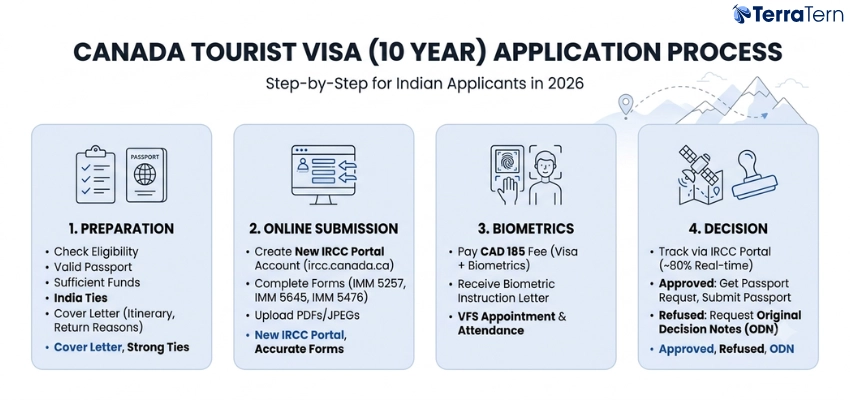
To apply for a canada tourist visa 10 years in 2026, Indian applicants must create an account on the new IRCC Portal, complete IMM 5257 online, upload required documents, pay CAD 185, receive a Biometric Instruction Letter, submit biometrics at VFS, and track via the IRCC Portal until a decision.
-
Step 1: Check eligibility, a valid passport, sufficient funds, clear travel intent, no criminal record, strong India ties; verify CAN+ eligibility for faster processing
-
Step 2: Create an account on the new IRCC Portal (ircc.canada.ca), not an older GCKey (phased out in 2026); this is your application dashboard
-
Step 3: Complete forms online IMM 5257 (Visitor Visa) + IMM 5645 (Family Info); add IMM 5476 if consultant files; answer 100% accurately
-
Step 4: Write a strong cover letter explaining the visit purpose, itinerary, funding source, and specific return reasons; vague letters trigger 2026 refusals
-
Step 5: Gather & upload all required documents and files in PDF/JPEG per IRCC specs; don't leave optional sections blank
-
Step 6: Pay CAD 185 fee CAD 100 (visa) + CAD 85 (biometrics) via IRCC Portal; avoid third-party agents (fraudulent in 2026)
-
Step 7: Receive Biometric Instruction Letter (BIL) in 1–5 days & book VFS appointment immediately; centres in Delhi, Mumbai, Chennai, Bengaluru, Chandigarh, Hyderabad
-
Step 8: Attend biometrics at VFS submit fingerprints + photo; processing starts when IRCC receives biometrics; track via IRCC Portal (real-time for ~80% applications)
-
Step 9: Receive decision. If approved: get Passport Request Letter, submit passport to VFS within 30 days (7–15 days return); If refused: request Original Decision Notes (ODN) for officer reasoning to strengthen reapplication
Can I Apply for a Canada Tourist Visa 10 Years Online from India in 2026?
Yes, canada tourist visa 10 years application is mandatory online for Indian applicants in 2026 via the IRCC Portal. Paper submissions are no longer accepted as standard. Only passport stamping at VFS requires an in-person visit.
-
Online application via the IRCC Portal is mandatory for all Indian TRV applicants in 2026
-
Paper submissions discontinued as standard process; exceptions only via IRCC webform for limited cases
-
If unable to apply online: submit the IRCC webform requesting an exception (rare, medical/accessibility issues only)
-
Passport submission to VFS for visa stamping remains the only required in-person step after approval
Expert Tip: Step 3 is the most common cause of rejections. Small inconsistencies between your application form and supporting documents (travel history dates, income figures, employer name formatting) are flagged by IRCC’s digital verification systems. Review every field against your documents before you click submit.
What Is the Difference Between a Canada Tourist Visa 10 Years and a Super Visa in 2026?
A canada tourist visa 10 years allows repeated visits with stays of up to 6 months per entry (up to 1 year from January 2026 for strong applicants).
|
Feature |
Tourist Visa (TRV) |
Super Visa |
|
Who Can Apply |
Any eligible foreign national (including Indians) |
Parents/grandparents of Canadian PRs or citizens only |
|
Stay Per Visit (2026) |
Up to 6 months (can extend to 1 year, case-specific) |
Up to 5 years per entry, extendable by 2 more years |
|
Validity |
Up to 10 years (or until passport expires) |
Up to 10 years (multiple-entry) |
|
Medical Insurance |
Strongly recommended |
Mandatory: CAD 100,000 minimum, from an approved insurer |
|
Financial Sponsor |
Self-funded applicant |
A Canadian child/grandchild must meet the LICO threshold |
|
Application Fee |
CAD 100 (per person) |
|
|
Processing Time (India) |
52–117 days (varies) |
|
|
Best For |
Frequent tourists, business visitors |
Extended family reunions (5-year stays) |
Important Tip: If you are a parent of a Canadian PR or citizen, the Super Visa’s 2-year per-stay allowance (updated 2026) makes it dramatically superior to the standard tourist visa’s 6-month limit. The additional requirement of Canadian-issued health insurance is a small price for years of uninterrupted family time.
What Are the Common Reasons for Canada Tourist Visa Rejection from India in 2026?
India's canada tourist visa rejection rate hit 81% in December 2024, driven mainly by insufficient financial proof, weak home country ties, incomplete applications, and vague travel purpose. For applicants seeking a canada tourist visa 10 years of validity, addressing these gaps with consistent documentation, clear itineraries, and verified financial proof significantly improves approval odds and reduces the risk of repeated refusals.
-
Insufficient Financial Proof (75%+ of refusals): Bank balance too low, inconsistent, or inflated by last-minute large deposits.
-
Weak Home Country Ties: No stable job, property, or dependent family; officers doubt you'll return to India.
-
Incomplete or Inconsistent Application: Mismatches between IMM 5257 answers and supporting documents trigger red flags.
-
Vague Travel Purpose: A cover letter stating only "tourism" with no itinerary or host details appears unconvincing.
-
Undisclosed Prior Refusals: Hiding a past Canadian or other visa refusal leads to immediate rejection.
-
Sudden Large Deposits: One-time large deposits right before applying the signal, manufactured, not genuine, funds.
-
Limited International Travel Histor: No prior visa stamps weaken credibility for a long-validity request.
-
Overstay or Immigration Violation History: Any past overstay, anywhere, is treated as a major red flag.
Can I Reapply for a Canada Tourist Visa After Rejection in 2026?
Yes, there's no mandatory waiting period to reapply after a Canada tourist visa rejection. However, reapplying without fixing the original issue usually fails again. Request your Original Decision Notes (ODN) via the IRCC Portal to see the officer's exact reasoning, then address that specific concern — ideally with expert guidance — before resubmitting.
As per our TerraTern Expert: Before you reapply after a Canadian visa rejection, request your Original Decision Notes (ODN), IRCC’s 2026 replacement for GCMS notes. It tells you exactly what the officer objected to. Reapplying without this intelligence is like retaking an exam without knowing which questions you got wrong.
Comparison: Single-Entry vs. 10-Year Multiple-Entry Canada Tourist Visa
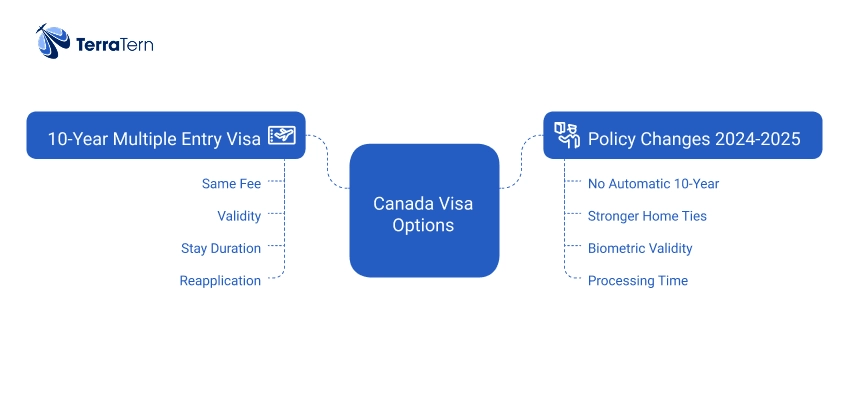
Here is the comparison between a single-entry and 10-year multiple-entry Canada tourist visa:
|
Features |
One Entry Visa |
10-Year Multi-Entry Visa |
|
Fee |
Canadian dollar 100 |
Canadian dollar 100 |
|
Validity |
Single ticket |
1 half a year Up to 10 years or expiry of the passport |
|
Biometric Reuse |
No |
Yes, if within 10 years |
|
Reapplication Needed? |
Yes |
No |
What Are the Latest 2026 Policy Updates for the Canada Tourist Visa 10 Years?
In 2026, major canada tourist visa 10-year policy updates include CBSA's January rule allowing up to 1-year stays for genuine tourists.
2026 Policy Update Log:
-
November 2024: End of Automatic 10-Year Grants: IRCC now decides visa duration case-by-case; passport expiry and applicant profile, not default policy, drives how long a TRV is valid.
-
December 2024: 81% Rejection Rate Recorded: India's visitor visa refusal rate hit an all-time high, prompting IRCC to tighten documentation requirements for Indian applicants.
-
January 2026: CBSA Entry Duration Update: Border officers can now grant stays of up to 1 year (up from 6 months) for bona fide tourists with strong funds and exit plans.
-
2026: Dual Intent Formally Recognised: Indian applicants with an active PR application can now also apply for a tourist visa, as IRCC accepts that temporary and permanent intent can coexist.
-
2026: IRCC Portal Replaces GCKey: All new Canadian visa applications must start on the new IRCC Portal, with the legacy GCKey system being phased out.
-
2026: Original Decision Notes (ODN) Introduced: ODNs give refused applicants a faster, clearer breakdown of an officer's exact refusal reasoning, replacing the older GCMS notes process.
-
March 2026: Processing Time Improvement: India's average TRV processing time dropped from 88 days in January 2026 to roughly 57 days by March, reflecting expanded IRCC capacity.
-
June 2026 (Pending): Digital Capacity Expansion: IRCC's proposed CAD 123-million budget aims to further modernise digital infrastructure and reduce processing backlogs for global TRV applicants.
Pro Tip: The dual intent recognition in 2026 is a significant relief for many Indian families. Previously, applicants with a PR application in progress were often refused tourist visas on the assumption they wouldn’t leave Canada. Now, officers must assess temporary intent on its own merits a meaningful policy shift that TerraTern’s advisors are actively leveraging for clients.
What Tips Help Indian Applicants Get a 10-Year Canada Tourist Visa in 2026?
To maximise your chances of securing a canada tourist visa 10 years validity in 2026, maintain a consistent six-month bank balance, demonstrate strong home country ties, write a detailed personalised cover letter,
-
Maximise Passport Validity First: Your visa can't exceed your passport's expiry, so renew to full validity before applying.
-
Maintain a Consistent 6-Month Bank Balance: Avoid sudden large deposits; steady balances signal genuine, sustainable funds.
-
Write a Detailed, Personalised Cover Letter: Specify itinerary, accommodation, purpose, funding source, and intent to return to India.
-
Document Home Country Ties Thoroughly: Combine employer NOC, salary slips, ITR, property documents, and proof of family dependency.
-
Check CAN+ Eligibility Immediately: A valid US visa reduces processing time to 10–20 days; attach a copy to your application.
-
Apply via the New IRCC Portal: Skip GCKey to avoid transitional processing delays in 2026.
-
Apply 4–5 Months in Advance: India processing runs 52–117 days, plus biometrics and passport stamping time.
-
Showcase International Travel History: Even one or two Schengen, US, or UK stamps strengthen your case.
-
Explicitly Request Multiple-Entry, Long Validity. State specific reasons (family visits, repeat tourism) in your cover letter; it costs nothing extra.
-
Get Expert Review Before Submission: With an 81% rejection rate, a professional document check from TerraTern's advisors is worth it, especially for first-timers.
Key Note: In 2026, the single most effective thing Indian applicants can do is stop treating the cover letter as an afterthought. In an environment where officers are scrutinising 193,000+ TRV applications per quarter from India alone, a well-crafted, specific, evidence-linked cover letter is what separates an approval from a rejection.
Also Read: Spouse Visa Canada: Latest Eligibility, Time & Benefit
Conclusion
Canada tourist visa fees for Indians remain fixed, but the total cost and approval odds depend on biometrics status, application strength, and documentation quality. Processing currently runs 45–90 days, so applying early and booking biometrics promptly matters more than payment speed. A well-prepared application not only improves approval chances but also increases eligibility for a canada tourist visa 10 year multiple-entry visa, reducing future reapplication costs.
To get assistance for Canada tourist visa and help in immigrating to Canada, Contact TerraTern right away!


 AI Summary