Key Highlights
- Why Should Indians Choose Banking Jobs in Australia in 2026?
- What Are the Different Types of Banking Jobs in Australia?
- What Is the Salary for Banking Jobs in Australia in 2026?
- What Are the Eligibility Criteria for Banking Jobs in Australia?
- What Are the Best Visa Options for Bank Jobs in Australia for Indians?
- Which Are the Top Banks Hiring Indians for Banking Jobs in Australia?
- How Can TerraTern Help You Solve Your Banking Job & Immigration Challenges?
- Conclusion
Why Should Indians Choose Banking Jobs in Australia in 2026?
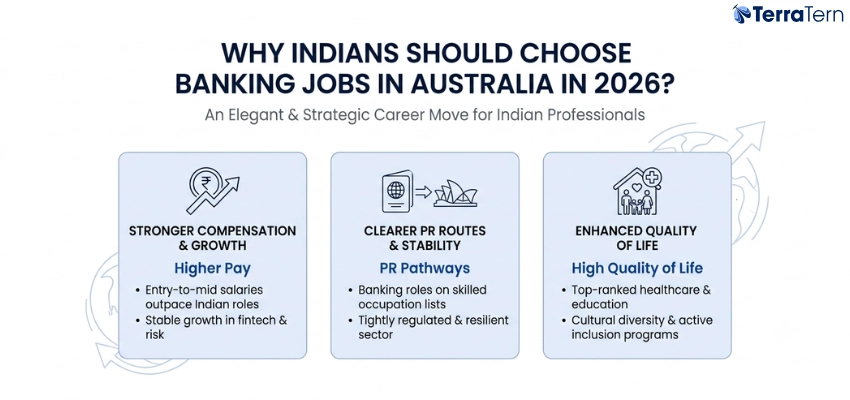
Why banking jobs in Australia for Indians? In short: stronger pay, clearer PR routes, stable regulation, and high quality of life make Australian banking roles attractive to Indian professionals.
-
Economic Stability: Australia’s banking sector is tightly regulated and resilient (Australian Banking Association).
-
Higher Pay: Typical entry-to-mid salaries in Australia far outpace comparable Indian roles.
-
PR Pathways: Many banking occupations appear on skilled occupation lists enabling pathways to permanent residency.
-
Quality of Life: Healthcare, education, and social safety nets rank highly.
-
Cultural Diversity: Major banks actively recruit South Asian talent and run inclusion programs.
-
Post-COVID Recovery: Hiring in fintech, risk, and digital roles has rebounded strongly.
What Are the Key Benefits of Banking Jobs in Australia for Indians?
High salaries and total compensation. Australian banking roles offer substantially higher base pay than comparable positions in India, plus annual bonuses, performance-linked incentives, and mandatory employer superannuation contributions of 11%. Together these elements boost both your current income and long-term retirement savings.
Clear PR pathways. Many banking occupations appear on Australia’s skilled occupation lists (MLTSSL/STSOL). Employer‑sponsored visas such as Subclass 482 commonly lead to permanent residency routes like Subclass 186, making banking a viable skill-to-PR pathway for Indian professionals.
Multicultural workplaces and Indian diaspora. Major Australian banks foster diverse teams and employee networks, and large Indian communities in cities like Sydney and Melbourne make professional networking and social integration easier for newcomers.
How Does Australia's Banking Sector Compare to India's?
Australia and India both have large, growing banking sectors, but they differ markedly in pay structures, regulatory frameworks, workplace norms, and long-term benefits. This introduction compares the two markets across the factors Indian professionals care about most: entry salaries, typical work hours, retirement benefits, PR pathways, and job security so you can quickly see where moving to Australia may improve your career prospects and quality of life.
|
Factor |
Australia |
India |
|
Avg. Entry Salary |
AUD 60,000–72,000 (~Rs. 33–40 LPA) |
Rs. 4–8 LPA |
|
Work Hours (Weekly) |
38 hours (regulated) |
45–55 hours |
|
Superannuation |
11% employer-contributed |
No equivalent |
|
PR Eligibility |
Yes (via skilled visas) |
N/A |
|
Job Security |
High (Big 4 dominant) |
Medium-High |
Also Read: Know MBBS in Australia for Indian Students Fees
What Are the Different Types of Banking Jobs in Australia?
Australia’s banking sector covers a wide range of roles across retail, commercial, corporate, investment, private, digital/fintech and operations functions. Each area has distinct responsibilities, skill requirements, employers, and salary bands. Below is a summary table for quick reference, followed by short, structured definition blocks for each major role type to help you identify which path best matches your skills and career goals.
What Is Retail Banking and What Jobs Does It Offer in Australia?
Retail banking serves individual customers and small businesses by delivering deposit, lending and advisory services.
-
Typical Roles: Personal banker, branch manager, loan officer, customer service representative, mortgage consultant.
-
Key Responsibilities: Account management, sales of retail products, loan processing, KYC/AML checks, customer query resolution.
-
Required Skills: Strong customer service, sales ability, knowledge of retail banking products, CRM proficiency, regulatory/compliance awareness.
-
Average Salary: AUD 55,000–90,000.
-
Key Employers: Commonwealth Bank, Westpac, NAB, ANZ.
What Are Commercial Banking Jobs in Australia?
Commercial banking focuses on business clients providing loans, treasury solutions and relationship management for SMEs and mid-market firms.
-
Typical Roles: Business relationship manager, credit analyst, commercial lending officer, treasury officer.
-
Key Responsibilities: Credit analysis, structuring loans, account management, cash-flow and treasury services, business development.
-
Required Skills: Financial analysis, credit risk assessment, negotiation, commercial awareness, client relationship skills.
-
Average Salary: AUD 80,000–130,000.
How Lucrative Are Investment Banking Jobs in Australia?
Investment banking is the top-earning segment, handling M&A, capital markets and advisory mandates.
-
Typical Roles: Analyst/Associate, M&A advisor, ECM/DCM analyst, corporate finance associate.
-
Key Responsibilities: Deal origination, financial modelling, valuations, pitchbooks, transaction execution, due diligence.
-
Required Skills: Advanced financial modelling, valuation techniques, Excel/PowerPoint mastery, sector knowledge, deal negotiation.
-
Average Salary: AUD 120,000–200,000+ (bonuses can be substantial).
What Is Corporate Banking and What Roles Exist?
Corporate banking caters to large corporations offering structured finance, syndicated loans, and treasury solutions.
-
Typical Roles: Relationship manager (corporates), syndications officer, structured finance specialist, credit risk manager.
-
Key Responsibilities: Complex credit structuring, syndication, relationship governance, sector risk analysis, large-ticket lending.
-
Required Skills: Corporate finance expertise, structuring skills, stakeholder management, risk modelling.
-
Average Salary: AUD 100,000–180,000.
What Is the Salary for Banking Jobs in Australia in 2026?
Banking salaries in Australia remain highly competitive in 2026, offering Indian professionals attractive base pay, performance bonuses, and mandatory employer superannuation (11%). Below is a comprehensive breakdown by role, experience level, and city, with INR equivalents for easy comparison.
What Is the Entry-Level Banking Salary in Australia for Indians?
If you’re an Indian finance professional exploring opportunities in Australia, understanding typical salary expectations is crucial for planning your move. The entry-to-senior salary ranges below show what employers currently pay across banking functions in 2026, expressed in AUD with INR equivalents for easy comparison.
|
Experience Level |
Annual Salary (AUD) |
Approx. INR Equivalent |
|
Entry-Level (0–2 yrs) |
AUD 60,000–72,000 |
Rs. 33–40 LPA |
|
Mid-Level (3–5 yrs) |
AUD 80,000–100,000 |
Rs. 44–56 LPA |
|
Senior-Level (6–10 yrs) |
AUD 120,000–150,000 |
Rs. 67–84 LPA |
|
Director/VP (10+ yrs) |
AUD 175,000–250,000+ |
Rs. 98 LPA+ |
Which Australian Cities Offer the Highest Banking Salaries?
City-level salary differentials reflect demand, head-office concentration, and living costs across Australia. Major banking hubs such as Sydney and Melbourne generally pay a premium, while Perth and Brisbane offer competitive packages with lower living costs in some cases.
|
City |
Avg. Banking Salary (AUD) |
Key Banking Hubs |
|
Sydney |
AUD 110,000–160,000 |
CBD, Parramatta |
|
Melbourne |
AUD 95,000–140,000 |
Collins St, Docklands |
|
Perth |
AUD 85,000–125,000 |
Perth CBD |
|
Brisbane |
AUD 80,000–120,000 |
Fortitude Valley |
Also Read: Why Choose Australia Over Other Countries? 6 Top Reasons
What Are the Eligibility Criteria for Banking Jobs in Australia?
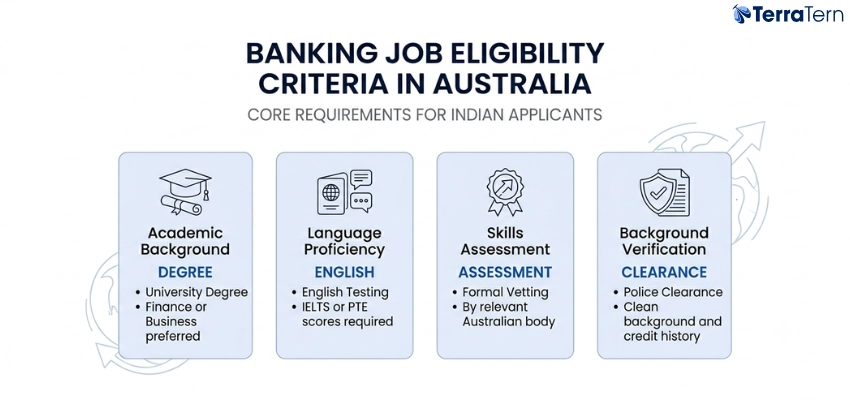
To be eligible for bank jobs in Australia, especially as an Indian applicant, you must meet education, language, certification, skills-assessment, and background-check requirements. Below is a numbered checklist that covers the core criteria and role-specific differences.
What Educational Qualifications Are Required for Banking Jobs in Australia?
Academic credentials form the baseline for most banking roles in Australia. Employers typically screen candidates by degree discipline and level, while senior positions favour postgraduate qualifications and professional credentials. The paragraph below explains the typical minimums, preferred advanced degrees, and how Indian qualifications are evaluated for Australian roles.
-
Minimum: Bachelor’s degree in finance, commerce, economics, business administration, or a related field.
-
Preferred for Senior Roles: MBA, Master of Finance, or equivalent postgraduate qualification.
-
Recognised Indian Degrees: Most UGC-recognised Indian degrees are accepted, but some roles require formal skills assessment.
What English Proficiency Score Is Needed for Banking Jobs in Australia?
Proficiency in English is essential for client interaction, regulatory compliance, and visa eligibility. Australia immigration authorities expect standardised test scores; requirements vary by role and visa subclass.
-
Typical Employer Expectation: IELTS Academic 6.5 overall (no band below 6.0) or PTE Academic 58+.
-
Visa-relevant Minimums (guideline): Subclass 482 sponsor applications often accept IELTS 6.0 per band; independent skilled visas commonly require IELTS 6.5+ or equivalent.
-
Other Accepted Tests: PTE, TOEFL iBT (approx. 79 for general skilled visa equivalence).
What Professional Certifications Boost Your Banking Job Application in Australia?
Professional certifications can significantly strengthen your candidacy, especially for specialised functions like investment banking, risk, and accounting. Australian banks value both international credentials (CFA, FRM) and local recognitions (CPA Australia, FINSIA).
-
Highly Valued: CFA for investment/wealth roles, CPA Australia for accounting-linked roles, FRM for risk management.
-
Australia-specific Credentials: FINSIA courses and other industry micro-credentials.
-
Role-specific Licences: Certain advisory roles (financial advice, mortgage broking) may require AFSL-related authorisations or a Diploma of Finance and Mortgage Broking Management.
What Are the Best Visa Options for Bank Jobs in Australia for Indians?
Visa choice is often the deciding factor when planning a banking career move to Australia. For Indian applicants the most relevant pathways balance employer sponsorship, points-tested nomination, and regional options. Below I explain the key visa subclasses, eligibility highlights, expected processing timelines, PR pathways, and the role of skills assessments and occupation lists (MLTSSL/STSOL).
|
Visa |
Type |
PR Pathway |
Key Requirement |
|
Subclass 482 (TSS) |
Yes (via 186) |
Employer nomination + occupation on STSOL/MLTSSL |
|
|
Subclass 186 (ENS) |
Permanent employer-sponsored |
Direct PR |
3 years with sponsoring employer |
|
Subclass 189 |
Points-tested, independent |
Direct PR |
EOI via SkillSelect; 65+ points |
|
Subclass 190 |
State-nominated |
Direct PR |
State nomination + occupation on state list |
|
Subclass 494 |
Regional employer-sponsored |
Yes (via 191) |
Work in designated regional areas |
Which Are the Top Banks Hiring Indians for Banking Jobs in Australia?
Major Australian banks and global financial firms actively hire Indian professionals for banking roles, offering visa sponsorship for specialised positions and graduate pipelines. Below I profile the top 10 institutions Big Four banks (CBA, ANZ, Westpac, NAB), global banks (HSBC, Citibank, JPMorgan, BNP Paribas), investment bank Macquarie Group, and a neobank example plus their Indian hiring history, typical open roles, sponsorship track record, and direct careers links.
-
Big Four Banks: Commonwealth Bank (CBA), ANZ, Westpac, NAB
-
Global Banks: HSBC, Citibank, JPMorgan Chase, BNP Paribas
-
Investment Bank: Macquarie Group
-
Neobank Example: Stitch (digital challenger)
Also Read: What is COE Australia? A Complete Expert's Guide
How Can TerraTern Help You Solve Your Banking Job & Immigration Challenges?

If you’re an Indian professional aiming for banking jobs in Australia, navigating qualifications, English tests, visa pathways, and job applications can feel overwhelming. TerraTern simplifies this entire journey with end-to-end immigration and career support tailored for banking professionals
-
End-to-end Immigration Support: TerraTern handles skills assessment (VETASSESS/CPA), ANZSCO code mapping, and visa application guidance for Subclass 482, 189/190, or 494 pathways.
-
Australian Resume & Application Tailoring: They create ATS-friendly, 2-page Australian-style resumes with selection criteria statements optimised for banking job descriptions.
-
English Test Preparation: Structured IELTS/PTE coaching and timeline planning to meet visa and employer English score requirements efficiently.
-
Job Search Strategy & Employer Connections: Access to partner banks, recruitment networks, and guidance on portals like SEEK, LinkedIn, and Hays to find visa-sponsored banking roles.
Conclusion
Banking jobs in Australia represent one of the most rewarding career transitions for Indian finance professionals in 2026. Australia's stable, well-regulated banking sector offers exceptional salaries (AUD 60,000–175,000+), clear PR pathways, multicultural workplaces, and world-class career development. With major banks like CBA, ANZ, Westpac, NAB, and HSBC actively sponsoring international talent, the opportunity for skilled Indian professionals has never been more accessible. For official visa and immigration information, always refer to the Australian Government's Department of Home Affairs website. To know more about banking jobs in Australia visit TerraTern now!