

Key Highlights
- What are AI Jobs in Germany?
- Why Is Germany One of the Best Countries for AI Jobs?
- What Are the Top AI Jobs Available in Germany Right Now?
- What Salaries Can Indian Professionals Expect from AI Jobs in Germany?
- Which Cities in Germany Have the Most AI Jobs?
- What Qualifications Do You Need for AI Jobs in Germany?
- How Can Indian Professionals Apply for AI Jobs in Germany?
- What Visa Do You Need for AI Jobs in Germany as an Indian?
- How Do AI Jobs in Germany Compare to AI Jobs in India and the US?
- What Are the Challenges of Getting AI Jobs in Germany for Indians?
- 2026 Industry Context Section
- Conclusion
Germany is ranked among the best places to find AI jobs in Germany, with competitive salaries, a clear visa route, and a requirement to work in tech-intensive areas. In 2026, thousands of machine learning, data science, NLP, and computer-vision jobs will have salaries of approximately €58,000-€95,000 annually, with thousands of jobs accessible to Indian applicants through the EU Blue Card or the Opportunity Card (Chancenkarte).
What are AI Jobs in Germany?
AI jobs in Germany in machine learning, data science, NLP, computer vision and MLOps can be found in technology start-ups, the automobile market, medical and industrial automation.
-
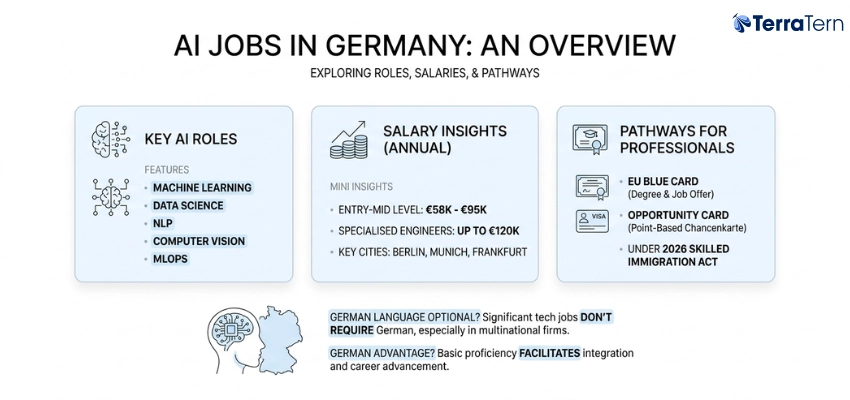
Entry- to mid-level wages range from €58,000 to €95,000 annually, and top, more specialised AI engineers earn up to €120,000 in places like Berlin, Munich and Frankfurt.
-
Indian professionals can apply for jobs in Germany using the EU Blue Card (degree and an offer of employment at a salary above the threshold) or the Point-based Opportunity Card (Chancenkarte), both of which are now being expanded and introduced under the 2026 Skilled Immigration Act.
-
A significant portion of tech-related AI jobs do not require knowledge of German, particularly in multinational firms and research and development centres, but basic German proficiency facilitates integration and long-term career advancement.
Also Read: Data Scientist Jobs in Germany for Indians Guide
Why Is Germany One of the Best Countries for AI Jobs?
Germany has a significant skilled-worker shortage (Fachkraftemangel), and across industries, there are hundreds of thousands of vacancies in tech, engineering, and STEM, which contributes to the popularity of AI jobs in Germany.
-
The country's National AI Strategy is supported by an investment of approximately 3 billion euros, leading to AI-based R&D, industrial automation, and AI startups across various sectors.
-
Germany is also competing with the Netherlands and France for attracting AI professionals, with average AI salaries of about 78,500-84,500 per year and a strong work-life balance, as well as strong public healthcare and employment security.
-
Indian and other non-EU professionals have been allowed to take AI positions in Germany under the 2026 Skilled Immigration Act reforms, and AI-assisted pilot visas have made it one of the most immigration-friendly tech hubs in Europe.
As per TerraTern Expert, Divyansh, Germany's combination of a talent shortage, strong AI investment, and streamlined visa routes for Indian professionals creates an unusually low barrier to entry for qualified AI specialists, particularly compared to the US or UK.
What Are the Top AI Jobs Available in Germany Right Now?
The best AI jobs in Germany are:
|
Role |
Role Definition |
Key Responsibilities |
Typical Skills/tools |
Main Industries Hiring |
Approx. Annual Salary (gross, EUR) |
|
Machine Learning Engineer |
Builds and deploys ML models that power automation and prediction systems. |
Design ML pipelines, train and tune models, integrate into production services, and monitor performance. |
Python, PyTorch/TensorFlow, Scikit-learn, SQL, AWS/Azure/GCP. |
Automotive, logistics, finance, e-commerce. |
€65,000 – €95,000+ |
|
Data Scientist (AI-focused) |
Uses data analysis and ML to generate business-driven insights. |
Clean data, run statistical analyses, build predictive models, visualise results, support decisions. |
Python/R, SQL, Pandas, ML libraries, Jupyter, BI tools (e.g., Tableau). |
Finance, healthcare, retail, and industrial IoT. |
€60,000 – €90,000 |
|
NLP Engineer |
Develops systems that understand and generate human language. |
Build chatbots, language models, text-classification pipelines, and dialogue systems at scale. |
Python, Transformers, Hugging Face, spaCy, BERT/GPT-like models, APIs. |
FinTech, SaaS, customer-support automation, legal-tech. |
€65,000 – €105,000 |
|
Computer Vision Engineer |
Designs AI systems that “see” and interpret images or video. |
Train object-detection and segmentation models, optimise inference, and integrate into robotics or cameras. |
Python, OpenCV, PyTorch/TensorFlow, ONNX, CUDA, Docker. |
Automotive, manufacturing, medical imaging, and security. |
€65,000 – €100,000+ |
|
MLOps / AI Ops Engineer |
Manages the lifecycle of ML models from dev to production. |
Automate training, deployment, monitoring, logging, and model-versioning pipelines. |
Python, Docker/Kubernetes, CI/CD (GitLab CI, GitHub Actions), MLflow, Kubeflow. |
Automotive, SaaS, FinTech, and cloud providers. |
€85,000 – €130,000+ |
|
AI Researcher |
Conducts advanced research in AI/ML theory and algorithms. |
Propose and test novel architectures, publish papers, and prototype new methods for real-world use. |
Strong math, deep-learning frameworks, experimental design, often PhD-level. |
Academia, corporate R&D labs, large tech firms. |
€75,000 – €120,000+ |
|
LLM / GenAI Specialist |
Designs and finetunes large language and generative AI systems. |
Adapt foundation models, build RAG pipelines, evaluate outputs, and align with safety and compliance. |
LLM APIs (OpenAI, local models), LangChain, Prompt-engineering, Guardrails, PyTorch. |
Enterprise software, consulting, media, legal-tech. |
€100,000 – €150,000+ |
What Does a Machine Learning Engineer Do in Germany?
Machine Learning Engineer in Germany designs, trains, and deploys ML models in production systems on a large scale.
-
Responsibilities: end-to-end ML pipelines, experimentation, hyperparameter tuning, and model monitoring.
-
Skill Sets/Tools: Python, TensorFlow/PyTorch, cloud (AWS/Azure/GCP), MLOps, CI/CD.
-
Industries: Automotive (BMW, VW), finance (N26), e-commerce (Zalando), SaaS.
-
Salary: ≈ €65,000–€95,000; senior roles in Munich often exceed €100,000.
Important Note: German automotive companies like BMW and Siemens are increasingly hiring ML Engineers not just for R&D, but for production-level deployment in autonomous systems and factory automation, making practical MLOps experience more valuable than academic credentials.
What Are the Responsibilities of a Data Scientist in Germany?
-
Data Scientist: AI opportunities in Germany: develops ML models, data pipelines, A/B tests and predictive analytics.
-
Activities: exploratory data analysis, feature engineering, model selection, reporting, and experimentation.
-
Technologies: Python, SQL, Spark, Databricks, TensorFlow, AWS SageMaker.
-
Industries: E-commerce, fintech (N26), industrial (Siemens), healthcare (Bayer), logistics.
-
Salary: ≈ €50,000–€112,000; 40% of 2026 postings demand GenAI/LLM experience, and 65% want MLOps/CI-CD skills.
Expert Advice: Data scientist roles in Germany are rapidly shifting from analysis to production deployment. Indian candidates who can demonstrate real-world ML model deployment experience (not just notebooks) will stand out significantly.
What Is the Role of an NLP Engineer in Germany?
The role of an NLP engineer in Germany is:
-
NLP Engineer: AI jobs in Germany: writes language understanding systems, translation systems, chatbots, and voice assistants.
-
Tasks: text processing, fine-tuning of models, integration of APIs, and multilingual deployments.
-
Tools: Hugging Face, BERT/ GPT-style models, spaCy, Python, occasionally speech libraries.
-
Industries: Automotive, enterprise software (SAP), telecommunication (Deutsche Telekom), government.
-
Wages: The figure ranges from 70,000 to 100,000 and higher in senior and German-LLM-oriented positions.
Expert Tip: German companies building NLP systems often require bilingual model training (German + English), making Indian professionals with multilingual NLP experience exceptionally competitive.
Is Computer Vision Engineering in Demand in Germany?
Computer vision engineering is in demand in Germany because of the following reasons:
-
Computer Vision Engineering: The AI-based jobs in Germany: specialises in image processing, CNNs, object recognition, and edge deployment.
-
Responsibilities: image-data curation, model training, real-time inference and real-time optimisation.
-
Skills: PyTorch/TensorFlow, OpenCV, CUDA, large-dataset handling, model compression.
-
Industries: Automotive (BMW, Daimler), MedTech, manufacturing, robotics, security.
-
Pay: Salary: 65,000-100,000; lead-level pay.
Important Tip: Germany's leadership in precision engineering and autonomous vehicles makes Computer Vision one of the most future-proof AI specialisations, and one that German employers actively seek international talent for.
What Is an MLOps Engineer, and Is It in Demand in Germany?
MLOps is an engineer, and it is in demand in Germany because:
-
MLOps Engineer Germany: production of ML models (CI/CD, monitoring, scaling).
-
Roles: training pipeline, versioning, and deployment of models, logging, and alerting.
-
Skills: Docker, Kubernetes, CI/CD, cloud platforms, monitoring tools, ML runtime orchestration.
-
Industries: Large enterprises, fintech, e-commerce, SaaS, automotive.
-
Salary: ≈ €70,000–€95,000; one of the fastest-growing AI jobs in Germany (2025–2026).
As per TerraTern Expert: MLOps is one of the fastest-growing AI specialisations in Germany, yet remains underpopulated. Indian professionals with DevOps backgrounds who pivot to ML pipeline management will find exceptional demand and limited competition.
Are LLM and GenAI Specialist Roles Growing in Germany?
In Germany, the LLM and GenAI specialist jobs are increasing because of:
-
LLM/GenAI Specialist: AI jobs in Germany: creates and fine-tunes large language and generative AI models.
-
Accountability: timely engineering, RAG systems, assessment, and embedded in product, AI ethics guardian.
-
Skills: Transformers, Hugging Face, LLM APIs, as well as vector DBs, and evaluation models.
-
Industries: Berlin startups, research institutes, Enterprise SaaS (SAP) and telecom.
-
Salary: ≈ €80,000+; roles grew ≈300% since 2024 with 20–25% premium over classic data-science roles.
Pro Tip: The LLM wave represents the single biggest near-term opportunity for Indian AI professionals in Germany, particularly those with fine-tuning, RAG, and prompt engineering experience, which are critically undersupplied skills in the German market.
What Salaries Can Indian Professionals Expect from AI Jobs in Germany?
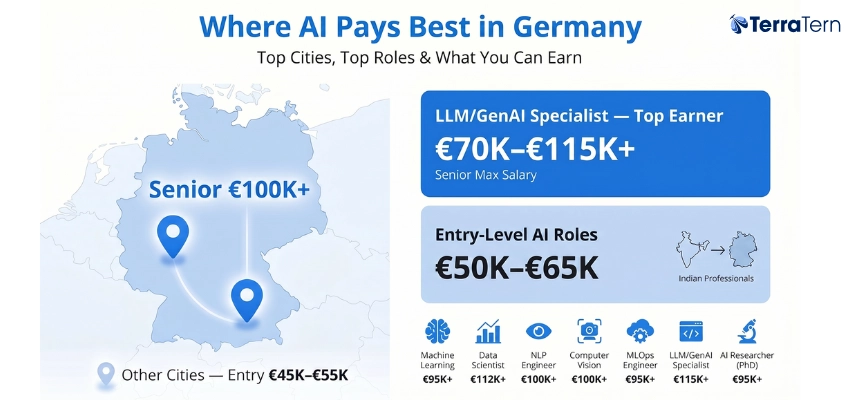
In Germany, AI specialists generally get between 58,000 and 95,000 (annually), with high-quality senior positions in Munich and Frankfurt regularly going over 100,000. In its non-Bavarian centres, Indian workers possessing work-related degrees and projects, and applying for entry-level AI jobs can begin earning approximately €45,000-€55,000 per year.
|
AI Role → Level ↓ |
Entry-Level |
Mid-Level |
Senior Level |
|
Machine Learning Engineer |
€58,000 (≈INR 52.2 LPA) |
€75,000 (≈INR 67.5 LPA) |
€95,000+ (≈INR 85.5 LPA+) |
|
Data Scientist |
€50,000 (≈INR 45 LPA) |
€70,000 (≈INR 63 LPA) |
€112,000+ (≈INR 100.8 LPA+) |
|
NLP Engineer |
€60,000 (≈INR 54 LPA) |
€80,000 (≈INR 72 LPA) |
€100,000+ (≈INR 90 LPA+) |
|
Computer Vision Engineer |
€65,000 (≈INR 58.5 LPA) |
€82,000 (≈INR 73.8 LPA) |
€100,000+ (≈INR 90 LPA+) |
|
MLOps Engineer |
€60,000 (≈INR 54 LPA) |
€78,000 (≈INR 70.2 LPA) |
€95,000+ (≈INR 85.5 LPA+) |
|
LLM/GenAI Specialist |
€70,000 (≈INR 63 LPA) |
€90,000 (≈INR 81 LPA) |
€115,000+ (≈INR 103.5 LPA+) |
|
AI Researcher (PhD) |
€55,000 (≈INR 49.5 LPA) |
€75,000 (≈INR 67.5 LPA) |
€95,000+ (≈INR 85.5 LPA+) |
As per TerraTern Expert, Shreya, German AI salaries grow steadily and predictably rather than dramatically, but, combined with exceptional job security, 30 days of paid leave, public healthcare, and a fast path to permanent residency, the total compensation package often exceeds that of equivalent US roles once living costs and benefits are factored in.
Also Read: Jobs in Germany with Visa Sponsorship: How to Find & Apply?
Which Cities in Germany Have the Most AI Jobs?
Germany, the biggest job market in AI, is in Berlin, Munich, Frankfurt, and Hamburg, with their own areas of strength. Berlin (startups), Munich (automotive AI), Frankfurt (fintech), and Hamburg (logistics AI) are all strong AI teams.
Is Berlin the Best City for AI Jobs in Germany?
At the startup centre in Germany, 4 out of 10 companies in Berlin are concerned with AI. NLP, GenAI, fintech and health tech AI. An expensive life is better than Munich. The most important employers: HelloFresh, Zalando, N26, Celonis, and Fraunhofer Berlin.
Best For:
-
Mid-level AI pros
-
GenAI/LLM specialists
-
AI researchers
Why Is Munich a Top City for AI Engineers in Germany?
Enterprise AI with hosts BMW, Siemens, SAP, and MAN. Largest salaries in AI in Germany (1020 per cent above Berlin). ML and computer vision, autonomous/industrial AI. Rent: €1,500–€2,500/month for 1BHK.
Best For:
-
ML Engineers
-
Computer Vision Engineers
-
Top positions in AI
What AI Jobs Are Available in Frankfurt, Germany?
The financial capital of Europe: AI fintech, risk analysis, fraud detection. The major employers are: Deutsche Bank, Commerzbank, Finanz Informatik, and DWS Group.
Best For:
-
Experts in AI who are financial professionals.
-
ML specialists quantitative
Are There AI Jobs in Hamburg, Germany?
Logistics, artificial intelligence, online shopping, and aircraft. The major employers are Airbus, Otto Group, and Hamburg Port Authority. On the increase of supply chain optimisation. Less expensive than Munich; friendly to the English.
Best For:
-
Logistics AI specialists
-
Optimisers of supply chains
Important Note: For Indian AI professionals prioritising career growth, Berlin offers the best ecosystem for GenAI and startup exposure, while Munich offers the best salaries and enterprise stability. Starting in Berlin and transitioning to Munich after 2–3 years is a common and effective career strategy.
What Qualifications Do You Need for AI Jobs in Germany?
AI jobs in Germany typically require a Bachelor's/Master's degree in Computer Science, Data Science, Math, or a related field, plus 2–5 years' experience. Master Python, ML frameworks (TensorFlow/PyTorch), and cloud platforms like AWS/Azure for top roles.
What Degree Do You Need for AI Jobs in Germany?
Bachelor's minimum for AI jobs in Germany; Master's/PhD ideal for senior/research roles.
-
German firms verify Indian degrees via Anabin (seek H+ rating)
-
Unlisted unis? Get ZAB Statement of Comparability (€208; 2–12 weeks)
-
No degree? EU Blue Card possible with 3+ years IT experience (exceptional specialist route)
What Technical Skills Are Most In-Demand for AI Jobs in Germany?
Must-Have for AI Jobs in Germany :
-
Python (pandas, NumPy, scikit-learn)
-
ML frameworks TensorFlow, PyTorch, Keras
-
SQL/database management
-
Cloud AWS SageMaker, Azure ML, Google Vertex AI
-
Git/GitHub
Strongly Preferred:
-
MLOps: Docker, Kubernetes, MLflow, Kubeflow
-
NLP/LLM: Hugging Face, LangChain, RAG
-
Big Data: Spark, Databricks, Hadoop
-
Domain: expertise (auto, finance, healthcare AI)
Top Certifications:
-
AWS Certified ML – Speciality
-
Google Professional ML Engineer
-
Microsoft Azure AI Engineer
-
TensorFlow Developer
Is German Language Required for AI Jobs in Germany?
English suffices for most AI jobs in Germany, no German needed.
-
B1 German aids integration, faster PR
-
Required for healthcare/legal/gov AI roles
-
A2–B1 boosts interview callbacks 30–40% (stats-based)
Expert Advice: Indian AI professionals who combine technical depth with even a basic level of German (A2) consistently outperform English-only candidates in the hiring process, not because it's required, but because it signals integration intent, which German employers value deeply.
How Can Indian Professionals Apply for AI Jobs in Germany?
Indians targeting AI jobs in Germany should use StepStone, LinkedIn, Glassdoor, craft a tabular Lebenslauf CV, apply to SAP, BMW, Siemens, and pursue EU Blue Card or Opportunity Card visas.
Which Job Portals Are Best for Finding AI Jobs in Germany?
TerraTern offers job assistance; check their services for personalised support
|
Portal |
Best For |
Notes |
|
|
International AI roles, networking |
Set to Germany + remote |
|
StepStone |
German employer postings |
Top comprehensive portal |
|
Glassdoor |
Salary info + applications |
Employee reviews included |
|
Make It In Germany |
Official govt jobs |
Curated vacancies |
|
|
German pro networking |
LinkedIn equivalent |
|
Glassdoor Germany |
AI filtering |
1,200+ AI roles (Apr 2026) |
|
Indeed Germany |
Broad coverage |
Great for SMEs |
|
Fraunhofer Karriere |
Research/academic AI |
Institute roles |
How Should Indian Candidates Optimise Their CV for German AI Jobs?
Indian candidates should optimise their CV in the following ways:
-
No graphics/multi-columns (ATS-unfriendly)
-
3-line summary targeting AI role
-
Highlight certs (AWS/Google ML/TensorFlow)
-
Add GitHub link (80% managers check)
-
CEFR German level (A1–C2)
-
Match job desc keywords (60% use ATS like SuccessFactors)
What Are the Top Companies Hiring for AI Jobs in Germany?
The top companies hiring for AL jobs in Germany are
-
SAP (Walldorf/Berlin): Enterprise/GenAI in ERP
-
BMW (Munich): Autonomous driving, vision analytics
-
Siemens (Munich/Berlin): Industrial AI, IoT maintenance
-
Deutsche Telekom (Bonn/Berlin): NLP telecom AI
-
Volkswagen (Wolfsburg/Berlin): Automotive ML/self-driving
-
Zalando (Berlin): E-commerce recommendation AI
-
Bosch (Stuttgart): Edge/manufacturing vision
-
Fraunhofer (Multi-City): Research, visa-friendly
-
N26 (Berlin): Fintech fraud AI
-
HelloFresh (Berlin): Supply chain forecasting
Expert Tip: Don't overlook the Fraunhofer-Gesellschaft, Europe's largest applied research organisation, which actively recruits international AI talent, provides visa sponsorship, and offers a unique combination of research depth and industry relevance that is rare outside Germany.
Also Read: Job Openings in Germany: Latest Salary, Apply & More
What Visa Do You Need for AI Jobs in Germany as an Indian?
The EU Blue Card is ideal for Indian AI Jobs in Germany, requiring a job offer at €45,934.20+ salary (IT/AI shortage occupation, 2026), a recognised degree, and fast PR in 21 months with B1 German.
What Is the EU Blue Card and How Does It Apply to AI Jobs in Germany?
The EU Blue Card is a combined work-and-residence permit for highly qualified non-EU professionals who want to work in Germany, and it is one of the main immigration routes for AI talent such as machine learning engineers, data scientists, AI software engineers, and related IT specialists. In Germany, AI jobs can qualify for the Blue Card if you have a relevant job offer, the role matches your qualifications or high-level IT experience, and the salary meets the applicable threshold.
-
2026 salaries €50,700 standard; €45,934.20 shortage (IT/AI)
-
Up to 4 years, renewable; no labour market test
-
PR: 21 months (B1 German) or 33 months
-
Family reunites immediately; spouse works unrestricted
-
IT exception 3+ years exp, no degree needed.
What Is the Opportunity Card (Chancenkarte) and Can AI Professionals Use It?
The Germany Opportunity Card (Chancenkarte) is a points-based residence permit that allows skilled non-EU professionals to enter Germany for up to 12 months to search for a job, without needing a job offer first. For AI professionals, this is a highly viable and increasingly popular pathway, given Germany's strong demand for data science, machine learning, and AI talent.
-
Requirement is 2+ years training/degree; A1 German or B2 English
-
Part-time OK (20 hrs/week); €1,091/month funds
-
Points for age, exp, German skills, Germany ties
-
Perfect for interviews and networking for Indian AI pros.
What Are the Steps to Apply for a Germany Work Visa for AI Jobs from India?
Steps to apply for Germany work visa for AI jobs from india are:
-
Evaluate Degree: Check Anabin; get ZAB (€208, 2–12 weeks)
-
Secure Job: offer meeting salary (€45,934.20+ for Blue Card)
-
Gather Docs: passport, contract, degrees (translated), insurance
-
Book Embassy: appt (6–8 weeks ahead); interview/biometrics. Enter within 90 days.
-
Post-arrival: Blue Card at Ausländerbehörde; Anmeldung in 2 weeks.
Important Tip: Indian AI professionals should pursue the EU Blue Card rather than the standard Skilled Worker Visa. The faster permanent residency timeline (21 vs. 60 months), unrestricted family work rights, and EU mobility rights make it significantly more valuable as a long-term career investment.
How Do AI Jobs in Germany Compare to AI Jobs in India and the US?
AI jobs in Germany offer salaries of €65,000–€95,000, lower than US levels but far above India's INR 10–30 LPA. Germany's edge lies in unmatched job security, public healthcare, 30+ days of paid leave, and fast PR, making it ideal for Indian professionals seeking stability amid US volatility.
|
Factor |
India (Senior AI) |
Germany (Senior AI) |
US (Senior AI) |
|
Avg Salary |
INR 25–50 LPA |
€75,000–€95,000 (~INR 67–85L) |
$150,000–$200,000 |
|
Job Security |
Medium |
Very High |
Medium-Low (layoffs) |
|
Healthcare |
Private (costly) |
Public (included) |
Employer-dependent |
|
Paid Leave |
15–20 days |
30+ days |
10–15 days |
|
PR Timeline |
N/A |
21–33 months |
6–10+ years (H1B) |
|
Language |
None |
Minimal for AI jobs |
None |
Pro Tip: For Indian AI professionals planning long-term settlement rather than short-term earnings maximisation, Germany offers a more sustainable and accessible pathway than the US, particularly given the H-1B lottery uncertainty and recent volatility in the US tech sector.
What Are the Challenges of Getting AI Jobs in Germany for Indians?
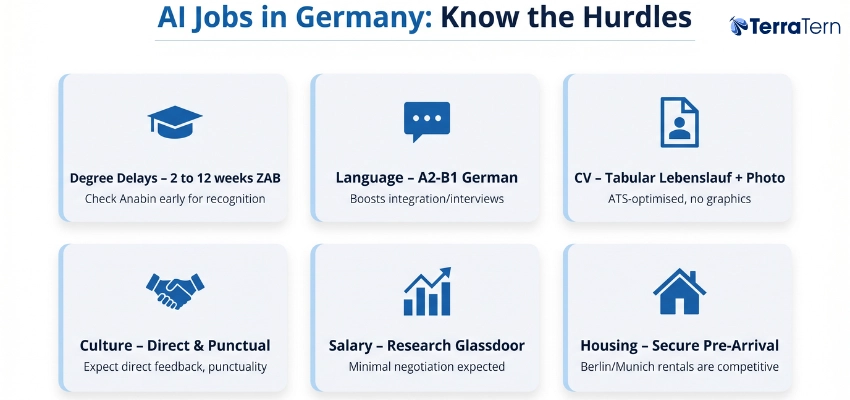
AI jobs in Germany are achievable despite hurdles; plan ahead for success. You can encounter challenges like:
-
Degree Delays: ZAB recognition takes 2–12 weeks; check Anabin early
-
Language: A2–B1 German boosts integration/interviews (English OK for tech)
-
CV Format: Use tabular Lebenslauf with photo; ATS-optimised, no graphics
-
Culture: Expect direct feedback, punctuality; differs from Indian norms
-
Salary Norms: Research Glassdoor rates; minimal negotiation expected
-
Housing: Berlin/Munich rentals are competitive, secure pre-arrival
Key Note: Most Indian professionals who fail to secure AI jobs in Germany don't fail because of skills; they fail because of preparation gaps: incorrect CV format, unrecognised degrees, or unrealistic salary expectations. Addressing these three points before applying dramatically increases success rates.
Also Read: Tech Jobs in Germany: Latest Salaries & Careers
2026 Industry Context Section
The latest facts are:
-
Statistic (2026): Germany has over 1,200 open AI/artificial intelligence roles listed on Glassdoor as of early 2026, a figure that does not include direct-apply portals like StepStone or company career pages.
-
Statistic: The AI job market in Germany is projected to grow at 15% annually, with demand concentrated in fintech, automotive, healthcare, and manufacturing.
-
Industry Development: Germany's Digital Strategy targets R&D spending at 3.5% of GDP by 2026, directly fuelling demand for AI and data specialists.
-
Visa Development (2026): EU Blue Card salary threshold for shortage occupations (including IT/AI) is now €45,934.20/year, making it accessible to mid-career Indian professionals.
-
Talent Gap: German companies are moving "beyond basic analytics into predictive modelling, automation, and AI-driven decision-making" with Indian professionals identified as among the most trusted talent pools due to strong technical education.
-
GenAI Trend: LLM/GenAI specialist roles grew 300% in Germany since 2024, commanding 20–25% salary premiums over traditional data scientist roles.
-
Indian Workforce Growth: India's professional community in Germany has grown sixfold in less than a decade, from 23,000 in 2015 to over 137,000 in 2024.
Conclusion
AI jobs in Germany offer Indian professionals unmatched opportunities, including high-demand roles in Berlin, Munich, and Frankfurt; competitive salaries (€65K–€95K); and fast EU Blue Card pathways to PR in 21 months. While challenges like degree recognition and housing exist, the stability, public healthcare, and work-life balance far surpass those in India and rival those in the US. Start with LinkedIn/StepStone, optimise your Lebenslauf CV, and leverage.
Contact TerraTern for more information on AI Jobs in Germany: Roles, Salaries & How to Apply.




 AI Summary