

Key Highlights
- Why the UK Is Targeting Phones and SIM Cards
- The Border Security, Asylum and Immigration Act Explained
- Operational Deployment: Where and How It Works
- Government's Rationale and Political Support
- Legal and Ethical Considerations
- Impact on Smuggling Networks
- Public Reaction and Human Rights Debate
- What Happens Next for Illegal Migrants and Smugglers
- Conclusion
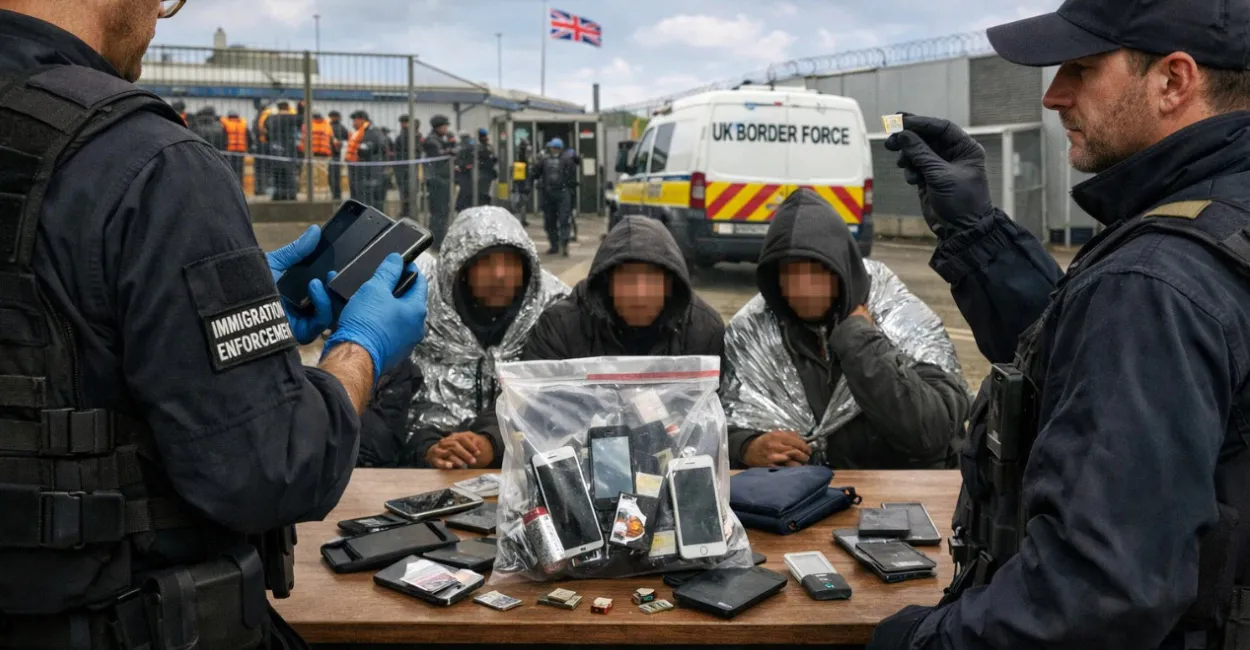
The United Kingdom has unveiled a new fighting force against illegal migration, where law enforcement has been given the unheard-of powers to confiscate mobile phones and SIM cards of people who enter the country via unapproved routes. With the assistance of the new Border Security, Asylum and Immigration Act that has been implemented, these measures are aimed at disrupting the organised smuggling gangs that support dangerous crossings of the Channel and assist the authorities to collect crucial intelligence without necessarily having to wait until a person is arrested. According to Home Office officials, it is a game-changing application to the ongoing effort to regulate borders and uproot criminal gangs who make a fortune out of risky migration activities.
Why the UK Is Targeting Phones and SIM Cards?
Mobile phones and SIM cards have turned out to be essential instruments for both the people smugglers and the migrants. They are also employed to organise trips, phone contacts across the Channel, and routes through ways that are not noticeable. The UK government claims that by getting into the data of these devices, they can trace the whole chain of smuggling routes, track their chain of communications and finally find the major persons who help organise illegal arrivals.
In the past, police were restricted in their ability to confiscate gadgets without necessarily arresting their owner. The new legal authorities eliminate this barrier and police can seize electronic tools as soon as they come across the illegal migrants. The officials also enjoy better search rights, such as searching of clothing and special searches for concealed SIM cards.
Also Read: Unlock Opportunities with UK Startup Visas
The Border Security, Asylum and Immigration Act Explained
The Border Security, Asylum and Immigration Act provides a repertoire of instruments by which authorities in the UK can respond to illegal migration much more agilely. The act contains major provisions that include:
-
Taking of Legal Devices Without Arrest: The police can take away mobile phones and SIM cards of migrants without arrest.
-
Widened Search Authorities: The officers have the right to request people to strip off their outer garments and seek certain searches to locate concealed SIMs.
-
New Criminal Offences: The smugglers receive up to 14 years imprisonment in case they provide items that are used in crossing illegally, like boat engines.
-
Data-Driven Disruption: Authorities can download and analyse data at the place to speed up the intelligence collection.
Such actions are a part of the overall approach of the government to prevent unlawful entry, discourage organised smuggling and accelerate the deportation of illegal migrants.
Operational Deployment: Where and How It Works
These powers were first rolled out in the migrant holding facility at Manston, Kent. In this case, border officers, police and National Crime Agency (NCA) staff members are using technology to download information from confiscated devices, identifying leads on smuggling routes and networks.
In addition to the Manston centre, the authorities have the right to search property and vehicles, which implies that they can do it anywhere in case they find illegal migrants or signs of illegal activities. The wide application is supposed to ensure that the smugglers do not utilise safe havens and caches to shelter themselves against the law.
Government's Rationale and Political Support
This legislation is an attempt to deal with the criminal networks involved in illegal migration so as to restore order and control to the borders of the UK, as Alex Norris, the Minister of Border Security and Asylum, claims that the legislation is a promise to the government to put an end to illegal migration. Officials feel that digital evidence found in confiscated gadgets will greatly increase the rate at which traffickers are detected, examined and charged.
Since the institution of the Border Security Command, about 4,000 contraventions of smuggling operations have been documented, varying between confiscation of cash and large-scale convictions of leading personalities. The government officials believe that increasing powers are the next logical step in putting pressure on criminal organisations.
Also Read: Dream Big and Get Your UK Work Visa for Indians
Legal and Ethical Considerations
As much as the government focuses on security and enforcement benefits, the new powers are likely to pose significant questions about civil liberties and individual rights. Because of personal inferences, critics believe that within this system, taking personal devices without arrest might act against privacy and the misuse of confidential information.
Such policies have been challenged in the UK in the past. One of the past blanket phone seizure policies particularly led to the judicial review, where the immigration officials were found to have overstepped the law, leading to the debate over the issue of security and the protection of rights.
The existing law, however, seeks to solve the issues of the past by addressing the legal issues in a more precise way and addressing intelligence-based enforcement of the law against organised smuggling and not the general, indiscriminate approach to the issue. However, the human rights groups and legal experts are keeping a close eye on the implementation.
Impact on Smuggling Networks
The UK government hypothesises that by attacking phones and SIM cards, the ability of smuggling networks to operate will be weakened because communication channels would be cut off, and coordination schemes would be revealed. This may not only affect the flow of migrants but also the money and logistical backup that support illegal migration flows.
Criminals may be prosecuted under new criminal offences involving downloading, researching, or storing information that helps them to illegally migrate, such as the analysis of maps or the identification of launch points of small-boat crossings, punishable by up to five years in prison.
Public Reaction and Human Rights Debate
Public opinion is divided. The aggressive approach of the government is appreciated by many citizens, especially those who are concerned with the security of the country and uncontrolled immigration. They perceive greater powers as a requirement that will intimidate threatening sea crossings that have taken lives and reinforced border security.
On the other hand, activists and rights organisations claim that the policies are dangerous because they may infringe the privacy and human rights of migrants. One is afraid that the devices may be utilised excessively or without proper supervision in light of sensitive personal information being stored in the present-day mobile devices.
By emphasising open processes and protection, legal activists have advocated that human rights requirements should not be violated despite the increased efforts to enforce.
Also Read: Most Common Reasons For UK Visa Rejection: Don’t Make These
What Happens Next for Illegal Migrants and Smugglers
The new authorities will imply that once they are caught crossing the border, illegal migrants are likely to have their devices taken and examined. This might result in faster detection of smuggling rings and more focus on enforcement. Smugglers and their partners are more severely punished and are more likely to be caught.
Other immigration reforms are also in the pipeline to make the illegal routes less appealing to the government and also to make the asylum system more efficient. These are expedited removals and constriction of legal routes where it is required.
Conclusion
The move by the UK to authorise law enforcement to confiscate mobile phones and SIM cards of illegal migrants is a major escalation of its fight against unauthorised migration and people smuggling. Although the strategy is expected to provide intelligence-based disruption of criminal networks and a more effective border protection, it leaves a complicated legal and ethical issue of privacy and the rights of civil liberties.
These powers will be evaluated when implemented and tested in the practical activities by the policymakers, legal professionals and even human rights activists, with regard to their effectiveness and fairness. The trade-off between strong enforcement and the rights of the individual will probably continue to be at the centre of the current debate on immigration policy in the UK.
Contact TerraTern for more information.