

Key Highlights
- Work Permit in European Countries
- What Exactly Is a Work Permit in European Countries?
- What Are the Types of Work Permits in European Countries?
- Which European Country Gives Work Permit Most Easily to Indians?
- What Are the Eligibility Requirements for a Work Permit in European Countries?
- What Documents Are Required for a Work Permit in European Countries?
- How to Apply for a Work Permit in European Countries from India?
- What Is the Cost of a Work Permit in European Countries? (Fees in EUR and INR)
- Which European Country Gives Work Permit to Refugees?
- What Is the European Passport Work Permit Permission? Which Country Offers It?
- What Are the In-Demand Jobs for Europeans Work Permit Holders from India in 2026?
- How Long Does It Take to Get a Work Permit in European Countries?
- Can You Convert a Tourist Visa to a Work Permit in European Countries?
- What Is the Pathway from Work Permit to PR in European Countries?
- How Can TerraTern Help You Get a Work Permit in European Countries?
- 2025–2026 Industry Context: Key Facts About European Work Permits
- Conclusion
One of the entry routes to European countries is to obtain a work permit in European countries, and as long as the opportunity exists in the EU countries, such as India, like yourself, considering the opportunities in 2026, the work permit route is one of the many approaches that could be implemented to secure employment. One of the main options in most member states (excluding Denmark and Ireland) is the EU Blue Card, which is aimed at highly qualified employees, with a degree or five years of experience, an offer of employment with a minimum salary level (e.g. approximately 48,300 per year in Germany), and is usually sponsored by the employer before official approval.
National programs, like the skilled worker visa used in Germany, the Highly Skilled Migrant Permit in the Netherlands, or the D7 visa used in Portugal to become an entrepreneur, provide flexibility but require documents such as a job contract, qualifications, and evidence of funds, with processing times of 2-12 weeks and embassy applications. This guide provides you with current actions, country regulations and post arrival advice to help make your relocation out of India much easier. This Guide will cover work permits in European countries, European passport work permits, in which European countries give work permits to refugees, and more.
Work Permit in European Countries
The rules for work permits in European countries vary from country to country, depending on the country, job offer, and qualifications.
-
The majority of courses require formal qualifications, experience and an annual salary which may be subject to local guidelines.
-
Germany, Austria and Ireland are popular skilled-worker pathways.
-
The EU Blue Card is an alternative option for highly qualified workers.
-
Typically requires one or two months (1-6).
-
Country visa requirements may change. Please check the latest visa legislation before making a visa application.
Also Read: Work Permit in European Countries For Indians Update
What Exactly Is a Work Permit in European Countries?
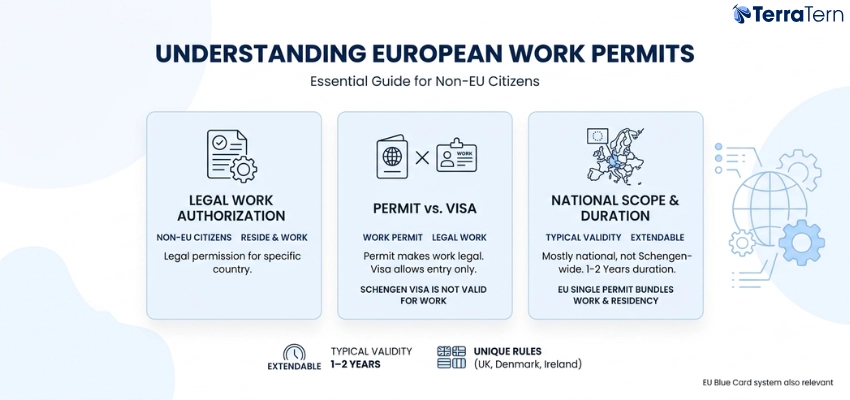
A work permit in a European country is a legal permission for people who are not from the EU to reside in and work in a certain country.
-
A work permit is not the same as a work visa. The visa allows you to enter; the work permit is a piece of paper that makes it legal to work.
-
A Schengen visa is not valid for work.
-
Most permits are national, and not Schengen-wide and the EU Single Permit is now a bundle of work and residency permits.
-
The typical validity of this is 1-2 years, though it can be extended.
-
The UK, Denmark, and Ireland have unique rules beyond the EU Blue Card system.
As per TerraTern Expert Shreya, Many Indians confuse a Schengen tourist visa with a work permit; they are legally distinct. Working on a tourist visa is illegal and can result in deportation and a multi-year ban from the Schengen Area.
What Are the Types of Work Permits in European Countries?
The EU Blue Card, national work visas and Single Permit are the three main pathways to getting a work permit in European countries.
-
The EU Blue Card does not exist in the UK, Denmark, or Ireland, and it is for highly skilled workers in most EU countries.
-
National work visas are visas issued by a specific country, such as Germany's Skilled Worker Visa or Austria's Red-White-Red Card.
-
In many countries of the EU, the Single Permit is issued that serves for work and residence.
-
The Intra-Company Transfer permits will be applicable to employees being rolled over within the same company.
-
Seasonal work permits are temporary and by sector.
-
Portugal's visa for freelance workers or digital nomads is a favourable option for remote workers from other countries.
-
A digital nomad or freelance visa is a great choice for remote workers in Portugal, Spain, and Estonia.
Expert Tip: The new EU Single Permit Directive (May 2026) will be a game-changer: it merges residence and work authorisation into a single document for most EU countries, significantly reducing paperwork for Indian applicants.
What Is the EU Blue Card and Who Qualifies?
The EU Blue Card is the most well-known work permit in European countries for skilled migrants.
It is offered to non-EU citizenship candidates with additional qualifications or strong professional experience.
-
A bachelor's degree or relevant experience is generally required, and some IT positions will accept experience in lieu of a degree.
-
Along with that, you must have an offer of employment, typically for at least 6 months.
-
Salaries may differ from country to country and position to position.
-
Benefits are, among others, earlier time available to live in, family reunification, and finally, mobility (after a period of time) in Europe.
-
The UK, Denmark and Ireland are not part of the EU Blue Card.
What Are National Work Visas in Europe?
National work visas for Europe
|
Country |
Permit Name |
Minimum Salary |
PR Eligibility |
|
Germany |
Skilled Worker Visa |
Varies by role |
Yes, often possible after a few years |
|
Austria |
Red-White-Red Card |
Varies by category |
Yes, with renewal and settlement routes |
|
Netherlands |
Highly Skilled Migrant Permit |
Employer-set threshold |
Yes, possible through long-term residence |
|
Ireland |
Critical Skills Employment Permit |
Sector-specific threshold |
Yes, pathway to long-term residence |
|
France |
Talent Passport |
Case-specific |
Yes, depending on residence status |
|
Sweden |
Work Permit |
Employer-sponsored salary rules |
Yes, through continued residence |
|
Portugal |
Highly Qualified Activity Visa / Tech Visa |
Category-based |
Yes, through residence progression |
Which European Country Gives Work Permit Most Easily to Indians?
For work permit in European countries, Germany, Portugal, Estonia, and Lithuania are among the most accessible options for Indians because they combine clear eligibility rules, strong hiring demand, and relatively quick processing times. For European passport work permit permission in which country, EU passport holders can usually work freely across EU states, while non-EU applicants must follow each country’s permit route.
|
Country |
Permit Type |
Min. Salary (EUR/yr) |
Min. Salary (INR/yr approx.) |
Processing Time |
PR Eligibility |
|
Germany |
EU Blue Card / Skilled Worker Visa |
€45,934 / €50,700 |
~₹41–₹46 lakhs |
4–8 weeks |
21–33 months |
|
Portugal |
Highly Qualified Activity Visa |
~€30,000 |
~₹27 lakhs |
4–6 weeks |
5 years |
|
Estonia |
EU Blue Card |
~€38,000 |
~₹34 lakhs |
2–4 weeks |
5 years |
|
Lithuania |
National Visa (D) |
~€25,000 |
~₹22 lakhs |
4–6 weeks |
5 years |
|
Ireland |
Critical Skills Permit |
€38,000–€64,000 |
~₹34–₹57 lakhs |
6–8 weeks |
5 years |
|
Netherlands |
Highly Skilled Migrant |
€5,688/month (30+) |
~₹61 lakhs/yr |
4–8 weeks |
5 years |
|
Sweden |
Work Permit |
1.25× average salary |
~₹53 lakhs |
4–8 weeks |
4 years |
Important Note: Estonia offers the fastest EU Blue Card processing in Europe (2–4 weeks), making it an underrated option for Indian IT professionals who want to enter Europe quickly.
Which European Country Is Best for Indian IT Professionals?
Work permits in European countries is easiest for IT professionals in Germany, the Netherlands, Ireland, and Sweden because these markets actively hire software engineers, DevOps specialists, and data scientists.
-
Germany has the highest demand for IT and a significant skills shortage, making it a strong option for Indian tech talent.
-
The Netherlands offers English-friendly workplaces and high salaries, which help Indian applicants adapt faster.
-
Ireland is attractive because major global tech companies have European bases there.
-
European passport work permit permission in which country is simplest for EU citizens, but Indian professionals usually need a sponsored or skilled-worker route.
Which European Country Is Best for Indian Healthcare Workers?
A work permit in European countries is often most practical for healthcare workers in Germany due to structured recruitment pathways such as the Triple Win project.
|
Country |
Best Route |
Nurses (EUR/yr) |
Nurses (INR/yr approx.) |
Doctors (EUR/yr) |
Doctors (INR/yr approx.) |
|
Germany |
Triple Win / Skilled Worker Route |
€30,000–€38,000 |
~₹27–₹34 lakhs |
€55,000–€90,000 |
~₹49–₹81 lakhs |
|
Sweden |
Job-offer-based Work Permit |
€33,000–€40,000 |
~₹30–₹36 lakhs |
€60,000+ |
~₹54 lakhs+ |
|
Ireland |
Critical Skills Permit |
€35,000–€45,000 |
~₹31–₹40 lakhs |
€60,000+ |
~₹54 lakhs+ |
|
Austria |
Nursing Pathway / Ausbildung Route |
€28,000–€35,000 |
~₹25–₹32 lakhs |
€50,000+ |
~₹45 lakhs+ |
What Are the Eligibility Requirements for a Work Permit in European Countries?
A work permit in European countries usually requires a valid job offer from a registered employer.
-
You typically need a recognised bachelor’s degree or at least 5 years of relevant experience.
-
Most countries require a salary that meets the local threshold for that permit.
-
Health insurance, a clean police record, and proof of accommodation are commonly needed.
-
Indian degrees may need credential recognition or evaluation.
-
In some countries, IT professionals can qualify without a degree if they have strong experience.
-
English proof is not always mandatory, but language skills help.
-
Applications are strongest when all documents are prepared in advance.
Expert Tip: Indian IT professionals can now qualify for the EU Blue Card in Germany, the Netherlands, and France without a traditional degree; 3 years of relevant professional experience suffice. This is a significant change that most guides haven't caught up to.
What Documents Are Required for a Work Permit in European Countries?
Work permit in European countries often slow down when degree recognition is missing.
-
Germany may ask for a ZAB recognition letter, while Austria, the Netherlands, and Ireland have their own country-specific checks.
-
Start credential evaluation early, ideally 3 months before applying.
|
Document |
Notes |
|
Valid passport |
Usually, it must be valid for at least 6 months beyond the intended stay. |
|
Visa application form |
Filled online or on paper, depending on the country. |
|
Employment contract |
Must clearly show role, salary, start date, and duration. |
|
Educational certificates |
Often need translations and notarisation. |
|
Salary proof |
Must show you meet the required threshold. |
|
Health insurance |
Must be valid in the destination country. |
|
Proof of accommodation |
Rental agreement or employer housing letter. |
|
Passport photos |
Must match the country’s size and format rules. |
|
Police clearance |
Often required from India, and sometimes from other countries where they live. |
|
Biometric data |
Usually collected at the visa centre or embassy. |
Expert Advice: Getting your Indian degree recognised in the destination country is often the step that causes the most delay. Start the credential evaluation process (ZAB for Germany, NARIC for the UK, WES for others) at least 3 months before applying.
How to Apply for a Work Permit in European Countries from India?
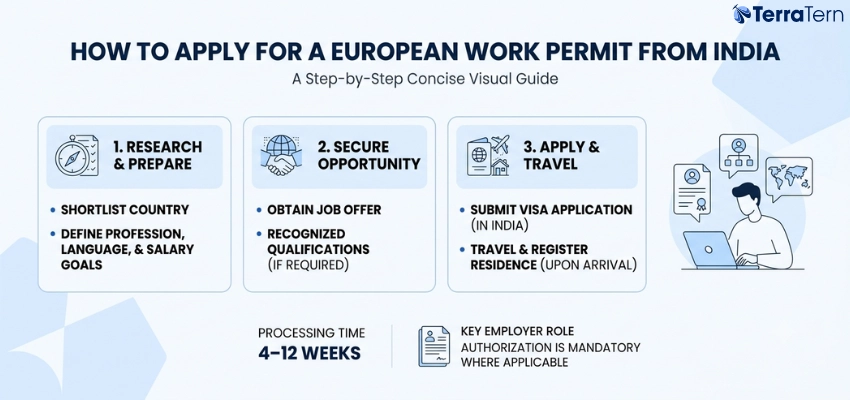
To apply for a work permit in European countries is
-
Shortlist your target country based on your profession, language level, and salary goals.
-
Secure a job offer through job portals, company websites, or European hiring networks.
-
Get your qualifications recognised if the destination country requires it.
-
Let the employer apply for work authorisation where that step is mandatory.
-
Submit your visa application at the embassy, consulate, or VFS centre in India.
-
Attend the biometric appointment or interview, if required.
-
Wait for the decision, which usually takes 4–12 weeks.
-
Travel, then register your residence soon after arrival, since many countries require it.
Important Tip: Always apply through the official embassy or authorised VFS centre, never through unverified agents. Working with a registered immigration consultant like TerraTern can significantly reduce the risk of rejection due to documentation errors.
What Is the Cost of a Work Permit in European Countries? (Fees in EUR and INR)
Work permit in European countries typically cost between €75 and €300, or about ₹6,800 to ₹27,000.
|
Country |
Permit Fee (EUR) |
Approx. INR |
Processing Time |
|
Germany |
€75 |
~₹6,800 |
4–8 weeks |
|
France |
€99 |
~₹9,000 |
6–10 weeks |
|
Netherlands |
~€192 |
~₹17,400 |
4–8 weeks |
|
Austria |
~€120 |
~₹10,900 |
4–8 weeks |
|
Ireland |
€1,000 |
~₹91,000 |
6–8 weeks |
|
Portugal |
~€90 |
~₹8,200 |
4–6 weeks |
|
Estonia |
~€100 |
~₹9,100 |
2–4 weeks |
As per TerraTern Expert: Ireland's Critical Skills Permit fee of €1,000 (~₹91,000) looks steep, but the permit includes a direct pathway to permanent residency, and your spouse gets immediate work rights, making it one of the best-value permits in Europe for skilled Indian professionals.
Which European Country Gives Work Permit to Refugees?
If you're asking "in which European country gives work permit to refugee", all EU member states must provide labour market access to asylum seekers within a maximum of 9 months under the EU Reception Conditions Directive, while some countries allow access earlier.
-
Refugees, beneficiaries of subsidiary protection, and people under temporary protection can generally obtain a work permit in European countries, though the scope and duration of rights vary by protection status.
-
Germany, Sweden, France, Spain, and Portugal are widely recognised for strong refugee employment and integration frameworks.
-
Recognised refugees in Germany receive full work rights; France grants a 10-year residence permit with work authorisation, while Spain provides residence and work rights for up to 5 years.
-
The 2026 EU Migration and Asylum framework aims to streamline asylum processing, improve labour market integration, and create more consistent standards across EU countries.
Pro Tip: Contrary to common assumptions, recognised refugees in EU countries don't just receive accommodation, they have the legal right to work, and in countries like Sweden and Germany, many have access to the labour market within weeks of their application being lodged.
What Is the European Passport Work Permit Permission? Which Country Offers It?
The phrase "European passport work permit permission in which country" usually refers to pathways such as the EU Blue Card and EU long-term residence permits that provide mobility benefits within Europe, not an actual passport.
-
For non-EU nationals seeking a work permit in European countries, the EU Blue Card is the closest equivalent, allowing highly skilled workers to live and work in 25 participating EU member states.
-
After 12 months in the first Blue Card country, holders can often move to another participating EU country under simplified mobility rules.
-
Countries where Blue Card mobility is commonly used include Germany, the Netherlands, Sweden, France, and Spain due to strong labour demand and established migration systems.
-
After around 5 years of legal residence, many countries offer EU long-term resident status, providing additional cross-border work and residence rights.
-
Permanent residence and citizenship pathways generally become available after 4–8 years (depending on the country), eventually leading to actual EU passport rights and full freedom of movement across the European Union.
Key Note: The EU Blue Card's intra-EU mobility rule is one of its most underutilised benefits. After just 12 months in your first EU country, you can transfer to another EU country without restarting the entire work permit process.
What Are the In-Demand Jobs for Europeans Work Permit Holders from India in 2026?
Work permits in European countries are most favourable for Indian candidates in IT, healthcare, engineering, data science, logistics, and skilled trades, with Germany, the Netherlands, and Ireland showing the strongest demand. In which European country gives work permit to refugee, the refugee route is separate from job-based migration and depends on each country’s asylum system.
|
Sector |
Average Annual Salary (EU) |
INR Equivalent |
|
Software Engineer |
€60,000–€90,000 |
₹54–₹81 lakhs |
|
Data Scientist |
€70,000–€100,000 |
₹63–₹90 lakhs |
|
Civil/Mechanical Engineer |
€45,000–€70,000 |
₹40–₹63 lakhs |
|
Nurse (Germany) |
€35,000–€50,000 |
₹31–₹45 lakhs |
|
Doctor (Germany) |
€60,000–€90,000 |
₹54–₹81 lakhs |
|
DevOps Engineer |
€60,000–€85,000 |
₹54–₹76 lakhs |
Important Note: the demand has intensified into 2026, and Indian tech talent is actively sought across Germany, Ireland, and the Netherlands, often with employer-sponsored work permit support.
How Long Does It Take to Get a Work Permit in European Countries?
A work permit in European countries usually takes 4–8 weeks, but the fastest cases can be 2–4 weeks, and the slowest can stretch to 12 weeks or more. In which European country gives work permit to refugee, timing is different because refugee work access depends on the asylum process, not the standard employment permit route.
|
Country |
Average Processing Time |
Fast-Track Option? |
|
Estonia |
2–4 weeks |
Yes |
|
Portugal |
4–6 weeks |
No |
|
Germany |
4–8 weeks, up to 12 for complex cases |
Yes |
|
Netherlands |
4–8 weeks, sponsor approval may take 30–90 days |
Yes |
|
Ireland |
6–8 weeks |
No |
|
France |
6–10 weeks |
Yes |
|
Austria |
4–8 weeks |
No |
|
Sweden |
4–8 weeks |
No |
Expert Tip: Spain offers one of the fastest processing times for the Highly Skilled Professionals permit visa decisions within 10 working days, residence permits within approximately 20 days ,making it worth considering for time-sensitive career moves.
Can You Convert a Tourist Visa to a Work Permit in European Countries?
In almost all European countries, you cannot legally work on a standard tourist visa or convert it into a work permit in European countries while remaining inside the territory.
-
The Correct Pathway: You must return to India or your home country and apply for a dedicated national employment visa directly through that nation’s embassy.
-
The Rare Exception: Portugal stands as a unique exception where in-country legalisation is historically possible via specific formal "Expressions of Interest," though rules remain highly fluid.
-
Severe Legal Penalties: Working illegally on a Schengen tourist visa is a serious immigration violation that will trigger immediate deportation, fines, and a multi-year ban from entering the entire Schengen Area.
-
Employer Mandate: Legitimate European employers cannot sponsor a workplace transition for someone residing in the country on short-stay tourism credentials without completing mandatory home-country consular processing.
Expert Advice: If you're already in Europe on a tourist visa and have received a job offer, do not start working, even informally. Return to India and apply for the appropriate work visa. The risk of deportation and a Schengen-wide entry ban is not worth it.
What Is the Pathway from Work Permit to PR in European Countries?
Transitioning from a temporary work permit in European countries to Permanent Residency (PR) follows a structured path. While most European nations grant PR after 4 to 5 years of continuous legal residence, the EU Blue Card provides a fast-track for highly skilled professionals.
The baseline PR eligibility requirements across key destination countries are structured below:
|
Country |
Standard PR Waiting Period |
Fast-Track Availability (EU Blue Card)? |
Core Language / Pension Requirements |
|
Germany |
4 Years |
Yes — 21 months (with B1 German) or 27–33 months (with A1 German) |
Continuous statutory pension contributions; secure household income. |
|
Sweden |
4 Years |
No — Independent national rules |
Unbroken employment; meeting strict minimum salary thresholds. |
|
Netherlands |
5 Years |
Yes — Via EU Long-Term Resident route |
Passing the civic integration exam (Inburgeringsexamen). |
|
Ireland |
5 Years |
No — Uses Critical Skills framework |
5 years on Stamp 1/Stamp 4; no formal language exam required. |
|
Portugal |
5 Years |
No — Single Permit framework |
Proof of A2 level basic conversational Portuguese. |
|
Austria |
5 Years |
No — Uses Red-White-Red Card |
B1 German integration certificate; continuous qualified employment. |
Expert Takeaway: Germany's EU Blue Card offers the fastest PR track in Europe — just 21 months if you have B1-level German language skills. For Indian IT professionals already learning German, this dramatically accelerates the PR timeline compared to the 5-year standard route.
How Can TerraTern Help You Get a Work Permit in European Countries?
TerraTern is an Indian immigration consultancy that can help you, being in Srinagar, with the European work permits with the end-to-end services of such programmes as the Germany Opportunity Card or the EU Blue Card.

-
Gives clear guidance, personal visit consultations and application-specific checklists.
-
Provides complete documentation services, such as translations, notarizations, and filing of forms.
-
Assistance in job searching, contacts with employers and language test preparation, such as IELTS.
-
Provides post-arrival relocation services, including accommodation, registration, and integration advice in Europe.
-
Has a successful record of Indians having Germany, Estonia, and Portugal in the shortest time possible.
Key Note: Before spending months researching European work permit requirements independently, a 30-minute eligibility consultation with an immigration expert can save you from applying in the wrong country, to the wrong permit category, with the wrong documents.
2025–2026 Industry Context: Key Facts About European Work Permits
current facts with publication context:
-
Single Permit Directive goes live in May 2026, merging work and residence authorisation for most EU countries, significantly simplifying the process (European Commission, 2025)
-
India is the #1 source country for EU work permits. Indian nationals received the most first-residence permits for work reasons in several EU countries in recent Eurostat data, representing 33% of all ICT-category permits in one year (Eurostat, 2025)
-
EU Blue Card issuances to Indians are at an all-time high, with over 20,000 Blue Cards issued to Indian nationals in recent years, with numbers growing as the recast 2021 Directive is implemented (European Commission)
-
EU faces a critical skills shortage, approximately 96,000 additional IT specialists needed in Germany alone by 2026; healthcare shortages across Germany, Sweden, and Ireland are driving fast-track visa programmes (BTW Visas / Eurostat 2025)
-
Asylum applications in the EU fell 23% in H1 2025, shifting the EU's immigration focus back toward labour migration and skilled-worker attraction (EUAA, September 2025)
-
Italy, Poland, Hungary, and Slovakia all updated their work permit systems in 2025. Italy increased quotas, Poland introduced a "protected professions" list replacing the labour market test, and Hungary launched new liberalised permits (The Workers' Rights, November 2025)
Conclusion
A work permit in European nations in 2026 provides Indian workers such as you with plausible best entry to the high-need IT, healthcare, and engineering areas of electrical engineering, bioengineering, or bioinformatics by using the EU Blue Card, Germany Opportunity Card, or Estonia fast-track D Visa possibilities, albeit with contrasting eligibility, expenses (300-2000 euros), and processing durations (2-12 weeks). One can now move with ease with the simplified Single Permit regulations, improving movement and allowing family rights. Success will depend on the correct qualification versus availability of shortages, employer sponsorship, and accurate paper-trails- consultancies such as TerraTern can help you with your application even in Srinagar. Begin with short-term jobs, use online portals and plan to easily move to the dynamic job market of Europe.
Contact TerraTern for more information on Work Permit in European Countries: Complete Guide 2026, European passport work permit permission in which country, and in which European country gives Work permit to refugee.




 AI Summary