
Key Highlights
The nanny/carer industry in Canada is active and has plenty of opportunities for current domestic workers as well as internationally trained workers, including thousands of job postings for home child care providers (NOC 44100) and home support workers (NOC 44101) in Ontario, British Columbia, and Quebec.
The federal Home Child Care Provider and Home Support Worker pathways to permanent residence were frozen for new applications in 2026, but employers can continue to use LMIA to hire under these programs, and some provincial nominee pathways are still accepting applications, particularly for skilled Home Child Care providers.
Jobs in Canada are babysitting and entry-level nannies, where the wages range from CA$15 to CA$28 an hour, while professional nannies make CA$21 an hour and entry-level full-time workers make CA$27 to CA$30 an hour, and monthly wages for full-time workers can exceed CA$2,800 to CA$4,000 based on the city, live-in status, and specialization.
What Do Nanny Caregiver Jobs in Canada Involve?
Nannies and caregivers in Canada typically have two National Occupational Classification (NOC) codes: Home Child Care Provider (NOC 44100) and Home Support Worker (NOC 44101). The duties will depend on the needs of the client and will be either live-in or live-out, but core duties are well defined.
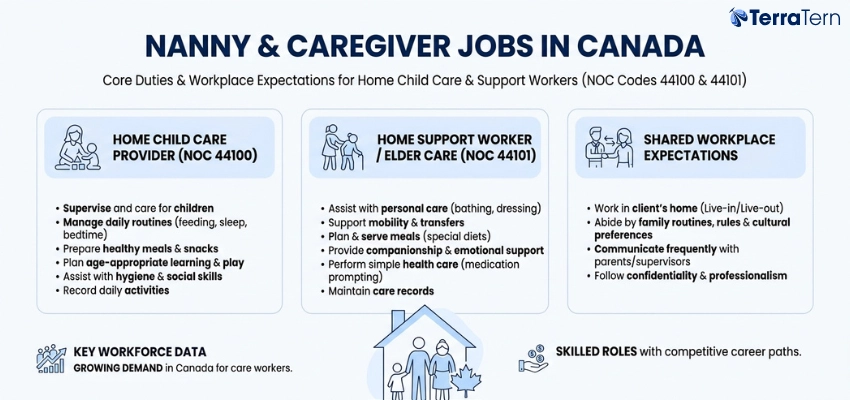
Nanny / Home Child Care Provider, Child Focused (NOCC 44100)
-
Supervise and care for children in the employer's private home (or sometimes in the provider's own home).
-
Change nappies and feed babies, prepare baby formulas, dress, bathe and feed young children.
-
Take responsibility for planning, preparing and serving healthy meals and snacks for children of their age and nutritional requirements.
-
Set up and follow regular feeding schedules, sleeping, play, school, and bedtime.
-
Plan age-appropriate learning and play opportunities (play, crafts, reading, outings).
-
Promote emotional health and social growth; Teach children personal hygiene and social skills.
-
Properly discipline children to the parents' style and keep the home environment safe and healthy.
-
Drive children to and from school, outings, and medical visits (occasionally).
-
Record basic information about the activities, food, sleep, and health of each child on a day-to-day basis.
-
Do light housework associated with child care (children's laundry duties, tidying children's play areas, washing children's dishes).
Caregiver/disability worker (NOC 44101) – Elder
-
Assist with personal care and companionship to elderly persons with disabilities or clients recovering from illness.
-
Help with bathing, cleaning, dressing, going to the bathroom, and personal care.
-
Using safe handling techniques, assist with mobility and transfers (walking, getting in/out of bed or chairs)
-
Plan, prepare, and serve meals; follow special diets and, when necessary, help with feeding.
-
Engage in routine Housekeeping related to care (Laundry, dishwashing, bed making, and light cleaning).
-
Perform simple health care activities, under direction, including changing non-sterile dressings; prompting; and/or assisting with medications and monitoring changes in condition.
-
Offer emotional support, conversation and companionship, to decrease isolation and enhance quality of life.
-
Keep care records and provide details of concerns or changes in the client's health or behaviour to family/supervisors.
Shared expectations for the nanny/caregiver positions
-
Mainly work in the client's home; some are live-in, some are live-out.
-
Abide by the family's (or agency's) routines, rules, and cultural preferences.
-
Share information frequently with parents, family, or home care supervisors regarding timeframes, requirements, and concerns.
-
Follow confidentiality and professionalism regarding personal and health information.
Also Read: Caregiver Opportunities in Canada: No Age Limit & More
What Is the Difference Between a Nanny and a Live-In Caregiver in Canada?
-
Main Responsibility: A nanny is primarily responsible for children, whereas a live-in caregiver could take care of children, senior citizens, or the handicapped. This outline describes the type of care that is provided: Nannies may be involved in child care, including playtime, feeding, bathing, and supervising children.
-
Personal Assistance: Live-in caregivers can assist with personal care, including activities like dressing, moving around, medication reminders, and daily routines, depending on their role.
-
Type of Arrangement: A live-in caregiver lives in the employer's home; a nanny can be live-in or live-out.
-
Household Duties: Both may undertake certain household tasks, but these must be related to caring for the person and explicitly agreed upon in the employment contract.
-
Requirements Needed: The skills needed for nannying jobs tend to focus on childcare experience, whereas the skills needed for caregiver jobs tend to include experience or training in elderly care, disability, or personal care.
Do Nanny Caregiver Jobs Include Housekeeping Duties?
Yes, occasionally, in some nanny/ caregiver positions, light housekeeping duties are included in the job.
- Cleaning Duties Involving Children: Nannies might be asked to clean kids' rooms, do laundry, or handle play areas.
- Preparing Meals And Cleaning Up After Children: This can also be a part of meal preparation.
- Light Housekeeping Duties: Dusting, vacuuming, laundry, and basic housekeeping tasks may be necessary if these are listed in the job description.
- Not Always Deep Cleaning: Heavy cleaning, extensive yard work, or extensive household maintenance is usually not light housekeeping.
- Review The Agreement: Workers need to read and understand precisely what housekeeping tasks and conditions they are covered by in the employment contract.
What Is the Salary for Nanny Caregiver Jobs in Canada?
- Average Nanny Salary In Canada: On average, a nanny will earn CAD $19 per hour in Canada.
- Average Salary: The average wage is around $18 per hour and can vary from around $15 to $28 an hour, based on experience, location, and job duties.
- Experienced Workers: Nannies with extensive childcare experience and/or special skills or duties may fall into the upper half of the wage range.
- Pay Is Dependent On Location: The job pays differently from province to province. The median salary in Calgary is $21/hour, while the median salary in the Toronto region is $20.85/hour, for instance.
- Live-In Positions: A live-in situation can involve providing housing, but the employment conditions and treatment for the provision of room and board should be agreed upon in the employment contract.
- Other Benefits: Some workers are eligible for benefits like vacation and sick leave, or employer contributions to programs like CPP and EI; 48.4% of workers in this occupation are eligible for at least one of these non-wage benefits, reports Job Bank.
Also Read: Developer Jobs in Canada
How Much Do Live-In Caregivers Earn Compared to Live-Out Nannies?
- Pay Rates May Also Be Comparable: The hourly wage is largely determined by the work and location of the job, as well as experience and responsibilities, and not just by whether the worker is in the employer's house.
- Live-In Caregivers Are Provided With Accommodation: A live-in means that a caregiver lives in the home, but the housing and any room and board are subject to applicable rules.
- Live-Out Nannies Pay For Their Own Accommodation: Live-out nannies are not included in an employer-provided accommodation package.
- Greater Job Responsibilities Lead To Greater Pay: The amount of compensation may vary for those caregivers who have additional responsibilities, such as caring for children, seniors, persons with disabilities, personal care, etc.
- Overtime And Employment Standards Are Important: Workers should receive wages in accordance with any relevant provincial or territorial employment standards rules on working hours and overtime.
- For Foreign Caregivers: Employers who hire through a TFWP must provide wages at or above the prevailing wage for the job and location.
Which Canadian Cities Pay the Highest Nanny Salaries?
- Calgary, Alberta: Calgary offers some of the highest-paying positions in the major markets of Canada for nannies.
- Toronto, Ontario: The competitive salary for a nanny is also partially due to the high demand for childcare in the city.
- Vancouver, British Columbia: Vancouver has high wages and a high cost of living.
- Ottawa, Ontario: There are good opportunities for childcare workers and nannies in Ottawa.
- Other Alberta Cities: Other Alberta cities with competitive salaries for nanny and childcare jobs include Edmonton.
- Wages Differ Across Regions: There is no single national “highest-paying city” since wages are reported by specific communities/economic regions and for some foreign-worker programs, employers are required to pay the prevailing wage in their community.
How Can You Get Nanny Jobs in Canada With Visa Sponsorship?
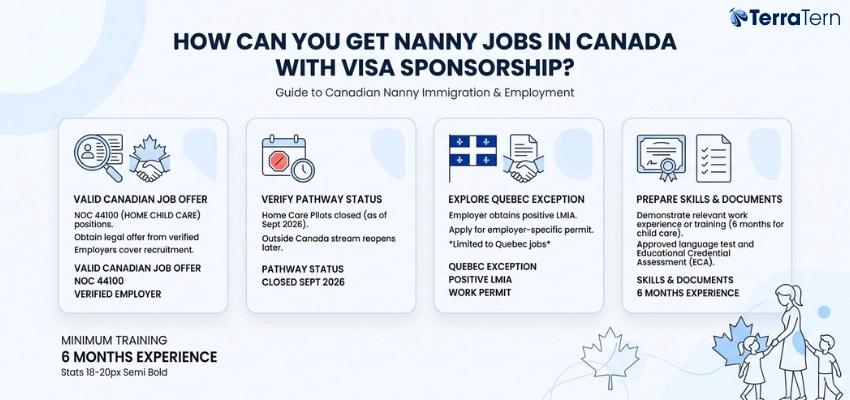
- Check Out Available Nanny Jobs: Nanny work is typically categorized as Home Child Care Provider (NOC 44100) if the responsibilities are done in a home environment.
- Secure A Job Offer From A Legitimate Canadian Employer: You should have a true offer from a Canadian employer who is legally allowed to hire a foreign caregiver. Employers are responsible for adhering to Canadian standards and can't charge the worker recruitment costs.
- Check the Current Immigration Pathway: As of September 2026, Canada's Home Care Worker Immigration Pilots are closed to new applications. The government states the stream for those outside Canada will be open at a later date but doesn't provide any date for opening.
- For Certain Situations: The employer can get a positive Labour Market Impact Assessment (LMIA) and then apply for an employer-specific work permit. This option is available for workers outside Canada, as long as the job is in Quebec.
- Get Your Qualifications Ready: Qualifications Required for the Home Care Worker Immigration Pilots include relevant work experience and/or training. The child-care pathway has a minimum of 6 months of qualifying full-time experience or training required as stipulated by detailed rules of the programme.
- Language and Education Documents: Candidates on the carer immigration pathway might require a language test approval, as well as an educational credential assessment that demonstrates a Canadian high school diploma or higher.
Also Read: Canada PR Visa Fees in Indian Rupees: Complete Breakdown
What Is the Home Child Care Provider Pilot Program?
- The Home Child Care Provider Pilot (HCCWP): Was an initiative by the Government of Canada to provide immigration to Canada for qualified Home Child Care workers who were seeking to obtain permanent residency in Canada.
- Typical Work Included Under NOC 44100: Home child care providers, which refers to care provided in a private home for children, except where the care is provided in a child care institution that serves children in a day care.
- The New Home Care Worker Immigration Pilot: Child Care: Was created to replace the old pilot and to offer a pathway to permanent residence for eligible workers.
- Typically, Applicants Had To Have: A job offer, pertinent work experience or training, language skills, and a degree that was compatible with the program.
- The Job Offer Had To Be: Legitimate, regular (30 hours per week or more), and permanent.
Note: Home Care Worker Immigration has no new applications accepted at this time, and current applications are in the process of being considered.
How Does an LMIA-Backed Job Offer Work for Nannies?
- The Employer First Offers: A nanny/caregiver a true full-time job in accordance with employment standards in Canada.
- Typically, The Employer Files: A Labour Market Impact Assessment (LMIA) to demonstrate that it is appropriate to hire a foreign worker under the Temporary Foreign Worker Program.
- If The LMIA Is Favorable: The foreign nanny can submit a request for an employer-specific work permit with information from the LMIA.
- This Position Is Required To Be: At least 30 hours per week, and the employer is required to comply with relevant wages, recruitment, and working condition requirements.
- Live-In Or Live-Out: Caregiver jobs may be offered depending on the job and the employment contract.
- In General, The Federal LMIA Caregiver Visa Option: Is open to applicants if the position is available in Quebec, but may be different in the case of individuals who already hold a visa.
Can Nanny Jobs Lead to Permanent Residency in Canada?
- Yes, Possibly: If the worker in this position is eligible to become a permanent resident for a specific immigration program, then a nanny can help the worker become eligible.
- Home Child Care Workers Are Included In Occupation NOC 44100: Of the Canadian National Occupational Classification (NOC) system, which is a recognized caregiver occupation under the Canadian immigration system.
- Canada's New Home Care Worker Immigration Pilot: Child Care: Is designed to offer a permanent-residency pathway for eligible home child-care workers.
- Qualifying Job Offer And Experience Or Training: Language proficiency and education credentials may be relevant.
- But The Current Caregiver Pilots Are Closed To New Applicants: And nanny jobs do not necessarily allow you to qualify for a path to PR.
- Depending On The Nanny's Work Experience: Province, language proficiency, education, and immigration status, they may need to look into other immigration programs that may be available. Canada also declares that temporary caregiver work is different from permanent-residence pathways.
Also Read: HR Jobs in Canada: Latest Jobs, Salaries, Scope & More
How Can Indians Apply for Nanny Caregiver Jobs in Canada?
Look for employers that have home childcare jobs listed under NOC 44100. Work should be in a family setting.
- It Is Important To Verify The Immigration Pathway: Applicants already in Canada do not have a federal LMIA-based caregiver work-permit pathway in place; however, the pathway in Quebec is available. Applications for caregiver positions in other provinces at this time are not eligible for applicants from outside of Canada.
- Provide An LMIA Work Permit: The employer in Canada must hold a positive LMIA in the country before the nanny can apply for a work permit on LMIA.
- Get Your Papers In Order: You will need a valid passport, work papers, childcare qualifications or experience, education records, and anything else that may be needed for you to apply for your work permit.
- Apply For The Work Permit: After receiving the positive LMIA and required employment documents from the employer, you can submit your work-permit application to the Canadian government.
- Beware Of Job Scams: A legitimate employer must abide by Canadian labour and recruitment regulations. Beware of anyone who guarantees a Canadian nanny visa and requires an improper recruitment fee.
What Qualifications Do You Need as an Indian Caregiver Applying to Canada?
- Experience With Children: Experience working with children, such as a nanny, child care provider, or providing child care services at a similar facility, can be relevant for a home child-care position.
- Training Or Education: Some immigration or work-permit pathways may require your training or education.
- Language Skills: Some programs for caregiver immigration may require a language test in either English or French.
- Genuine Job Offer: To apply for a caregiver work permit on an LMIA, you will need a valid job offer from a Canadian employer with a positive LMIA.
- General Work-Permit Eligibility: You must meet Canada's general requirements for working temporarily in Canada and provide the documents requested by IRCC.
- Medical, Security And Admissibility Requirements: Depending on your situation, medical examination, police certificates, biometrics and other checks may be necessary.
What Is the Step-by-Step Process to Apply From India?
- Obtain A Real Caregiver Position: Find an available home child care position with a Canadian employer.
- Employer Receives A Positive LMIA: If you are applying for the LMIA-based caregiver route, the employer needs to receive a positive LMIA before application to a work permit.
- Gather Your Paperwork: A passport, job offer/employment paperwork, LMIA information, work experience evidence, and other necessary paperwork.
- Apply For A Work Permit From IRCC: Apply for a work permit through IRCC's secure account online if you are applying for it from outside Canada.
- Provide Biometrics: Once you have applied for a job, please follow the biometrics instructions and make an appointment as soon as possible to ensure there is no delay.
- If Approved, Wait For The Decision: Follow instructions from IRCC and prepare for travel to Canada. For any given application and situation, there may be variations in your processing time.
Also Read: Dubai Golden Visa Price & Fee Breakdown Guide
How Long Does It Take to Get a Caregiver Work Permit From India?
- IRCC Processing Times Are Estimates: And they are not guaranteed; there is no fixed processing time.
- If An LMIA Is Needed: Then the employer must have an LMIA completed prior to making an application for the work permit.
- Processing Times For LMIAs Differ: In July 2026, the average processing time for the low-wage category stream was 73 business days, though some LMIAs may be processed faster or slower.
- Processing Of The Work Permit Is Separate From The LMIA: Once the LMIA is issued, the IRCC processes applications for work permits, and the government data in early 2026 revealed that the processing times for work permits differed greatly by stream and time.
- Timing Is Impacted By Biometrics And Document Checks: A lack of documents, extra checks, medical evaluations, or security/bg checks can cause a delay in decision-making.
- Instead Of Basing Your Eligibility On A Set Number Of Days: Plan several months for an Indian applicant planning to rely on an LMIA-based caregiver route to obtain a work permit: From the start of the employer's LMIA process to the end of the work permit process.
What Is Life Like as a Nanny Caregiver in Canada?
- The Primary Focus Is Childcare: A nanny will usually be responsible for supervising the children, cooking, managing schedules, and offering activities suitable for their ages.
- Working Hours Can Be Flexible: The daily schedules may change daily depending on the needs of the family; they may be mornings, evenings, weekends, or changes in the schedule may occur.
- Household Tasks May Be Incorporated: Depending on the employment contract, light housekeeping duties, which may include laundry, tidying up at play areas, and cooking meals for children, may be included. Employers may not impose responsibilities on a worker which have nothing to do with the job he or she was employed to perform.
- Live-In Workers Have Accommodation: When the job is Live-In, the caregiver resides in the employer's house. All accommodations and room and board costs should be specified.
- Workers Have Employment Rights: There are provincial/territorial employment protections, such as wage regulations, days off, vacations, holidays, and overtime.
- It Can Be Rewarding But Challenging: Caring for the children involves patience, responsibility, energy, and good communication. Having less separation between work and personal life with an employer may also be a consideration, and it is important to clarify the working hours and duties.
Also Read: Nurse Average Salary in Australia: Latest Salary Guide
Conclusion
There are opportunities for qualified childcare workers in Canada to find nanny caregiver jobs, and their work varies in both scope and pay, depending on the employer and the location. The Canada Job Bank reports that the average salary in Canada for home child care workers is $19 an hour, and some areas and child care workers with experience offer higher wages.
If you're an international applicant, it's crucial to understand the work-permit system, employer requirements, qualifications, and the immigration rules before accepting an offer of a job. But for those who know what to do and how to do it with proper documentation and have a sincere Canadian employer, nanny duties can be a valuable career as well as a valuable service to many Canadian families.
To learn more about the Canadian job market, visit Terra Tern now!