
Key Highlights
- What Are the Medical Tests for Canada Immigration, or the Canada Immigration Medical Exam (IME), and Why Is It Mandatory?
- Who Needs Medical Tests for Canadian Immigration From India?
- What Are the Medical Tests Required for Canada Immigration in 2026?
- What Are the 2026 Updates to Canada Immigration Medical Exam Rules?
- How Do You Find an IRCC-Approved Panel Physician in India?
- What Documents Do You Need for the Canada Immigration Medical Exam?
- How Much Do Medical Tests for Canada Immigration Cost in India?
- What Is the Step-by-Step Process for the Canada Immigration Medical Exam in India?
- What Medical Conditions Can Affect Your Canada Immigration Application?
- How Long Are Canada Immigration Medical Exam Results Valid?
- What Should Indian Applicants Expect After the Medical Exam?
- Conclusion
The complete guide explains who needs an immigration medical exam (permanent residence applicants and many work/study applicants in jobs that involve contact with patients or work in the health sector), what standard tests are typically conducted (medical history review, physical examination, blood and urine tests, chest X ray, and any follow up tests if necessary), how to book an appointment to see an approved panel physician only, the usual wait times and costs, and the process that takes place after the results are submitted electronically to IRCC (followed by an additional review of the application for additional information or surveillance conditions if necessary because of problems found in the examination, such as inactive TB).
It also guides you through practical preparation advice, including carrying identity documents, glasses/prescriptions, medical records, etc., to help your exam run smoothly and not delay your visa/PR outcome.
What Are the Medical Tests for Canada Immigration, or the Canada Immigration Medical Exam (IME), and Why Is It Mandatory?
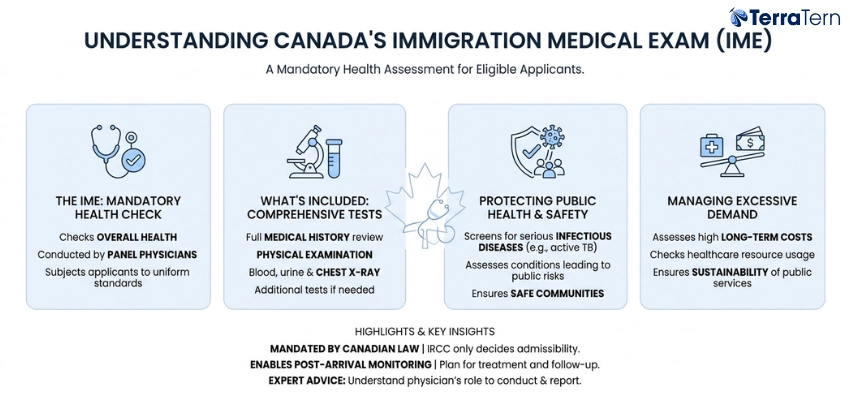
The Canadian Immigration Medical Exam (IME) is a mandatory health assessment for eligible immigration applicants. It checks your overall health and helps determine whether you meet Canada’s medical admissibility requirements.
|
Aspect |
Key Points |
Why It Matters |
|
What is IME? |
The medical exam used for most permanent residents and some temporary residents of Canada. |
Subjects all applicants to the same health requirements. |
|
Who does it? |
Only immigration doctors: panel physicians. |
Ensures that exams meet Canadian immigration medical requirements. |
|
What it includes |
Medical history, physical examination, and basic tests (blood, urine, chest X ray, and additional tests if required). |
Provides IRCC with a full health history and possible risk factors. |
|
Public health protection |
IME takes screening for serious infectious diseases that may pose a risk to Canada, such as active tuberculosis. |
Prevents outbreaks and helps to keep people safe in Canada. |
|
Public safety protection |
Screening for conditions that might lead to unexpected or violent responses or loss of control. |
Minimizes the potential for harm to others and promotes safer communities. |
|
Excessive demand check |
Assesses whether your condition would create very high, long term costs for Canada’s health and social services. |
Safeguards the sustainability of publicly funded healthcare in Canada. |
|
Legal requirement |
The “medical admissibility” rules are incorporated into the Canadian immigration law and require a medical examination. |
IRCC will not consider a lot of applications without a valid IME result. |
|
Follow up & surveillance |
IME includes individuals who are medically monitorable in Canada (inactive TB) but can immigrate. |
Enables Canada to plan for appropriate treatment and follow-up upon arrival. |
Expect Advice: The panel physician's role is to conduct and reportt, IRCC alone decides your admissibility. Understanding this distinction helps applicants avoid unnecessary anxiety if referred for additional tests.
Also Read: Cost of Study in Canada for Indian Students
Who Needs Medical Tests for Canadian Immigration From India?
Let's break down the types of individuals that usually require medical testing (IME) for immigration to Canada:
1. Permanent Residence (PR) Applicants
-
Anyone applying for permanent residence (Express Entry, PNP, spouse sponsorship, etc.) must do an immigration medical exam.
-
This includes the principal applicant, family members, and their dependent children, even if they aren't travelling to Canada at the time.
2. Workers from India
-
In many cases, having an IME is a requirement for Indians who are seeking to get a Canadian work permit for a period exceeding 6 months, particularly if they will be employed in occupations that are sensitive to public health (such as the healthcare sector, child care, teaching, elderly care, etc.).
-
Most medical exams are required for close contact with vulnerable persons (patients, children, seniors).
3. Students from India
-
If you are an Indian student planning to study in Canada for more than 6 months, you may require a medical exam – particularly if you have been living in India (a country on the “medical exam list”) for 6+ months within the past year.
-
An IME is usually needed if the student intends to seek employment in the healthcare or childcare sector as part of their course (e.g., nursing, early childhood education).
4. Visitors Staying Long-Term
-
If you are travelling to Canada for an extended period of time of over 6 months, you may require an IME if you plan on staying for a long business visit or you plan on reuniting with extended family.
-
A medical examination is not required for short tourist visits (less than 6 months) unless there are special risk factors.
5. The Family Members and Special Cases.
-
If the main applicant is accompanied by family members (spouse, children), they are also required to undergo the exam.
-
Medical exams are also conducted for refugees and select humanitarian applicants from India, but with different cost rules and procedures on occasion.
Do Family Members Also Need Medical Tests for Canada Immigration?
-
Yes. All family members who are dependents (spouse or partner, children) of a PR applicant must undergo a medical examination by a panel physician.
-
This applies whether they are with you this year or not – they have to be medically able to be sponsored in the future.
Is the Canada Medical Test Required for a Student Visa From India?
-
Often yes. Indian students typically would require a medical examination when their course is longer than 6 months, and the students have resided in India (a designated country) for 6+ months in the previous year.
-
If their studies or internships are related to healthcare, childcare, or other positions with a high risk of contact with the public, which would require protection of public health, it is certainly required.
Pro Tip: Even if your Canadian stay will be less than six months, Indian applicants may still require an IME because India is on IRCC's mandatory country list, always verify on the official IRCC tool before booking.
Also Read: Top 10 Medical Universities in Canada: Fee, Scope & More
What Are the Medical Tests Required for Canada Immigration in 2026?
The following are the primary medical examinations typically needed for Canada immigration (IME) in 2026, with simple explanations. This is the typical set of tests that most Indian applicants will encounter, although the specific tests may vary slightly based on age, gender, and health history.
Core Clinical Checks
- Review Of Medical History: Past illnesses, surgeries, medicines, hospitalizations, family history.
- Physical Exam: The doctor examines the eyes, ears, nose, throat, heart, lungs, abdomen, skin, nervous system, height, weight, and blood pressure.
Laboratory Tests
- Blood Tests: HIV, syphilis (VDRL or other), kidney function (creatinine); additional tests may be ordered by the doctor if they think there is a risk for them.
- Urine Test: Simple urine tests for kidney or urinary tract issues, diabetes markers, or any other underlying conditions.
Imaging and Special Tests
- X-Ray Of The Chest: Routine for most applicants to adults for tuberculosis and serious lung or heart conditions.
- Extra Investigations: If something abnormal is thought to be present (such as suspected TB, suspected hepatitis, or more serious heart disease), the panel physician may request further tests and/or specialist reports.
Varying Degrees Of Risk According To Age
- Children: History and PE are usually only obtained if clinically indicated; blood tests and X-rays are only obtained if clinically indicated.
- Pregnant Women: Consider deferral or special protection from X-rays, and more emphasis on blood tests and clinical exam.
What Does the Physical Examination Include?
-
Height, Weight, Blood Pressure, and Heart Rate Review
-
Examine eyes, ears, nose, and throat; heart; lungs; abdomen; skin; spine; and joints
-
Assessment of basic neurological and mental status.
-
The doctor performs a physical examination to find out whether there are serious conditions, such as a disease or disability, that may impact someone's admissibility.
What Is the Chest X-Ray for Canada Immigration?
-
For most people over 11 years old
-
Emphasis is on the lungs and heart, primarily to identify current or previous TB infection.
-
Helps confirm physical exam findings and uncover hidden lung problems
-
Designed to help determine whether you will need treatment or medical surveillance once you have made your landing.
What Blood Tests Are Done for Canada Immigration?
-
Human Immunodeficiency Virus (HIV) test to check for a serious infectious disease.
-
STD (Syphilis) serology for the detection of untreated STDs.
-
Serum Creatinine (Kidney Function) to check for chronic kidney disease
-
Other blood tests (such as liver tests and tests for diabetes) may be ordered if there is a risk because of history or exam
Are There Any Additional Tests That May Be Required?
-
If the heart, lungs, or organs may be affected, additional imaging tests (such as a CT scan and an ultrasound) may be used.
-
For complex conditions, specialist reports from a cardiologist, psychiatrist, and pulmonologist are provided.
-
Repeat or more detailed lab tests if initial test results are abnormal
-
Pregnancy considerations, deferral of X rays or use of protective shielding as necessary,
Key Note: Chest X-rays are the most critical component for Indian applicants due to India's TB burden, be upfront with your panel physician about any past respiratory illness, even if treated, to avoid processing delays.
Also Read: 10 Best Medical Colleges in Canada: Rankings, Tips & More 2026
What Are the 2026 Updates to Canada Immigration Medical Exam Rules?
The following are the main changes to the medical exam requirements for Canadian immigration in 2026, broken down into points.
Upfront Medicals for PR (Express Entry & Most PNP)
-
To submit the e‑APR, PR applicants, except for most of the PNP streams, are required to go through the IME first.
-
Applications for PR without an upfront medical (IMM 1017B sheet) will be rejected as incomplete within 24-48 hours of their filing.
In-Canada applicants will be subject to the 5-Year Reuse Rule.
-
If you are in Canada and have had an IME in the past 5 years, you may have been exempt from having to take another IME for PR or extensions.
-
The exemption only applies where your previous IME has been determined to be ‘low risk' or ‘no risk ', and you'll be required to include the old IME number on your new application.
The cost threshold has been raised to a higher level, defined as “excessive demand".
-
The medical “excessive demand” threshold was increased in Canada to approximately $28,878 annually or $144,390 over five years.
-
If the healthcare and social-service expenses you expect are higher than this, you might not be medically eligible; however, your spouse and dependent children are not subject to this cost test.
Country List Changes for Temporary Residents
-
IRCC updated the list of countries for medical exams for temporary residents who plan to stay for more than 6 months, for use in 2026, and which will take effect late in 2025.
-
The list has been updated with the removal of some countries, and new ones have been added, so applicants should double-check the current list, as opposed to checking the previous one.
To explore the interaction of biometrics and medicine.
-
Medical exams continue to be independent of biometrics, but the rules of 2026 place an emphasis on the fact that PR applicants should always supply new biometrics, even if they had them for a previous study or work permit.
-
Biometrics for temporary residents (visitors, students, workers) are valid for up to 10 years and can be used again for new temporary applications.
What Does the Upfront Medical Exam Rule Mean for Indian Express Entry Applicants?
-
The “upfront medical” for Indian Express Entry means that you are required to take your Immigration Medical Exam prior to filing a PR application following an ITA.
-
You and all listed family members (even non accompanying) must do the exam with an IRCC approved panel physician and include proof (IMM 1017B).
Advice by our Expert: The upfront IME rule for Express Entry is a significant change that catches many Indian applicants off guard — book your panel physician appointment as your very first step in the Express Entry journey, not as an afterthought.
Also Read: Canada Medical Test List: Experts Updated Guide
How Do You Find an IRCC-Approved Panel Physician in India?
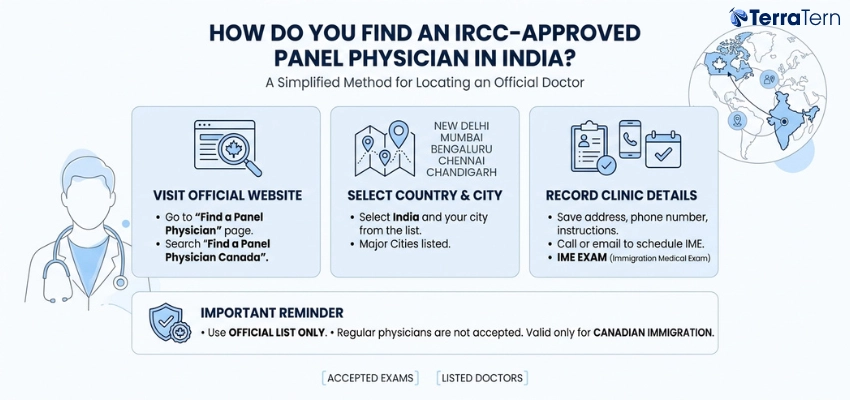
Let's take a look at the easy, step-by-step method for an Indian applicant to locate an IRCC-approved panel physician.
-
Visit the official Government of Canada immigration website and click on the “Find a Panel Physician” page (type Find a panel physician Canada).
-
Click on the country (India) and then your city (New Delhi, Mumbai, Hyderabad, Bengaluru, Chennai, Chandigarh, Kolkata, Ahmedabad). It displays the list of doctors and clinic information that are approved.
-
Record the clinic address, phone number, and any special instructions; then call or email to schedule an Immigration Medical Exam (IME).
-
Keep in mind that this is an official list of doctors, and your physician, with whom you have your regular care, is not included. Physician’s exams are only accepted for Canadian immigration programmes.
Where Can I Get the Canada Medical Test Done in India? (City-Wise Guide)
The medical tests conducted in Canada and India are conducted by IRCC-approved panel physicians and not by regular clinics.
City-wise Guide
-
Approved panel physicians are available in Ahmedabad.
-
Bangalore: There are approved clinics.
-
Apollo Hospitals provides medical checkup services for obtaining a Canadian visa in Chennai.
-
The authorised sites include Max Medcentre and others in Delhi/New Delhi.
-
Hyderabad: Centre for Migration Medicine is a panel clinic.
-
Mumbai: list of approved panel physicians for the city.
-
The doctors in Chandigarh, Guwahati, Kolkata, Ludhiana, and Mohali are also approved.
Booking Tip
-
Get instructions from IRCC and select the nearest doctor from the list of authorised doctors.
-
Please call the clinic directly; some clinics require an appointment.
-
Have your passport and necessary documents on hand.
How Do I Book a Canada Immigration Medical Exam Appointment in India?
-
Firstly, await the instructions of IRCC and then select an approved panel doctor in India.
-
Many clinics require booking – call, email, or go to the appointment section of the clinic.
-
Have your passport, photos, and medical records with you before going.
-
If you have not completed an up-front medical, then wait until the IME form is completed before booking.
-
Please plan to bring the necessary fee and arrive punctually; some clinics will not accept online booking.
Expert Advice: Don't choose a panel physician clinic based on price alone, select a clinic that completes X-rays and blood tests on-site to avoid multiple appointments and potential delays in result submission to IRCC.
Also Read: Canada Ends Policy Allowing Visitors to Apply for Work
What Documents Do You Need for the Canada Immigration Medical Exam?
Documents You Need for Canadian Immigration Medical Exam:
|
Document |
Need a medical exam for Canada? |
|
Accepted government-issued photo ID such as a passport or driver's license. |
Yes, please bring ID. |
|
Each student will bring a medical form or referral sheet from IRCC to the school. |
Yes, as long as you have one from IRCC. |
|
Send a letter of support or a supporting letter |
For students and/or workers, occasionally. |
|
Goggles or contact lenses |
Yes, if you're using them. |
|
Previous medical reports |
It may be helpful if you have any existing conditions. |
|
Prescription medicines list |
Very helpful, particularly when it comes to dosage. |
|
Passport photos |
Generally not required, but may be requested at some clinics. |
|
Payment method |
Yes, bring the exam fee with you. |
Valid ID, any IRCC medical instructions, and glasses (if any) or medical records.
Do I Need to Fast Before the Canada Immigration Medical Exam?
-
No, it's not necessary to fast before the Canada immigration medical exam.
-
Eating and drinking are allowed unless advised otherwise by clinic staff.
-
Drinking water is recommended, as a urine sample is often needed.
-
If a medical condition, follow any special instructions from your panel physician.
Pro Tip: Carry original vaccination records, especially BCG proof. Indian applicants with past TB vaccinations sometimes face additional chest X-ray scrutiny, and documentation of prior vaccination can expedite the process.
How Much Do Medical Tests for Canada Immigration Cost in India?
-
The cost of the medical test for Canadian immigration in India is approximately INR 6000 to INR 8000.
-
Some clinics charge less for children, which is about INR 3600.
-
The fees are approximately INR 7,000 – INR 9,550 for adult applicants.
-
The cost may vary depending on the city and clinic.
-
Additional tests (such as an X-ray or blood analysis) may impact the final amount.
-
Some centers may charge a little more for weekend or holiday appointments.
-
Direct payment to the hospital or panel physician is typically required.
Does IRCC Reimburse the Cost of the Canada Immigration Medical Exam?
-
The answer to the question is that IRCC does not reimburse the medical exam fee for Canadian immigration.
-
The medical fee is also not refunded if the application is rejected after the exam.
-
Special health programs may provide coverage for refugees and asylum seekers.
-
In most other cases, you have to pay the clinic at the time of examination.
Key Note: Always get a cost breakdown from your clinic before your appointment, some clinics bundle all tests into one fee, while others charge separately for X-rays and labs. Unexpected additional costs are common if IRCC requests further tests.
Also Read: BSc Nursing Salary in Canada: Experts Latest Guide
What Is the Step-by-Step Process for the Canada Immigration Medical Exam in India?
-
Review instructions from IRCC and then decide if you should have a medical exam up front or a form from the visa office.
-
Select a doctor in India who is a panel doctor for IRCC; your family doctor can't make this choice.
-
Make an appointment date and time with the clinic by phone or online.
-
Bring your own passport, copies, photos, and medical records/prescriptions.
-
If you wear glasses or contact lenses, bring them with you.
-
Be punctual and pay for the exam at the clinic.
-
Depending on the process, the clinic will provide a report that can be sent directly to IRCC or proof to upload.
How Long Does It Take for Canada Immigration Medical Results to Be Processed?
-
You typically find medical results in your IRCC account 30 days after you have booked an exam.
-
There are also some cases where it will take longer if IRCC requires additional information or further testing.
-
However, in the case of an upfront medical, the result will not be reflected until IRCC makes the connection to the application.
-
Sometimes updates can take up to 6 weeks.
-
Your clinic might need additional time to submit results if additional tests are needed.
Advice by our Expert: Choosing a panel physician clinic where X-rays and blood tests are done on-site significantly reduces the risk of result delays — avoid clinics that require separate lab or radiology visits.
Read More: Top Jobs in Canada: The Latest Guide for the year
What Medical Conditions Can Affect Your Canada Immigration Application?
-
Uncontrolled, untreated tuberculosis may render you medically ineligible.
-
There can be other communicable diseases that may be of public health concern.
-
If serious mental disorders are likely to endanger or require significant care, they are considered.
-
Chronic kidney disease needing dialysis can be a concern.
-
The decision might be impacted by advanced heart disease.
-
Treatment requirements for some cancers that require longterm or expensive treatment may be identified.
-
Diabetes or autoimmune diseases are evaluated based on severity and treatment requirements, so they are not considered a rejection.
Which Conditions Cause Automatic Inadmissibility to Canada?
-
You may be considered inadmissible for security reasons, serious criminality, human rights violations, organised crime, or misrepresentation.
-
Medical inadmissibility is typically not a foregone conclusion, except when the condition poses a threat to public health, public safety, or the overload of services.
What Is the "Excessive Demand" Test for Canada Immigration?
-
IRCC examines whether your health is likely to result in high future costs or to place significant strain on health or social services in Canada.
-
It examines treatment needs, the cost of care, and the support services needed.
-
There are exceptions to the excessive-demand rule.
What Is a Procedural Fairness Letter (PFL) and What Should You Do?
-
The notice from IRCC that it intends to deny your application and will want your explanation/evidence first is a PFL.
-
Medical reports, specialist letters, and a clear explanation should be submitted before the deadline.
-
The failure to meet the deadline may have an adverse impact on the case.
What happens if the TB Test Is Positive in Canada Immigration Medical Exam?
-
A positive TB result does not necessarily lead to refusal.
-
More tests may be requested by IRCC, including sputum tests or additional X-rays, and/or treatment or medical surveillance may be ordered.
-
Even if TB is latent, you might still be approved, but you will be required to adhere to public-health guidelines.
Expert Advice: Many Indian applicants fear their health conditions will bar them from Canada — but in most cases, only active TB and untreated syphilis trigger automatic inadmissibility. For all other conditions, the right documentation and a well-prepared mitigation plan can make the critical difference.
Also Read: After Biometric What Is Next for Canada Visitor Visa in 2026
How Long Are Canada Immigration Medical Exam Results Valid?
-
The medical exam results for Canadian immigration are typically valid for 12 months from the day of the exam.
-
The validity will be for the day of appearance in the exam, not the date the application was made.
-
If IRCC does not finalize your application before the final date, a re-medical might be required.
-
The validity period is typically identical for study, work, and permanent residence applications.
-
IRCC may extend the validity internally in rare cases, but this is not guaranteed.
What Happens If My Canada Immigration Medical Exam Expires?
-
Applications may be extended if your medical expires before IRCC is completed.
-
IRCC may ask you to do a re-medical at your own cost.
-
The medical does not automatically cancel legal status.
-
If you are a student or traveling, you may need a visa to be reactivated to be able to travel.
-
Do not make travel arrangements until IRCC updates your file.
-
When medicals expire, it can lead to additional time, additional fees, and new medicals.
Pro Tip: Indian applicants with complex PR processes should time their IME carefully — an expired IME mid-application forces a costly and time-consuming repeat, potentially delaying landing by months.
What Should Indian Applicants Expect After the Medical Exam?
-
You can assume that your clinic will give the results to IRCC electronically, typically within around 30 days of the exam.
-
Monitor your IRCC account to make sure you are updated to “medical passed/completed" before the next decision stage.
-
Once finished, IRCC may not require anything additional, or if further tests are required, they will ask for them to be done.
-
After coming to Canada, you might be asked for medical surveillance if you have inactive TB.
-
Eligibility and background checks continue (may take longer than the medical).
-
If the officer requires further information, some applicants will be asked for more documents and/or follow-up questions.
-
When everything is clear, your file progresses toward approval, portal steps, and final landing documentation.
Key Note: Do not call IRCC or your panel physician repeatedly to chase results; the eMedical system handles transmission automatically. Monitoring your IRCC account is the most effective way to track your medical status.
Also Read: Canada Visitor Visa Processing Time After Biometrics
Conclusion
The Canada immigration medical exam in 2026 is an essential health assessment that only IRCC-approved panel doctors conduct; Indian applicants must ensure they have a valid ID, an appointment with a clinic, a healthy appetite (unless advised otherwise), and the clinic fee (usually paid at the clinic). Most results are considered valid for 12 months and will be processed in about 30 days, unless IRCC requests additional information or identifies a condition that requires follow-up testing, re-medicals, or medical surveillance.
To make the process of moving to Canada easier for you and to get more information about the procedures required, you can contact TerraTern right now!