Key Highlights
- Latest Facts & News on Idioms for IELTS Speaking (2026)
- Why Idioms Matter in IELTS Speaking for Indians in 2026?
- What are the Most Common Idioms for IELTS Speaking in 2026?
- How to Use Idioms Effectively in IELTS Speaking in 2026?
- Dos and Don'ts of Idiom Usage in IELTS Speaking in 2026
- What are the Latest and Most Useful Idioms and Phrases for IELTS in 2026? (with PDF Download)
- Practice Exercises: Mastering Idioms for IELTS in 2026
- What are the Common Mistakes Made When Using Idioms in IELTS Speaking in 2026?
- Conclusion
The use of idioms is an intelligent move in refining one's fluency and impressing the examiner for IELTS speaking. This guide contains common idioms for IELTS speaking and offers the necessary explanation and examples. Whether you're searching for useful idioms for IELTS speaking PDFs or want a complete list of idioms and phrases for IELTS, this little guide will help you sound more natural and confident during the IELTS Speaking test.
Latest Facts & News on Idioms for IELTS Speaking (2026)
Staying updated with the latest facts and news on idioms for IELTS speaking in 2026 is essential for test takers aiming to sound natural, fluent, and well-prepared.
-
Speaking in idioms is increasingly recognised as a sign of fluency and cultural awareness in the IELTS Speaking test, but overusing or misusing them will bring down one's score.
-
On average, Band 9 IELTS candidates use 1.2 idioms per speaking test.
-
IELTS examiners seek naturally contextualised idiomatic usage, not some forced cueing in.
-
The latest updates focus on the need to use idioms you can pronounce clearly and explain confidently.
-
Digital resources and PDFs comprising useful idioms for IELTS are among the most sought-after prep materials in 2026.
-
Google's "People Also Ask" and "People Also Search For" sections tend to increase curiosity towards idioms per subject, such as idioms about health, success, or education.
-
Videos and infographics explaining idioms are becoming popular ways among the most favourable choices for students preparing for the IELTS.
-
Such platforms are now introducing interactive exercises that allow users to practise idioms in real-world speech situations.
-
In 2026, the most popular of these idioms for IELTS speaking will be to bite the bullet, a piece of cake, and kill two birds with one stone.
-
They say that while reading to memorise idioms for IELTS, no remembrance comes clearly to mind with respect to their meaning or the way in which they are used.
Also Read: Documents Required for IELTS Exam: Latest Checklist
Why Idioms Matter in IELTS Speaking for Indians in 2026?

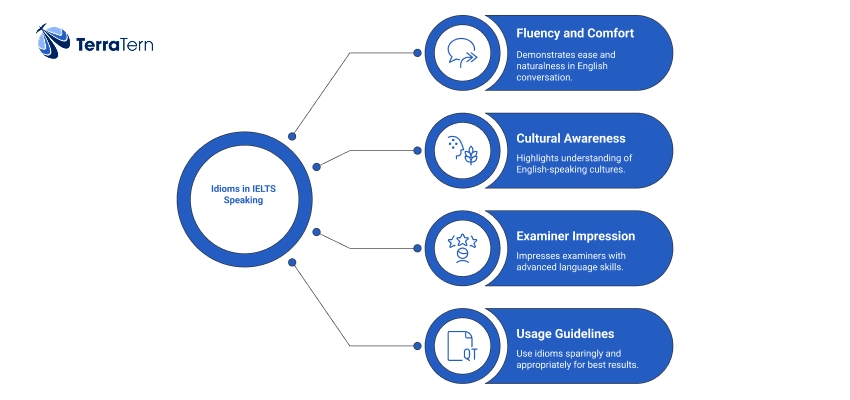
Knowing an idiom or two would work wonders for giving a boost to the impression that you are a fluent speaker, as the examiners look for idioms in IELTS Speaking. The selection of an idiom for IELTS speaking may reflect cultural awareness and furnish an extra mark for the IELTS band, depending on successful execution. Some reasons for making idioms for IELTS Speaking are given below:
-
Idioms for IELTS speaking show that you're comfortable with everyday English and not just textbook phrases.
-
Correct use of idioms mirrors fluency and natural speech, two essentials for a high IELTS band score.
-
Idioms make your answers colourful and interesting, enabling you to be remembered.
-
Knowing when not to use idioms signifies that you understand cultural competence and context.
-
If you misuse or overuse them, they could instead sound clumsy and murky, thus lowering your score.
What are the Most Common Idioms for IELTS Speaking in 2026?
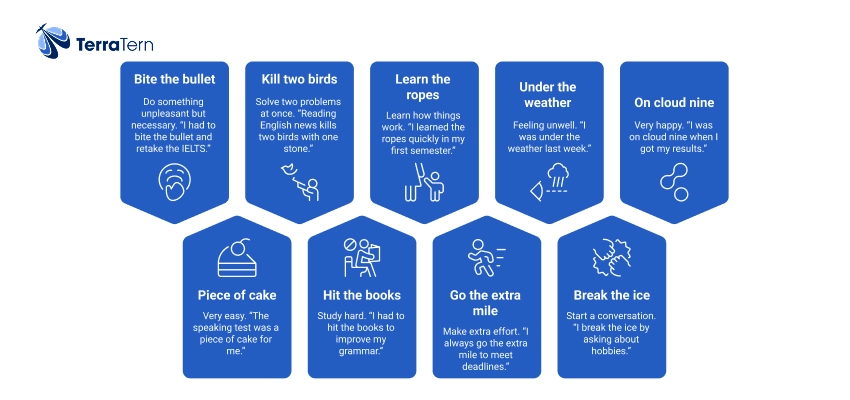
Used appropriately and originally, common idioms for IELTS speaking would add some weight, fluidity, and native lightness to your answers. Band 9 applicants would usually use idioms in IELTS mocks quite rarely but quite astutely. Here is a list of common idioms for IELTS speaking, compiled with meanings, origins, and IELTS context examples.
|
Idioms |
Meaning |
Sample Sentence |
|
Bite the bullet |
To do something unpleasant but necessary |
I had to bite the bullet and retake the IELTS to achieve my target score. |
|
Piece of cake |
Very easy |
The speaking test was a piece of cake because I practised every day. |
|
Kill two birds with one stone |
Solve two problems at once |
By reading English news, I kill two birds with one stone |
Idioms for Everyday Topics for IELTS Speaking
The IELTS speaking test usually centres around familiar subjects: education, work, health, and daily life. These related idioms can help you sound natural and confident when discussing these topics.
-
Education
Idioms about learning can help you sound natural when discussing school or university.
-
Hit the Books: I had to hit the books if I wanted to improve my grammar.
-
Learn the Ropes: I had to learn the ropes very quickly in my first semester.
-
Work
Work-related idioms show your familiarity with professional situations.
-
Climb the Career Ladder: After my master's studies, I want to climb the career ladder.
-
Go the Extra Mile: I always try to go the extra mile to get something done when the deadline gets close.
-
Health
Health idioms are useful when describing personal well-being or lifestyle.
-
Under the Weather: That was a pretty heavily under-the-weather feeling last week.
-
Back on My Feet: I was, after a short illness, back on my feet in no time.
-
Daily Life
These idioms fit everyday conversations and common IELTS topics.
-
Break the Ice: I always break the ice by asking about hobbies.
-
On Cloud Nine: I was on cloud nine when I got my results.
Which Idioms Should Be Avoided in IELTS Speaking in 2026?
Some idioms may lower your score if misused. These are the types you should avoid:
|
Type of Idiom |
Why to Avoid |
|
Overly informal (e.g., YOLO) |
Too casual for a formal speaking test |
|
Outdated idioms (e.g., bees' knees) |
It may sound unnatural or confusing |
|
Misused or misunderstood idioms |
Incorrect usage can affect clarity and reduce your IELTS band score |
|
Difficult to pronounce |
If you can't say it confidently, it's better to skip it |
Also Read: Everything About IELTS Learning & Exam Is Right Here!
How to Use Idioms Effectively in IELTS Speaking in 2026?

But when done right, common idioms for IELTS speaking could elevate your fluency, show your comfort with natural English, and move up your score; otherwise, it further drags your score down. Cramming into an answer with too many idioms or using idioms that you do not understand will bring your score down instead of helping it because examiners want to hear idioms that relate to the topic, are clear in pronunciation, and are common idioms for IELTS speaking. Now here is how this works:
-
Stick to 1 - 2 good idioms for IELTS speaking per answer; Quality score more than quantity.
-
Understand the meaning of the idiom and how to use it in the question.
-
Practice pronunciation so you do not sound too artificial or hesitant.
-
Using the idioms in context, without fillers.
-
Learn idioms for such general topics as daily life, work, study, and health.
Dos and Don'ts of Idiom Usage in IELTS Speaking in 2026
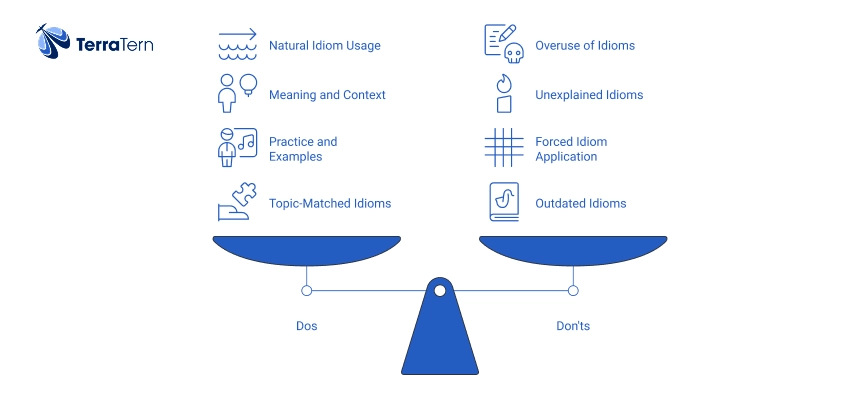
Here’s a quick checklist to help you use idioms the right way:
|
Do |
Don't |
|
Use common, useful idioms for IELTS speaking that match the topic |
Overusing idioms 1 or 2 is enough per response |
|
Pronounce idioms clearly and naturally |
Use idioms you can't explain |
|
Practice idioms in mock answers and real contexts |
Force idioms into answers unnaturally |
|
Use idioms to enhance fluency, not replace real content in the context |
Memorise long lists without understanding |
Sample Band 9 Answers Using Idioms for IELTS Speaking
Below are sample answers to real IELTS Speaking questions. Notice how common idioms for IELTS speaking are highlighted in context.
Question 1: What do you do in your free time?
- Well, in the evenings or at any free time, I usually walk out or read. I feel it unwinds me from the day. Other times, I watch a movie just to get myself out for a while and relax. It is just one way that I recharge my batteries and keep myself focused during the week.
Question 2: Do you enjoy your work or studies?
- Yes, I do enjoy my work. It can be stressful; however, I have learned to roll with the punches and keep a cool head. I do try to go the extra mile when I can; it is that feeling of achievement which gives me a sense of pride in what I do.
Question 3: Is health important in your culture?
- It surely is. In my culture, people believe that health is wealth. Most families avoid junk food and cook at home. If someone is sick, due to the support of the family and a healthy environment, they become alright very soon.
What are the Latest and Most Useful Idioms and Phrases for IELTS in 2026? (with PDF Download)

Looking for a systematic review before the test? These practical, useful idioms for IELTS speaking pdf will help you to swiftly grasp and remember high-scoring idioms. It features phrases based on topics, actual IELTS examples, and some tips for their usage, making it a good means of practising offline. The useful idioms for IELTS speaking PDF contains:
-
Education Idiots: Hit the books, learn the ropes, pass with flying colours
-
Work Idioms: Climb the career ladder, pull your weight, burn the midnight oil
-
Health Idioms: Under the weather, back on my feet, a clean bill of health
-
Life Idioms: On cloud nine, break the ice, piece of cake
Also Read: Minimum IELTS Score for Australia Work Visa: Latest Guide
Practice Exercises: Mastering Idioms for IELTS in 2026
Learning idioms and phrases for the IELTS is just the first step - after all, practice makes perfect when it comes to speaking naturally and confidently. Here you can find a collection of interactive exercises and topic-based questions to help you reel off idioms and phrases for IELTS in real exam situations. These activities will be progressively improved by difficulty and focus on key speaking topics.
-
Beginner Level: Learning the Idioms and their Meanings to have a foundation.
-
Intermediate Level: Practice in sentence applications by filling them with the correct idioms.
-
Advanced Level: Answering real IELTS questions with their idioms in speaking responses.
-
All Levels: Self-check the answers to perfect your articulation, accuracy, and fluency.
What are the Common Mistakes Made When Using Idioms in IELTS Speaking in 2026?

In idioms for IELTS speaking, while the use of idioms can add to your fluency and impress your examiner, it is unfortunate that a few candidates lose marks due to their misuse. If you want to get high scores, be careful to avoid common traps and learn to use idioms in a very natural and effective way. Here are some common traps for idioms for IELTS speaking that you should abide by:
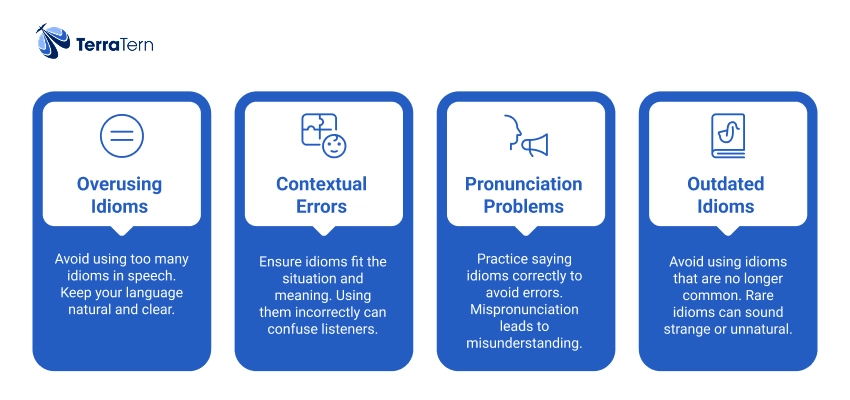
1. Overusing Idioms: Trying to put in too many idioms in one answer.
2. Using Idioms Out of Context: Using an idiom that does not correspond to the situation.
3. Mispronouncing Idioms: Incorrectly saying the idiom or putting the wrong stress.
4. Using Outdated or Rare Idioms: Employing idioms that are no longer of current use in the scope of modern English.
Also Read: Long Term Visa Germany: Types, Process, and Benefits
Conclusion
The use of idioms for speaking IELTS is one of the very effective ways to boost fluency, cultural awareness, and also improve the IELTS band score. As we can see, successful candidates do not just memorise the phrases; they know how to use them in a manner which appears natural and confident.
From learning the common idioms for IELTS speaking to avoiding the misuse of idioms, progress depends on smart practice as much as real understanding. Moreover, one should be able to learn more idioms in relation to each topic in IELTS and make a habit of checking examples. Our handy, useful idioms for IELTS speaking PDF makes for quick revision and study offline. Whether in health, education, or work-related idioms and phrases for IELTS, continuous practice will help you speak even more fluently while scoring higher.
To know more such information, visit TerraTern.


 AI Summary