Key Highlights
- Introduction
- Masters in Engineering Management in Germany
- What Exactly Is a Masters in Engineering Management in Germany?
- What Are the Top Universities for Masters in Engineering Management in Germany?
- What Is the Difference Between Industrial Engineering and Engineering Management in Germany?
- What Are the Eligibility Requirements for Masters in Engineering Management in Germany?
- What Is the Total Cost of Masters in Engineering Management in Germany?
- What Scholarships Are Available for Masters in Engineering Management in Germany?
- What Is the Career and Salary Outlook After Masters in Engineering Management in Germany?
- How to Apply for Masters in Engineering Management in Germany Step-by-Step
- How Can TerraTern Help You Get Admission to Engineering Management in Germany?
Introduction
Getting a Masters in Engineering Management in Germany is the ideal choice for 2026 because it combines technology with management. If you are looking for masters in engineering management germany english, or masters in industrial engineering and management in germany, masters in mechanical engineering and management in Germany or any other specialisation, the possibilities are truly limitless. So join the top universities for masters in engineering management in Germany and embark on an international career today with this powerhouse of Europe!
Masters in Engineering Management in Germany
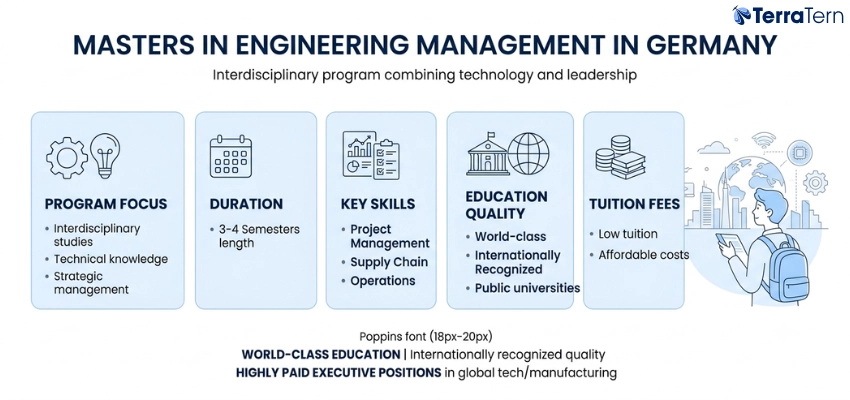
A Masters in Engineering Management in Germany is a program that combines technical and engineering aspects with strategic management skills within the context of a corporation or enterprise.
-
The interdisciplinary programs range in length from 3 to 4 semesters.
-
Students learn project management, supply chain, and operations management skills that are in demand.
-
The quality of education at German public universities is world-class and internationally recognised.
-
The education at public universities is world-class, with knowledge recognised internationally, and tuition fees are low.
-
Many graduates are sought after for highly paid executive positions in the tech and manufacturing industries worldwide.
Also Read: Masters in Engineering Management in Germany: Complete Guide
What Exactly Is a Masters in Engineering Management in Germany?
A two-year postgraduate course (typically an M.Sc.) that combines in-depth engineering knowledge with business management, operations and leadership strategy, a masters in engineering management in Germany is.
-
Audience: Designed for engineering graduates who want to move on to executive or managerial positions in technical companies while keeping their engineering background intact.
-
Curriculum Breakdown: A typical syllabus consists of engineering modules (30-40%), management modules (30-40%) and a culminating project or master's thesis (20-30%).
-
Key Distinctions: This is an interdisciplinary course – neither a purely technical M.Sc. Engineering is not a purely commercial MBA, but rather a course that serves as a bridge between the shop floor and the boardroom.
-
The name of the degree may be Industrial Engineering and Management, Technology Management, Management and Technology or Technologiemanagement, depending on the university.
-
In German: In the university databases, you will find the traditional German term Wirtschaftsingenieurwesen (Business Engineering). This is the classic term for this well-respected, well-balanced dual-discipline degree.
|
Program |
Engineering Content |
Management Content |
Best For |
|
M.Sc. Engineering Management |
~35% |
~50% |
Engineers targeting leadership and management roles |
|
M.Sc. Industrial Engineering |
~60% |
~30% |
Engineers optimising production and operations systems |
|
M.Sc. Technology Management |
~30% |
~55% |
Engineers targeting tech strategy and consultancy |
|
MBA (Technical focus) |
~15% |
~75% |
Experienced professionals (typically tuition-charged) |
|
Wirtschaftsingenieurwesen |
~45% |
~45% |
Balanced dual-discipline; deeply respected in Germany |
As per TerraTern Expert Divyansh, Indian engineering graduates who search only for "Engineering Management" in English will miss dozens of high-quality German programmes listed under "Wirtschaftsingenieurwesen" or "Technologiemanagement"; they should always search both English and German labels in DAAD's programme database (daad.de/en/study-and-research-in-germany/finding-a-course/).
What Are the Top Universities for Masters in Engineering Management in Germany?
TUM, RWTH Aachen, KIT, TU Berlin, and the University of Stuttgart are the top universities for masters in engineering management in Germany, where TUM is the overall best choice for Indian students. Here, it is a public university that reigns supreme thanks to its high ranking, low rates and proximity to the German industry.
|
University |
Programme |
QS/ranking signal |
Duration |
Fees |
Language |
Specialisation strength |
|
TU Munich (TUM) |
M.Sc. Management and Technology |
2 years |
English + German |
Automotive, tech, entrepreneurship |
||
|
RWTH Aachen |
Business Administration & Engineering |
Top German technical university |
2 years |
Low semester fee |
Mostly German |
Mechanical, manufacturing, energy |
|
KIT |
Industrial Engineering and Management |
Top German technical university |
2 years |
Very low semester fee |
Mostly German |
Automation, production, IT |
|
TU Berlin |
Industrial Engineering |
Strong public option |
2 years |
Low semester fee |
Mostly German |
Logistics, technology management |
|
University of Stuttgart |
Technology Management / related tracks |
Strong engineering university |
2 years |
Low semester fee |
English/German tracks |
Automotive R&D, manufacturing |
|
TU Darmstadt |
Wirtschaftsingenieurwesen |
Strong technical reputation |
2 years |
Low semester fee |
Mostly German |
Electrical and mechanical engineering |
|
University of Mannheim |
Business informatics/management tracks |
Strong business school reputation |
2 years |
Higher public-style fee pattern |
English/German |
IT + management, consulting |
|
TUHH |
International Management and Engineering |
Well-known applied technical option |
2 years |
Low semester fee |
English |
Maritime, logistics, engineering |
Why Is TUM's "Management and Technology" Programme the Most Prestigious for Indian Students?
TU Munich is globally ranked #37 (QS 2026) and Germany's best-ranked technical university when it comes to the world's top universities for masters in engineering management in Germany
-
The M.Sc. Management and Technology (120 ECTS) offers a combination of focus on engineering/natural sciences and management.
-
International Student Body: completely taught in English (German courses are optional and available – students over 50%).Industry Access: Partnering with companies such as BMW, Siemens, MAN, Allianz and SAP allows students to work with companies in a structured way and to have projects available.
-
The starting salary of a graduate after completion of their courses is between €62,000 and €75,000 (₹68.2–82.5 lakh) on average.
-
Entry Qualifications: Usually require a good CGPA (7.5/10 or First Class) and IELTS 7.0+ or TOEFL 88+. GRE/GMAT – optional but recommended.
-
Deadlines: December 15 (summer) or June 1 (winter).
Why Is KIT's Industrial Engineering and Management Programme a Hidden Gem?
KIT ranks at #8 in Germany and #119 worldwide and is one of the top universities for masters in engineering management in Germany
-
Core Strength: Excellent level of reputation for automation, production systems and energy engineering.
-
Language/Prerequisites: The M.Sc. Industrial Engineering and Management (Wirtschaftsingenieurwesen) is a program taught in German (and English-track options for certain specialisations).
-
Cost Efficiency: The station is one of the most affordable high-tier stations in Germany, with a semester charge of €155- €158.
-
Karlsruhe: KIT is located in the heart of Baden-Württemberg's engineering valley and has strong ties with the companies Bosch, Mercedes-Benz, Siemens Energy, and SAP.
-
ROI for Language Learners: KIT offers what is arguably the most employer-recognised cost-benefit ratio for Indian students willing to invest in learning German at this level.
What English-Taught Engineering Management Programmes Are Available in Germany?
At the top universities for masters in engineering management in germany, you'll find some excellent English-language programs. Still, most of the highly ranked public schools (such as the RWTH Aachen, KIT and TU Berlin) are German-language programs.
-
Fully English-taught, fully TUM and #37 globally: The number one choice.
-
B.Eng. International Maritime Management and Engineering (corresponds to M.Sc. International Management and Engineering): Fully taught in English in Hamburg with a special focus on maritime, logistics and engineering.
-
TU Dresden (M.Sc. Business Engineering): Only partially in the English language; DAAD scholarship possible.
-
The former Jacobs University Bremen was then known as Constructor University Bremen; it is a private, broadly engineering- and management-based, fully English-taught campus with international facilities (tuition is about €20000/yr.).
-
English-medium engineering management programs are offered by several Universities of Applied Sciences (FH). They have a lower academic reputation but are more academically accessible than TU9s and place greater emphasis on practicality.
Important Note: TUM's Management and Technology programme is the only Engineering Management master's at a top-37 global university taught entirely in English. For Indian applicants who want maximum global brand recognition without a German-language investment, it is a category of one. The trade-off is intense competition: a CGPA below 8.0/10 (or 70% equivalent) makes admission unlikely.
What Is the Difference Between Industrial Engineering and Engineering Management in Germany?
Industrial Engineering (Industrielles Engineering) is very technical and concentrates on manufacturing systems, optimising processes and maximising manufacturing efficiency. Engineering Management, on the other hand, takes a more industrial approach, combining engineering fundamentals with business leadership, business strategy, and financial management. For a masters in engineering management in Germany, the decision is really yours to make.
Comparing the Disciplines
Your career path is determined by what track you choose. For those with an eye on the bottom line, whether in a factory or a worldwide supply chain, a masters in Germany in industrial engineering and management from one of the well-reputed institutions such as KIT, TU Berlin and RWTH Aachen would be perfect. Choosing a masters in mechanical engineering and management in Germany (at TU Munich, Stuttgart, TU Darmstadt, the best ones) can be the solution to get from the design of heavy machinery to corporate responsibility.
|
Dimension |
M.Sc. Engineering Management |
M.Sc. Industrial Engineering & Management |
|
Core focus |
Management, strategy, leadership, and engineering foundation |
Production systems, process optimisation, operations management |
|
Engineering content |
~30–40% |
~50–60% |
|
Management content |
~50–60% |
~30–40% |
|
Primary German title |
Technologiemanagement / Wirtschaftsingenieurwesen |
Wirtschaftsingenieurwesen / Produktionstechnik |
|
Typical career paths |
Engineering manager, operations director, consultant, product manager |
Industrial engineer, production manager, supply chain manager, process engineer |
|
Employer types |
Tech firms, management consulting, automotive, corporate strategy |
Manufacturing, automotive (shop-floor), process industries, FMCG |
|
Best university in Germany |
TUM (Management and Technology) |
KIT (Industrial Engineering and Management) |
|
German language required? |
Some programs are strictly English-taught |
Most programs are German-medium |
Expert Advice: Indian mechanical engineering graduates who want to move into project management or operations leadership should specifically look for "Wirtschaftsingenieurwesen" programmes with a mechanical engineering specialisation at TU Stuttgart or TU Darmstadt; these are structurally better matched to their background than generic Engineering Management programmes and carry stronger recognition at German automotive employers.
What Are the Eligibility Requirements for Masters in Engineering Management in Germany?
To be eligible for a masters in engineering management in Germany, Indian students need a relevant bachelor's degree in engineering (B.E./B.Tech.) with a minimum CGPA of 6.5–8.0/10, depending on the university. Whether you are applying for a masters in industrial engineering and management in Germany or a masters in mechanical engineering and management in germany, meeting these baseline criteria is your first step.
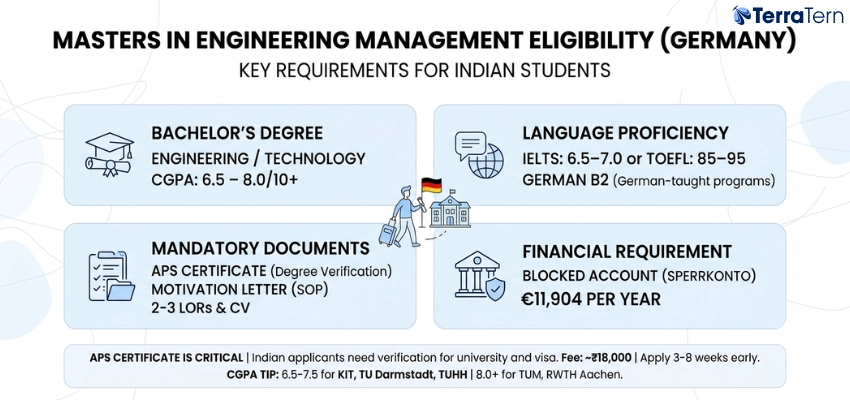
1. Bachelor’s degree: Must be in Engineering, Technology, or a related technical discipline.
2. Minimum CGPA: Ranges from 6.5/10 for entry-level public universities to 8.0+/10 for elite institutions like TUM and RWTH Aachen (equivalent to 65–75%+).
3. English proficiency:
-
IELTS: 6.5–7.0 overall (minimum 6.0 per band) for most programs; 7.0–7.5 for TUM.
-
TOEFL iBT: 85–95 (100+ for TUM).
-
Note: Only required for English-medium programs.
4. German language: Not required for fully English-taught programs. However, B2 German is mandatory for German-medium programs (like those at KIT, RWTH, and TU Berlin). A1–B1 is highly beneficial for daily life regardless of your track.
5. APS Certificate: Mandatory for all Indian university applicants.
6. Motivation Letter (SOP): Typically 500–1,000 words outlining your career goals, why you chose Germany, and why you selected this specific program.
7. Letters of Recommendation: 2–3 academic or professional references.
8. CV (Lebenslauf): Clean, structured, German-format resume (1–2 pages). No photo is required for international applicants.
9. Blocked account (Sperrkonto): Required for the student visa. (Note: While some older sources cite €11,208, the German government officially increased this requirement to €11,904/year for 2025/2026.
10. GMAT/GRE: NOT required at most German public universities, though a strong score may give you a competitive edge at TUM.
What Is the APS Certificate and Why Is It Critical for Indian Applicants?
The Academic Evaluation Centre (APS), operated by the German Embassy and DAAD in India, verifies the authenticity of your Indian university degrees and transcripts
-
Without an APS Certificate, no German university will process your application, and you cannot obtain a student visa.
-
The fee is approximately ₹18,000. Because processing takes 3–8 weeks (and longer during the peak July–September season), you should book your slot immediately
-
. Following recent visa reforms, errors in APS documentation cannot be informally corrected, so ensure your submission is flawless the first time.
Expert Tip: The CGPA threshold is the most overlooked barrier for Indian students,TU Munich's M.Sc. Management and Technology has an unofficial CGPA floor of approximately 8.0/10 for international applicants. Students with CGPAs between 6.5 and 7.5 should prioritise KIT, TU Darmstadt, or TUHH, where admission is more accessible and programme quality remains excellent.
What Is the Total Cost of Masters in Engineering Management in Germany?
A masters in engineering management in Germany at a public university costs effectively zero in tuition. You only pay an administrative semester fee of €150–€350 (₹16,500–₹38,500). Total annual living and study costs for an Indian student generally range from €11,000 to €16,000 (₹12.1–17.6 lakh). This budget comfortably covers accommodation, food, compulsory health insurance, and public transportation.
What Are the Tuition Fees for Masters in Engineering Management in Germany?
While specialised branches like a masters in industrial engineering and management in Germany or a masters in mechanical engineering and management in germany carry the same fee structures at public universities, private institutions will charge standard global tuition rates.
|
University Type |
Program Examples |
Tuition Fee (€/year) |
Tuition Fee (₹/year) |
Semester Admin Fee |
|
Public University (standard) |
KIT, TU Berlin, TU Darmstadt |
€0 (free) |
₹0 |
€155–€350/sem (₹17,050–₹38,500) |
|
TU Munich (TUM) |
M.Sc. Management and Technology |
€0 (free) |
₹0 |
~€144/sem (₹15,840) |
|
RWTH Aachen |
M.Sc. Engineering Management |
€0 (free) |
₹0 |
~€290/sem (₹31,900) |
|
University of Stuttgart |
M.Sc. Technology Management |
€0 (free) |
₹0 |
~€190/sem (₹20,900) |
|
University of Applied Sciences (FH) |
Multiple EM programs |
€0 (free) |
₹0 |
€250–€400/sem (₹27,500–₹44,000) |
|
Private University |
Constructor, Jacobs |
€15,000–€25,000 |
₹16.5–₹27.5 lakh |
N/A |
|
State-charged international fee |
Select MBA-adjacent programs |
€3,000–€8,000 |
₹3.3–₹8.8 lakh |
N/A |
What Is the Annual Budget for an Indian Student in Germany (Engineering Management)?
For a masters in engineering management in Germany, an Indian student should budget about €11,500–€16,500 per year all-in, which is roughly ₹12.65–₹18.15 lakh per year at an approximate rate of 1 EUR = ₹110. Over 2 years, that comes to about ₹25–₹36 lakh total, including one-time setup costs.
|
Expense |
Cost (€/year) |
Cost (₹/year approx.) |
|
Tuition |
€0 |
₹0 |
|
Semester contribution (x2) |
€300–€700 |
₹33,000–₹77,000 |
|
Blocked account requirement |
€11,208 |
₹12.33 lakh |
|
Accommodation |
€3,600–€7,200 |
₹3.96–₹7.92 lakh |
|
Food and daily expenses |
€2,400–€3,600 |
₹2.64–₹3.96 lakh |
|
Health insurance |
€1,450–€1,850 |
₹1.60–₹2.04 lakh |
|
Transport |
€350–€750 |
₹38,500–₹82,500 |
|
Books and lab costs |
€400–€700 |
₹44,000–₹77,000 |
|
APS, visa, documents |
€400–€700 |
₹44,000–₹77,000 |
|
Total annual cost |
€11,500–€16,500 |
₹12.65–₹18.15 lakh |
Germany vs other destinations
|
Destination |
Programme |
Tuition (₹ total, 2 years) |
Living cost (₹/year) |
Total 2-year cost (₹) |
|
Germany (public) |
M.Sc. Engineering Management |
₹0 |
₹12–18 lakh |
₹24–36 lakh |
|
UK (top 20) |
M.Sc. Engineering Management |
₹30–55 lakh |
₹18–24 lakh |
₹48–79 lakh |
|
USA (top 50) |
M.Eng. Management |
₹60–100 lakh |
₹24–36 lakh |
₹84–136 lakh |
|
India (IIT) |
M.Tech. / MBA |
₹2–8 lakh |
₹1.5–3 lakh |
₹5–14 lakh |
Important Tip: The blocked account (€11,208/year = ₹12.33 lakh) is frequently mistaken by Indian families as an additional cost; it is actually your own money, released monthly at €934 to cover living expenses. The real upfront cash requirement before departure is approximately ₹2–3 lakh in visa fees, APS, translation costs, and initial accommodation deposits. Plan this separately from the blocked account.
What Scholarships Are Available for Masters in Engineering Management in Germany?
Indian students pursuing a masters in engineering management in Germany can target DAAD scholarships, Deutschlandstipendium, foundation fellowships, and university-specific merit awards. Most of these scholarships support living costs rather than tuition, because public universities in Germany usually charge little or no tuition.
|
Scholarship |
Provider |
Amount |
Coverage |
Eligibility |
|
DAAD Scholarship |
DAAD |
€861–€1,200/month + travel |
Living costs, health insurance support |
Strong academics, study or research plan |
|
Deutschlandstipendium |
German federal system + sponsors |
€300/month |
Monthly merit stipend |
Merit-based, usually through university |
|
Heinrich Böll Foundation |
Heinrich Böll Foundation |
About €850/month + flat rate |
Living costs |
Academic merit + civic or political engagement |
|
Konrad Adenauer Foundation |
Konrad Adenauer Foundation |
About €850/month + flat rate |
Living costs |
Strong academics + values alignment |
|
Friedrich Ebert Foundation |
Friedrich Ebert Foundation |
About €850/month + flat rate |
Living costs |
Academic merit + social engagement |
|
TUM Excellence Scholarship |
TUM |
Varies |
Merit support |
For enrolled high-achieving TUM students |
|
RWTH / KIT awards |
University-specific |
Varies |
Merit support |
Strong academic profile |
As per our TerraTern Expert, most Indian students overestimate the probability of receiving a scholarship and underplan their finances as a result. A safer strategy: apply for scholarships but structure your financial proof around the blocked account and family funding. If a scholarship comes through, use those funds to reduce the financial burden; never make it the foundation of your Germany study plan.
What Is the Career and Salary Outlook After Masters in Engineering Management in Germany?
Graduates with a masters in engineering management in germany earn lucrative starting salaries ranging from €55,000 to €85,000 per year (₹60.5–93.5 lakh). The EU Blue Card is accessible immediately upon securing a qualifying job, with permanent residency achievable in as little as 21 months. Notably, this degree including any masters in engineering management in germany in English is universally recognised across all EU countries and the DACH region.
What is the starting salary after an Engineering Management Masters in Germany?
Salaries reflect average entry-level to mid-level compensation for recent master's graduates in 2026.
|
Role / Sector |
Starting Salary (€/year) |
Approx. (₹/year) |
Key Employers |
|
Engineering Manager (Automotive) |
€60,000–€80,000 |
₹66–88 lakh |
BMW, Mercedes-Benz, Volkswagen, Bosch |
|
Operations / Industrial Manager |
€55,000–€75,000 |
₹60.5–82.5 lakh |
Siemens, Bosch, ThyssenKrupp, Airbus |
|
Management Consultant (Engineering) |
€60,000–€85,000 |
₹66–93.5 lakh |
McKinsey, BCG, Roland Berger, Accenture |
|
Technology / Product Manager |
€65,000–€90,000 |
₹71.5–99 lakh |
SAP, Siemens, BASF, Continental |
|
Supply Chain Manager |
€55,000–€70,000 |
₹60.5–77 lakh |
Amazon, DHL, Deutsche Post, Lidl |
|
Project Engineer / Project Manager |
€55,000–€72,000 |
₹60.5–79.2 lakh |
Construction, Energy, Engineering |
|
Sustainability / Green Engineering Manager |
€58,000–€80,000 |
₹63.8–88 lakh |
Renewables, ESG |
|
R&D Manager |
€65,000–€95,000 |
₹71.5–104.5 lakh |
Chemical, Pharma, Automotive R&D |
What Is the Post-Study Visa and PR Pathway for Engineering Management Graduates?
The post-study visa and pr pathway for engineering management graduates includes
-
18-Month Job Seeker Visa: After you graduate, you can remain in Germany for up to 18 months to search for employment. You do not need employer sponsorship during this window.
-
EU Blue Card: Activated within weeks of starting qualifying employment. (Note: While older figures cite €41,041, the official 2026 EU Blue Card salary threshold for shortage occupations—which includes engineering—is now €45,934.20/year, and €50,700/year for standard occupations.
Gradding -
Permanent Residency (Niederlassungserlaubnis): The standard timeline is 5 years. However, EU Blue Card holders who achieve C1 proficiency in German can qualify in just 21 months, or in 33 months with B1 proficiency.
-
German Citizenship: Eligible after 5 years of residence (or 3 years with exceptional integration). As of 2024, dual citizenship with India is officially permitted. Start your masters in engineering management in germany in English (or German).
|
Timeline |
Milestone |
|
0 |
Begin M.Sc. Engineering Management in Germany |
|
2 years |
Graduate with an M.Sc. degree |
|
2–3.5 years |
Job seeker visa period; secure employment at a qualifying salary |
|
3.5 years |
Apply for the EU Blue Card |
|
5 years from EU Blue Card |
Eligible for Permanent Residency (PR) |
|
5 years total residence |
Eligible for German citizenship, with dual citizenship with India allowed |
Pro Tip: The 18-month post-study job seeker permit is the most underused benefit for Indian engineering management graduates in Germany. It allows you to attend interviews, build your professional network, and negotiate your first role without any time pressure or dependence on an employer. Most Indian graduates begin their job search too late (at month 18) rather than at month 1 of the permit period.
How to Apply for Masters in Engineering Management in Germany Step-by-Step
Book your APS appointment first, because it usually takes the longest time and is mandatory for Indian applicants.
-
Prepare your language proof: IELTS 6.5–7.5 or TOEFL 85–100 for masters in engineering management in Germany in English, or B2 German for German-medium programmes.
-
Shortlist 4–6 universities based on your CGPA, language level, and specialisation fit.
-
Draft a focused Statement of Purpose covering your engineering background, choice of Germany, university choice, and career plan.
-
Gather documents: APS certificate, degree and mark sheets, language scores, CV, SOP, recommendations, and passport.
-
Apply through uni-assist for many public universities, or directly through the university portal where required.
-
After admission, open the blocked account, accept the offer, and apply for the student visa.
-
Arrange accommodation early, especially student housing, because waiting times can be long.
|
When |
Action |
|
Now → Month 2 |
Book an APS appointment immediately. |
|
Months 1–3 |
Begin IELTS/German preparation; research university shortlist. |
|
Months 2–4 |
Complete APS certificate; sit IELTS (target 7.0+). |
|
Months 4–6 |
Shortlist 4–6 universities; draft SOP; request LoRs. |
|
Months 6–8 |
Register on the uni-assist portal; begin applications. |
|
Months 7–9 |
Submit applications by the deadlines (June–July for the October intake). |
|
Months 9–11 |
Receive admission offers; accept best fit. |
|
Months 11–12 |
Open a blocked account; apply for a student visa at the German Embassy. |
|
Months 12–14 |
Visa appointment; receive visa; arrange accommodation. |
|
Months 14–16 |
Travel to Germany; register (Anmeldung); begin studies. |
Key Note: The most common cause of missed deadlines for Indian students applying to German engineering management programmes is the assumption that the APS can be booked in the final 2–3 months before application deadlines. For July application deadlines, APS appointments in peak season (June–August) book out months in advance — treat the APS appointment as the first action, not the last.
How Can TerraTern Help You Get Admission to Engineering Management in Germany?
TerraTern provides comprehensive guidance for Indian engineering graduates applying to master's programmes in engineering management in Germany, from APS certificate scheduling and university shortlisting to SOP review, visa processing, assistance with blocked accounts, and post-arrival settlement support.
-
Targeted Placements: We align your profile with top-tier programs, whether you seek a masters in engineering management in germany in English, a masters in industrial engineering and management in germany, or a masters in mechanical engineering and management in germany.
-
End-to-End Services: Seamless support for profile assessment, SOP/LoR review, uni-assist applications, student visa processing, blocked accounts, and accommodation guidance.
-
The TerraTern Edge: Leverage our India-specific expertise, engineering-management-specific program knowledge, and comprehensive dual-currency financial planning.
As per TerraTern Expert Shreya, German engineering management admissions have no formal interview; in most cases, your SOP, CGPA, and LoRs determine admission. A poorly drafted SOP that doesn't articulate why Engineering Management (not just engineering) eliminates otherwise strong profiles. Getting the SOP reviewed by someone who understands what German admissions committees look for is the single highest-ROI step in your application.