


Key Highlights
- What are Canada PR Medical Rejection Reasons?
- What Are the 3 Official Canada PR Medical Rejection Reasons?
- What Medical Conditions Can Cause Canada PR Medical Rejection?
- How Does IRCC Calculate the "Excessive Demand" Cost Threshold in 2026?
- What Is the Upfront Medical Exam Rule and How Does It Change Things in 2026?
- What Happens After a Canada PR Medical Rejection? Understanding the Procedural Fairness Letter
- Can You Still Get Canada PR With a Medical Condition? Alternatives & Solutions
- How to Prepare for the Canada PR Immigration Medical Exam: A Step-by-Step Guide
- What Are the Most Common Canada PR Medical Rejection Reasons for Indian Applicants?
- How Can TerraTern Help You Overcome Canada PR Medical Rejection Reasons?
- Conclusion
Getting hit with Canada PR medical rejection reasons can stop your immigration dreams cold, especially for Indian applicants facing conditions like diabetes, TB history, or thalassemia. Canada PR medical rejection reasons fall under three main grounds: danger to public health, public safety, and excessive demand on services, and are hit hardest when costs top the 2026 threshold of ~$27,162/year. Since August 21, 2025, Express Entry demands upfront Immigration Medical Exams (IME), catching issues early before applications are even submitted.
Canada PR medical rejection reasons don't always end your chances. A Procedural Fairness Letter (PFL) gives you 60 days to fight back with proof. Common triggers include active tuberculosis, hepatitis B, chronic kidney disease, and psychiatric risks, but strong mitigation plans reverse many cases. Families need to check all dependents, too, as one flagged condition can sink the whole PR bid. Understand these rules now to prepare smart and avoid Canada PR medical rejection reasons altogether.
What are Canada PR Medical Rejection Reasons?
Canada PR medical rejection reasons fall into three categories under Canada's Immigration and Refugee Protection Act (IRPA): (1) danger to public health such as active tuberculosis or untreated syphilis; (2) danger to public safety such as certain psychiatric or behavioural disorders; and (3) excessive demand on health or social services where the applicant's condition is estimated to cost more than the government's annual threshold (~$27,162 in 2026).
Canada PR medical rejection reasons can affect all PR visa categories, including Express Entry, PNP, family sponsorship, and applicants, spouses, or dependents. IRCC notifies via a Procedural Fairness Letter (PFL) first, giving 60 days to respond with evidence. Most Canadian PR medical rejection reasons are tied to excessive demand, especially for Indian applicants.
Also Read: Cost of Study in Canada for Indian Students
What Are the 3 Official Canada PR Medical Rejection Reasons?
Canada PR medical rejection reasons happen under three official grounds defined by the Immigration and Refugee Protection Act (IRPA Section 38). The third excessive demand is the most common for rejections, especially among Indian applicants. All three apply to PR applicants, dependents, and most family sponsorship cases (excessive demand waived for spouses/kids).
-
Ground 1: Danger to Public Health: Active contagious diseases like untreated tuberculosis or syphilis that risk spreading in Canada. IRCC assesses the current transmission threat. In simple terms: If you can infect others now, you fail this ground.
-
Ground 2: Danger to Public Safety: Psychiatric or behavioural conditions with documented violence risk, like severe schizophrenia with a history. Focus stays on the future danger likelihood. In simple terms: Risk of hurting people, not just having a diagnosis.
-
Ground 3: Excessive Demand: Conditions costing over $27,162/year (2026 threshold) in health/social services over five years. Covers dialysis, cancer care, or special needs support. In simple terms: Too expensive for Canada's public system.
What Medical Conditions Can Cause Canada PR Medical Rejection?
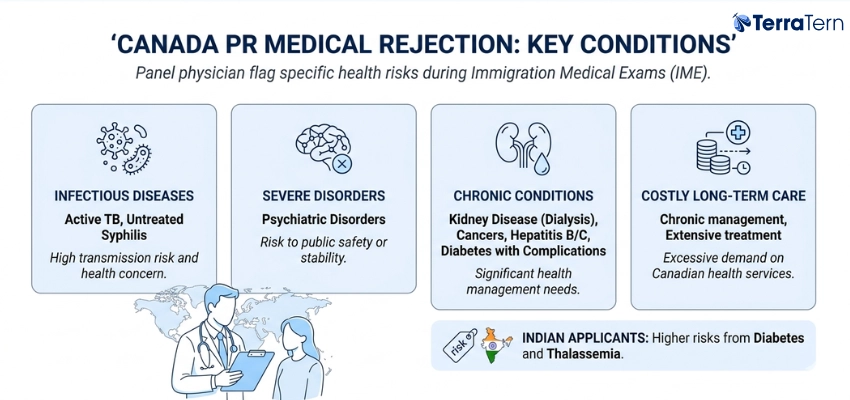
Canada PR medical rejection reasons often stem from conditions that disqualify Canada immigration under the three grounds. Active tuberculosis, untreated syphilis, severe psychiatric disorders, chronic kidney disease requiring dialysis, certain cancers, hepatitis B/C, diabetes with significant complications, and costly long-term care needs top the list. Panel physicians flag these during your Immigration Medical Exam (IME). Indian applicants face higher risks from diabetes and thalassemia.
Which Conditions Trigger the "Danger to Public Health" Ground?
IRCC targets infectious diseases with contagion risk to Canadians. Active pulmonary TB and untreated syphilis lead to Canada PR medical rejection reasons here. Latent TB rarely triggers rejection; only active cases fail. Panel physicians check transmissibility.
|
Condition |
Risk Type |
Likely Outcome |
|
Active pulmonary TB |
High contagion |
Rejection |
|
Untreated syphilis |
Communicable |
Rejection |
|
Active hepatitis |
Transmissible |
Case-by-case |
|
Untreated gonorrhea |
Bacterial spread |
Rejection |
Which Conditions Trigger the "Danger to Public Safety" Ground?
IRCC reviews clinical history for violence likelihood, not diagnosis alone. Canada PR medical rejection reasons include paranoid states with violent acts, organic brain disorders, pedophilia, substance abuse causing harm (like impaired driving), and impulsive sociopathy.
-
Paranoid schizophrenia with attack history
-
Brain injuries leading to aggression
-
Pedophilia with documented risk
-
Alcoholism tied to violence
-
Antisocial personality with a record of harm
Which Medical Conditions Commonly Trigger "Excessive Demand" for Indian Applicants?
Canada PR medical rejection reasons for Indians cluster around diabetes, kidney disease, and blood disorders. IRCC calculates five-year costs, divides by 5, and compares to the $27,162/year threshold. Thalassemia major with transfusions fails; minor often passes.
|
Condition |
Estimated Annual Cost |
Likely Inadmissibility Outcome |
|
Chronic dialysis |
Rs. 41,50,000+ ($50,000+) |
Rejection |
|
Thalassemia major |
Rs. 33,20,000+ ($40,000+) |
Rejection |
|
Cancer chemotherapy |
Rs. 24,90,000+ ($30,000+) |
High risk |
|
Insulin-dependent diabetes w/ complications |
Rs. 12,45,000–Rs. 20,75,000 ($15,000–25,000) |
Case-by-case |
|
Hepatitis B (active) |
Rs. 12,45,000+ ($15,000+) |
Possible |
|
Lupus w/ organ damage |
Rs. 16,60,000+ ($20,000+) |
Rejection |
How Does IRCC Calculate the "Excessive Demand" Cost Threshold in 2026?
Canada PR medical rejection reasons under excessive demand trigger when estimated healthcare or social service costs exceed approximately $27,162 per year in 2026, or if your condition worsens, wait times for Canadians already in the system. This ground causes most Canada PR medical rejection reasons, especially for Indian applicants with diabetes or dialysis needs. IRCC medical officers project costs over five years using data from Canadian provincial rates. 2026 Excessive Demand Threshold: ~$27,162/year. Updated via Canada Gazette, November 2025 regulations.
-
Estimate yearly costs for your condition using provincial averages
-
Project five-year total based on treatment trajectory
-
Divide by 5 to get the average annual cost
-
Compared to the threshold, exceeding $27,162 is inadmissible
-
Check wait-time impact on other patients
Also Read: Latest Eligibility for Canada PR from India: Experts Guide
What Is the Upfront Medical Exam Rule and How Does It Change Things in 2026?
From August 21, 2025, all Express Entry program applicants must complete an upfront medical exam, an Express Entry 2026, and an Immigration Medical Exam (IME) before submitting their PR application. This shifts from the old post-ITA request process, spotting Canada PR medical rejection reasons early to cut delays.
-
Since August 21, 2025: All Express Entry applicants must complete an upfront medical exam, the Express Entry 2026 Immigration Medical Exam (IME), before PR submission
-
Major shift: Old process waited for post-ITA IRCC letter; now upload IME proof upfront or get instant rejection
-
Goal: Spot Canada PR medical rejection reasons early, cut processing delays by months
-
Who Needs It: FSW, CEC, FST, PNP streams + all family members/dependents
-
Exemptions: Recent IME (<5 years, low risk); applicants already living in Canada
-
Timeline Impact: IME valid 12 months, book 3-6 months before expected ITA/draw
-
India Clinics: IRCC panel physicians in Mumbai, Delhi, Bangalore, handle upfront IMEs
-
Pro Tip: Time IME so results don't expire mid-application saves redo costs and delays
What Happens After a Canada PR Medical Rejection? Understanding the Procedural Fairness Letter
If IRCC flags potential Canada PR medical rejection reasons, they send a Procedural Fairness Letter (PFL); this is NOT a final rejection. It's your chance to submit evidence addressing Canada PR medical rejection reasons before they decide. Most applicants panic here, but strong responses reverse many cases.
What Is a Procedural Fairness Letter and What Does It Mean?
A Procedural Fairness Letter (PFL) is IRCC's official notice that Canada PR medical rejection reasons may refuse your application. You typically get 60 days to respond with specialist medical reports, treatment plans, private insurance proof, and evidence that your condition stays managed.
|
What it IS |
What it is NOT |
|
IRCC notice flagging Canada PR medical rejection reasons |
Final Canada PR medical rejection |
|
60 days to submit specialist reports, treatment plans, private insurance |
Automatic refusal |
|
Legal chance to overcome Canada PR medical rejection reasons with evidence |
End of immigration journey |
|
Common for excessive demand cases (diabetes, dialysis) |
Only for public health/safety risks |
|
TerraTern helps craft winning responses |
Ignore and lose automatically |
How Can You Respond to a Canada PR Medical Rejection or PFL?
Follow this step-by-step strategy to overcome Canada PR medical rejection reasons:
-
Hire a Regulated Canadian Immigration Consultant (RCIC) or lawyer. TerraTern's experts handle PFL responses routinely
-
Obtain specialist medical reports from your treating physician showing current stability
-
Draft a Mitigation Plan proving ongoing treatment keeps costs under the $27,162/year threshold
-
Submit private health insurance evidence to offset the public system burden
-
Assert waivers if eligible (excessive demand skipped for spouses/dependent children)
-
Submit everything before the 60-day deadline via the IRCC portal
Also Read: Canada Ends Policy Allowing Visitors to Apply for Work
Can You Still Get Canada PR With a Medical Condition? Alternatives & Solutions
Yes, despite Canada PR medical rejection reasons, you can still get Canada PR with a medical condition. Respond to the Procedural Fairness Letter with strong mitigation plans, apply via family sponsorship (waives excessive demand), or secure a Temporary Resident Permit (TRP). These paths overcome many Canada PR medical rejection reasons hope exists beyond initial flags.
What Is a Temporary Resident Permit and When Can You Use It?
A Temporary Resident Permit (TRP) is a special document allowing Canada entry despite Canada PR medical rejection reasons, issued when your presence benefits Canada more than the risks posed. Apply at the visa offices or ports of entry with strong justification.
-
Duration: Typically 1–3 years, renewable
-
TRP to PR Pathway: After 3 years for non-criminal medical inadmissibility, apply for PR
-
How to Apply: Submit via the Canadian visa centre with medical history, mitigation proof
-
Limitations: Officer's discretion, no guarantees
Are There Canada PR Pathways That Waive Medical Inadmissibility?
Family sponsorship waives excessive demand (the most common Canada PR medical rejection reasons) for sponsored spouses, common-law partners, conjugal partners, and dependent children. Public health/safety grounds still apply. Refugee protection offers humanitarian overrides rarely.
-
Family Sponsorship Waives Excessive Demand: covers sponsored spouses, common-law partners, conjugal partners, and dependent children (the most common Canada PR medical rejection reasons)
-
Public Health/Safety Grounds Still Apply: active TB, violence risk cannot skip these
-
Refugee Protection: offers rare humanitarian overrides for Canada PR medical rejection reasons
-
Indian Families Benefit Most: sponsor diabetic spouse? No $27,162/year cost worries
-
Spousal Sponsorship Exception: Excessive demand has been completely removed for these categories
-
Practical Tip: Controlled chronic conditions clear easily under family class sponsorship
How to Prepare for the Canada PR Immigration Medical Exam: A Step-by-Step Guide
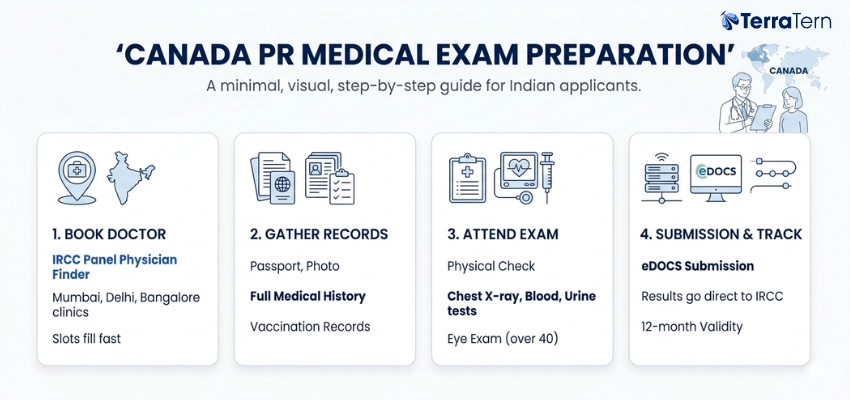
Canada PR medical exam requirements in India demand careful preparation to avoid Canada PR medical rejection reasons. Book an IRCC-approved panel physician, gather records, complete tests (X-ray, blood, urine, physical), and ensure eDOCS submission within the 12 month validity window. This targets how to prepare for IME Canada searches perfectly.
-
Find a panel physician using the IRCC Panel Physician Finder for Mumbai, Delhi, and Bangalore clinics
-
Express Entry needs upfront IME since Aug 21, 2025; slots fill fast
-
Gather documents, passport, full medical history, vaccination records
-
Attend exam, physical check, chest X-ray, blood/urine tests, eye exam (if over 40)
-
Physician submits results, which go directly to IRCC eDOCS; you get IMM 1017B receipt
-
Track status check IRCC account; valid 12 months from exam date
Also Read: Is 7.5 a Good IELTS Score? Here is the Truth
What Are the Most Common Canada PR Medical Rejection Reasons for Indian Applicants?
Indian applicants face Canada PR medical rejection reasons disproportionately due to tuberculosis history, thalassemia, Hepatitis B, type 2 diabetes complications, and South Asian-prevalent conditions, hitting the excessive demand threshold. Canada PR medical rejection reasons strike hardest here due to India's health patterns. TerraTern has guided hundreds of Indian clients through these challenges.
-
Higher TB exposure in India's prevalence flags even latent cases for review
-
Hepatitis B carriage, common in South Asian populations, triggers cost checks
-
Type 2 diabetes surges complications like kidney damage, exceeding $27,162/year
-
Thalassemia prevalence in the major form needs costly transfusions
-
Vitamin D deficiency and kidney disease long-term costs add up
How Can TerraTern Help You Overcome Canada PR Medical Rejection Reasons?
Canada PR medical rejection reasons don't have to end your Canada immigration journey. TerraTern's expert team reverses them daily. With hundreds of successful PFL responses for Indian applicants, we turn medical inadmissibility into Canada PR approvals.
-
PFL Response Strategy: 60-day plans with specialist letters, mitigation proof, and private insurance evidence
-
Upfront IME Guidance: book IRCC panel physicians, time exams to avoid expiry
-
Excessive Demand Appeals: cost projections under the $27,162/year threshold with Canadian data
-
Family Sponsorship Optimisation: leverage waivers for spouses with diabetes, thalassemia
-
TRP Applications: bridge to PR for temporary stays while building cases
-
Indian-specific Expertise: TB history, Hepatitis B carriers, thalassemia strategies that work
Conclusion
Canada PR medical rejection reasons span three grounds: public health, public safety, and excessive demand, but strong responses turn most around. The $27,162/year 2026 threshold, the upfront IME rule since August 21, 2025, and the Procedural Fairness Letter process give Indian applicants clear paths forward. Canada PR medical rejection reasons hit diabetes, TB history, and thalassemia hardest, but PFL mitigation plans, family sponsorship waivers, and TRP bridges make PR achievable. Disclose conditions honestly during IME to avoid misrepresentation bans. Check official Canada PR medical inadmissibility rules at IRCC Medical Inadmissibility, your primary source for current regulations. To know more about Canada PR, visit TerraTern now!




 AI Summary