

Key Highlights
- Singapore Launches Job Placement Initiative
- What Happened to the Workers?
- Immediate Financial Assistance for Workers
- More Than 80 Employers Step Forward
- Relocation to a Single Accommodation Facility
- Wage Recovery Process Underway
- Support from the Government and Labour Organisations
- Broader Implications for Migrant Worker Protection
- What It Means for Indian and Bangladeshi Workers?
- Conclusion
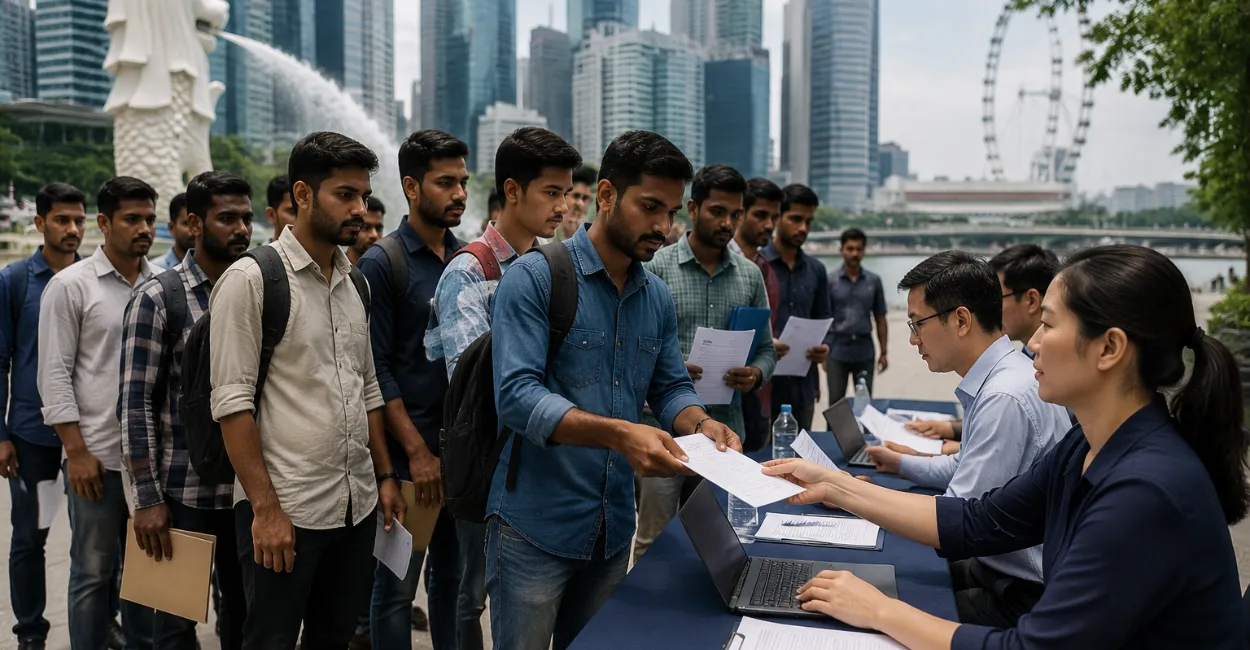
Singapore has intervened to help over 400 migrant workers from India and Bangladesh who were reportedly deprived of wages for months. From next week, the country's biggest labour body will start to assign these workers to new jobs, along with government organisations and migrant welfare organisations. The relocation is designed to provide financial stability for the workers affected, as well as wage claim support, housing, and employment assistance. The development has also reignited the debate on the responsibility of employers and the safeguarding of migrant workers in one of the world's biggest labour markets in Asia.
Singapore Launches Job Placement Initiative
Job placements for over 400 affected migrant workers will be initiated next week, the National Trades Union Congress (NTUC), Singapore's largest labour organisation, said on Monday.
So far, NTUC has already got backing from over 80 companies that are prepared to employ the displaced workers, said Ng Chee Meng, NTUC's Secretary-General. There are almost 400 opportunities identified across various industries, and unions are still seeking out other opportunities to ensure that every worker finds an appropriate job.
This is one of the most extensive and systematic employment support programs for migrant workers abandoned by their employers in recent years.
Also Read: Singapore Job Vacancy: Latest Pay, Roles, Scope & More
What Happened to the Workers?
The workers were hired by three Singapore-based companies:
-
SK Industries
-
KPA Engineering
-
VVR Plant Engineering
The three firms have a common director, Ramu Palani Velu, an Indian-origin businessman who is said to be uncontactable and presumed to have moved out of Singapore, reports said.
Hundreds of workers were said to have not received any salaries for three to four months before seeking help from the Ministry of Manpower (MOM) to get their wages. Many had no income so were unable to afford their food and basic needs, and there was also uncertainty over where they were to be accommodated, which exacerbated this situation further.
Immediate Financial Assistance for Workers
Emergency financial support has already been provided for the workers affected before the employment programme started.
NTUC and the Migrant Workers' Centre (MWC) shared the following with each worker:
-
SGD 100 in cash
-
SGD 100 worth of supermarket vouchers
The financial aid is meant to assist workers in buying food and other necessities while they await the new job and salary recovery processes to be realized.
The help is only short-term, but it will bring relief to people who have been working but not getting paid for months.
More Than 80 Employers Step Forward
One of the most promising breakthroughs has been the positive feedback from Singaporean employers.
NTUC says more than 80 companies have already indicated their interest in employing the displaced workers. There are nearly 400 positions at present, and labour unions are still sending workers to employers as a result of their skills and experience.
The high levels of industry involvement reflect the need for skilled migrant workers, as well as employers' desire to assist employees in overcoming this unprecedented employment crisis.
Relocation to a Single Accommodation Facility
In addition to employment support, Singapore is also making support services easier by housing the workers in a single housing complex.
This relocation has several aims:
-
More convenient access to welfare services
-
Improved liaison with employers
-
Improving the provision of legal and administrative assistance
-
Better interaction between the workers and the government agencies.
Having employees housed in the same area will also simplify the verification of employment documents and interviews with prospective employers by the officials.
Wage Recovery Process Underway
Finding new employment is only one part of the government's response.
The police are also assisting workers to retrieve their unpaid salaries via Singapore's Tripartite Alliance for Dispute Management (TADM).
The officials have gone to the workers' dormitory and helped the people claim their salaries directly. TADM is a collaborative effort of:
-
Ministry of Manpower (MOM)
-
National Trades Union Congress (NTUC)
-
Singapore National Employers Federation (SNEF)
The organisation focuses on employment dispute resolution, including mediation and legal proceedings, to recover wages owed to employees by employers.
Also Read: Singapore Immigration: A Comprehensive Guide
Why This Case Has Drawn Attention
Singapore has hundreds of thousands of migrant workers, including in the following industries:
-
Construction
-
Manufacturing
-
Marine engineering
-
Infrastructure development
-
Maintenance services
The majority of migrant workers depend solely on their employers for wages, housing, and employment permits.
Workers may find themselves in a financial crisis when their employers suddenly stop paying wages or go out of business because it is difficult for them to move their work to another employer without permission.
The case has thus garnered a good amount of public interest and the need for more robust protection and prompt action on the part of employers in the event that they do not comply with their rights and duties.
Support from the Government and Labour Organisations
The response has included coordinated action by several organisations.
Key stakeholders include:
-
National Trades Union Congress (NTUC)
-
Migrant Workers' Centre (MWC)
-
Ministry of Manpower (MOM)
-
Tripartite Alliance for Dispute Management (TADM)
These organisations are taking action on four key priorities:
-
Emergency financial assistance
-
Temporary accommodation
-
Job placement
-
The right to be paid unpaid wages.
Officials have also promised that there will be no workers who are impacted left without help during the process.
Broader Implications for Migrant Worker Protection
The incident again has brought into question the accountability of employers in international labour markets.
Asian countries remain reliant on migrant workers, especially in the service sectors where labour is required. There is legal protection, but it is difficult to enforce if employers go out of business, go bankrupt, or move abroad.
Singapore's quick response is a testament to the ability of labour unions, government bodies, and welfare organisations to collaborate to reduce the hardship faced by the affected workers.
Experts say the case will help pave the way for more debate on:
-
Enhancements to wage protection mechanisms.
-
Improved employer monitoring
-
Stronger financial safeguards
-
Improved crisis response mechanism for migrant workers
The finding could affect future policies to address vulnerabilities of foreign workers in Singapore.
Also Read: Singapore Visa Photo Requirements: Latest Experts Guide
What It Means for Indian and Bangladeshi Workers?
Indian and Bangladeshi workers need to find jobs.
They can change jobs without having to go back home without the payment of their unpaid wages. By changing their jobs, they do not have to go back home without getting paid for the wages that they have not recovered. It also helps maintain their income, supports their families with remittances, and avoids further losses due to the fact that they have not had a salary for months.
This process of salary recovery provides a glimmer of hope for workers that they might be paid what they are due from their former employers and still work for different companies.
While the legal process can be lengthy, emergency support, shelter, and employment assistance can make a huge difference in the short-term lives of these individuals.
Conclusion
Singapore's decision to launch a dedicated job placement programme for more than 400 abandoned Indian and Bangladeshi workers marks a significant effort to protect vulnerable migrant employees. By combining employment opportunities, emergency financial assistance, accommodation support, and legal help to recover unpaid wages, authorities and labour organisations are providing a comprehensive response to a serious labour dispute. While investigations into the employers continue, the priority remains ensuring that affected workers regain financial stability, continue working legally, and receive the support needed to rebuild their livelihoods.
Contact Terratern for more information.