

Key Highlights
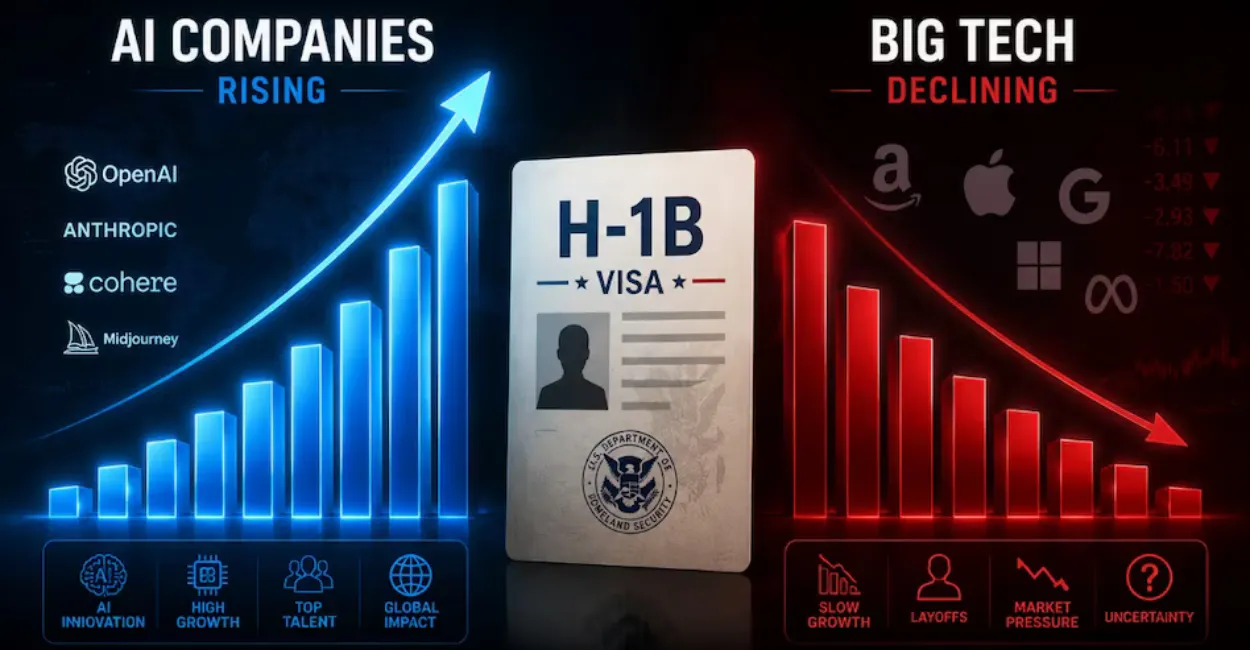
AI companies OpenAI, Anthropic, and Nvidia are dramatically boosting their H-1B visa applications as the talent war for specialized researchers intensifies. This surge comes even as a temporary $100,000 fee makes hiring foreign talent more expensive, and while traditional tech giants like Meta, Microsoft, Amazon, and Google are pulling back from the program.
Federal data reveals a stark divide in how tech companies are approaching overseas hiring. Anthropic, OpenAI, and Nvidia filed more H-1B visa applications for new hires and renewals in the second quarter of fiscal 2026 than they did a year earlier. Meanwhile, other major tech companies reduced their visa filings significantly.
The Numbers Behind the Surge
Department of Labor certifications show the growth is dramatic across all three AI companies. Anthropic recorded the biggest year-over-year percentage jump among the seven companies reviewed, with certified applications rising from 10 in Q2 2025 to 59 in Q2 2026. OpenAI filed more applications than Anthropic, with 63 in Q2 2026 up from 20 in Q2 2025. Nvidia's numbers dwarf both model makers in absolute terms. The chipmaker reported 765 certified filings in Q2 2026, reflecting a steady increase from 641 in the same period last year.
Also Read: How Many Types of Visa in the USA? New Full Expert Guide
Traditional Tech Giants Pull Back
The contrast with established tech companies is stark. Several major firms saw declines in certified applications compared to the previous year:
|
Company |
Percentage Change |
Reason |
|
|
-64% |
Rolling job cuts targeted at specific teams |
|
Amazon |
-30% |
Restructuring around smaller specialized teams |
|
Microsoft |
-20% |
Setting up operations overseas to avoid visa costs |
|
Meta |
-3% |
General headcount reduction |
Why Are AI Companies Willing to Pay More?
Recruiters say these AI companies are willing to absorb higher costs and hurdles to secure elite talent. Raghu Shivakumar, a recruiter with Nexocean, told Business Insider that Anthropic and OpenAI likely seek more foreign workers because they have a "mindset of 'do whatever it takes'" for hiring. Before Monday's court ruling, the $100,000 H-1B visa fee represented "a rounding error against the cost of not landing the right researcher," Shivakumar said. The $100,000 H-1B visa fee was proposed by President Trump but a US judge struck it down as unlawful in June 2026. This ruling means the fee is no longer in effect, though the companies had already increased their filings anticipating the cost.
Also Read: US Visitor Visa B1/B2
Why Are AI Companies Willing to Pay More?
Recruiters say these AI companies are willing to absorb higher costs and hurdles to secure elite talent. Raghu Shivakumar, a recruiter with Nexocean, told Business Insider that Anthropic and OpenAI likely seek more foreign workers because they have a "mindset of 'do whatever it takes'" for hiring.
Before Monday's court ruling, the $100,000 H-1B visa fee represented "a rounding error against the cost of not landing the right researcher," Shivakumar said. The $100,000 H-1B visa fee was proposed by President Trump but a US judge struck it down as unlawful in June 2026. This ruling means the fee is no longer in effect, though the companies had already increased their filings anticipating the cost.
New Rules Favor Higher-Paid Applicants
The decline at traditional tech companies comes amid significant changes to the visa program. New rules give higher-paid applicants better odds in the lottery, disadvantaged younger workers. Large firms are restructuring around smaller, specialized teams or "pods" and are increasingly comfortable setting up operations overseas to avoid visa costs. This strategy differs sharply from AI companies racing to build breakthrough models.
-
New rules give higher-paid applicants better odds in the H-1B lottery, disadvantaging younger workers
-
Large firms are restructuring around smaller, specialized teams called "pods"
-
Many companies are setting up operations overseas to avoid visa costs
-
This strategy differs sharply from AI companies racing to build breakthrough models
Also Read: Difference Between B1 and B2 Visa USA: Experts' New Guide
The Diverging Talent Strategies
Federal data reveals a diverging talent strategy among leading artificial intelligence developers. While the broader technology sector has scaled back foreign hiring, Anthropic, OpenAI, and Nvidia have accelerated their pursuit of specialized overseas researchers and engineers.
The AI talent war is apparently recession-proof. While much of Big Tech is trimming headcount and pulling back on H-1B visa filings, AI heavyweights are doing the opposite.
Analysts note that the divergence highlights how AI hiring is becoming less about filling seats and more about landing a handful of highly specialized researchers and engineers. For companies racing to build the next breakthrough model, securing top talent is essential regardless of cost.
What Does This Means for Indian Professionals?
The shift adds uncertainty for Indian professionals as US immigration rules tighten, though AI hiring stays strong. Indians with H-1B visas should note that Google and Amazon hiring numbers have reduced significantly, while Nvidia increased certifications. The H-1B applications fell to 211,600 overall, but AI companies are bucking the trend hard. This means opportunities in AI remain strong even as traditional tech reduces foreign hiring.
-
The shift adds uncertainty for Indian professionals as US immigration rules tighten
-
AI hiring stays strong despite tighter immigration rules
-
Indians with H-1B visas should note that Google and Amazon hiring numbers reduced significantly
-
Nvidia increased certifications while traditional tech reduced foreign hiring
-
Overall H-1B applications fell to 211,600, but AI companies are bucking the trend hard
- h
Opportunities in AI remain strong even as traditional tech reduces foreign hiring
Conclusion
H-1B filings rise at OpenAI, Anthropic and Nvidia as companies expand overseas recruitment, marking a clear divide between AI companies and traditional tech giants. While Anthropic surged 490%, OpenAI jumped 215%, and Nvidia climbed 19%, companies like Google, Amazon, Microsoft, and Meta all reduced their filings. The AI talent war proves recession-proof as these companies prioritize securing specialized researchers over cost concerns. For official U.S. government information on H-1B visas and the latest regulations, visit the U.S. Department of Labor website. To know more about H-1B visa, visit TerraTern now!