
Key Highlights
Step up your preparation with the IELTS Listening Practice Test. Test your listening skills, then explore the transcript and answer key to understand your results.
In this test, you will listen to 4 Sections and answer Questions 1–40 based on the information you hear. Each section reflects a typical situation you may encounter in the actual IELTS Listening exam.
-
Section 1: A woman telephoning to get information about a festival
-
Section 2: A guide is talking to the visitors of an art museum
-
Section 3: A student talking to her supervisor about the research that she has done
-
Section 4: A lecture on the use of soil to reduce carbon dioxide (CO2) in the atmosphere
By completing this practice test, you can strengthen your listening skills, understand spoken English more effectively, and prepare yourself confidently for the IELTS exam.
IELTS Listening Practice Test 37
Section 1
This audio contains answers for questions 1–10.
Questions 1-7
Complete the table below.
Write ONE WORD AND/OR A NUMBER for each answer
|
Event |
Cost |
Venue |
Notes |
|
Jazz band |
Example : Tickets available for £15 |
The 1. ……….. school |
Also appearing: Carolyn Hart (plays the 2. ………… ) |
|
Duck races |
£1 per duck |
Start behind the 3. …………. |
Prize: tickets for 4. ………… held at the end of the festival. Ducks can be bought in the 5. …………. |
|
Flower show |
Free |
6. …………. Hall |
Prizes presented at 5 pm by a well-known 7. …………. |
Questions 8-10
Who is each play suitable for?
Write the correct letter A, B or C next to the question
Plays
- The Mystery of Muldoon 8. …………..
- Fire and Flood 9. …………..
- Silly Sailor 10. …………
A. Mainly for children
B. Mainly for adults
C. Suitable for people of all ages
Section 2
This audio contains answers to questions 11–20.
Questions 11-16
What does the speaker say about each of the following collections?
Choose SIX answers and write the correct letter A-G next to the questions.
Collections
- 20th- and 21st-century paintings 11. ……….
- 19th-century paintings 12. ……….
- Sculptures 13. ………..
- ‘Around the world’ exhibition 14. ………
- Coins 15. ……….
- Porcelain and glass 16. …………
Comments
A. Was given by one person
B. Was recently published in the media
C. Includes some items given by members of the public
D. Includes some items given by the artists
E. Includes the most popular exhibits in the museum
F. Is the largest of its kind in the country
G. Has had some of its contents relocated
Questions 17-20
Label the plan below.
Write the correct letter A-H next to the questions.
Basement Of Museum
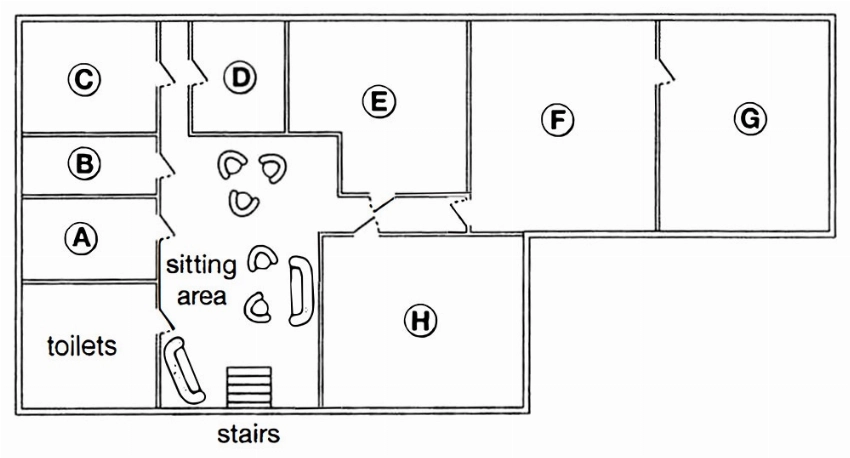
17. Restaurant………..
18. Café…………
19. Baby-changing facilities………..
20. Cloakroom…………
Section 3
This audio contains answers for questions 21-30.
Questions 21-22
Choose TWO letters A-E.
Which TWO characteristics were shared by the subjects of Joanna’s psychology study?
A. They had all won prizes for their music.
B. They had all made music recordings.
C. They were all under 27 years old.
D. They had all toured internationally.
E. They all played a stringed instrument.
Questions 23-24
Choose TWO letters A-E.
Which TWO points does Joanna make about her use of telephone interviews?
A. It meant rich data could be collected.
B. It allowed the involvement of top performers.
C. It led to a stressful atmosphere at times.
D. It meant interview times had to be limited.
E. It caused some technical problems.
Questions 25-26
Choose TWO letters A-E.
Which TWO topics did Joanna originally intend to investigate in her research?
A. Regulations concerning concert dress
B. Audience reactions to the dress of performers
C. Changes in performer attitudes to concert dress
D. How the choice of dress relates to performer roles
E. Links between musical instruments and dress choice
Questions 27-30
Choose the correct letter A, B or C.
27. Joanna concentrated on women performers because
A. Women are more influenced by fashion.
B. Women’s dress has led to more controversy.
C. Women’s code of dress is less strict than men’s.
28. Mike Frost’s article suggests that in popular music, women’s dress is affected by
A. Their wish is to be taken seriously.
B. Their tendency to copy each other.
C. Their reaction to the masculine nature of the music.
29. What did Joanna’s subjects say about the audience at a performance?
A. The musicians’ choice of clothing is linked to respect for the audience.
B. The clothing should not distract the audience from the music.
C. The audience should make the effort to dress appropriately.
30. According to the speakers, musicians could learn from sports scientists about
A. The importance of clothing for physical freedom.
B. The part played by clothing in improving performance.
C. The way clothing may protect against physical injury.
Section 4
This audio contains answers to questions 31-40.
Questions 31-40
Complete the notes below.
Write ONE WORD ONLY for each answer.
The Use Of Soil To Reduce Carbon Dioxide (CO2) In The Atmosphere
Rattan Lal:
-
Claims that 13% of CO2 in the atmosphere could be absorbed by agricultural soils
-
Erosion is more likely in soil that is 31. ……….
-
Lai found soil in Africa that was very 32. …………
-
It was suggested that carbon from soil was entering the atmosphere
Soil And Carbon:
-
Plants turn CO2 from the air into carbon-based substances such as 33. ....……..
-
Some CO2 moves from the 34. ....……… of plants to microbes in the soil
-
Carbon was lost from the soil when agriculture was invented
Regenerative Agriculture:
-
Uses established practices to make sure soil remains fertile and 35. ………..
-
e.g. through year-round planting and increasing the 36. ………… of plants that are grown
California Study:
-
Taking place on a big 37. …………. farm
-
Uses compost made from waste from agriculture and 38. …………
Australia Study:
-
Aims to increase soil carbon by using 39. ………… that are always green
Future developments may include:
-
Reducing the amount of fertiliser used in farming
-
Giving farmers 40. ………… for carbon storage, as well as their produce
Answers

Unlock Remaining Answer

