
Key Highlights
Step up your preparation with the IELTS Listening Practice Test. Test your listening skills, then explore the transcript and answer key to understand your results.
In this test, you will listen to 4 Sections and answer Questions 1–40 based on the information you hear. Each section reflects a typical situation you may encounter in the actual IELTS Listening exam.
-
Section 1: A telephone conversation between a woman and an official about a cookery class
-
Section 2: A chairman of the highway committee of Granford speaking about the changes in traffic
-
Section 3: Two biology students discussing an experiment
-
Section 4: A lecture on recent research on the effects of urban environments on animals
By completing this practice test, you can strengthen your listening skills, understand spoken English more effectively, and prepare yourself confidently for the IELTS exam.
IELTS Listening Practice Test 36
Section 1
This audio contains answers for questions 1-10.
Questions 1-10
Complete the table below.
Write ONE WORD AND/OR A NUMBER for each answer.
COOKERY CLASSES
|
Cookery Class |
Focus |
Other Information |
|---|---|---|
|
Example: The Food Studio |
How to 1. …………… and cook with seasonal products |
|
|
Bond’s Cookery School |
Food that is 4. ………… |
|
|
The 7. ……….. Centre |
Mainly 8. ……… food |
|
Section 2
This audio contains answers to questions 11-20.
Questions 11-13
Choose the correct letter A, B or C.
Traffic Changes In Granford
11. Why are changes needed to traffic systems in Granford?
A. The number of traffic accidents has risen.
B. The amount of traffic on the roads has increased.
C. The types of vehicles on the roads have changed.
12. In a survey, local residents particularly complained about
A. Dangerous driving by parents.
B. Pollution from trucks and lorries.
C. Inconvenience from parked cars.
13. According to the speaker, one problem with the new regulations will be
A. Raising money to pay for them.
B. Finding a way to make people follow them.
C. Getting the support of the police.
Questions 14-20
Label the map below.
Write the correct letter A-I next to the questions
Proposed Traffic Changes In Granford
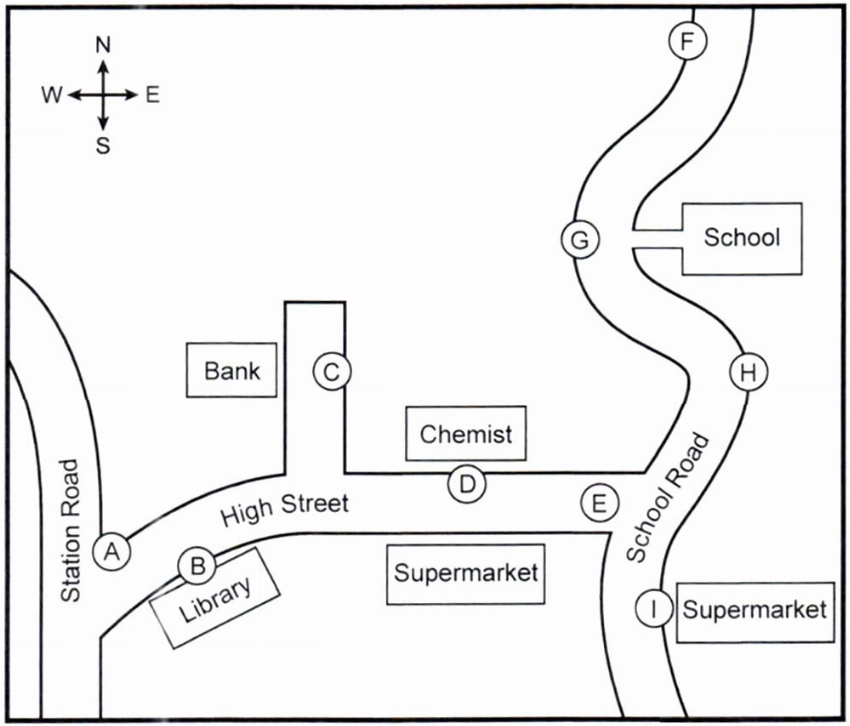
14. New Traffic Lights………..
15. Pedestrian Crossing…………
16. Parking Allowed……….
17. New ‘No Parking’ Sign……..
18. New Disabled Parking Spaces………
19. Widened Pavement………..
20. Lorry Loading/Unloading Restrictions………..
Section 3
This audio contains answers for questions 21-30.
Questions 21-25
Choose the correct letter A, B or C.
21. Why is Jack interested in investigating seed germination?
A. He may do a module on a related topic later on.
B. He wants to have a career in plant science.
C. He is thinking of choosing this topic for his dissertation.
22. Jack and Emma agree that the main advantage of their present experiment is that it can be
A. Described very easily.
B. Carried out inside the laboratory.
C. Completed in the time available.
23. What do they decide to check with their tutor?
A. Whether their aim is appropriate
B. Whether anyone else has chosen this topic
C. Whether the assignment contributes to their final grade
24. They agree that Graves’ book on seed germination is disappointing because
A. It fails to cover recent advances in seed science.
B. The content is irrelevant to them.
C. Its focus is very theoretical.
25. What does Jack say about the article on seed germination by Lee Hall?
A. The diagrams of plant development are useful.
B. The analysis of seed germination statistics is thorough.
C. The findings on seed germination after fires are surprising.
Questions 26-30
Complete the flow-chart below.
Choose FIVE answers from the box and write the correct letter A-H next to the questions.
Stage In The Experiment
Select seeds of different 26. …………. and sizes.
↓
Measure and record the 27. ………… and the size of each one.
↓
Decide on the 28. …………. to be used.
↓
Use a different 29. ……………. for each seed and label it.
↓
After about 3 weeks, record the plant’s 30. ……………
↓
Investigate the findings.
List of Words
A. Container
B. Soil
C. Weight
D. Condition
E. Height
F. Colour
G. Types
H. Depths
Section 4
This audio contains answers to questions 31-40.
Questions 31-40
Complete the notes below.
Write ONE WORD ONLY for each answer.
Effects Of Urban Environments On Animals
Introduction
Recent urban developments represent massive environmental changes. It was previously thought that only a few animals were suitable for city life, e.g.
-
The 31. …………. – because of its general adaptability
-
The pigeon – because the walls of city buildings are similar to 32. ………..
In fact, many urban animals are adapting with unusual 33. …………
Recent Research
-
Emilie Snell-Rood studied small urbanised mammal specimens from museums in Minnesota.
- She found the size of their 34. ………… had increased.
- She suggests this may be due to the need to locate new sources of 35. ……….. and to deal with new dangers.
-
Catarina Miranda focused on the 36. …………. of urban and rural blackbirds.
- She found urban birds were often braver, but were afraid of situations that were 37. ……….
-
Jonathan Atwell studies how animals respond to urban environments.
- He found that some animals respond to 38. ………… by producing lower levels of hormones.
-
Sarah Partan’s team found urban squirrels use their 39. ………… to help them communicate.
Long-Term Possibilities
Species of animals may develop which are unique to cities. However, some changes may not be 40. …………..
Answers

Unlock Remaining Answer

