

Key Highlights
- What Exactly Is an Immigrant Visa?
- What Exactly Is a Non-Immigrant Visa?
- What Are the Key Differences Between Immigrant and Non-Immigrant Visas?
- What Is Dual Intent and Can a Non-Immigrant Visa Lead to a Green Card?
- What Is the Application Process for Immigrant vs Non-Immigrant Visas from India?
- What Are the 2025 Policy Changes Affecting Indian Visa Applicants?
- How Does an Immigrant Visa Lead to a Green Card for Indians?
- Which Visa Is Right for You — Immigrant or Non-Immigrant?
- What Are Common Mistakes Indian Applicants Make With Immigrant and Non-Immigrant Visas?
- Conclusion
Immigrant visas permit someone to live in the United States permanently, and, as a plus, they can become citizens as well, whereas non-immigrant visas are designed to accommodate individuals travelling to and staying in the country for temporary purposes such as tourism, business, study, or short-term employment. If you are considering travel or relocation, it is essential to be aware of what is immigrant and non immigrant visa.
What Exactly Is an Immigrant Visa?

An immigrant visa is a U.S. visa issued to foreigners who plan to live in the U.S. permanently. Knowing what is immigrant and non immigrant visa is allows them to plan their immigration journey for a permanent stay in a country or for a temporary stay.
-
Under the Immigration and Nationality Act, an immigrant visa is for a person intending to live permanently in the United States.
-
Used by the U.S. embassy or consulate in the applicant’s country of residence or operation.
-
Alternate terms are permanent residency, immigrant status and the green card pathway.
-
A qualifying petition from a U.S. citizen, lawful permanent resident, or employer must be filed with USCIS.
-
An immigrant visa applicant must complete a medical examination with a panel physician approved by the U.S. embassy or consulate.
-
An immigrant visa is usually valid for up to 6 months, and the applicant must enter the United States before it expires.
-
Upon CBP inspection, Holder has now become a Lawful Permanent Resident (LPR).
What Are the Main Types of Immigrant Visas?
This table clarifies what is immigrant and non immigrant visa categories for permanent U.S. residence.
|
Type |
Category |
Description |
Annual Cap |
|
IR |
Immediate Relative |
Spouse, unmarried children under 21, parents of U.S. citizens |
None |
|
F |
Family Preference |
Other family relationships |
Limited |
|
EB-1 |
Priority Workers |
Extraordinary ability, outstanding professors, and multinational managers |
Limited |
|
EB-2 |
Advanced Degrees |
Professionals with advanced degrees or exceptional ability (including NIW) |
Limited |
|
EB-3 |
Skilled Workers |
Skilled workers, professionals, and unskilled workers |
Limited |
|
EB-4 |
Special Immigrants |
Religious workers, broadcasters, SIVs for Afghans/Iraqis |
Limited |
|
EB-5 |
Investors |
$1.05M or $800K in targeted areas; creates 10 U.S. jobs |
Limited |
|
DV |
Diversity Lottery |
55,000 visas for cap (India NOT eligible) |
55,000 |
|
SIV |
Special Immigrant |
Afghan/Iraqi nationals who assisted U.S. forces |
Limited |
As per TerraTern Expert, Diyansh, for Indian professionals, the EB-2 and EB-3 categories typically face decade-long wait times due to per-country numerical limits. Starting the immigration process early and exploring National Interest Waiver (NIW) options is critical strategic advice.
Also Read: Migration and Immigration: Differences, Meaning & More
What Exactly Is a Non-Immigrant Visa?
A non-immigrant visa is issued for temporary stays in the United States for a specific, declared purpose such as tourism, business, study, work, or medical treatment. It does not confer the right to remain in the U.S. indefinitely. When exploring what is immigrant and non immigrant visa, the non-immigrant visa represents the opposite end of the spectrum.
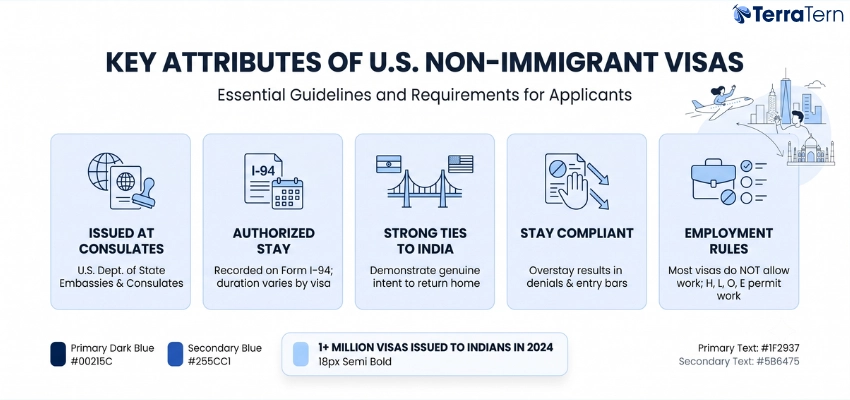
Key attributes of a non-immigrant visa:
-
Issued by the U.S. Department of State at U.S. embassies and consulates.
-
Authorised stay is recorded on Form I-94 (Arrival/Departure Record), not the visa stamp itself.
-
Duration varies from days to several years, depending on the visa category.
-
Core requirement for Indian applicants: Must demonstrate strong ties to India and non-immigrant intent, i.e., genuine intent to return home after the visit.
-
Overstaying the authorised period can result in future visa denials, cancellation, and re-entry bars.
-
Most non-immigrant visas do not authorise employment, although several categories such as H, L, O, E, and TN permit work under specific rules.
-
Working without authorisation carries serious consequences: deportation, visa cancellation, and future inadmissibility.
-
The U.S. Mission to India issued more than one million non-immigrant visas for the second consecutive year in 2024, underscoring the massive volume of Indian applicants navigating this process annually.
What Are the Main Types of Non-Immigrant Visas for Indians?
To fully grasp what is immigrant and non immigrant visa classifications are, Indian applicants need to understand the specific NIV categories available to them. Below is a structured overview of the most relevant categories, along with a 2025 fee update:
|
Visa Type |
Category |
Purpose |
Duration |
Work Authorised? |
|
B-1 |
Tourism & Business |
Conferences, negotiations |
Up to 6 months |
No |
|
B-2 |
Tourism & Business |
Vacation, medical, family |
Up to 6 months |
No |
|
B-1/B-2 |
Tourism & Business |
Combined (most common) |
Up to 6 months |
No |
|
F-1 |
Study & Exchange |
Academic students |
Duration of status |
Limited (CPT/OPT) |
|
M-1 |
Study & Exchange |
Vocational students |
Duration of status |
Limited |
|
J-1 |
Study & Exchange |
Exchange visitors/scholars |
Program duration |
Limited |
|
H-1B |
Work Visas |
Speciality occupation workers |
3 yrs (extendable to 6) |
Yes |
|
L-1A/L-1B |
Work Visas |
Intracompany transferees |
1–3 yrs (extendable) |
Yes (employer only) |
|
O-1 |
Work Visas |
Extraordinary ability |
Up to 3 yrs |
Yes (employer only) |
|
E-1/E-2 |
Other |
Treaty traders/investors |
2 yrs (renewable) |
Yes (limited) |
|
R-1 |
Other |
Religious workers |
Up to 5 yrs |
Yes (employer only) |
Important Note: Indian applicants must be especially careful to demonstrate 'non-immigrant intent' and strong ties to India, such as property ownership, family, employment, or financial assets, because consular officers assess this rigorously before approving any temporary visa.
What Are the Key Differences Between Immigrant and Non-Immigrant Visas?
Understanding what is immigrant and non immigrant visa comes down to one core distinction an immigrant visa is for those intending to live permanently in the U.S., while a non-immigrant visa is for temporary visits with a mandatory return requirement.
|
Attribute |
Immigrant Visa |
Non-Immigrant Visa |
|
Purpose |
Permanent residence |
Temporary stay |
|
Duration |
Indefinite (leads to Green Card) |
Fixed (days to years) |
|
Work Authorisation |
Yes (after Green Card) |
Mostly No (exceptions apply) |
|
Intent Required |
Immigrant intent |
Non-immigrant intent (return home) |
|
Petitioner Required |
Yes (USCIS petition) |
Usually No (self-application) |
|
Medical Exam |
Required |
Not required (usually) |
|
Path to Citizenship |
Yes (via Green Card → Naturalisation) |
No (exceptions: dual-intent visas) |
|
Application Complexity |
High |
Low to Medium |
|
Common Examples |
EB-1, EB-2, EB-3, IR, F-series |
B-1/B-2, F-1, H-1B, L-1, O-1 |
Expert Tip: The single most important question before applying for any U.S. visa is: 'Do I intend to return to India after my visit, or do I want to live in the U.S. permanently?' Your honest answer determines whether you need a non-immigrant or immigrant visa, and choosing incorrectly can result in visa denial or future inadmissibility.
What Is Dual Intent and Can a Non-Immigrant Visa Lead to a Green Card?
One of the most misunderstood aspects of what is immigrant and non immigrant visa law is the concept of dual intent, a legal provision that significantly affects long-term planning for Indian professionals in the U.S.
1. What Is Dual Intent?
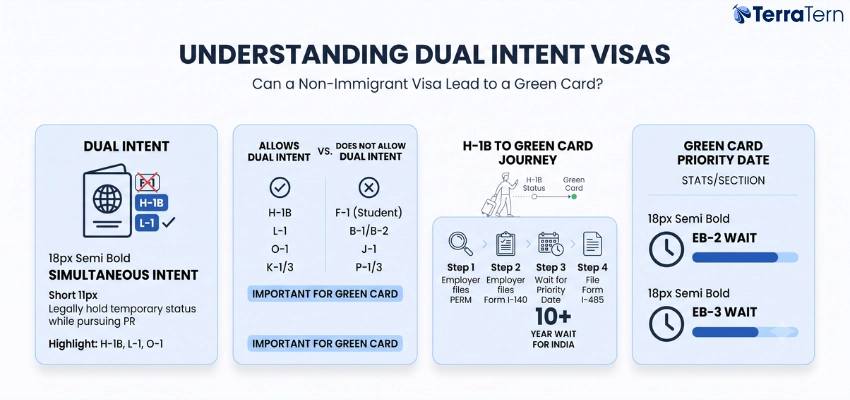
Dual intent refers to the legal concept where a foreign national can hold a temporary (non-immigrant) visa while simultaneously pursuing permanent residency (a Green Card). The Immigration and Nationality Act (INA) recognises this for specific visa categories. Without dual intent protection, a consular officer who suspects you intend to stay permanently can deny your non-immigrant visa application outright.
2. Which Visas Allow Dual Intent?
-
H-1B: Yes, the most common dual-intent visa; Indian professionals can pursue an employment-based Green Card while maintaining H-1B status.
-
L-1: Yes, intracompany transferees may pursue concurrent permanent residence.
-
K-1/K-3: Yes, fiancé(e) and spouse of a U.S. citizen visas are immigration-related by design.
-
E-1/E-2: Generally contested, but involves nuanced analysis.
3. Which Visas Do NOT Allow Dual Intent?
-
F-1 (Student): No applicant must demonstrate intent to return to India after completing their studies.
-
B-1/B-2 (Tourist/Business): No strong non-immigrant intent is required for approval.
-
J-1 (Exchange): No, a two-year home residence requirement often applies before any immigrant visa can be sought.
4. How Does H-1B Lead to a Green Card? (Step-by-Step)
-
Employer files PERM Labour Certification with the U.S. Department of Labour
-
Employer files Form I-140 (Immigrant Petition for Alien Workers) with USCIS
-
Wait for the priority date to become current (can take 10+ years for Indians on EB-2/EB-3 due to per-country caps)
-
File Form I-485 (Adjustment of Status) in the U.S., or apply for an immigrant visa at a U.S. consulate in India
Expert Advice: If you're an Indian professional on an H-1B visa with long-term U.S. residency goals, begin exploring Green Card options as early as possible. Starting PERM Labour Certification within the first 1–2 years of H-1B status can save years of waiting.
Also Read: How Many Types of Visas are in the USA? New Full Expert Guide ...
What Is the Application Process for Immigrant vs Non-Immigrant Visas from India?
Knowing what is immigrant and non immigrant visa is in theory is only half the picture; understanding how each process works for Indian applicants is equally important.
How Do You Apply for a Non-Immigrant Visa from India?
Step-by-step process for a B-1/B-2 non-immigrant visa (the most common NIV for Indian applicants):
-
Determine the correct visa category based on your purpose of travel
-
Complete Form DS-160 (Online Nonimmigrant Visa Application) on travel.state.gov
-
Pay the MRV (Machine-Readable Visa) fee — 2025 Update: Total cost is now approximately INR 40,000 (~$472), including the new $250 Visa Integrity Fee effective October 1, 2025
-
Schedule your visa appointment (OFC biometrics appointment + Consular Interview)
-
The interview waiver (Dropbox) has been significantly restricted as of September 2, 2025. Only applicants renewing full-validity B-1, B-2, or B-1/B-2 visas qualify. Interview waiver eligibility and document-drop locations can change, so applicants should verify the current India-specific rules before booking. Most other applicants must attend in-person interviews.
-
Attend the Visa Application Centre (VAC) for biometrics collection
-
Attend your consular interview, demonstrate non-immigrant intent and strong ties to India
-
Await processing and visa decision
-
Collect your passport with the visa foil affixed.
Key documents required for Indian applicants:
-
Valid Indian passport (with at least 6 months' validity beyond your intended stay)
-
DS-160 confirmation page
-
MRV fee payment receipt
-
Passport-sized photograph as per U.S. visa specifications
-
Supporting documents: bank statements, employment letter, property documents, and evidence of family ties in India
How Do You Apply for an Immigrant Visa from India?
When it comes to what is immigrant and non immigrant visa, immigrant visa applications are considerably more involved than non-immigrant ones. Follow these steps:
-
Petitioner (U.S. citizen, LPR, or employer) files a petition with USCIS Form I-130 for family-based or Form I-140 for employment-based
-
USCIS approves the petition and transfers the case to the National Visa Centre (NVC)
-
NVC processes the case, collects the required fees and documents
-
Applicant waits for the priority date to become current, and checks the State Department Visa Bulletin monthly
-
Schedule an immigrant visa interview at the U.S. Embassy in New Delhi or the U.S. Consulate in Chennai, Hyderabad, Mumbai, or Kolkata
-
Complete the mandatory medical examination with a USCIS-approved panel physician in India
-
Attend the immigrant visa interview at the relevant U.S. mission
-
Receive the immigrant visa (typically valid for 6 months; the applicant must enter the U.S. before it expires)
-
At the U.S. port of entry, the CBP officer reviews documents, and the applicant becomes a Lawful Permanent Resident
-
A Green Card is mailed to the U.S. address within 60–90 days
Important Tip: As of 2025, the Dropbox (interview waiver) facility for Indian applicants has been dramatically curtailed. Most B-1/B-2 applicants must now attend in-person interviews. Book appointments well in advance, as wait times at Indian consulates can extend several months.
What Are the 2025 Policy Changes Affecting Indian Visa Applicants?
A comprehensive understanding of what is immigrant and non immigrant visa in 2025 must account for the sweeping policy changes that directly affect Indian nationals. Staying current on these developments is critical for any Indian applicant. Here is a summary of the most significant updates:
-
Record NIV Issuance (2024): The U.S. Mission to India issued more than 1 million non-immigrant visas for the second consecutive year, including a record number of visitor visas. Indian visitors to the U.S. increased fivefold over four years. (Source: U.S. Embassy India, December 2024)
-
New $250 Visa Integrity Fee (Effective October 1, 2025): A mandatory $250 Visa Integrity Fee now applies to all non-immigrant visa applicants from countries not on the Visa Waiver Program list, including India. A typical B-1/B-2 visa now costs approximately INR 40,000 (~$472) in total. (Source: One Big Beautiful Bill Act, October 2025)
-
Interview Waiver Restrictions (Effective September 2, 2025): Only applicants renewing full-validity B-1, B-2, or B-1/B-2 visas qualify for interview waivers. B-1/B-2 Dropbox appointments consolidated at New Delhi only. Most other applicants must attend in-person consular interviews.
-
H-1B Social Media Vetting (Effective December 15, 2025): Enhanced social media vetting for H-1B and H-4 visa applicants has caused appointment rescheduling at Indian consulates — account for additional processing time.
-
$100,000 H-1B Petition Fee (Effective September 21, 2025): A presidential proclamation introduced a one-time $100,000 fee for new H-1B petitions — significantly impacting Indian IT professionals and their sponsoring employers.
-
EB-2 Per-Country Limit Reached (FY2026): The State Department exhausted all available EB-2 immigrant visas chargeable to India for fiscal year 2026, underscoring continued and severe backlogs for Indian employment-based immigrant visa applicants.
-
Appointment Scheduling Rule (2025): Applicants can schedule their first non-immigrant visa appointment at any location in India, but may reschedule only once.
Pro Tip: Indian applicants planning U.S. travel in 2026 should budget significantly more for visa fees than in previous years and expect longer processing times, both due to the new Visa Integrity Fee and the return of mandatory in-person interviews for most non-immigrant visa categories.
How Does an Immigrant Visa Lead to a Green Card for Indians?
For many Indian nationals, the ultimate goal of understanding what is immigrant and non immigrant visa is to navigate the pathway to permanent residency. An immigrant visa is the gateway to a Green Card (Lawful Permanent Residence). Here's how the sequence works:
-
Receive an approved immigrant visa from a U.S. embassy or consulate in India
-
Enter the United States through a port of entry before the immigrant visa expires (typically 6 months from issuance)
-
CBP officer at the port of entry reviews documents and verifies Lawful Permanent Resident status
-
The Green Card is mailed to the U.S. address within approximately 60–90 days
-
An LPR can apply for U.S. naturalisation (citizenship) after 5 years of continuous residence (3 years if married to a U.S. citizen)
Key distinctions for Indian applicants:
-
Employment-Based (EB-2, EB-3): Indian nationals may face long EB-2 and EB-3 backlogs due to per-country caps, but wait times vary by category and priority date.. The State Department's Visa Bulletin should be monitored monthly.
-
Family-Based IR Category: Immediate relatives of U.S. citizen spouses, unmarried children under 21, and parents are exempt from the annual numerical cap, making this the fastest Green Card route for eligible Indians.
-
EB-5 Investor Visa: A pathway for high-net-worth Indian nationals to bypass the employment-based queue through a minimum $800,000 investment in a targeted employment area, creating at least 10 U.S. jobs.
-
Green Card vs. Immigrant Visa: The immigrant visa enables entry into the U.S.; the Green Card is the physical proof-of-status document mailed separately after arrival.
Key Note: Obtaining an immigrant visa is only the first step; Indian nationals must enter the U.S. before the immigrant visa's expiry (typically 6 months) to activate their Lawful Permanent Resident status, after which their Green Card will be mailed to them.
Also Read: US Immigration: Everything You Should Know Is Here
Which Visa Is Right for You — Immigrant or Non-Immigrant?
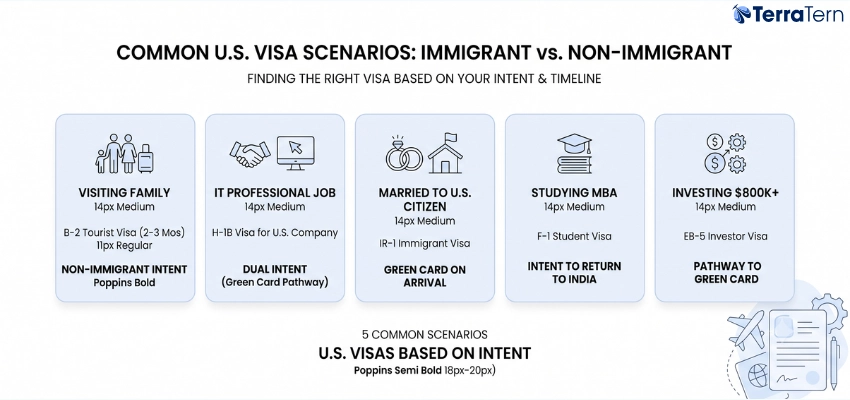
The most practical way to understand what is immigrant and non immigrant visa is in real terms is through scenarios. Whether you're visiting family, starting a job, or investing in a business, the right visa category depends entirely on your intent and timeline. Use the guide below to identify which visa applies to your situation:
-
Scenario 1 — Visiting Family for 2–3 Months: Non-Immigrant Visa (B-2 Tourist Visa). Apply with proof of strong ties to India.
-
Scenario 2 — Working for a U.S. Company as an IT Professional: Non-Immigrant Visa (H-1B Speciality Occupation Visa) — with dual intent option for eventual Green Card pursuit.
-
Scenario 3 — Spouse Is a U.S. Citizen, Relocating Permanently: Immigrant Visa (IR-1 Spouse of U.S. Citizen) → Green Card on arrival at U.S. port of entry.
-
Scenario 4 — Studying an MBA at a U.S. University: Non-Immigrant Visa (F-1 Student Visa) — must demonstrate intent to return to India after graduation. Dual intent NOT permitted.
-
Scenario 5 — Investing $800K+ and Starting a U.S. Business: Immigrant Visa (EB-5 Investor Visa) → Green Card pathway for qualifying investments.
-
Scenario 6 — U.S. Employer Sponsoring Permanent Residency: Begin with Non-Immigrant Visa (H-1B), then pursue Immigrant Visa through PERM Labour Certification / I-140 / Adjustment of Status.
-
Scenario 7 — Medical Treatment in the U.S.: Non-Immigrant Visa (B-2 for medical purposes) with documented evidence of a treatment plan and funding.
As per TerraTern Expert, Shreya, the most common mistake Indian applicants make is applying for a tourist (B-2) visa with the secret intention of staying long-term. This misrepresentation of intent, if detected by a consular officer, can result in a permanent bar from the United States.
What Are Common Mistakes Indian Applicants Make With Immigrant and Non-Immigrant Visas?
Even experienced travellers can misunderstand the nuances of what is immigrant and non immigrant visa requirements. A clear understanding of these common errors could mean the difference between an approved visa and a denial or, worse, a multi-year bar from the United States:
-
Applying for a Tourist Visa With Hidden Immigrant Intent: Consular officers are trained to detect this inconsistency. If you plan to stay permanently, apply for the correct immigrant visa category.
-
Not Demonstrating Ties to India for Non-Immigrant Visas: Failing to provide evidence of property, family, employment, or financial ties in India regularly results in B-1/B-2 denials.
-
Overstaying the Authorised Period: Even one day of overstay can trigger future visa denials. Overstays of 180+ days result in a 3-year re-entry bar; overstays of 1+ year result in a 10-year bar.
-
Confusing Dual-Intent and Non-Dual-Intent Visas: Because an F-1 is not a dual-intent visa, applicants must be careful that any immigrant intent does not conflict with their student status. H-1B and L-1 are the most common dual-intent non-immigrant visas.
-
Not Tracking the Visa Bulletin: For employment-based immigrants, the priority date must be current before filing an Adjustment of Status. Missing this timing causes significant delays.
-
Ignoring the 6-Month Use Requirement: The immigrant visa must be used (U.S. entry made) before it expires, typically within 6 months of issuance. Missing this deadline requires restarting the process.
-
Assuming Dropbox / Interview Waiver Is Still Available: As of September 2025, interview waivers are severely restricted for Indian applicants. Not checking the current policy before scheduling leads to wasted time and missed appointments.
Pro Tip: Overstaying a U.S. non-immigrant visa, even unintentionally, is one of the most serious and long-lasting immigration violations an Indian national can make, often resulting in multi-year bars from re-entry and automatic visa revocation.
Conclusion
Understanding the difference between immigrant and non-immigrant visas is the foundation of any U.S. immigration strategy. The choice between these two visa categories shapes every aspect of your U.S. experience, from your legal status and work authorisation to your path to permanent residency and citizenship. For personalised guidance on your U.S. visa or immigration strategy, consult TerraTern's immigration advisors. Our experts can assess your profile, identify the right visa pathway, and walk you through every step of the process. Visit the TerraTern U.S. Immigration Services page to get started.
Contact TerraTern for more information on what is immigrant and non immigrant visa.




 AI Summary