


Key Highlights
- What are the UK Business Visa Requirements?
- What Exactly Is a UK Business Visa for Indian Citizens?
- What Are the Different Types of UK Business Visas Available for Indians?
- Who Is Eligible for a UK Business Visa from India?
- What Documents Are Required for a UK Business Visa from India?
- How to Apply for a UK Business Visa from India: Step-by-Step Process
- What Are the UK Business Visa Fees from India in 2026?
- How Long Does UK Business Visa Processing Take from India?
- What Are the Most Common UK Business Visa Rejection Reasons for Indians?
- How Does the 2026 UK Business Visa eVisa System Affect Indian Applicants?
- What Is the Impact of the India–UK Free Trade Agreement on Business Visas?
- 2026 Industry Context
- Conclusion
Indian nationals planning business travel to the UK must understand the visa requirements, permitted activities, and documentation standards before applying. The conditions and prerequisites laid down by the UK business visa laws and regulations. Contract negotiations, conferences, and meetings can all be included within the definition of most business activities and can be undertaken with a stay of up to 6 months, which can be granted under a Standard Visitor Visa. This is a comprehensive guide that provides detailed information on the eligibility criteria, the required documents, fees, and the application process for Indian candidates in 2026.
What are the UK Business Visa Requirements?
To satisfy the UK business visa requirements and get the visa, you're required to submit the following:
-
Valid Passport: Must be valid for your whole trip.
-
Financial Proof: Alternative to public funds by provision of funds to finance oneself.
-
Pre-Planning to Leave: Proof of intention to leave the UK before your visa expires.
-
Business Evidence: Invitation letters, meeting itinerary or documentation of other activities allowed under business rules.
-
Key Restriction: No paid employment for a UK-based employer is permitted under this visa.
Also Read: UKImmigration: All You Need to Know
What Exactly Is a UK Business Visa for Indian Citizens?
The business visa for India citizens is known as the Standard Visitor Visa (Business). It will enable Indians to move to the UK for up to six months to engage in legitimate business activity, but not work with a UK company.
-
The Standard Visitor Visa permits business activities but strictly prohibits paid employment for any UK employer, whether in the public or private sector.
-
Key UK business visa requirements & 2026 updates:2026
-
Visas are now issued in digital eVisa format and linked to your passport via a UKVI account.
-
Indian citizens are not allowed to apply for an Electronic Traveller Authorisation (ETA) and must apply for a full visa.
As per TerraTern Expert, Shreya, Many Indian professionals confuse the UK business visa with a work permit; they are fundamentally different. The Standard Visitor Visa permits business activities like meetings and conferences but strictly prohibits employment. Applying under the wrong category is a leading cause of refusal.
What Are the Different Types of UK Business Visas Available for Indians?
There are several UK business visas available for Indian nationals, depending on the purpose of their travel, such as the 6-month Standard Visitor Visa, 10-year long-term multiple-entry visas and specialist visas like Global Business Mobility, which are granted to foreigners for the purpose of transfer within companies.
Standard Visitor Visa (Business) — 6 Months
Standard Visitor Visa (Business) 6 Months:
-
Best for: Occasional business travel and first-time visits.
-
Entry Deadline: 6 months (Can be only one entry or multiple entries)
-
Processing: ~3 weeks standard. Fee: ~INR 16,335 (£135). The maximum permitted time is 6 months per visit.
Long-Term Standard Visitor Visa — 2, 5, or 10 Years
Long-term Standard Visitor Visa 2, 5 or 10 years:
-
Ideal for: Business travellers with regular flights to and from the UK, where they are in regular contact with others.
-
Validity: The attending person is again limited to a maximum of 6 months per person visit.
|
Visa Duration |
2026 Fee (GBP) |
Estimated Fee (INR) |
Value Analysis |
|
2-Year |
£506 |
~INR 61,200 |
Breaks even if you plan 4 or more trips over the two years. |
|
5-Year |
£903 |
~INR 1,09,300 |
Higher upfront cost, but saves biometrics time and money for frequent travellers. |
|
10-Year |
£1,128 |
~INR 1,36,500 |
Best overall value at ~£113/year. Ideal for executives with permanent UK interests. |
Global Business Mobility Visas — For Employer-Sponsored Transfers
The GBMV is issued through the employer-sponsored visa.
-
Global Business Mobility Visa (GBMV): A visa obtained through an employer-sponsored visa.
-
Advantage to: Senior levels of management or specialist working party dispatched to the UK from their employer in India.
-
Sub-routes: The Global Business Mobility visa has five sub-routes: Senior or Specialist Worker, Graduate Trainee, UK Expansion Worker, Service Supplier, and Secondment Worker.
-
Requirements: Must have a valid sponsor licence for the UK branch/client.
-
Duration: The duration's validity depends on the sub-route and the assignment contract, with a maximum of 5 years.
Innovator Founder Visa — For Indian Entrepreneurs Starting a UK Business
Innovator founder visa for Indian entrepreneurs:
-
Ideal for businesses: looking to start up in the UK with a new, viable, and scalable business concept.
-
Requirements: The Innovator Founder Visa requires endorsement from a UK-approved body, which assesses whether the business idea meets four criteria: genuine, innovative, viable, and scalable. A path to ILR is available after 3 years.
-
Advantage: This route offers a direct path to settlement (Indefinite Leave to Remain) in the United Kingdom, which is where this route differs from visas for visiting and moving.
Important Tip: For Indian professionals who visit the UK more than 3 times per year, the 2-year or 5-year multiple-entry visa often pays for itself within the first year and eliminates the stress of repeated applications. Always calculate your anticipated travel frequency before choosing a validity period.
Who Is Eligible for a UK Business Visa from India?
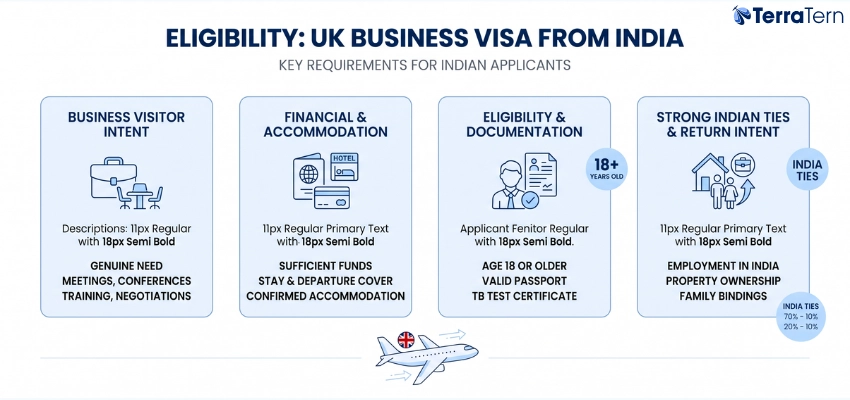
It takes a genuine business need for Indian nationals to travel to the UK by obtaining a visa for business, funds to cover stay and a strong Indian tie-in with a valid passport that either has a blank page or is suitable for the visa.
-
Must be age 18 or older.
-
The passport must be in good condition, have at least 1 page available, and be valid for the full duration of the trip.
-
Express purpose: Meetings, Conferences, Training, Negotiations, trade fairs
-
Accommodation: Provide confirmation of accommodation arrangements for the entire stay, such as hotel bookings or a host's details.
-
Employment, property ownership, and family in India indicate a strong relationship and intent to return to India.
-
No criminal record: They must report any prior visa refusals.
-
Indian applicants must provide a tuberculosis (TB) test certificate from a UKVI-approved clinic in India.
-
Medical insurance: Insurance cover or proof of funds from the medical insurance provider to cover the service.
Note: Must NOT intend to work for the employer in the UK: If they do work in the UK, then for a non-UK employer.
What Business Activities Are Permitted on a UK Business Visa?
Indian nationals with a UKStandard Visitor Visa (Business) can be in the UK for meetings, conferences, trade fairs, and negotiations, but cannot work for or offer paid services to a UK company.
1. Permitted Activities
-
Participating in meetings, conferences, seminars and trade fairs.
-
Finalising deals with UK clients and making contracts with clients in the UK.
-
Receiving intra-company training provided by the UKhost organisation (but not delivering training or expert services to UK clients).
-
Attending job interviews
-
Exploring investment/business opportunities
2. NOT Permitted Activities
-
Working for a business based in the UK.
-
Selling goods or services directly to the public.
-
Providing paid services to UK businesses.
-
Working as a healthcare professional, including a doctor, dentist or registered individual.
-
Getting married/entering a civil partnership (separate visa needed)
Expert Tip: A common trap for Indian professionals: delivering training or expert services to a UK client while on a Standard Visitor Visa is NOT permitted, even if payment comes from India. This can result in cancellation, deportation, and a 10-year ban. If your visit involves service delivery, explore the Permitted Paid Engagement visa or a work route instead.
Also Read: Which Visa is Required for London? Latest Indians Guide
What Documents Are Required for a UK Business Visa from India?
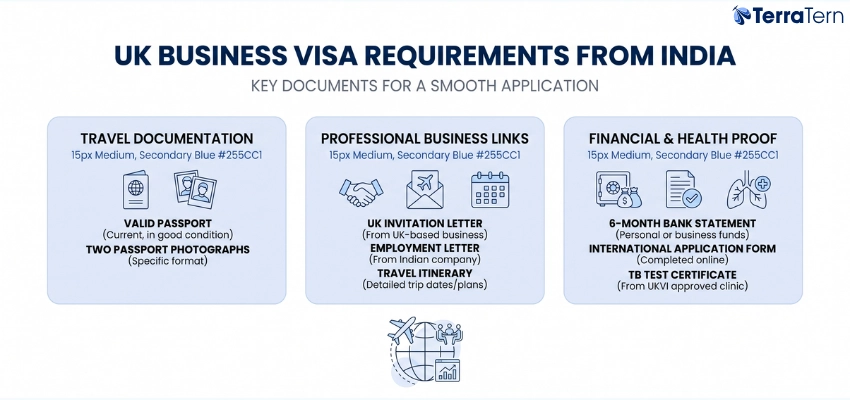
Business visa Requirements for a UK Business Visa from India include the main documents: a valid passport, an International Application Form, two photographs, a Bank Statement (6 months), an Invitation Letter from the business in the UK, an Employment letter, a Travel Itinerary, and a TB Test Certificate. Completing all UK business visa requirements ensures a smoother approval process.
Mandatory Documents for UK Business Visa Application
These are essential UK business visa requirements that cannot be skipped.
-
Valid Passport: Minimum 1 blank page; valid for the entire UK stay duration
-
Online Application Form: Completed via the UKVI portal/Visa4UK
-
Biometric Photograph: Recent passport-sized, meeting UKVI specifications
-
TB Test Certificate: From a UKVI-approved clinic in India (mandatory for Indians)
-
Biometric Data: Collected at the VFS Global visa application centre
Financial and Employment Documents
Financial proof is critical for the approval of the UK business visa requirements.
-
Bank Statements: 6 months' personal accounts (original, showing regular salary credits)
-
Income Tax Returns (ITR): Last 2–3 years
-
Salary Slips: Last 3 months
-
Employer Letter: Confirming employment, role, salary, and approved leave
-
Self-Employed: CA-certified business financials, GST returns, company registration
Travel and Business Purpose Documents
These documents satisfy UK business visa requirements for business purpose verification.
-
Invitation Letter: From a UK organisation on company letterhead with contact details
-
Flight Bookings: Confirmed return tickets or detailed travel itinerary
-
Accommodation: Hotel/accommodation bookings for the entire stay
-
Event Registration: Conference/event confirmations (if attending)
-
UKHost Company Profile: Demonstrating the legitimacy of the business partner
-
Covering Letter: From an Indian employer explaining the purpose, duration, and itinerary
Additional Supporting Documents (Strengthening Your Application)
Including these strengthens UK business visa requirements compliance and improves approval chances.
-
Property Ownership: Documents in India demonstrating strong home country ties
-
Family Dependency: Spouse/children documents strengthening return intent
-
Previous Visa History: Photocopies of past UK/international visas
-
Travel Insurance: Recommended; private medical insurance required for some routes
Expert Advice: The invitation letter is frequently under-prepared. A strong invitation letter should be on official company letterhead, signed by a senior representative, and include: the purpose of the visit, specific dates, a description of business activities, and confirmation that the UK company will not pay the applicant's wages.
How to Apply for a UK Business Visa from India: Step-by-Step Process
To apply for a UK business visa from India, complete the online application on the UKVI portal, pay the fee, book a biometric appointment at a VFS Global centre in India, submit your documents, and wait approximately 3 weeks for a decision.
-
Choose the Right Visa Type: Identify whether the Standard Visitor Visa (Business) or the Global Business Mobility route suits your purpose
-
Gather Documents: Collect all originals and self-attested copies per the UK Business Visa Requirements Checklist
-
Complete Online Application: Create a UKVI account at gov.uk/apply-uk-visa; fill the form accurately, ensuring consistency across all documents
-
Pay Application Fees: Pay online via UKVI portal (Standard/Priority/Super Priority); fees in GBP, INR shown at checkout
-
Book Biometric Appointment: Visit the VFS Global website to book at the nearest centre (Delhi, Mumbai, Chennai, Bengaluru, Hyderabad, Kolkata, Pune, Ahmedabad, Chandigarh, Goa, Jaipur, Kochi)
-
Attend VFS Appointment: Bring confirmation email, passport, printed application, all documents, fingerprints and photograph taken
-
Track Application: Track via the VFS portal using the GWF reference number; status includes "Application Being Assessed" and "Passport Ready"
-
Collect Passport/Access eVisa: Passport returned or eVisa linked digitally; view status via UKVI account
Important Note: Home Office caseworkers are instructed to cross-reference all information across systems before approving any business visa. A single inconsistency between your application form, bank statements, and employer letter can trigger a refusal, even if all other elements are strong. Review every document for alignment before submitting.
What Are the UK Business Visa Fees from India in 2026?
UK business visa fees from India in 2026 range from approximately INR 15,644 for a standard 6-month visa to INR 1,31,136 for a 10-year multiple-entry visa, following a 5–10% fee increase in April 2026. Understanding UK business visa requirements includes budgeting for these fees plus potential priority service add-ons.
|
Visa Type |
Validity |
Fee (GBP) |
Fee (INR approx.) |
Processing Time |
|
Standard Visitor |
6 months |
£135 |
INR 15,644 |
|
|
Long-Term Visitor |
2 years |
£506 |
INR 58,513 |
~3 weeks |
|
Long-Term Visitor |
5 years |
£903 |
INR 1,04,461 |
|
|
Long-Term Visitor |
10 years |
£1,128 |
INR 1,30,453 |
|
|
Priority Service (Add-on) |
— |
£500 |
~INR 61,600 |
~5 working days |
|
Super Priority (Add-on) |
— |
£1,000 |
~INR 1,23,200 |
Next working day |
As per TerraTern Expert: Many Indian applicants choose the cheapest 6-month visa without calculating their likely travel frequency. For a senior executive making quarterly UKvisits, the 2-year multiple-entry visa costs the same as just two 6-month applications, and saves the hassle of reapplying each time.
Also Read: Innovator Founder Visa: UK Startup Path for Entrepreneurs
How Long Does UK Business Visa Processing Take from India?
Standard UK business visa processing from India takes approximately 3 weeks (15 working days) after the biometric appointment. Priority processing reduces this to around 5 working days, while Super Priority offers a decision by the next working day. Understanding UK business visa requirements includes planning for these processing timelines.
|
Processing Type |
Processing Time |
Additional Fee |
Availability |
|
Standard |
~3 weeks (15 working days) post-biometrics |
None |
All VFS centres |
|
Priority |
~5 working days |
£500 (~INR 61,600) |
Selected centres |
|
Super Priority |
Next working day |
£1,000 (~INR 1,23,200) |
Subject to availability |
1. Application Window: Submit up to 3 months before the intended travel date
2. Peak Seasons: Processing takes longer during April–June and October–November
3. Holiday Delays: Indian/UK public holidays can extend processing times
4. VFS Appointment Wait Times:
- Delhi, Mumbai: Typically available within 1–2 weeks
- Smaller Cities: May have longer wait times; book early
Pro Tip: Never book non-refundable flights or hotel accommodation before receiving your UK business visa. Even standard 3-week processing can stretch to 5–6 weeks during peak periods or if the Home Office requests additional documents (a process called "further information request").
What Are the Most Common UK Business Visa Rejection Reasons for Indians?
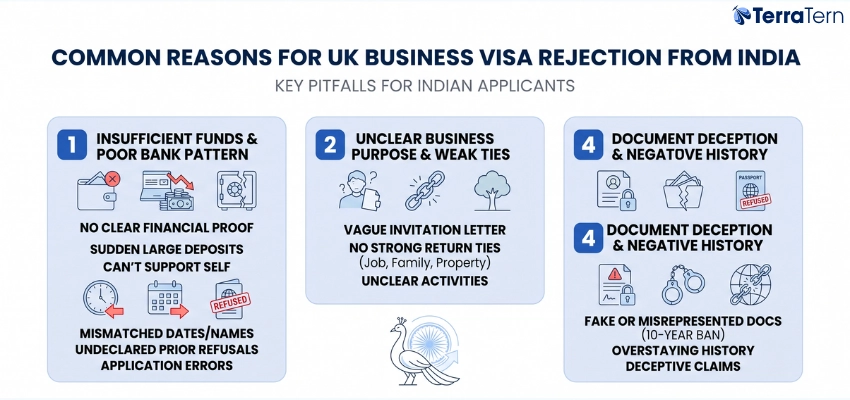
The most common reasons UK business visas are rejected for Indian applicants include insufficient proof of funds, unclear business purpose, weak ties to India, inconsistencies in documents, and failure to demonstrate intention to leave the UK business visa requirement after the visit.
-
Insufficient Funds: No clear evidence that you can support yourself in the UK without working.
-
Weak Ties to India: No strong evidence of reason to return (no stable employment, property, or family).
-
Unclear Business Purpose: Vague or missing invitation letter; no clear explanation of activities.
-
Document Inconsistencies: Dates, names, or financial figures that don't match across documents.
-
Previous Visa Refusals Not Disclosed: Failure to declare prior refusals is treated as deception.
-
Poor Bank Statement Pattern: Sudden large deposits before application ("parking" funds).
-
Overstaying History: Any previous overstays in the UK or another country.
-
Fake or Misrepresented Documents: Results in a 10-year ban and potential criminal action.
-
Application Errors: Mistakes in personal details, travel history, or declaration sections.
How Can Indian Applicants Maximise UK Business Visa Approval Chances?
Indian applicants can maximise their UK business visa approval chances by:
-
Apply Well in Advance: Submit your application 6–8 weeks before your intended travel dates.
-
Understand the Criteria: Thoroughly review the UK business visa requirements to ensure your trip strictly aligns with permitted business activities.
-
Draft a Precise Covering Letter: Prepare a strong covering letter explaining your business purpose, daily itinerary, and goals in detail.
-
Demonstrate Financial Stability: Show 3–6 months of healthy, consistent bank statements without sudden, unexplained deposits.
-
Secure Proper Documentation: Obtain a well-drafted, highly specific invitation letter from your UK host detailing your role and funding for the trip.
-
Consult an Expert: Work with a qualified immigration consultant (OISC-regulated or equivalent) to review your application.
-
Be Completely Transparent: Disclose all prior travel history, minor convictions, and visa refusals.
-
Prove your Home Ties: Include strong evidence of your life in India, such as property deeds, business ownership, or a No Objection Certificate (NOC) from your employer, to prove you will return.
Key Note: "Parking" funds, depositing a large lump sum into your bank account just before applying, is one of the most reliably spotted red flags by UK visa caseworkers. Your account history should show consistent income and regular transactions, not a sudden pre-application top-up.
How Does the 2026 UK Business Visa eVisa System Affect Indian Applicants?
From 27 February 2026, the UK stopped issuing physical visa stickers to Indian citizens. All immigration permission is now issued as a digital eVisa linked to the applicant's passport and UKVI account. Your immigration permission is stored digitally and linked to your passport, accessible via your UKVI online account. For Indian citizens, physical visa vignettes are no longer issued for any route as of 27 February 2026. All permissions are now digital eVisas.
-
What is an eVisa: It is a secure digital record of your immigration status that is directly linked to your passport's biographic data.
-
How Indian applicants Access It: You can view and manage your digital status by logging into your secure UKVI online account.
-
Crossing the UK Border Force: Physical checks are streamlined; when an officer scans your passport, your digital status is instantly confirmed in their system.
-
Sharing eVisa Status: You can easily prove your right to travel, work, or rent to airlines, employers, and landlords by generating a temporary "Share Code" from your UKVI account.
-
Handling eVisa Errors: If you find any discrepancies or errors in your digital immigration record, you must contact UKVI directly to have them corrected.
-
ETA vs eVisa: To meet UK business visa requirements, Indian citizens must apply for a full Standard Visitor Visa (issued as an eVisa), as they are not eligible to travel on an ETA (Electronic Travel Authorisation).
Pro Tip: Always create your UKVI account using a permanent email address you will retain access to. Your eVisa status, which serves as your proof of immigration permission in the UK, is tied to this account. Losing access to the email can create complications at the border or when renting property in the UK.
Also Read: Navigating UK Work Visa: Here is All the Info About it
What Is the Impact of the India–UK Free Trade Agreement on Business Visas?
The India–UKFree Trade Agreement (FTA), finalised in 2026, includes provisions that enhance mobility for Indian business visitors and investors, simplifying certain entry conditions and creating new pathways for professionals and entrepreneurs.
-
Historic Context: The India-UKFTA, signed in 2026, represents the most significant bilateral trade deal for Indian businesses in recent years, significantly reshaping the landscape of corporate mobility.
-
Business Mobility Provisions: The agreement establishes easier entry pathways specifically tailored for senior managers, specialists, and investors transferring between the two nations.
-
Social Security Exemption: The FTA introduces a Double Contribution Convention, providing a crucial social security exemption for certain Indian workers on temporary corporate assignments in the UK, preventing dual taxation on pensions.
-
Increased Mobility Rights: Indian business visitors benefit from increased mobility rights and a streamlined framework for temporary stays when conducting corporate activities.
-
What the FTA Does NOT Change: Despite the new mobility provisions, Indian citizens must still meet all standard UK business visa requirements and obtain a Standard Visitor Visa before travelling; the Electronic Travel Authorisation (ETA) system remains not applicable to Indian passport holders.
-
Strategic Guidance: TerraTern is actively helping Indian businesses and Bangalore-based professionals navigate these new post-FTA business travel regulations, ensuring fully compliant and optimised visa applications under the 2026 rules.
Key Note: The India-UKFTA is still being operationalised, the broad provisions are in place, but specific implementation details for visa categories may evolve through 2026. Indian professionals planning long-term UK business strategies should monitor UKVI updates and consult a qualified immigration adviser for the latest position.
2026 Industry Context
Key facts and industry facts:
-
Fee Update (April 2026): Most UK visa fees rose by 5–10% in April 2026; Standard Visitor Visa (6-month) now £135 for Indian applicants (Source: GOV.UK, April 2026)
-
eVisa Transition: As of 2026, UK immigration permission is issued as an eVisa linked to the passport, replacing physical Biometric Residence Permits (Source: UKVI, 2026)
-
ETA Note: The UKElectronic Travel Authorisation (ETA) does NOT apply to Indian citizens; a full Standard Visitor Visa remains mandatory (Source: UKVI, 2026)
-
India-UKFTA: The new India–UKFree Trade Agreement (signed 2025) includes enhanced mobility provisions for business visitors and investors, potentially easing some routes (Source: UKGovt / Indian MEA, 2026)
-
Processing Baseline: Standard processing from outside the UK is approx. 3 weeks post-biometrics; priority and super-priority services available for faster turnaround (Source: GOV.UK)
-
TB Test Requirement: Indian applicants must provide tuberculosis (TB) test results from an approved clinic as part of their application (Source: UKVI)
-
Visa Centre Network: VFS Global operates UK visa application centres across India's major cities, including Delhi, Mumbai, Chennai, Bengaluru, Hyderabad, Kolkata, and Pune
Conclusion
Navigating the 2026 UKeVisa transition is crucial for smooth corporate travel. Under the updated UK business visa requirements, Indian applicants must establish a secure UKVI online account to manage their digital immigration status. Ensure all passport details match your digital record perfectly before booking travel, as physical visa stickers are obsolete. Ultimately, staying proactive with your digital profile guarantees seamless border crossings for all your future UK corporate ventures.
Contact TerraTern for more information on UK Business Visa Requirements: Complete Guide for Indians.




 AI Summary