Key Highlights
- What is the Teacher Job Qualification in Germany?
- What Are the Core Teacher Job Qualifications Required in Germany?
- What German Language Proficiency Do You Need to Teach in Germany?
- How Does the Anerkennung Process Work for Indian Teachers in Germany?
- What Are the Different Types of Teaching Jobs in Germany for Indian Teachers?
- What Is the Process for Getting a Teacher Job in Germany from India?
- What Visa Does an Indian Teacher Need to Work in Germany?
- What Is the Teacher Salary in Germany for Indian Teachers?
- What Subjects Are Most In-Demand for Teacher Jobs in Germany?
- What Are the Challenges of Getting a Teacher Job Qualification in Germany?
- 2026 Industry Context Section
- Conclusion
What is the Teacher Job Qualification in Germany?
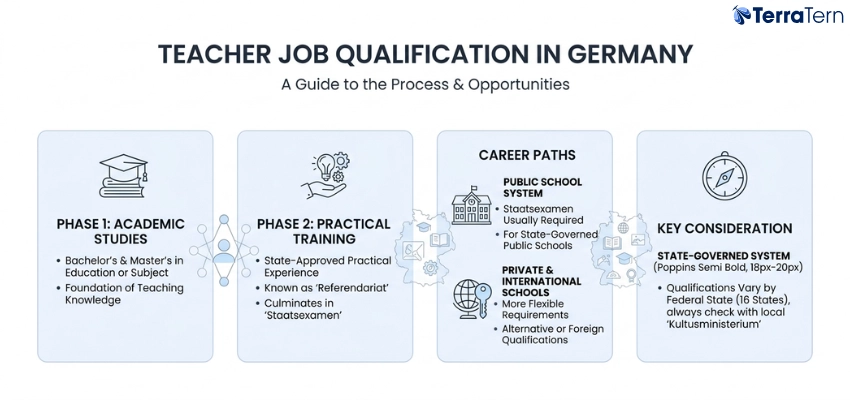
Germany is a country with 16 federal states, which have their own system of Teacher Job Qualification in Germany.
-
There are two phases to the core model: academic studies (typically Bachelor's and Master's in education or subject), and state-approved practical training.
-
The Referendariat is the training period, which culminates in the Staatsexamen, needed for most jobs in the public school system.
-
Private and international schools are more flexible and might consider other qualifications or foreign qualifications.
-
Many language and international schools offer courses that include language/TEFL certificates and practical experience, a path that is not the Staatsexamen path.
As per TerraTern Expert, Shreya, Germany's education system is state-governed, meaning qualification requirements can vary significantly between Berlin and Bavaria. Always check the specific Kultusministerium of the state where you plan to teach.
Also Read: Teacher Job Qualification in Germany: Latest Experts Guide
What Are the Core Teacher Job Qualifications Required in Germany?
The basic requirements for a Teacher Job Qualification in Germany are a suitable Bachelor or Master's degree in education or the subject taught, a state-recognised teaching qualification (usually achieved by taking Staatsexamen at public schools), a state of German language skills at B2–C1 level, and a formal endorsement of foreign degrees by the Anerkennung (credential evaluation) process.
What Degree Do You Need to Teach in Germany?
For teacher job qualification in Germany, Bachelor's degree is typically required for the language schools and many international schools, as well as for most secondary and public school jobs in Germany, and a Master's or equivalent is expected in most private schools.
|
Degree Level |
Typical School Type / Role |
Eligibility |
|
Bachelor’s in Education / Subject |
Language schools, some international/private schools |
Entry-level teaching, often without Staatsexamen |
|
Master’s / M.Ed. |
Public secondary schools, and many international schools |
Standard route with Referendariat + Staatsexamen |
|
PhD (subject or education) |
Universities, research institutes |
Academic careers and higher education teaching |
Important Note: Indian teachers with a B.Ed. + Bachelor's subject degrees are often assessed as equivalent to German requirements, but this is never automatic and must be formally confirmed by the relevant state authority.
Do You Need the Staatsexamen to Teach in Germany?
The teacher job qualification in Germany is mandatory and undertaken under the name of Staatsexamen at public schools (First and Second State Exam).
-
It comes after 1.5-2 years of Referendariat (a paid school internship with supervised lessons and seminars).
-
Applicability: compulsory for public/state schools, but typically not for international schools, many private schools, or language academies.
-
For Indian teachers, the Referendariat is available once their degrees are recognised, and most enter Germany through international or language schools.
Expert Advice: Unless you plan to teach at a German public school, the Staatsexamen is not your immediate concern. Most Indian teachers enter Germany through international schools, which do not require the Staatsexamen.
What Certifications Are Needed for English Teaching Jobs in Germany?
A TEFL, TESOL or CELTA plus a Bachelor's degree typically fulfils the basic Teacher Job Qualification in Germany for language academies and some international schools that hire English teachers.
-
TEFL/TESOL: widely accepted for entry positions in the German market and private schools.
-
Cambridge CELTA is a widely recognised and sought-after course by reputable schools and larger chains.
-
Typically, international schools look for strong grades in addition to recognised qualifications, and native or near-native English proficiency is desirable to enhance the Teacher Job
Expert Tip: CELTA (Cambridge Certificate in English Language Teaching to Adults) carries the highest brand recognition among German language schools — if choosing between TEFL/TESOL/CELTA, CELTA is the strategic investment.
What German Language Proficiency Do You Need to Teach in Germany?
Public school teacher job qualification in Germany normally require C1-level German, proven through exams like TestDaF, DSH, Goethe-Zertifikat C1, or telc Deutsch C1. International and private schools often accept B2–C1 German, while English-focused language academies mainly expect high English fluency plus basic German, making them a common starting point for Indian teachers.
|
CEFR Level |
Typical School Type / Use |
Common Accepted Tests |
|
B2 |
Entry roles in private/international schools; support roles; first step for many Indian teachers |
Goethe-Zertifikat B2, telc Deutsch B2 |
|
C1 |
Public schools (mandatory), most stable teaching posts in Germany |
TestDaF (C1 scores), DSH, Goethe-Zertifikat C1, telc C1 |
|
C2 |
Highly competitive roles, academic/leadership positions, and advanced teaching |
Goethe-Zertifikat C2, telc Deutsch C2 |
Important Tip: C1 German is a multi-year commitment — start your German language journey (B1 → B2 → C1) at least 2–3 years before your planned move to Germany to keep qualification timelines on track.
How Does the Anerkennung Process Work for Indian Teachers in Germany?
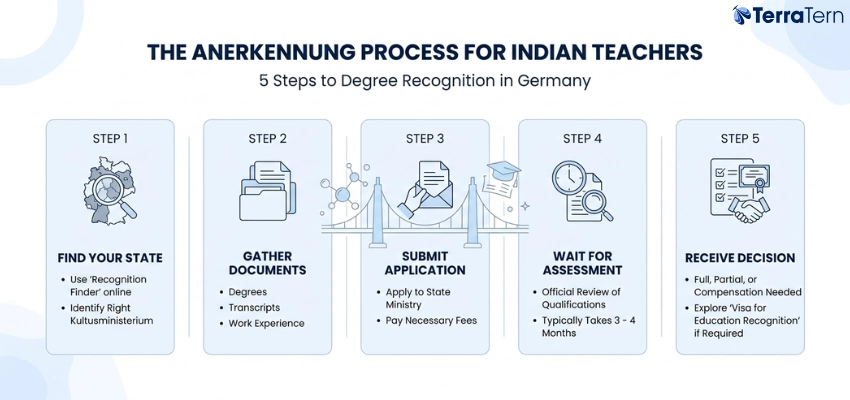
The Anerkennung process officially checks if your Indian teaching degree matches German standards, and it is mandatory because teaching is a regulated profession under the Teacher Job Qualification in Germany.
-
The responsible authority is the Kultusministerium (Ministry of Education) of the German federal state where you want to work.
-
Typical 5-step Anerkennung pathway for Indian teachers under
-
Use the online “Recognition Finder” to identify the right state authority.
-
Collect all required documents (degrees, transcripts, experience, translations).
-
Submit your application to the relevant Kultusministerium.
-
Wait for assessment, usually around 3–4 months.
-
Receive a decision: full recognition, partial recognition, or recognition with compensation measures.
-
-
If you receive only partial recognition, Germany may require “compensation measures,” such as an adaptation period or an exam, before the full is granted.
-
The Germany Visa for Education Recognition (often called 17a/16d visa) lets you enter Germany to complete bridging or adaptation measures related to your Anerkennung.
What Documents Do Indian Teachers Need for Anerkennung?
University degree certificates (subject degree + B.Ed. or M.Ed.), attested and translated into German, form the core of your Teacher Job Qualification in Germany.
-
Detailed academic transcripts or mark sheets for all semesters.
-
Teaching licence/B.Ed. certificate, properly attested.
-
Work experience certificates that show your teaching history and roles.
-
Valid passport copy for identity verification.
-
A German language proficiency certificate (if available) strengthens your profile.
-
Proof of intended work or target state in Germany (for example, a contact address or planned region).
-
Certified German translations of all non-German documents by sworn translators.
What Happens If Your Qualification Receives Only Partial Recognition?
Partial recognition means assessors found “substantial differences” between your Indian qualification and the German reference qualification for Teacher Job Qualification in Germany.
-
You are usually given two compensation options:
-
An adaptation period (supervised practical work or additional study in Germany).
-
A knowledge/aptitude exam focused on the missing subject or pedagogy content.
-
-
To complete these measures, many Indian teachers use the Germany Visa for Education Recognition (17a visa), which allows them to stay in Germany, participate in bridging programmes, and typically work part-time (up to 20 hours per week) while building a full Teacher Job.
As per TerraTern Expert: Partial recognition is not a rejection; it's a stepping stone. Germany's system is designed to help skilled teachers bridge gaps, and TerraTern's visa specialists can guide you through the compensation measure pathway.
Also Read: Teaching Jobs in Germany for Indians New Guide
What Are the Different Types of Teaching Jobs in Germany for Indian Teachers?
Indian teachers can build a Teacher Job Qualification in Germany profile for roles in public schools (Grundschule, Gymnasium), private schools, international schools, language academies, vocational schools (Berufsschule), and special education schools (Sonderschule), each with different requirements, language levels, and recognition expectations, offering multiple entry routes depending on your degree, German level, and experience.
What Qualifications Are Needed for Public School Teaching in Germany?
The full Staatsexamen route is central to Teacher Job Qualification in Germany for public schools.
-
C1 German proficiency is mandatory for classroom teaching and official duties.
-
This is the hardest pathway for Indian teachers but offers the highest salary and long-term job security.
-
Formal recognition (Anerkennung) by the state Kultusministerium is essential for public schools.
What Are the Requirements for International School Teaching in Germany?
Schools follow international curricula (IB, British, American), and this shapes Teacher Job Qualification in Germany for these roles.
-
Require an internationally recognised teaching qualification (e.g., B.Ed., PGCE) and often accept TEFL/TESOL/CELTA for English roles.
-
Strong English proficiency is the primary requirement; B2 German is often acceptable, but not always mandatory.
-
More accessible for Indian teachers, with typical salaries around €30,000–€60,000 depending on city and experience, fitting well into the pathway.
What Qualifications Do Language Academy Teachers Need in Germany?
Core Teacher Job Qualification in Germany for language academies: TEFL, TESOL, or CELTA plus a Bachelor’s degree.
-
Require high fluency in the taught language (often English) rather than full German proficiency.
-
This is usually the least barrier-heavy entry point for Indian teachers and a good first step in the journey.
-
Many roles are part-time or freelance, allowing flexible work while improving German and pursuing Anerkennung.
What Are the Requirements for Vocational and Special Education Teaching?
Berufsschullehrer (vocational teachers) need strong subject expertise, teacher training, and often the Staatsexamen for full Teacher Job Qualification in Germany.
-
Sonderschullehrer (special education teachers) require specialised training in inclusive/special education and are in particularly high demand.
-
Both vocational and special education roles combine higher qualification barriers with strong long-term prospects in the framework.
Pro Tip: International schools are the fastest and most realistic entry point for Indian teachers, build your German language skills while working there to eventually transition into higher-paying public school positions.
What Is the Process for Getting a Teacher Job in Germany from India?
The process involves six clear steps to move from India to a teaching job in Germany.
-
Meet educational qualifications. Secure a Bachelor’s/Master’s in education or your subject; get TEFL/TESOL/CELTA for language schools.
-
Attain German language proficiency. Aim B2 for international/language schools, C1 for public schools; take TestDaF, DSH, or Goethe‑Zertifikat.
-
Initiate Anerkennung (qualification recognition). Use anerkennung-in-deutschland.de to submit documents to the relevant Kultusministerium.
-
Search for teaching positions. Use LinkedIn, Tes.com, school websites, and embassy job boards; contact international schools directly.
-
Secure job offer & gather visa docs. Get an employment contract from a recognised German school and prepare the required paperwork.
-
Apply for the correct visa. Options: Work Visa (Arbeitsvisum) 8–12 weeks, €75; EU Blue Card (Master’s + salary ≥ €43,759.80); Job Seeker Visa (6 months) to find roles.
Key Note: The Anerkennung should be initiated before you secure a job offer; many German schools require proof of recognised qualifications as part of the application, not just after hiring.
What Visa Does an Indian Teacher Need to Work in Germany?
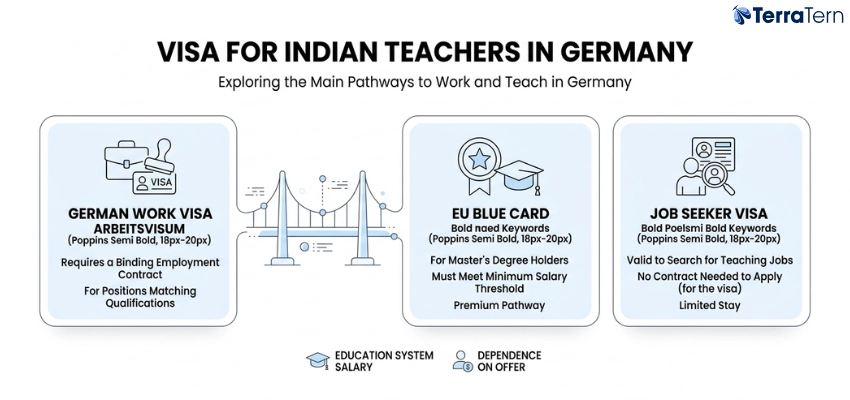
Indian teachers typically require either a German Work Visa (Arbeitsvisum), an EU Blue Card (for Master's holders with qualifying salary offers), or a Job Seeker Visa to search for teaching positions in Germany. The right choice depends on your qualifications, whether you already have a binding employment contract, and your proposed salary level within the German education system.
How Do You Apply for a German Work Visa as a Teacher?
You must apply in person at a German Consulate in India, located in Mumbai, Delhi, Chennai, Kolkata, Hyderabad, or Bangalore. Ensure all your translated certificates and formal documentation are complete before your visa appointment to avoid unnecessary processing delays.
|
Factor |
Details |
|
Requirements |
Recognised qualifications (Anerkennung) and a valid job offer |
|
Language |
B2 German (mandatory for public schools) |
|
Processing Time |
8–12 weeks |
|
Cost |
€75 |
Is the EU Blue Card an Option for Indian Teachers in Germany?
Yes. This premium permit is the best option for highly qualified teachers taking on senior roles or specialist subjects. Because teaching is officially classified as a shortage occupation, educators benefit from a lowered minimum salary threshold.
|
Factor |
Details |
|
Requirements |
Master's degree |
|
Salary Threshold |
Minimum €43,759.80 |
|
Primary Benefit |
Faster permanent residency (21 months with B1 German; 33 months otherwise) |
|
Cost |
€140 |
What Is the Germany Job Seeker Visa for Teachers?
This permit is valid for 6 months to explore the job market before committing. No work is allowed—it is for interviews only. It is a good strategy for teachers who haven't secured a job offer yet, as it can easily convert to a Work Visa once hired.
|
Type |
Requirements |
Processing Time |
Cost |
Best For |
|
Work Visa |
Recognised degree, valid job offer, B2 German |
8–12 weeks |
€75 |
Teachers with a confirmed job offer |
|
EU Blue Card |
Master's degree, minimum salary €43,759.80 |
8–12 weeks |
€140 |
Senior roles or specialist subjects |
|
Job Seeker |
Degree, sufficient funds for 6 months |
4–8 weeks |
€75 |
Teachers without a secure job offer |
As per TerraTern Expert, Divyansh, if you hold a Master's degree in education, the EU Blue Card is worth pursuing over a standard work visa. Its lower salary threshold for shortage occupations (including teachers) and faster route to permanent residency make it a superior long-term immigration strategy.
Also Read: German Teacher Jobs: Experts' Latest Research Insights
What Is the Teacher Salary in Germany for Indian Teachers?
Teacher salaries in Germany range from €30,000 to €65,000 per year, depending on the school type, state, subject, and your experience level. Public school teachers typically earn the most, with starting salaries averaging between €45,000 and €55,000 annually.
|
Role Type |
Entry-Level |
Mid-Career |
Senior |
|
Public School Teacher |
€45,000 |
€55,000 |
€65,000 |
|
International School Teacher |
€30,000 |
€45,000 |
€60,000 |
|
Special Education Teacher |
€40,000 |
€50,000 |
€60,000 |
|
Vocational Teacher |
€40,000 |
€48,000 |
€55,000 |
|
Language Academy Teacher |
€25,000 |
€32,000 |
€40,000 |
Important Note: A public school teacher in Germany can earn 3–5x the equivalent Indian salary, plus access to world-class social benefits, making Germany one of the highest-value teaching destinations globally for Indian educators.
What Subjects Are Most In-Demand for Teacher Jobs in Germany?
Germany has the highest demand for teachers in STEM subjects (Science, Technology, Engineering, Mathematics), the English language, special education, and foreign languages, making Indian educators with these specialisations highly sought after.
-
STEM Subjects: There is a critical, ongoing shortage across all German states.
-
English Language: Over 40,000 open positions exist, largely within international schools and private language academies.
-
Special Education (Sonderpädagogik): The country is experiencing a severe national shortage.
-
Foreign Languages: Schools are actively recruiting for French, Spanish, Arabic, and increasingly Mandarin.
-
Vocational/Technical Education: There is a rapidly growing demand directly tied to supporting Germany's robust industrial base.
-
The Indian Advantage: Indian educators with a strong science or math background have a natural advantage in the hiring process, provided their Teacher Job Qualification in Germany is fully recognised.
Pro Tip: If you're a science or mathematics teacher from India, you're entering Germany's most critical shortage area. Your subject expertise, combined with recognised qualifications, puts you at the top of the hiring queue.
What Are the Challenges of Getting a Teacher Job Qualification in Germany?
While the opportunities are vast, navigating the system to secure your Teacher Job Qualification in Germany comes with specific hurdles that require careful planning and patience.
-
The Language Barrier: Public schools strictly require C1 (and sometimes C2) proficiency in German. If you are starting from scratch, reaching this fluency level is typically a 3- to 5-year journey.
-
Anerkennung Complexity: The formal recognition of foreign credentials (Anerkennung) is heavily decentralised. Because education is managed at the state level, the documentation burden and equivalence requirements vary significantly depending on where you apply.
-
Referendariat Requirements: For public school roles, even a recognised foreign degree often necessitates a Referendariat—an additional 1.5 to 2 years of mandatory, supervised practical training within the German school system.
-
Cultural Adjustment: Indian educators must adapt to distinct German classroom dynamics, different pedagogical approaches, and highly direct norms of parent communication.
-
Legal and Administrative Navigation: Moving to Germany requires managing a web of bureaucracy, including securing work permits, setting up mandatory health insurance, and completing your local residency registration (Anmeldung).
-
Targeted Competition: While Germany's overarching teacher shortage makes finding a job easier, securing the most stable, lucrative permanent positions in the public school system remains highly competitive.
Key Note: Every challenge in the German teacher qualification process has a structured solution, from language learning pathways to compensation measures and visas. The key is to start early and plan systematically.
Also Read: English Teaching Jobs in Germany For Indians Update
2026 Industry Context Section
Key Facts for Writers to Expand:
-
Teacher Shortage (2026): Germany is projected to have a shortage of 68,000–110,000 teaching positions by 2026–27, particularly in STEM and language subjects. (Source: GetGIS, 2026)
-
Active Recruitment from India: Germany's schools are actively recruiting from India, with 40,000+ open teaching positions for English and STEM subjects as of 2026. (Source: VisaBabu, 2026)
-
Salary Range: Teacher salaries in Germany range from €30,000 to €65,000 annually, with starting salaries for public school teachers averaging €45,000–€55,000. (Source: Expatova, Terratern)
-
EU Blue Card Threshold (2026): Highly qualified teachers with a master's degree may qualify for the EU Blue Card at a minimum salary of €50,700 (standard) or €45,934.20 (shortage occupations, which includes teachers). (Source: Terratern Germany Work Visa page)
-
Anerkennung Processing Time: Foreign teaching qualification assessments are typically completed within 3–4 months of full document submission. (Source: Make-it-in-Germany)
-
Work Visa Timeline: German work visa (Arbeitsvisum) for teachers takes 8–12 weeks, costing €75. (Source: GetGIS)
-
India Connection: Teaching is now classified as a shortage occupation in Germany, meaning Indian teachers benefit from a lower EU Blue Card salary threshold of €43,759.80. (Source: Terratern)
Conclusion
Securing a teaching career in Germany offers immense professional and financial growth for qualified Indian educators, provided you navigate the strict qualification recognition and language hurdles. While public schools demand near-native fluency, international institutions offer a smoother initial entry point. By choosing the right visa path, focusing on in-demand STEM or English subjects, and preparing for the administration, you can successfully transition into Germany’s highly rewarding and stable education system.
To learn more about teacher job qualifications in Germany and find ways to settle in Germany, you must contact TerraTern. With an expert team and more than a hundred services, TerraTern is a leading player in immigration-related services!




 AI Summary