



Key Highlights
- What Is a Study Permit Extension in Canada?
- Who Needs to Apply for a Canada Study Permit Extension?
- When Should You Apply for Your Study Permit Extension?
- What Documents Do You Need for a Study Permit Extension?
- Do You Need a Provincial Attestation Letter (PAL) for Your Study Permit Extension?
- How Do You Apply for a Study Permit Extension Online?
- How Much Does a Study Permit Extension Cost in Canada?
- How Long Does a Study Permit Extension Take in 2026?
- What Is Maintained Status and How Does It Protect You?
- Can You Travel Outside Canada While Your Extension Is Processing?
- What Happens If You Change Your College or University (DLI)?
- What If Your Study Permit Expires Before You Apply for an Extension?
- What Are the Most Common Reasons Study Permit Extensions Get Refused?
- How Can TerraTern Help With Your Study Permit Extension?
- 2025–2026 Industry Context Section
- Conclusion
For international students in 2026, the study permit extension Canada (PRC) process is essential to stand out from the competition and secure a residency visa. The frequent changes in processing instructions, provincial attestation letters (PALs/TALs) and caps necessitate a good grasp of the rules and when and how to apply for your study permit extension in Canada to avoid last-minute chaos, refusal and costly restoration applications.
What Is a Study Permit Extension in Canada?

A study permit extension Canada is a legal extension of your period of study in this country after the expiry of your study permit.
-
Permission to enter vs Visa: Remember that a study permit is NOT a visa; it gives you temporary resident status and the legal right to study. It's not a Canadian re-entry or entry visa. If your Temporary Residence Visa (TRV) or Electronic Travel Authorisation (eTA) is also expiring, then you will have to apply for that visa extension separately after receiving your extension to travel to Canada.
-
If Immigration, Refugees and Citizenship Canada (IRCC) accepts your application, they do not change or alter your current application documents. Rather, they create a brand-new document with a completely different permit number and a newer expiration date.
As per TerraTern Expert Divyansh, don't confuse a study permit with a visa. Your permit lets you study, while a separate TRV/eTA lets you travel; extending one doesn't automatically extend the other.
Also Read: SX-1 Visa Canada: Experts' Guide to Short-Term Study
Who Needs to Apply for a Canada Study Permit Extension?
To apply for a study permit extension Canada:
-
You need a study permit extension if you are already in Canada as an international student and your current study permit expires before your program’s new end date.
-
Maintained Status Candidates: If you submit your extension application before your current permit expires and remain in Canada, you benefit from “maintained status” (formerly “implied status”), which lets you legally continue your studies under your existing conditions while IRCC reviews your file.
-
Eligibility: You must be at a Designated Learning Institution (DLI) on a full-time basis and in good academic standing.
-
If your passport expires sooner than the requested end date of your new permit, IRCC will only extend your study permit until the passport’s expiry. For example, if your passport expires in 10 months, your extension will usually be limited to those 10 months, even if your program continues longer. Always renew an expiring passport before filing your extension, regardless of the length of time it takes you to complete your degree. Always renew an expiring passport before filing your extension.
Important Note: Your new study permit cannot be issued after your passport's expiry date. Renew your passport first if it's close to expiring.
When Should You Apply for Your Study Permit Extension?
Timing is crucial when you apply for a study permit extension while still in school. IRCC sets a legal minimum, but in practice, 2026 processing realities mean you should plan a much wider, strategic application window..
|
Timing Category |
Application Window |
Strategic Impact & Context |
|
Legal Minimum |
30 Days Before Expiry |
The baseline cutoff to comfortably trigger maintained status before your document lapses. However, the exact submission deadline is calculated in Coordinated Universal Time (UTC), not local Canadian time zones. Missing this by even a minute pushes you into an illegal status lapse. |
|
Recommended Window |
3–6 Months Before Expiry |
The safe zone designed to buffer against peak-season backlogs (typically May through August, when initial and extension volumes surge) and any unexpected IRCC document requests. |
Expert Tip: IRCC measures your deadline in UTC, not your local Canadian time zone. Submitting "the night before" your expiry can mean you're already late.
What Documents Do You Need for a Study Permit Extension?
Core documents for a study permit extension Canada include a valid passport, your current study permit, a Letter of Enrolment or updated Letter of Acceptance, proof of funds, and, for most undergraduate and diploma students, a provincial attestation letter (PAL) or proof of PAL exemption.
|
Document |
Why It's Needed |
Common Mistake |
|
Valid Passport |
Establishes identity and legal entry. Must include the bio-data page and every page with entry stamps, visas, or markings. |
The Expiry Blindspot: Uploading a passport expiring soon. IRCC cannot extend a study permit past your passport's expiration date. |
|
Current Study Permit |
Prove your legal status inside Canada at the exact time of application. |
Applying Late: Filing after the printed date voids the maintained status and requires an expensive restoration process. |
|
Letter of Enrolment / Updated LOA |
Issued by your Designated Learning Institution (DLI) to verify you are currently registered full-time or have been accepted into a new sequential program. |
Outdated Letters: Using a standard enrollment letter that doesn't clearly state your expected new graduation date. |
|
Proof of Funds |
Demonstrates that you can support yourself without unauthorised work. You must match the updated 2026 cost-of-living baseline. |
Using Outdated Financial Benchmarks: Showing the old thresholds. For a single applicant outside Quebec, you must prove you hold CAD 22,895 per year in liquid funds (plus tuition and travel). |
|
Official Academic Transcripts |
Proves you are making continuous, satisfactory progress toward completing your credential. |
Omitting Recent Terms: Missing the most recent semester's grades, which causes officers to question your compliance as a student. |
|
Letter of Explanation (Optional) |
A self-written letter clarifying non-standard timelines, gaps in study, or shifts in your academic path. |
Skipping Needed Context: Leaving unexplained program switches or part-time semesters to an officer's imagination. |
Expert Advice: A clean, well-organised Letter of Explanation for any irregularity (program change, academic break, late filing) resolves more borderline cases than any other single document.
Also Read: Breaking: Work Permit Holders Can Now Study in Canada Without a Study Permit
Do You Need a Provincial Attestation Letter (PAL) for Your Study Permit Extension?
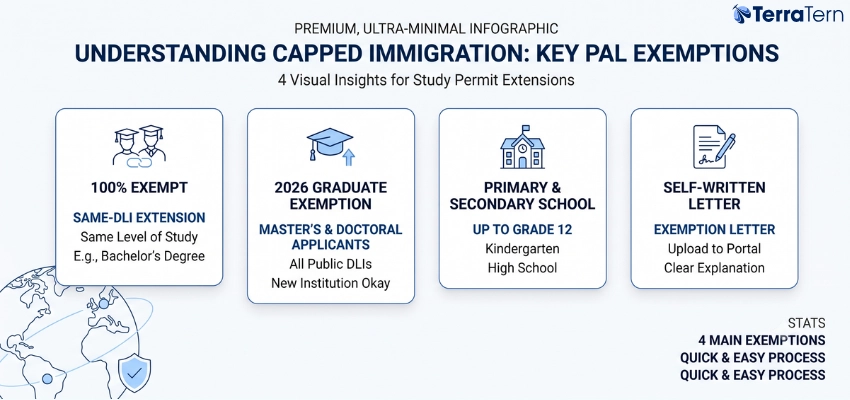
Navigating the capped immigration landscape means understanding exactly where you fit in the attestation system. The good news is that most students pursuing a standard study permit extension Canada are completely insulated from this requirement.
-
The Same-DLI Exemption: If you are extending your stay to continue your education at the same institution and at the same level of study (e.g., finishing a Bachelor's degree at your current university), you are 100% exempt from the PAL requirement.
Simon Fraser University -
The 2026 Graduate Student Exemption: Under the current 2026 ministerial instructions, all Master’s and Doctoral degree applicants at public DLIs are fully exempt from the PAL requirement. This applies even if you are moving to a brand-new institution to start your graduate program.
Scholaro -
School-Level Exemptions: You do not need a PAL if you are extending your studies at a Canadian primary school, kindergarten, or secondary school (up to grade 12).
IRCC.com -
Self-Written Exemption Letter: When filling out your online portal, you do not need an official document from your school to prove you don't need a PAL. Instead, you simply upload a short, clear Letter of Explanation stating exactly which exemption criteria you meet.
Important Tip: If you're unsure whether you qualify for a PAL exemption, write the self-declaration letter anyway and attach your current study permit as proof a missing exemption letter is a common, avoidable trigger for refusal.
How Do You Apply for a Study Permit Extension Online?
To submit your study permit extension Canada successfully, you must use the correct digital pathway and format your files precisely according to IRCC's system constraints.
-
Log in to the Secure Account: Create or sign in to your IRCC Secure Account (using GCKey or a Sign-In Partner). Note: Do not use the newer "IRCC Portal" meant for initial outside-Canada permits; extensions must go through the Secure Account.
-
Start the Application: Navigate to the "Apply to come to Canada" section and click on "Post-graduation work permit or Study permit extension".
-
Complete the Eligibility Questionnaire: Answer the initial screening questions accurately. Make sure to state that you are physically in Canada and want to "Extend my stay as a student."
-
Generate Your Checklist: The questionnaire will automatically create a personalised document checklist tailored to your specific situation.
-
Fill Out Form IMM 5709: Download the Application to Change Conditions, Extend my Stay or Remain in Canada as a Student (IMM 5709). Open it in Adobe Reader, complete it, and click the "Validate" button to generate barcodes. Save it without printing or scanning.
-
Upload Your Files: Upload your validated IMM 5709 form, transcripts, passport, and proof of funds. Every document must be a digital copy (PDF, JPG, or TIFF) and must fit under the 4MB file size limit per slot.
-
Pay the Processing Fees: Pay the required fee securely online using a credit card or debit card. The standard cost is CAD 150.
-
Submit and Record: Digitally sign the application, then submit it and immediately download and save your Submission Confirmation Letter, which contains your application number. This document acts as your proof of maintained status.
As per our TerraTern Expert: Always apply through your existing IRCC Secure Account, even if you used a different login for your first study permit. Using the wrong account can result in the loss of your maintained status.
How Much Does a Study Permit Extension Cost in Canada?
For most students, the study permit extension Canada costs:
|
Fee Type |
Amount (CAD) |
Notes |
|
Study permit extension (in Canada) |
150 |
The base government fee to process |
|
Biometrics fee (if required) |
85 |
Paid once per application; may not be needed if valid biometrics are already on file. |
|
Restoration of status (student) |
229–350+ |
Charged only if you let your status expire before applying; higher and riskier than a normal |
|
Co-op work permit (with a valid study permit) |
0 |
No extra government fee |
|
Payment method |
Online only |
Pay by credit card, prepaid card, or other IRCC-approved online options. |
Pro Tip: If using a prepaid card, keep it active for at least 18 months after payment; IRCC may need it to process a refund if your application is returned.
Also Read: Canada Visa for Indians: Types, Process & Requirements
How Long Does a Study Permit Extension Take in 2026?
As of June 3, 2026, IRCC's published processing time for a study permit extension Canada is 56 days at the 80th percentile, roughly eight weeks, a sharp improvement from 104 days back in January 2026.
1. What "80th Percentile" Actually Means: IRCC's figure isn't an average or a guarantee; it's the window within which 80% of applicants in that category received a decision. One in five applicants will fall outside it, in either direction.
2. The Number Changes Weekly: IRCC refreshes study permit and extension processing times every week, so any figure quoted here, including the 56 days above, is a snapshot, not a fixed rule.
3. Factors That Can Push Your Timeline Longer:
-
Peak Season (May–August): Application volumes surge as the academic year turns over, which can push processing times upward for weeks at a time.
-
Prior Refusals: A previous study permit refusal often triggers additional review on a new application.
-
Medical Exam Requirements: If your program or country of residence requires a medical exam, the result has to be received before a decision can be finalised.
-
Incomplete Documents: A missing enrolment letter, expired financial document, or unsigned form resets the review clock when the file is returned.
4. Always Verify With IRCC's Live Tool: Before you apply and again after you submit, check IRCC's official processing times page for the current figure specific to your application type, rather than relying on any single published number.
Key Note: Treat any processing-time figure you read, including this one, as a snapshot, not a guarantee; check IRCC's tool the week you apply, since timelines shift week to week.
What Is Maintained Status and How Does It Protect You?
Maintained status (formerly “implied status”) lets you continue studying and, if your previous permit allowed it, working under your existing conditions while your study permit extension is being decided, as long as you applied before your current permit expired and you remain in Canada., as long as you applied before your current permit expired and you remain in Canada.
-
What It Does: Preserves your existing study (and work, if applicable) rights in the gap between your old permit's expiry and a decision on your new one.
-
What Triggers It: Submitting your extension application before midnight UTC on your current permit's expiry date, not local time, and not "the same day" by your own clock.
-
What It is Not: A guarantee of approval. Maintained status only protects your ability to keep studying while you wait; it has no bearing on whether the extension itself is approved.
-
It Ends The Moment You Leave Canada: Maintained status doesn't travel with you if you exit the country while your extension is pending; you lose this protection, and re-entry depends on having a valid visa/eTA and the right documentation (see the travel section above).
-
It Doesn't Apply if You Missed the Deadline: If your permit expired before you applied, you're not in maintained status; you may instead need to apply for restoration of status within 90 days, which is a separate process with its own fee and requirements.
As per TerraTern Expert Shreya, Maintained status protects your ability to study and work; it does not protect your travel rights. Leaving Canada before your new permit is approved can immediately end your maintained status.
Can You Travel Outside Canada While Your Extension Is Processing?
You can leave while your study permit extension Canada is being processed, but doing so while you only hold maintained status, not yet the new permit itself, ends that protection, and you may not be able to resume studying or working until you return with an approved permit in hand.
|
Scenario |
Risk Level |
What You Need |
|
Leave Canada while on maintained status (extension not yet approved) |
High |
Strong reason to travel, awareness that you may lose the right to study/work until re-admitted with an approved permit and a valid TRV/eTA. |
|
Leave Canada after extension approval, waiting for a physical permit |
Medium |
Valid TRV/eTA, proof of approval (approval letter), and, ideally, someone in Canada to receive your mailed document. |
-
Why the Distinction Matters: Maintained status is tied to having an application pending inside Canada; it has no effect once you're outside the country, so the protection simply doesn't travel with you.
-
If You Must Travel Before a Decision: Plan to wait for an approval notification first, if at all possible; travelling while still in maintained status is the riskiest move in the entire extension process.
-
Safeguard Your Mailed Permit: Since the physical permit is often sent to your Canadian address, arrange for a trusted contact (roommate, advisor, family member) to receive and securely hold it if you're travelling when it's expected to arrive.
-
Double-Check Your TRV/eTA Status Separately: Even an approved study permit extension in Canada doesn't renew an expired visa or eTA; verify both are valid before booking travel.
Important Note: If your extension is still in process, the safest choice is to remain in Canada until you physically receive your new permit. Re-entry complications are one of the most common and most avoidable problems we see.
Also Read: SX1 Visa Canada for Indians: Guide to Rules & Success
What Happens If You Change Your College or University (DLI)?
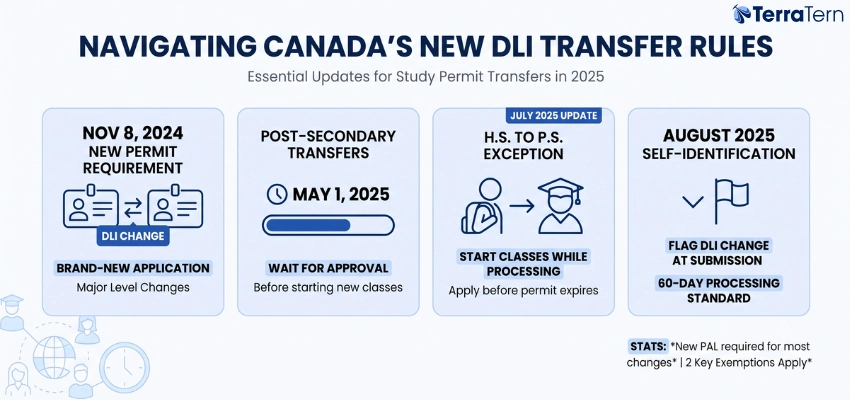
Since November 8, 2024, switching your Designated Learning Institution is usually not handled by a simple study permit extension Canada; it requires a brand-new study permit application, especially for major level changes.
-
Post-Secondary Transfers: Must wait for the new permit to be approved before beginning classes at the new DLI; the earlier grace period that allowed students to start while waiting expired May 1, 2025.
-
High-School-to-Post-Secondary Exception: Since IRCC's July 2025 update, students moving from a Canadian high school into a post-secondary program can begin classes while their new permit is processing, as long as they apply before their current permit expires or within 90 days of finishing high school (whichever comes first) and continue meeting their existing permit conditions.
-
August 2025 Self-Identification Feature: IRCC added a drop-down option that lets transferring students flag their application as a DLI change at submission, helping route these files to the targeted 60-day processing standard for post-secondary transfers.
-
Why This Affects Your PAL Requirement Too: Most DLI or level-of-study changes now also require a new, valid PAL; the same exemptions apply as covered earlier (same DLI/same level, or Master's/PhD at a public DLI from January 1, 2026 onward).
Pro Tip: If you're transferring institutions, don't submit an "extension" by mistake; applying for the wrong document type is now one of the fastest-growing causes of avoidable refusals.
What If Your Study Permit Expires Before You Apply for an Extension?
If your permit expires before you submit your study permit extension Canada, you immediately lose legal status and must stop studying and working, but you can apply for Restoration of Status within 90 days, for a combined 2026 fee of $396.25 CAD ($246.25 restoration fee plus the $150 study permit fee).
-
Stop Immediately: The moment your permit expires without a pending extension on file, you're out of status. Continuing to study or work, even briefly, can jeopardise your eligibility for restoration.
-
The 90-day Window is a Hard Cutoff: You must submit your restoration application within 90 days of your permit's expiry date. Apply on day 91, and the application is automatically refused no exceptions.
-
What Restoration Requires: Form IMM 5709 (selecting "Restore my status as a student"), a letter explaining why you lost status, proof you still meet your original permit conditions, current proof of funds, and payment of both fees together.
-
You're not Authorised to Study While it's pending: Unlike those with maintained status during a normal extension, restoration applicants cannot resume studying or working until the restoration itself is approved.
-
Expect Higher Scrutiny: Officers review restoration applications more closely than standard extensions; they're assessing not just your eligibility but why you let your status lapse in the first place.
-
Contact your DLI's International office immediately: Most schools can advise on enrolment holds, provide an updated letter of explanation, and flag the gap to avoid academic-standing complications while you sort out your status
Key Note: The 90-day restoration window is a hard deadline with no extensions — if you've lost status, treat same-week action as non-negotiable.
What Are the Most Common Reasons Study Permit Extensions Get Refused?
The leading refusal triggers for a study permit extension Canada are insufficient proof of funds against the 2026 threshold, unexplained academic gaps or poor grades, applying for the wrong document type after a DLI change, and incomplete or outdated PAL documentation.
|
Common Refusal Causes |
How to Avoid It |
|
Insufficient proof of funds |
Confirm your funds meet the current CAD 22,895/year threshold (single applicant) before applying, and show a stable balance history rather than a sudden lump-sum deposit. |
|
Unexplained academic gaps or poor grades |
Submit complete, official transcripts and attach a clear Letter of Explanation for any low grades, a leave of absence, or a program pause, so the officer is not left guessing. |
|
Wrong application type after a DLI change |
Confirm whether your situation needs a new study permit (most DLI transfers) versus a standard extension, and correctly self-identify the transfer when you apply. |
|
Incomplete or outdated PAL documentation |
Verify whether you actually need a PAL for your scenario, and if exempt, include a brief self-written exemption letter with your application. |
|
Missed UTC deadline |
Submit your application several days before your permit’s printed expiry date, remembering that IRCC’s technical deadline is based on UTC, not your local time zone. |
|
Passport expiring too soon |
Renew your passport before applying if it will not remain valid beyond your requested new permit end date, so your new permit is not shortened to match the earlier passport expiry. |
Expert Tip: Most refusals stem from documentation gaps, not ineligibility. A second pair of expert eyes on your file before submission catches the majority of these issues.
Also Read: New Rules for Canada Immigration: Experts' Latest Update
How Can TerraTern Help With Your Study Permit Extension?
TerraTern’s regulated advisors review your complete study permit extension Canada to confirm eligibility, spot risks early, and align your case with 2026 IRCC rules.
-
They cross-check your document checklist against current IRCC requirements, including funds, PAL, DLI change, and passport validity, before you click “submit.”
-
TerraTern helps you structure explanations and supporting documents to avoid the common refusal triggers discussed above, resulting in a smoother outcome.
-
All core procedural steps remain fully available to you, even if you do not use TerraTern; their role is simply to reduce errors and save you time.
Expert Advice: Self-filing is entirely possible if you follow each step above carefully; a professional review simply reduces the risk of a costly, time-consuming refusal.
2025–2026 Industry Context Section
Canada's study permit extension rules tightened significantly between late 2024 and mid-2026, and Indian students, historically the largest cohort of extension applicants, are most affected by increased financial proof requirements and the end of the Student Direct Stream.
-
Processing Time (June 3, 2026): 56 days at the 80th percentile, down from 104 days in January 2026 (IRCC weekly update)
-
Financial Threshold (2026): CAD 22,895/year for a single applicant, plus remaining tuition — up from prior years' figures
-
PAL Policy Shift (effective Jan 1, 2026): Graduate (Master's/PhD) applicants no longer need a Provincial Attestation Letter, even when changing DLI
-
DLI-Change Rule (Effective Nov 8, 2024): Changing institutions now requires a brand-new study permit application, not an extension
-
SDS Discontinued (Nov 8, 2024): All applicants, including Indian students, now go through the single Regular Study Permit stream, relevant context, since many extension applicants originally entered via SDS
-
Restoration-of-Status Cost: CAD 229 restoration fee + CAD 150 new permit fee = CAD 379 total if the permit lapses before filing
-
2026 Federal Volume Cap: Overall study permit issuance is capped at roughly 408,000, intensifying scrutiny on "genuine student" criteria at the extension stage, too
Important Tip: The financial threshold and processing-time changes move faster than most blog content. Always verify current figures on IRCC's live tool before submitting, since a stale number is one of the most common reasons applications stall.
Conclusion
A study permit extension Canada is ultimately a documentation and timing exercise: apply 3–6 months early, confirm your PAL status, verify proof of funds against the 2026 threshold, and never let your permit lapse without a plan. Most refusals trace back to incomplete files, not ineligibility. Bookmark IRCC's live processing times tool, keep your DLI's international office informed, and, when in doubt, get your documents reviewed before you submit.
Contact TerraTern for more Information on Study Permit Extension Canada 2026: Complete Expert Guide.




 AI Summary