


Key Highlights
- What Is the SOL List Australia and Why Does It Matter?
- What Are the 4 Main Sub-Lists Under the SOL List Australia?
- How Do You Check If Your Occupation Is on the SOL List Australia?
- What Are the Most In-Demand Occupations on the SOL List Australia in 2026?
- What Is the Western Australia SOL List (WASMOL) and How Does It Work?
- What Are the Eligibility Requirements to Apply Through the SOL List Australia?
- How Do You Apply for a Skilled Visa Using the SOL List Australia?
- How Do Indian Professionals Maximise Their Points for the SOL List Australia?
- What Are the Key 2026 Updates to the SOL List Australia Indian Applicants Must Know?
- 2025 Industry Context Section
- Conclusion
The SOL list Australia is the official grouping of occupations the Australian government uses to determine eligibility and prioritise processing for skilled migration and employer‑sponsored visas in 2026. This means your ANZSCO job code directly affects whether you can qualify for points‑tested, state‑nominated or employer‑sponsored visas.
What Is the SOL List Australia and Why Does It Matter?

The Skilled Occupation Lists are official lists of jobs issued by the Australian Department of Home Affairs, based on labour‑market advice from Jobs and Skills Australia.
-
The SOL list Australia is a key eligibility framework for many skilled migration visas and PR pathways, especially points‑tested and employer‑sponsored routes.
-
It is regularly revised in response to Jobs and Skills Australia's advice on market shortages at the time.
-
Each occupation listed has a definite link to a 6-digit Australian Standard Classification of Occupation (ANZSCO) code that outlines the qualifications you are expected to have and the duties you are expected to perform.
-
If you're an Indian applicant, consider it the equivalent of an official national hiring list that is based on a lack of applicants, but in this case, it's to grant you a visa.
-
That's because certain skilled visas, such as the independent skilled visa and state-sponsored skilled visa, are available only for specific professions.
As per TerraTern Expert Divyansh, the SOL is not a guarantee of a visa; it is the starting gate. Your occupation must be on the correct sub-list for the specific visa subclass you are targeting, or your application will be ineligible before it even starts.
Also Read: Skilled Visa Australia: Eligibility, Costs & Updates
What Are the 4 Main Sub-Lists Under the SOL List Australia?
The SOL list Australia framework includes four key occupation lists for skilled visas: MLTSSL, STSOL, ROL and CSOL. The MLTSSL provides the greatest access to PR, whereas the CSOL now regulates employer-sponsored temporary visas.
|
Sub-list |
Purpose |
Eligible Visas |
PR Pathway? |
|
MLTSSL |
Long-term high-value strategic skills |
189, 190, 491, 186 |
Direct & Broad |
|
STSOL |
Short-term tactical labour gaps |
190, 491 |
Via State Nomination |
|
ROL |
Regionally specific workforce needs |
491, 494 |
Regional to PR |
|
CSOL |
New employer-sponsored framework |
Skills in Demand (SID), 186 DE |
Streams to PR |
What Is the MLTSSL and Which Visas Does It Unlock?
The most extensive sub-list on the SOL list australia is the MLTSSL (Medium and Long-term Strategic Skills List), which lists occupations eligible for independent, state-nominated, regional, and employer-sponsored visas, including employer-sponsored visas for permanent residence.
-
It is often viewed as the most valuable pathway because eligible applicants can obtain a subclass 189 Skilled Independent visa without needing employer or state sponsorship.
-
It opens up much-coveted PR streams such as Subclass 189, Subclass 190 (Skilled Nominated), and Subclass 491 (Regional).
-
The occupations on this list are considered to have a long-term or structural skills shortage in Australia.
-
It is highly relevant to Indian professionals, particularly those in IT-related roles (e.g., Software Engineer, ICT Business Analyst).
-
It covers important engineering disciplines (Civil, Mechanical, Electrical) and essential healthcare professions (Registered Nurses).
-
Other key financial industries, such as Accounting and Auditing, are also well represented on this main index.
Important Note: If your ANZSCO occupation is on the MLTSSL, you have the widest range of visa options available, including Subclass 189, which requires no employer or state sponsorship.
What Is the STSOL and How Is It Different From the MLTSSL?
Unlike the MLTSSL, which offers broader permanent visa options, the STSOL contains occupations mainly eligible for short‑term or state‑nominated pathways with more limited routes to permanent residency.
-
The Short-Term Skilled Occupation List (STSOL) is not designed to address long-term occupational shortages, but rather short-term skill gaps.
-
It does not even allow you to apply through the independent pathway (Subclass 189 visa) like the MLTSSL.
-
It demands that applicants consider state/territory nomination under the Subclass 190 or 491 visa to create a pathway.
-
The CSOL has gradually taken on its employer-sponsorship duties since the launch of the Skills in Demand (SID) visa framework.
-
It remains a core component of the broader SOL list Australia architecture for point-tested regional migration applications.
What Is the CSOL and Does It Replace the Old SOL Lists?
The CSOL (Core Skills Occupation List) is a new occupation list used for the Skills in Demand (SID) subclass 482 Core Skills stream and the subclass 186 Direct Entry pathway. It does not supersede the MLTSSL or STSOL (which are still based on the traditional occupation lists) for independent skilled visas such as 189, 190 and 491.
-
The CSOL was developed by Jobs and Skills Australia and includes 456 occupations mapped to the current economic priorities of the domestic economy.
-
It does not replace MLTSSL or STSOL for points‑tested visas such as 189, 190 and 491.
-
It offers a simplified pathway to permanent residency via the subclass 186 Direct Entry employer‑nominated visa. Points‑tested visas such as subclasses 189 and 190 continue to rely on the MLTSSL, STSOL and ROL lists.
-
In the meantime, the independent and points-tested pathways (189, 190, 491) continue to be built around the old SOL list Australia model.
-
It coexists with existing systems and introduces changes to employer-sponsored migration without destroying the independent skilled systems.
Expert Tip: If you are planning an independent skilled migration (Subclass 189 or 190), the MLTSSL/STSOL still govern your eligibility. The CSOL applies only to employer-sponsored pathways under the new Skills in Demand visa.
How Do You Check If Your Occupation Is on the SOL List Australia?
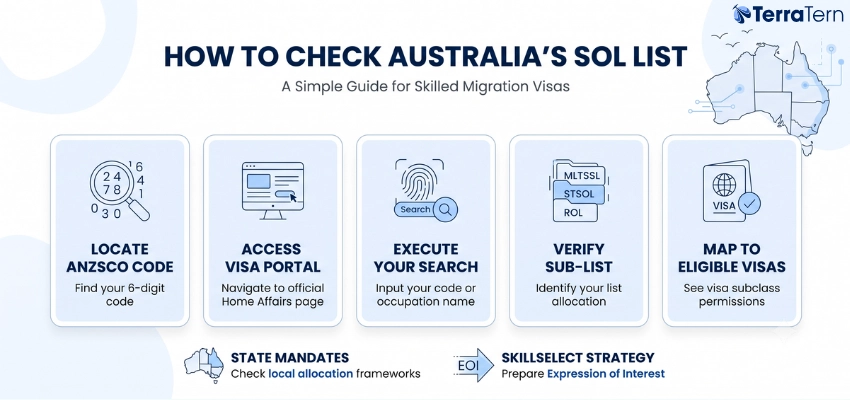
To check if your occupation is on the SOL list Australia, find your ANZSCO code, then search the Department of Home Affairs occupation list portal to identify which sub-list your job falls under and which visas it qualifies you for.
-
Locate Your ANZSCO Code: Identify your specific six-digit professional code via the Australian Bureau of Statistics or the official ANZSCO online search directory.
-
Access the Home Affairs Portal: Navigate directly to the official Department of Home Affairs skilled occupation list page to use their live tracking database.
-
Execute Your Search: Input either your precise ANZSCO code or your exact professional occupation name into the primary portal search bar.
-
Verify Your Sub-List Allocation: Determine if your job falls under the MLTSSL, STSOL, ROL, or the newer employer-driven CSOL database framework.
-
Map to Eligible Visas: Check the corresponding visa columns to see if your sub-list permits entry via Subclass 189, 190, 482, or 491.
-
Review State-Specific Mandates: Investigate individual state allocation frameworks (such as Western Australia’s WASMOL matrix) for localised criteria or hidden constraints.
-
Prepare Your SkillSelect Strategy: Transition to initiating an Expression of Interest (EOI) via the official SkillSelect portal once you confirm active listing status.
Expert Advice: Many Indian applicants assume their Indian job title directly matches an ANZSCO code; it often doesn't. Getting the wrong ANZSCO code is one of the most common and costly mistakes in the SOL application process.
What Are the Most In-Demand Occupations on the SOL List Australia in 2026?
Indian professionals target specific high-growth fields that offer streamlined pathways to migration. The technical, medical, infrastructure, and financial sectors continue to command the highest invitation rates on the SOL list Australia.
|
Sector |
Key Occupations |
Sub-list |
Visa Options |
|
Healthcare & Care |
Registered Nurses (Aged/Critical Care), General Practitioners, Psychologists |
MLTSSL / CSOL |
189, 190, 491, 482 |
|
ICT & Technology |
Software Engineers, Cybersecurity Specialists, Data Scientists, AI Engineers |
MLTSSL / CSOL |
189, 190, 491, 186 |
|
Engineering |
Civil Engineers, Mechanical Engineers, Electrical Engineers, Technologists |
MLTSSL / CSOL |
189, 190, 491, 494 |
|
Trades & Construction |
Electricians, Plumbers, Carpenters, Construction Project Managers |
MLTSSL / CSOL |
189, 190, 482, 186 |
|
Education |
Early Childhood Educators, Secondary STEM Teachers, Special Needs Teachers |
MLTSSL / CSOL |
189, 190, 491, 482 |
|
Business & Finance |
General Accountants, Taxation Accountants, External & Internal Auditors |
MLTSSL / CSOL |
189, 190, 491, 186 |
Important Tip: For Indian applicants, IT and engineering remain the most accessible entry points into the SOL list Australia, but healthcare roles like Registered Nursing now offer faster invitation timelines because of acute shortage levels.
What Is the Western Australia SOL List (WASMOL) and How Does It Work?
The Western Australia SOL list, officially known as the WASMOL (Western Australian Skilled Migration Occupation List), is WA's state-level occupation register used to nominate skilled workers for the Subclass 190 (permanent) and Subclass 491 (provisional) visas. It operates in addition to, not instead of, the national SOL list Australia.
-
This creates a localised selection layer that filters applicants based on the state’s direct economic and industrial workforce demands.
-
For the 2026 program year, Western Australia has a limited state nomination quota set by the federal government, making competition for 190 and 491 nominations tighter than in previous years.
-
The system distributes invitations via two distinct entry pathways: the General Stream (for global workers) and the Graduate Stream (for local students).
-
It structures eligible professions across three core sub-registers: WASMOL Schedule 1, WASMOL Schedule 2, and the separate Graduate Occupation List (GOL).
-
It manages nominations exclusively for Subclass 190 (giving immediate PR status) and Subclass 491 (a 5-year regional provisional pathway to PR).
-
The state deploys a strict sector-priority matrix, prioritising rapid processing for the building/construction, healthcare, hospitality/tourism, and education sectors.
-
The construction sector benefits from priority invitation rounds alongside significantly lowered employment contract obligations to accelerate local infrastructure projects.
-
Due to WA's tiering rules, an applicant in a high-priority construction trade at 75–80 points can receive an invitation over a non-priority role holding 90 points.
What Are the WASMOL Schedule 1 and Schedule 2 Occupations?
WASMOL Schedule 1 focuses on health and medical occupations and imposes stricter employment contract requirements for Subclass 190 applicants, while Schedule 2 covers a broader range of skilled roles and introduces more flexible contract options in 2026.
-
Schedule 1 Intent: This matrix focuses almost entirely on medical, nursing, and allied health professionals to stabilise the local healthcare infrastructure.
-
Stricter Mandates: To secure a permanent Subclass 190 nomination under Schedule 1, you must provide a signed, full-time local employment contract lasting at least 6 months.
-
Schedule 2 Scope: This covers a much wider spectrum of white-collar and blue-collar professions, with a strong focus on IT specialists, engineers, and construction managers.
-
Work Experience Flexibility: Schedule 2 pathways offer unique flexibility under the 2026 program guidelines, removing standard pre-existing domestic or international work experience quotas for specific streams.
-
Indian Applicant Relevance: Because Schedule 2 houses mainstream industrial professions (like Software Engineers and Civil Engineers), it represents the primary target under the national SOL list Australia structure for offshore Indian applicants.
How Does the Graduate Stream Differ From the General Stream in the Western Australia SOL List?
The Graduate Stream of the Western Australia SOL list is exclusively for international students who have completed at least two years of full-time study at an accredited WA institution, while the General Stream is open to all skilled workers whose occupation appears on WASMOL Schedule 1 or Schedule 2.
-
Target Audience: The Graduate Stream utilises a dedicated Graduate Occupation List (GOL) to retain locally trained talent in the state, whereas the General Stream attracts external global talent.
-
WA Study Prerequisite: Graduate applicants must document at least two academic years of full-time, face-to-face study at a registered Western Australian campus.
-
Minimum Qualification: You must have graduated with an accredited Certificate III or higher qualification (including Diplomas, Bachelor's, Master's, or PhDs) completed within WA.
-
Geographic Exclusion: This stream is completely unavailable to Indian applicants who completed their degrees solely within India; offshore professionals must apply exclusively through the General Stream.
-
Ranking Advantages: The state rewards local graduates by directly factoring their WA qualification tier into its ranking engine, prioritising PhD and Master's holders in invitation distributions.
As per TerraTern Expert: Indian professionals who studied in India and hold strong work experience should focus entirely on the General Stream under WASMOL Schedule 1 or 2; the Graduate Stream is only accessible if you studied physically in Western Australia.
What Are the Eligibility Requirements to Apply Through the SOL List Australia?
Meeting the baseline parameters of the SOL list Australia is mandatory before you can submit an official Expression of Interest (EOI). Carefully navigating these core elements determines whether you enter the competitive selection pool or face immediate rejection.
-
Active Listing Validation: Your primary profession must be actively catalogued on the specific sub-list (MLTSSL, STSOL, ROL, or CSOL) required for your target visa.
-
Age Limitation Threshold: You must be strictly under 45 at the exact moment you receive an official Invitation to Apply (ITA).
-
Positive Skills Assessment: You must obtain a comprehensive credential evaluation from a designated authority (e.g., ACS for IT, Engineers Australia, or VETASSESS) confirming that your qualifications meet domestic standards.
-
Baseline Score Benchmark: You must score at least 65 points on the federal points framework to register an eligible profile.
-
English Competency Mandate: You must achieve a minimum score of "Competent English" (equivalent to an IELTS band score of 6.0 or a PTE band score of 50 in each band) to qualify.
-
Post-Qualification Experience: You must present verified, paid professional work experience spanning at least 1 year that is recognised as skilled employment by your assessing body.
-
State Contract Commitments: For Western Australia’s 190 General Stream, you must secure an active, local employment contract of 35+ hours per week for at least 6 months.
-
Health and Character Clearances: Every applicant must clear rigorous national security checks, police clearances, and formal medical examinations.
|
Points Category |
Maximum Points Available |
|
Age |
30 points (Peak allocation between ages 25–32) |
|
English Language Ability |
20 points (Achieved via "Superior" English test bands) |
|
Skilled Work Experience |
20 points (Combined domestic and international limits) |
|
Educational Qualifications |
20 points (Awarded for verified Doctorate/PhD degrees) |
|
State Nomination (Subclass 190) |
5 points (Instantly credited upon state approval) |
|
Regional Nomination (Subclass 491) |
15 points (Substantial buffer for out-of-city routes) |
Pro Tip: Most Indian applicants underestimate the competition in SkillSelect invitation rounds. The minimum of 65 points gets you into the pool, but you typically need 80–90 points to receive an invitation in high-competition occupations like IT and accounting.
How Do You Apply for a Skilled Visa Using the SOL List Australia?
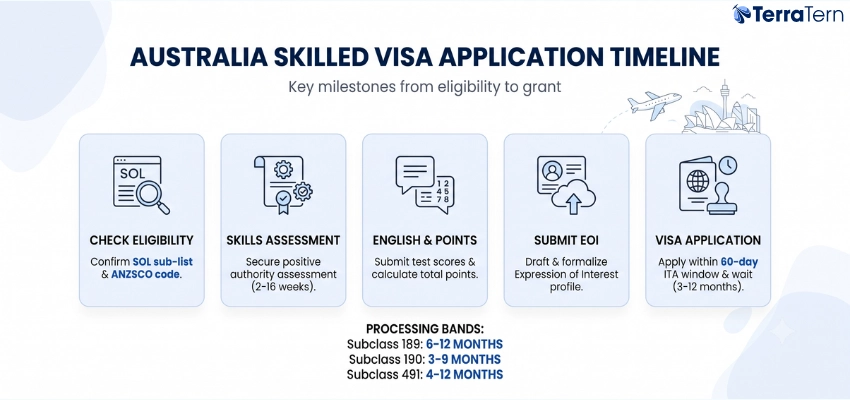
Transitioning from eligibility confirmation to visa grant follows a strict procedural sequence. Missing a single alignment or deadline can reset your timeline.
-
Confirm your occupation is on the correct SOL list Australia sub-list and identify your six-digit ANZSCO code.
-
Select your target skilled migration visa subclass based on your score, focusing on Subclass 189, 190, or 491.
-
Secure a positive skills assessment from your designated authority, allowing a processing timeline of 2 to 16 weeks, depending on the agency.
-
Take an approved high-stakes English language examination, such as the PTE Academic or IELTS, to cement your language points.
-
Calculate your total score using the official Department of Home Affairs interactive points calculator.
-
Draft and submit a formal Expression of Interest (EOI) profile inside the federal SkillSelect online portal.
-
Maintain an active EOI and update it immediately if you earn higher test scores or achieve work promotion milestones.
-
Submit your formal visa application within the strict, non-negotiable 60-day window following your Invitation to Apply (ITA).
-
Complete your mandatory biometric updates, localised panel physician health examinations, and national police clearances.
-
Await your official visa decision, tracking historical processing bands: Subclass 189 (6–12 months), 190 (3–9 months), and 491 (4–12 months).
Key Note: The most common reason Indian applicants miss their ITA window is failing to keep their SkillSelect EOI updated after initial lodgement. Any improvement in points, a new IELTS score, and additional work experience must be reflected in the EOI immediately, as WA and other states check EOI accuracy at the time of invitation.
How Do Indian Professionals Maximise Their Points for the SOL List Australia?
Indian professionals can maximise their SOL list Australia points score by targeting Superior English (20 points), claiming Australian work experience, applying for state nomination (up to +15 points with Subclass 491), and ensuring their partner's skills are assessed.
|
Category |
Max Points |
Indian Applicant Strategy |
|
English Skill |
20 |
Target Superior: Pivot from IELTS to PTE Academic if you hit plateaus. A score of 79+ across all communicative skills unlocks a massive 20-point injection that text-based profiles cannot match. |
|
Qualifications |
15 |
Verify Recognition: Ensure degrees from Indian universities are accredited. Major engineering colleges (IITs/NITs) are clearly recognised through the Washington Accord, while other sectors require thorough VETASSESS or ACS validation. |
|
Partner Skills |
10 |
The Dual Income Boost: Do not leave your partner's profile blank. Securing a positive skills assessment and competent English for your spouse injects 10 critical points into your joint EOI file. |
|
State / Regional |
15 |
Look Beyond Major Cities: If your independent score rests at 70–75 points, target a Subclass 491 regional nomination. This instantly adds 15 points to your profile and moves you ahead of saturated metropolitan lines. |
Important Note: For Indian applicants, improving from a Competent to a Proficient English score on IELTS is often the single highest-ROI action; it can add 4–10 extra points at a cost far lower than additional study qualifications.
What Are the Key 2026 Updates to the SOL List Australia Indian Applicants Must Know?
Staying ahead of rapid regulatory changes prevents costly filing delays. The framework governing the SOL list Australia has undergone critical structural updates that directly impact processing timelines, visa streams, and financial thresholds for international applicants.
-
CSOL Implementation: The Core Skills Occupation List (CSOL) controls 456 target profiles following the finalisation of its structural advice.
-
TSS Visa Replaced: The legacy Subclass 482 TSS visa framework was entirely retired in favour of the mobile Skills in Demand (SID) model.
-
Three SID Streams: Employer-sponsored applicants are segmented into the Specialist Skills, Core Skills, and Essential Skills visa streams.
-
CSIT Salary Threshold: The Core Skills Income Threshold requires a minimum salary of AUD $76,515, rising to AUD $79,499 for nominations after July 1, 2026.
-
WA Quota Cut: Western Australia's state nomination allocation was compressed by federal authorities to 3,400 places.
-
Targeted Sector Priorities: WA specifically accelerates invitations for candidates in the building/construction, healthcare, and technology sectors.
-
OET Scoring Redesign: The Occupational English Test shifted its reporting framework from alphabetical grades to precise numerical scores.
-
GSM List Stability: The yearly skilled‑migration instrument continues to update the occupation lists for points‑tested visas (189 and 190) in line with labour‑market conditions.
Pro Tip: Indian applicants using OET scores obtained before 7 August 2025 should verify that their score format still meets current WA requirements; the change in scoring methodology from alphabetical to numerical may affect how assessing bodies interpret results.
2025 Industry Context Section
Latest facts and industry context:
-
Latest CSOL Update (October 2025): Jobs and Skills Australia submitted its 2025 Core Skills Occupations List advice to the government on 20 October 2025, replacing the older MLTSSL/STSOL framework for employer-sponsored visas.
-
WA Allocation (November 2025): The Department of Home Affairs confirmed Western Australia's 2026 nomination allocation at 3,400 places, down 1,600 from the previous year, making competition significantly tighter.
-
Fastest-Growing Jobs (2026): LinkedIn Australia's Jobs on the Rise 2026 identifies AI engineers, chief risk officers, and mechanical engineers as the top three fastest-growing occupations.
-
SID Visa Launch (December 2024): The Skills in Demand (SID) visa replaced the TSS visa, with the Core Skills stream using the new CSOL list of 456 occupations.
-
Minimum Salary Threshold: The minimum salary for Core Skills stream visa holders is AUD $76,515 as of 2026.
-
WA Invitation Rounds: WA confirmed invitation rounds for 2026 began in December 2025, with monthly rounds thereafter.
-
Top In-Demand Sectors (2025): Healthcare & aged care, ICT & technology, trades & construction, engineering, and education consistently dominate the SOL.
Conclusion
Navigating the SOL list Australia requires strategic alignment with changing federal quotas and industry-targeted visa pools. Relying solely on the statutory minimum score is no longer enough; success hinges on maximising your points through superior language credentials, partner qualifications, and state-sponsored pathways. By proactively matching your specific ANZSCO code to active, high-demand sub-lists, you build a reliable, direct route to establishing permanent residency in Australia.
Contact TerraTern for more information on SOL List Australia 2026: Your Complete Visa Guide.




 AI Summary