


Key Highlights
- What Are Singapore PR Benefits?
- What Does Singapore PR Status Actually Mean?
- What Are the Top Singapore PR Benefits You Should Know?
- What Are the Tax Benefits of Singapore PR for Indians?
- What Are the Disadvantages of Singapore PR You Should Know?
- How Do Singapore PR Benefits Compare to Other Countries' PR Statuses?
- Who Is Eligible to Apply for Singapore PR and Are You Qualified?
- Conclusion
Singapore PR benefits include long-term stability, availability of government-subsidised services, and improved career prospects for approved residents. These benefits will make Singapore a desirable business and lifestyle destination for professionals and families who aspire to enjoy a high-quality life in Asia's economic powerhouse in 2026. This guide outlines some of the main benefits, based on official schemes such as the PTS, as approval rates continue to rise, according to the latest budget.
What Are Singapore PR Benefits?
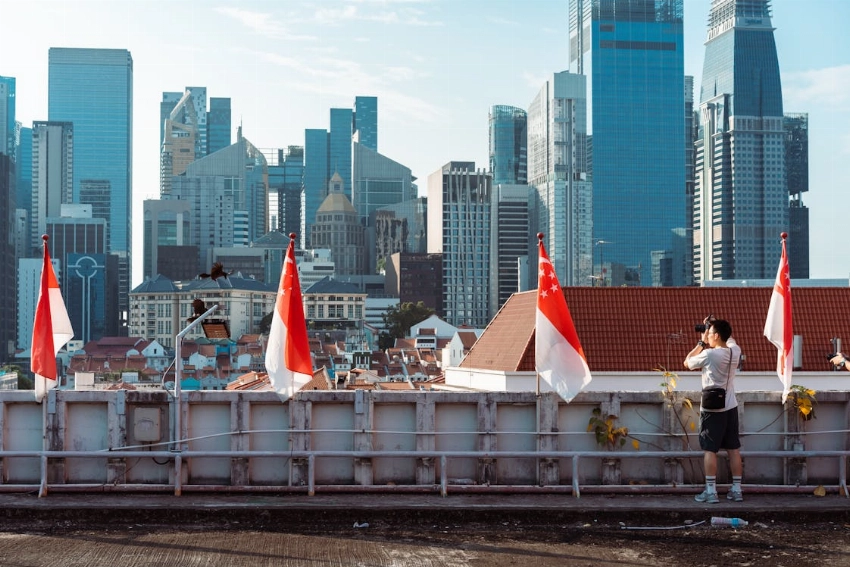
Singapore PR benefits offer stability, subsidized services, and family benefits to Permanent Residents (PRs), second only to citizens. These benefits entice expats with smoother routes in 2026 via PTS and cost reductions.
-
Employment Freedom: Freer work without passage guarantees; job involvement and security.
-
Housing Access: Purchase HDB-subsidized flats and resale flats.
-
Healthcare Subsidies: Discounts in the state facilities; MediShield Life insurance.
-
Education Priority: Children to the highest access to low-fee public schools.
-
CPF Savings: Employer contributions to the retirement, housing, and healthcare (vests after 2 years).
-
Family Sponsorship: Reunite with spouses/children/parents using LTVP.
-
Tax/Citizenship Route: Reduced rates; seek citizenship after a qualifying period.
Also Read: Singapore Immigration: A Comprehensive Guide
What Does Singapore PR Status Actually Mean?
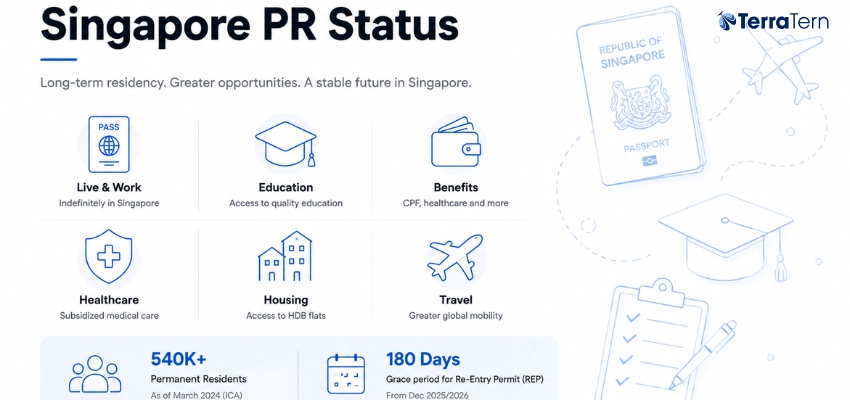
Singapore PR status confers indefinite residency privileges under ICA, a work pass, and citizenship seamlessly, but offers the essential benefits of Singapore PR status, such as job freedom and subsidised facilities.
-
Fundamentals: Permanent residency: Foreigners can work and reside permanently without renewing a work visa, indefinitely, unlike a temporary EP/S Pass, which requires employment renewal.
-
PR vs. Work Pass: PR is stable and very mobile; work passes need renewal and job approvals.
-
PR vs Citizenship: PR does not have voting rights, full HDB subsidies, or passport privileges; the difference between temp passes and full citizenship.
-
Blue NRIC Card: PRs are issued identity cards at age 15+, similar to citizen cards labeled PR.
-
Re-Entry Permit (REP): Overseas travel is now a compulsion, and beginning in Dec 2025/2026, a 180-day grace period to renew or lose permanently, with no reinstatement.
-
Misunderstanding: PR is not citizenship; it does not involve voting, and you cannot get housing when you share Singapore PR benefits, such as CPF and access to healthcare services.
As per TerraTern Expert, Shreya, Singapore PR sits in a unique middle ground; it offers near-citizen stability without the full obligations of citizenship, making it the preferred long-term status for most skilled Indian professionals in Singapore.
What Are the Top Singapore PR Benefits You Should Know?
Singapore PR benefits include job flexibility, subsidized healthcare, CPF savings, housing access, and a clearer path to citizenship. PRs can switch employers without reapplying for a work pass, which gives far more freedom than EP or S Pass holders. They can also buy certain public housing options, sponsor family members more easily, and enjoy stronger long-term financial stability in Singapore. For many professionals, the combination of career mobility and social security makes PR especially valuable.
Does Singapore PR Give You Employment Freedom?
Yes, Singapore PRs enjoy full employment freedom, unlike EP/S Pass holders, who are tied to their sponsors.
-
Job Switching: Change employers freely without reapplying for work passes (EP requires sponsorship).
-
Business Ownership: Incorporate/fully own companies in your name—no Singapore citizen director needed.
-
Flexibility: Work across industries, start side businesses; maintain employment for RP renewal.
-
Key Advantage: Untethered career mobility boosts Singapore PR benefits for Indian professionals seeking stability and growth.This "can Singapore PR change jobs freely" perk makes it ideal for dynamic careers.
Important Note: For Indian IT professionals and entrepreneurs on Employment Passes, PR status eliminates the anxiety of pass renewal every 2–3 years, one of the most underrated Singapore PR benefits.
Can Singapore PR Buy HDB Flats? (Housing Benefits Explained)
Yes, Singapore PRs can buy resale HDB flats, which is one of the biggest Singapore PR benefits for long-term residents.
Housing benefits explained:
-
Eligible for Resale HDB Flats: PRs can buy eligible resale HDB units, but not new BTO flats.
-
Better Affordability: HDB homes are usually much cheaper than private condominiums.
-
Lower Stamp Duty: PRs generally pay 5% ABSD on their first property, compared with 60% for foreigners.
-
Better Access to Loans: Banks often view PRs as lower-risk borrowers, making it easier to obtain financing.
-
More Housing Choices: Resale options include 3-, 4-, 5-, and executive condominium units, subject to eligibility rules.
-
Rental Advantage: PRs may also rent HDB flats at lower rates than foreigners.
|
Buyer Type |
ABSD on the First Property |
HDB Access |
|
Citizen |
0% |
New BTO and resale HDB |
|
PR |
5% |
Resale HDB only |
|
Foreigner |
60% |
No HDB purchase |
- Buy resale HDB (3-5 room, EC); no new BTO.
-
Lower interest rates; reduced rent prices.
Expert Advice: The ABSD difference alone,60% for foreigners vs. 5% for PRs on first property, can translate to savings of hundreds of thousands of SGD, making housing the single largest financial benefit of Singapore PR for most applicants.
How Does the CPF System Benefit Singapore PRs?
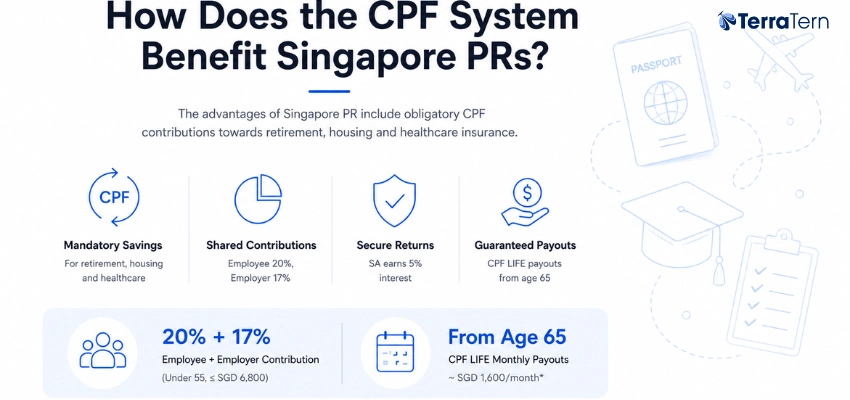
The advantages of Singapore PR include obligatory CPF contributions towards retirement/housing/healthcare insurance.
-
Accounts: OA (housing/invest), SA (5% interest), and MA (health).
-
Rates (under 55, ≤SGD 6,800): Employee 20%, employer 17%; graduated Years 1-2.
-
Tax-deductible; CPF LIFE payment at age 65 (FRS SGD 213k 065 FRS SGD 213k = 20.8payments = SGD 1,600/month).
-
Concentrates savings versus independent PF/NPS.
Expert Tip: CPF is often seen as a reduction in take-home pay, but with interest rates of 3.5–5% p.a. and tax deductibility, it is one of the most powerful long-term wealth-building tools available to Singapore PRs, especially compared to India's EPF system.
What Healthcare Benefits Do Singapore PRs Receive?
Singapore PR benefits are good, with subsidised healthcare facilities that are significantly lower than those for foreigners.
|
Procedure |
Foreigner Cost |
PR Subsidized |
|
Hospital Admission |
Full private |
30-50% off |
- MediShield Life insurance; Medisave for bills.
-
Care Shield of long-term care; family access.
Important Note: For Indian families in Singapore with children or elderly parents, subsidised healthcare under PR can reduce annual medical expenses by thousands of SGD compared to fully private healthcare costs on an EP pass.
What Education Benefits Does Singapore PR Offer for Children?
Singapore PR benefits kids are eligible for some of the most privileged PR kids in the most esteemed schools, with minimal fees.
|
Level |
Foreigner |
PR |
Citizen |
|
Primary |
High |
Subsidized |
Lowest |
|
University |
SGD 30k+ |
SGD 12-17k |
Subsidized |
As per TerrraTern Expert: For Indian parents who value education above all else, Singapore's world-class schooling system, accessible at near-citizen rates under PR, is often the decisive reason to pursue permanent residency rather than stay on a work pass.
Can Singapore PR Sponsor Family Members?
Singapore PR benefits include spouse/child sponsorship, but only to a limited extent compared to citizens.
|
Family |
PR Sponsorship |
Citizen Sponsorship |
|
Spouse/Children <21 |
LTVP |
PR/Citizenship |
|
Parents |
No |
Yes (LTVP/PR) |
Pro Tip: While Singapore PR allows family unity through LTVP sponsorship for spouses and children, the inability to sponsor parents is a key distinction from citizenship, something Indian applicants with elderly dependents must factor into long-term planning.
How Does Singapore PR Serve as a Pathway to Citizenship?
Holders of positions in Singapore are eligible for Singapore PR benefits to become citizens upon residency.
-
As required, the PR step for most foreigners.
-
Late after 2 years minimum (normally 6+).
-
Gains: passport, voting, BTO flats.
-
Denounce foreign (e.g., Indian OCI ends).
As per TerraTern Expert, Divyansh, while Singapore citizenship offers the world's 2nd-ranked passport (Henley Index 2026), the requirement to renounce Indian citizenship makes many Indian PRs content to remain permanent residents long-term,still enjoying nearly all the practical benefits of citizenship.
What Are the Tax Benefits of Singapore PR for Indians?
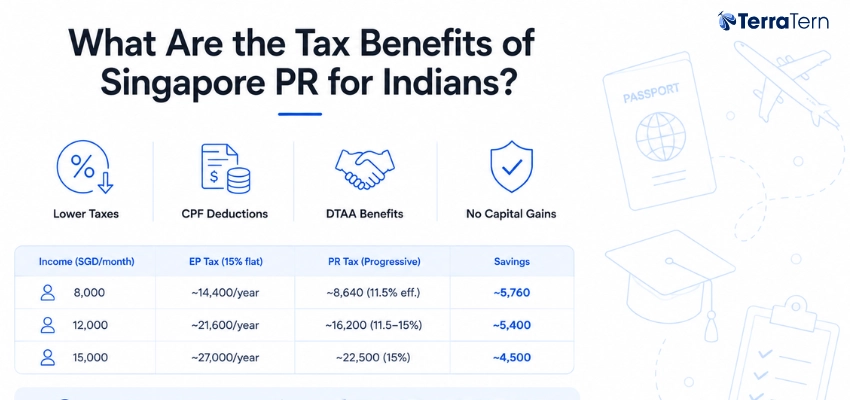
Singapore PR benefits are a progressive tax system for residents, which will save them from the 15% flat rate for foreigners, which is the best thing that can happen to Indian professionals. CPF deductions also reduce taxable income, and the DTAA is not subject to capital gains or estate taxes, and promotes against adverse taxation.
|
Income (SGD/month) |
EP Tax (15% flat) |
PR Tax (Progressive) |
Savings |
|
8,000 |
~8,640 (11.5% eff.) |
~5,760 |
|
|
12,000 |
~21,600/year |
~16,200 (11.5-15%) |
~5,400 |
|
15,000 |
~27,000/year |
~22,500 (15%) |
~4,500 |
Important Note: The tax savings from transitioning from a foreign flat rate to Singapore's progressive resident tax scale can amount to SGD 5,000–15,000 annually for Indian professionals earning SGD 8,000–15,000/month, a compelling but often overlooked financial Singapore PR benefit.
Also Read: What is the Difference Between PR and Citizenship?
What Are the Disadvantages of Singapore PR You Should Know?
Singapore PR benefits come with obligations like CPF contributions and NS duties, balancing perks with responsibilities.
|
Pros (Singapore PR Benefits) |
Cons |
|
Job freedom, CPF savings |
Mandatory CPF cuts take-home pay |
|
Healthcare subsidies |
Males/sons serve NS (2 years) |
|
Housing access |
REP renewal every 5 years; 180-day rule Dec 2026 |
|
Education priority |
|
|
Family sponsorship |
No BTO flats, parent sponsorship; renounce Indian citizenship for SC |
Expert Advice: The NS obligation for male children is the most significant concern for Indian families considering Singapore PR. It's essential to factor this into your decision before applying, particularly if you have sons under 18.
How Do Singapore PR Benefits Compare to Other Countries' PR Statuses?
Singapore PR benefits stand out for their speed and CPF gains, making them suitable for Indian finance/IT pros despite NS obligations.
Singapore PR Benefits vs. Other Countries
-
Core Atomic Insight: Singapore PR excels in speed (6–12 months) and low cost (~SGD 100) vs. Canada/Australia/UK; CPF delivers superior Singapore PR benefits like immediate housing access ideal for Indian IT/finance pros in Asia's hub, despite a smaller territory.
-
Singapore vs. Canada PR: Faster/cheaper than points-based Canada; lacks universal healthcare but offers CPF over Canada's territory scale.
-
Singapore vs. Australia PR: Discretionary (no points); CPF trumps superannuation for property use.
-
Singapore vs. UK ILR: Quicker/cheaper; UK edges in EU proximity/sponsorship.
-
Strategic Edge: Unmatched for Indians in finance/IT due to Asia positioning.
|
Feature |
Singapore PR |
Canada PR |
Australia PR |
UAE PR (Golden Visa) |
|
App Cost |
~SGD 100 (INR 6,200) |
CAD 1,525+ (INR 90,000+) |
AUD 465+ (INR 25,000+) |
AED 2,000+ (INR 45,000+) |
|
Processing |
6–12 months |
6–24 months |
4–12 months |
1–3 months |
|
Healthcare |
Subsidised for PRs |
Universal (all res.) |
Medicare (all res.) |
Private (premium) |
|
Housing |
CPF for HDB priority |
Loans/points help |
Super for deposits |
Property investment |
|
Tax Benefits |
No capital gains |
Progressive taxes |
No payroll tax perks |
0% income tax |
Pro Tip: For Indian professionals already working in Singapore, a Singapore PR is almost always the fastest and most affordable permanent residency route globally, with CPF and HDB benefits providing immediate, tangible financial returns unavailable elsewhere.
Who Is Eligible to Apply for Singapore PR and Are You Qualified?
Singapore PR benefits eligibility overview:
1. Primary Routes:
- PTS Scheme: For Employment Pass (EP) or S Pass holders (e.g., Indian professionals/technical workers); requires 6–12 months continuous employment in Singapore.
- Global Investor Program (GIP): Minimum SGD 2.5 million investment.
- ForArts Scheme: Exceptional artistic/cultural talent.
- Family Ties Scheme: Spouse/child of a Singapore citizen/PR; students in local institutions also qualify.
2. ICA Assessment Factors: Employment history, CPF contributions, tax records, community integration, and family ties.
3. Key Stats for Indians: One of the largest applicant groups; over 650,000 Indian residents in Singapore.
4. Application Details: Fee ~SGD 100 (INR 6,200) per applicant; processing 6–12 months; discretionary approval (no guarantees).
Key Note: Most Indian EP holders in Singapore are eligible to apply for PR after just 6 months of employment, but the strongest applications come from those with 2–3 years of stable employment, consistent CPF contributions, and visible community integration.
Also Read: Visa Sponsorship Jobs in Singapore: Guide for Indian Professionals
Conclusion
Securing Singapore PR unlocks transformative benefits, including an indefinite stay without work pass renewals, full CPF contributions for housing and retirement, seamless family sponsorship for spouses/children, and a fast track to citizenship after two years. For Indian EP/S Pass holders via the PTS Scheme, it means job stability, higher salaries, and community integration in a vibrant economy. With over 650,000 Indian residents thriving here, strong employment history, taxes, and ties boost approval odds despite discretionary ICA decisions. Embrace these Singapore PR benefits for a secure, prosperous future. Apply strategically today!
Contact TerraTern for more information on what are Singapore PR benefits.




 AI Summary