Key Highlights
- What Is the Portugal Retirement Visa (D7 Visa) and Who Is It For?
- Portugal D7 Visa Requirements Breakdown For Indians
- How Do You Apply for the Portugal Retirement Visa? Step-by-Step Process
- What Are the Costs and Fees Associated with the Portugal Retirement Visa?
- What are the Downsides of Retiring to Portugal? You Should Know
- What Is the D7 Visa Rejection Rate and Common Reasons for Refusal?
- What Are the Tax Implications for Portugal D7 Visa Holders in 2026?
- What Are the Best Cities and Regions in Portugal for Retirees?
- How Does the Portugal D7 Visa Compare to the Golden Visa for Retirees?
- What Healthcare Options Are Available for Portugal D7 Visa Holders?
- How Can TerraTern Help You with Your Retirement Visa for Portugal?
- Conclusion
The D7 Passive income visa or the retirement visa for Portugal is an easy way out of India with a simple monthly income of about 870, and retirees and passive income earners can have a very easy entry as an EU resident in 2026, compared to the investment-intensive option like the Golden Visa. Introduced in the year 2007, this plan will attract pensioners, property owners, and income-earners seeking sunny beaches, low cost of living, and Schengen travel without any age constraints or D7 Visa rejection rate, with only an 8-10 per cent refusal rate in cases where documents are perfect.
Although there are negative downsides of retiring to Portugal, such as bureaucracy and termination of tax benefits, the Portuguese D7 visa conditions, such as Portuguese bank deposit, health insurance, and clean records, open a 5-year citizenship route, which attracts thousands of people who find it increasingly expensive in India.
What Is the Portugal Retirement Visa (D7 Visa) and Who Is It For?

The retirement visa for Portugal allows non-EU citizens to live in the country on passive income evidence. There is no age restriction, and thus, those who retire early can benefit.
-
It was launched in 2007 and targets pensions, rentals, or dividends outside of Portugal.
-
Unlike the Golden Visa, it does not require any large investment, only 870 monthly income.
-
Allows Schengen visa travel and citizenship in 5 years.
-
Family inclusion includes the spouse as well as kids under 18.
Professional Implication: The D7 visa is the most available residency route in Portugal to financially independent people, without any large investment, i.e., only evidence of passive income of 10,440 Euros per year and a desire to live in Portugal.
Also Read: Portugal Work Visa: Types, Requirements, Benefits
Portugal D7 Visa Requirements Breakdown For Indians
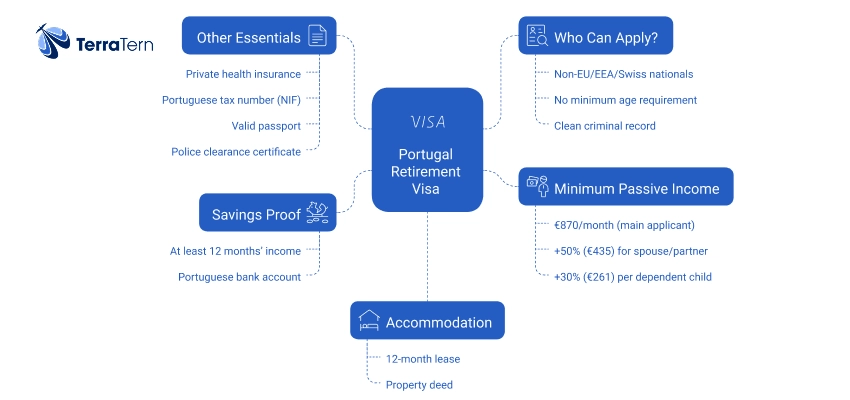
The Portugal D7 visa requirements require visible financial stability. Meet these to avoid delays.
-
Valid passport for three or more months after the stay.
-
Portuguese deposit 12 months' income into a bank account.
-
Bank statements for the 6 months with passive sources.
What Is the Portugal Retirement Visa Income Requirement for 2026?
In 2026, the Portugal Retirement Visa income requirement is 870 monthly for singles. This amounts to approximately Rs. 78,000, which is pegged on the minimum wage.
-
€870 per head; 50% spouse (€435), 30% children (€261).
-
Sources are pensions, rentals, dividends, and royalties.
-
Show with 6-12 months statements; deposit of Portuguese bank, 10440 US dollars.
Expert Takeaway: Indian applicants are encouraged to keep the passive income constant in INR and transfer an equal sum in EUR every month to their Portuguese bank account because the currency fluctuations may impact compliance, and it is better to have 10-15% more than the minimum levels.
What Documents Are Required for the Portugal D7 Visa Application?
Portugal D7 visa requirements have 12-15 essential documents to demonstrate finances, connections, and legality to the retirement visa for Portugal. File original documents certified in Portuguese/English and apostilled where necessary. Begin collecting 3-4 months ahead of time since records of crimes carry expiration after 6 months.
-
Valid passport (3+ months before the stay intended)
-
Finished D7 visa application form (obtained in VFS/Consulate)
-
Recent two passport photos (Portugal specifications: 3.5x4.5cm, white background)
-
Evidence of Portugal Retirement Visa earnings condition: 6-12 months bank statements (passive sources only)
-
Portuguese bank account statement of a deposit of at least 10,440 euros (individual applicant)
-
NIF tax number certificate (obtained through a lawyer, remotely)
-
Evidence of accommodation: a 12-month lease or a property deed
-
Health insurance policy (Portugal-valid, 30,000 cover)
-
Criminal record Certificate (apostilled through MEA India, last 5 years residence)
-
Family marriage/birth certificates (apostilled/translated)
Expert Tip: Began documenting 3-4 months before application- criminal record certificates last 6 months, and 2-4 weeks processing time through MEA India means that early preparations are necessary to ensure a smooth process.
How Do You Apply for the Portugal Retirement Visa? Step-by-Step Process
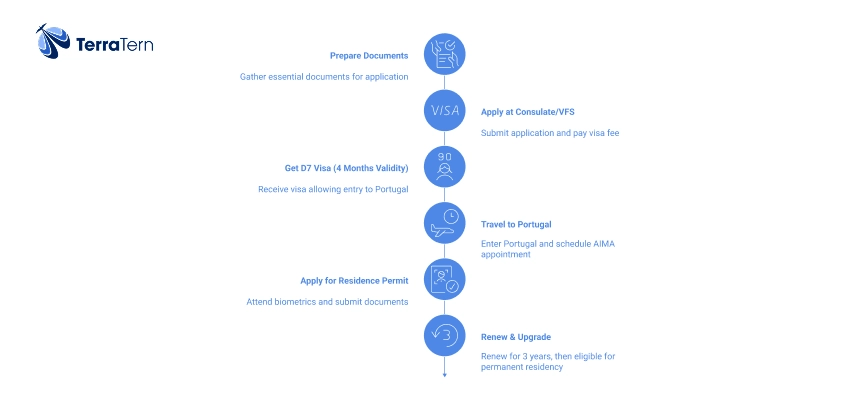
The NIF to residence card process of applying for the retirement visa for Portugal takes 6-8 months. These steps will be followed through VFS Global in India to satisfy the Portugal D7 visa requirements and avoid the D7 Visa rejection rate.
-
Portuguese NIF Tax Number (1-2 weeks, €50-100): Does it remotely; required to open a bank account and housing.
-
Open Portuguese Bank Account (2-4 weeks): Open an account at a minimum of 10440€ (Portugal Retirement Visa income requirement when one is single); attempt at Millennium BCP or Novo Banco.
-
Secure Accommodation Proof (2-8 weeks): Obtain a 12-month lease ( €600-1,200/month) or deed; it has to be registered by the landlord.
-
Gather All Documents (8-12 weeks): Collect apostilled passports, income proofs, insurance, and criminal records as listed earlier.
-
Book VFS Global Appointment (2-8 weeks wait): Book online to Delhi/Mumbai; high seasons book 1-2 months in advance.
-
Attend Consulate Interview (1 day, fee at the cost of 90): Respond to finances, ties, and biometrics are taken at this stage.
-
Issue 4-Month Entry Visa (60 days processing): Travel to Portugal during the period of validity.
-
Get AIMA Residence Permit (2-4 months after arrival): Book an appointment; receive a 2-year card, which can be renewed to 3 years.
Expert Lesson: The VFS appointment is usually the largest bottleneck- once you have your NIF and Portuguese bank account, make your appointment, which you can always rebook later, even when you are not fully prepared, because you have to get all of the necessary documents.
Also Read: Portugal's Golden Visa Scheme: Boosting Affordable Housing for Migrants
What Are the Costs and Fees Associated with the Portugal Retirement Visa?
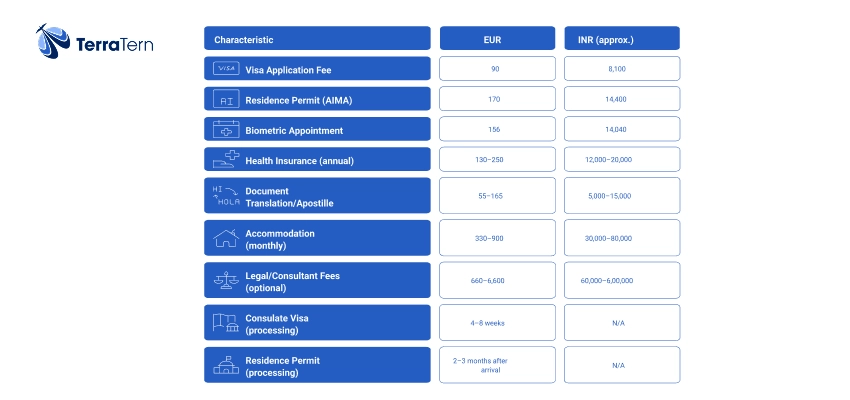
A visa and residence work permit (D7 visa) costing Portugal (10,440 with income retirement visa for Portugal Visa), 90 visa fee, 181 work permit, 20,000 bank deposit, rentals costing 7,200-14,400/year, legal charges (500-1500), and health insurance (600-1200/year) is between 2,000-3500 Euros, or 1,8,000-3,200
|
Category |
Single Applicant Cost |
Couple Cost |
Notes (INR Approx) |
|
Govt Fees (Visa + Permit + NIF) |
€271-321 |
€542-642 |
INR 24K -57K |
|
Bank Deposit |
€10,440 |
€15,660 |
INR 9.3 L |
|
Rental (Annual) |
€7,200-14,400 |
€7,200-14,400 |
INR 6.4L-12.8 L |
|
Health Insurance |
€600-1,200/year |
€1,200-2,400 |
INR 53k-1L; €30k coverage |
|
Legal/Consulting |
€500-1,500 |
€800-2,500 |
Cuts the D7 Visa rejection rate |
|
Other (Flights, Settling) |
€1,000-2,000 |
€1,500-3,000 |
INR 90k-2.7L return ticket |
|
Total Estimate |
€2,000-€3,500 |
€3,500-€5,500 |
INR 1.8L-4.9L |
Expert Takeaway: Budget 15-20% above minimum requirements as a safety margin—exchange rate fluctuations, unexpected document requirements, and processing delays can impact your total investment, and showing a financial buffer increases approval confidence.
What are the Downsides of Retiring to Portugal? You Should Know

The main downside of retiring to Portugal includes slow bureaucracy, ended NHR tax breaks (pensions now up to 53% tax vs old 10% flat), rising Lisbon rents (15-20% up since 2023), language gaps outside cities, and no central heat in old homes. These hit retirement visa for immigration holders in Portugal, but fixes exist. Expat surveys show 70% adjust in 6-12 months with prep.
-
Slow Bureaucracy: AIMA appointments and Portugal D7 visa requirements renewals drag on for months; use lawyers to cut waits on retirement visa for Portugal.
-
NHR Tax End: Foreign pensions now face 13-53% progressive rates vs the old 10% flat, hitting Portugal Retirement Visa income requirement planning.
-
Rising Costs: Lisbon/Porto rents up 15-20% since 2023; choose Porto or Silver Coast to dodge expat price surges.
-
Language Barriers: English is scarce outside cities, complicating daily tasks—a top downside of retiring to Portugal for non-speakers.
-
No Central Heating: Older homes stay damp and cold in winter; budget for newer rentals or upgrades on a retirement visa for Portugal.
Expert Takeaway: Most downsides are manageable with proper preparation—learning basic Portuguese before arrival, renting before buying property, and working with experienced immigration consultants can significantly reduce bureaucratic frustration and cultural shock.
What Is the D7 Visa Rejection Rate and Common Reasons for Refusal?
The D7 Visa rejection rate stands at 8-10% in 2025—far below most EU visas—with 90-92% approvals overall and 98-99% success using pros on the retirement visa for Portugal. Top causes: weak passive income proof (40%), bad docs (30%), poor housing evidence (15%), and insurance/record issues (15%).
|
Metric |
Rate/Figure |
|
D7 Visa rejection rate |
8-10% |
|
Approval rate |
90-92 % |
|
With consultant help |
98-99% |
|
Vs Golden Visa |
Lower by 5-7% |
Expert Opinion: The D7 visa has one of the highest approval rates among European residence visas, but success requires meticulous documentation—invest in professional document review before submission, as fixing errors post-rejection adds 3-6 months to your timeline.
What Are the Tax Implications for Portugal D7 Visa Holders in 2026?
Retirement visa for Portugal (D7) holders staying 183+ days become tax residents, declaring worldwide income at 13-48% progressive rates with the first €12,180 tax-free. Old NHR's 10% flat pension tax ended in 2024; new ICICI helps pros, not most retirement visa for Portugal retirees.
|
Scenario |
Annual Pension |
Tax Liability |
Effective Rate |
|
Single: €12,000 |
€12,000 |
€0 |
0% |
|
Couple: €25,000 |
€25,000 |
€1,640 |
~6.5% |
|
Single: €30,000 |
€30,000 |
€5,200 |
~17.3% |
Expert Takeaway: The NHR regime significantly impacts tax planning—D7 applicants should work with cross-border tax advisors familiar with India-Portugal tax treaties to structure income optimally and avoid unexpected tax burdens after establishing Portuguese residency.
What Are the Best Cities and Regions in Portugal for Retirees?
The best regions for a retirement visa for Portugal holders include the Algarve (beaches, expats), Lisbon (culture), Porto (affordable), the Silver Coast (budget coast), and Central Portugal (cheapest rural life). Each fits Portugal D7 visa requirements with varying costs from €900-3,500/month for couples.
1. Algarve (Southern Coast)
300+ sunny days, mild winters (10-16°C)
-
Cost: €1,500-2,500/month for a couple
-
Best for: Beach lovers on a retirement visa for Portugal
-
Towns: Lagos, Tavira
-
Pros: English doctors, golf
-
Cons: Summer crowds
2. Lisbon (Capital)
Mediterranean climate (8-15°C winters)
-
Cost: €2,000-3,500/month
-
Best for: Urban vibe, airport access
-
Areas: Cascais, Belém
-
Pros: Culture, transport
-
Cons: High rents (15-20% up)
3. Porto (North)
Cooler (5-14°C winters), wine country
-
Cost: €1,300-2,200/month
-
Best for: Authentic feel
-
Areas: Ribeira, Foz do Douro
-
Pros: Affordable vs Lisbon
-
Cons: Rainy, hilly
4. Silver Coast
Atlantic breeze, moderate temps
-
Cost: €1,200-2,000/month
-
Best for: Budget beaches
-
Towns: Óbidos, Nazaré
-
Pros: Less touristy
-
Cons: Fewer amenities
5. Central Portugal
Lowest costs (€900-1,500/month)
-
Best for: Rural peace
-
Towns: Coimbra, Tomar
-
Pros: History, cheap living
-
Cons: Limited healthcare
6. Madeira Island
Stable 16-25°C year-round
-
Cost: €1,800-2,800/month
-
Best for: Island nature
-
Pros: Safe, scenic
-
Cons: Isolated
Expert Tip: First-time Portugal retirees should consider renting in 2-3 different regions for 1-3 months each before committing to a property purchase—climate, community fit, and lifestyle preferences often shift significantly after experiencing seasonal variations and local culture firsthand.
Also Read: Portugal Introduces Work Visa Requirement for Foreign Job Seekers
How Does the Portugal D7 Visa Compare to the Golden Visa for Retirees?

The retirement visa for Portugal (D7) needs €10,440 annual passive income matching Portugal Retirement Visa income requirement, plus 16+ months Portugal stay first 2 years at €2,000-3,500 total cost—vs Golden Visa's €250k-500k investment with just 7-14 days/year stay but €30k-50k fees. D7 suits full-time retirement visa for Portugal retirees; Golden fits flexible investors.
|
Factor |
D7 Retirement Visa |
Golden Visa |
|
Investment |
€10,440/year income + deposit |
€250k-500k capital |
|
Total Cost |
€2,000-3,500 |
€30k-50k+ fees |
|
Stay Requirement |
16+ months first 2 years |
7-14 days/year |
|
Processing |
6-8 months |
6-8 months |
|
Income Needed |
€870/month passive |
None |
|
Citizenship Path |
5 years |
5 years |
|
Renewal |
Every 2-3 years |
Every 2 years |
|
Best For |
Full-time retirees |
Part-time investors |
Expert Takeaway: For genuine retirees planning to make Portugal their primary home, the D7 visa is unquestionably the optimal choice—Golden Visa's high investment requirement only makes sense for those needing European residency flexibility or pursuing Portuguese investment opportunities beyond simple retirement.
What Healthcare Options Are Available for Portugal D7 Visa Holders?
Retirement visa for Portugal (D7) holders tap three healthcare paths: public SNS (free/low-cost post-183 days tax residency), private insurance (€600-1,200/year mandatory for Portugal D7 visa requirements), and pay-per-visit private care—Portugal ranks 35th globally with top urban services suiting retirement visa for Portugal retirees.
-
Public SNS: Free primary/emergency care after residency; €5-20 co-pays; longer waits.
-
Private Insurance: €30k+ coverage needed for the first 2 years; English doctors; quick access.
-
Pay Per Visit: €60-150/consult no insurance; ideal for specialists.
-
Hybrid Best: Private for speed + SNS for savings on Portugal Retirement Visa income requirement.
-
Regional Edge: Lisbon/Porto/Algarve excel; rural areas need city trips.
Expert Tip: Most D7 retirees benefit from a hybrid strategy—maintain affordable private insurance (€80-100/month) for immediate access to English-speaking doctors and elective procedures while using SNS for routine care and prescriptions to minimise costs and maximise coverage.
Also Read: Portugal Accelerates Golden Visa Processing to Clear Backlog
How Can TerraTern Help You with Your Retirement Visa for Portugal?
TerraTern simplifies the retirement visa for Portugal process for Indian applicants, cutting through Portugal D7 visa requirements complexity and slashing D7 Visa rejection rate risks to under 2% with expert handling.
-
Full Application Support: NIF setup, Portuguese bank opening, document apostille via MEA, VFS bookings—6-8 month timeline managed end-to-end.
-
Income Proof Optimisation: Verify Portugal Retirement Visa income requirement (€870+/month pensions/rentals); prepare 12-month statements to dodge 40% rejection cause.
-
Rejection Prevention: Pre-audit docs, interview prep; fix downsides of retiring to Portugal like bureaucracy with lawyer networks.
-
Personalised Planning: Region selection (Algarve vs Silver Coast), tax setup (India-Portugal treaty), healthcare hybrid strategies.
-
98% Success Rate: 1000+ Indian clients on retirement visa for Portugal; post-approval AIMA appointments and renewals included.
Conclusion
The retirement visa for Portugal (D7) delivers affordable EU residency for Indian retirees meeting Portugal D7 visa requirements like €870/month Portugal Retirement Visa income requirement, despite the downsides of retiring to Portugal, such as bureaucracy and tax shifts. With D7 Visa rejection rate at 8-10%, proper prep unlocks Schengen travel, healthcare access, and 5-year citizenship—ideal vs pricier Golden Visa. For official Portugal D7 visa requirements and retirement visa for Portugal details, visit the AIMA (Agency for Integration, Migration and Asylum) website.
To know more about retirement visas in Portugal, visit TerraTern now!





 AI Summary