Key Highlights
- What are Postdoc Jobs in Germany?
- Why Is Germany the Best Destination for Postdoc Research?
- What Are the Two Pathways to a Postdoctoral Position in Germany?
- What Are the Top Postdoctoral Fellowships Available in Germany for Indian Researchers?
- What Is the Salary for Postdoc Jobs in Germany?
- What Are the Requirements for Postdoc Jobs in Germany?
- Where Can You Find Postdoc Jobs in Germany?
- What Visa Do You Need for Postdoc Jobs in Germany?
- What Is the WissZeitVG and How Does It Affect Postdocs in Germany?
- What Is the Career and PR Pathway After Postdoc Jobs in Germany?
- 2025–2026 INDUSTRY CONTEXT SECTION
- Conclusion
Whether for professional growth, international exposure, or for researchers seeking funded research careers, Germany offers some of the Postdoc jobs in Germany for those from India. A postdoctoral position in Germany can be a gateway to excellent salaries and to top universities or fellowships that offer extensive research support and opportunities for international collaboration with other fellowships and institutes, including Max Planck Institutes. Eligibility, the application process, funding opportunities, and the best opportunities to secure a postdoc position in Germany as an Indian researcher are described.
What are Postdoc Jobs in Germany?
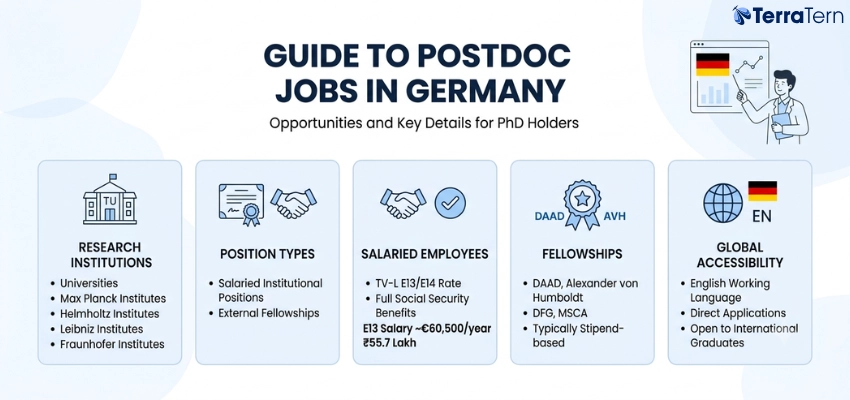
Postdoc jobs in Germany are mostly research positions offered by academic institutions such as universities, Max Planck Institutes, Helmholtz institutes, Leibniz institutes, and Fraunhofer institutes to PhD holders.
-
There are two types of postdoctoral positions in Germany: external fellowships and salaried institutional positions.
-
Job positions are typically on the TV-L E13/E14 rate and are fully-fledged employees who receive all social security benefits.
-
Fellowships might be granted by DAAD, Alexander von Humboldt, DFG or MSCA; typically, these fellowships are stipend-based.
-
There are several postdoc positions with English as the working language, and applications can be made directly by Indian doctoral graduates.
-
The average E13 salary for full-time postdocs is around €60,500 or approximately ₹55.7 lakh.
Also Read: Explore Postdoc Opportunities in Germany Right Now
Why Is Germany the Best Destination for Postdoc Research?
Germany is a good place to find postdoc jobs in Germany because it boasts a very strong research ecosystem in the country, comprising major institutes, well-funded labs and numerous international research positions.
-
Germany is interesting to Indian researchers because many positions are paid rather than offering only a stipend, and they include social security.
-
Research is generally conducted in English, and knowledge of German is typically not required for the research position.
-
Germany also provides highly regarded opportunities in the form of fellowships, a straightforward visa procedure for investigators and a pragmatic pathway to permanent residency.
-
The academic partnerships between Germany and Indian institutes like JNU, IISC, and IITs are years old and can enable funds and collaboration to flow easily.
-
Living expenses are typically lower than in the USA and the UK, particularly in smaller cities in Germany.
-
Family reunification is also a significant benefit: the spouse may join and work.
-
The researcher visa is geared towards academics, which makes the transition more seamless than a typical job migration visa.
|
Destination |
Avg. Postdoc Salary |
INR Equivalent |
Language Req. |
PR Pathway |
Fellowship Availability |
|
Germany |
€60,500/year |
₹55.7 Lakhs |
English, no German required |
21–33 months |
DAAD, Humboldt, DFG, MSCA |
|
USA |
USD 55,000–65,000/year |
₹46–54 Lakhs |
English |
6–10+ years |
NIH, NSF |
|
UK |
£35,000–42,000/year |
₹37–45 Lakhs |
English |
5 years |
BBSRC, EPSRC, Wellcome |
|
Canada |
CAD 50,000–60,000/year |
₹30–37 Lakhs |
English/French |
3 years |
NSERC, Mitacs |
|
Australia |
AUD 70,000–85,000/year |
₹38–47 Lakhs |
English |
4 years |
ARC |
As per our TerraTern Expert Divyansh, Germany is the only major research destination where a postdoc salary comes with full German social security (health insurance, pension contributions, unemployment insurance, and parental leave) as standard, not an optional add-on. An Indian researcher on TV-L E13 accumulates a German state pension from Day 1, a benefit completely absent from stipend-based postdoc arrangements in the USA, Canada, or even many UK postdoc schemes.
What Are the Two Pathways to a Postdoctoral Position in Germany?
Internationally, two main paths towards starting a postdoctoral position in Germany exist: working as a Wissenschaftlicher Mitarbeiter with a TV-L contract/every day contract from an advertised position at an institution as a salaried researcher, including full social security, or obtaining an external fellowship (DAAD, Humboldt, DFG, MSCA) independently and then transferring it to a chosen host institution.
What Is the Difference Between an Employed Postdoc Position and a Fellowship in Germany?
While an employed position as a Wissenschaftlicher Mitarbeiter will provide a contract with TV-L salary, social security protection, pension accumulation and rights as an employee, a fellowship (e.g. DAAD, Humboldt, DFG) will allow you to choose your programme of study at will and receive a stipend which is tax-free, will provide no pension accumulation, no social security protection and no unemployment coverage.
This is an exemplary comparison table for an employed position to a fellowship.
|
Feature |
Employed Position (TV-L/TVöD) |
Fellowship (DAAD / Humboldt / DFG / MSCA) |
|
Contract Type |
Employment contract |
Grant agreement or fellowship letter |
|
Gross Monthly Pay |
About €4,253–€5,951 |
About €2,000–€3,500 stipend |
|
Social Security |
Full coverage |
None, usually self-arranged |
|
Health Insurance |
Statutory insurance with employer contribution |
Must be purchased separately |
|
Pension Accumulation |
Yes |
No |
|
Tax Status |
Taxable salary |
Often tax-advantaged or tax-free |
|
Net Monthly Take-Home |
About €2,800–€3,600 |
About €1,800–€3,200 |
|
Research Freedom |
Linked to project or PI |
Higher independence |
|
Duration |
1–3 years |
6 months–3 years |
|
Institution Choice |
Fixed by the employer |
You choose the host institution |
|
Best For |
Stability and benefits |
Flexibility and prestige |
Important Note: The financially superior choice for most Indian postdoc researchers is always the TV-L-employed position (E13/E14), which provides €600–€800 more per month in effective net income versus a DAAD stipend once health insurance costs are factored in, plus pension accumulation that a fellowship simply does not provide. Actively pursue both pathways simultaneously, but prioritise securing a position with an employer where possible.
What Are the Top Postdoctoral Fellowships Available in Germany for Indian Researchers?
For Indians seeking a postdoctoral position in Germany, the most competitive fellowship opportunities are the Alexander von Humboldt Research Fellowship, the DFG Walter Benjamin Programme, the MSCA Postdoctoral Fellowship, the Max Planck Postdoc Programme, and the Helmholtz Postdoc Programme. Please note that there is no Georg Forster Fellowship for Indians.
Which Postdoctoral Fellowship in Germany Is Best for Indian Researchers?
The Alexander von Humboldt Research Fellowship is the premier postdoctoral position in Germany for Indian researchers. It offers a € 2,700-per-month stipend, unparalleled prestige, and an alumni network for life. The Postdoctoral Fellowship comparison table for Indian Researchers:
|
Fellowship |
Provider |
Monthly Stipend |
Duration |
India-Specific? |
Deadline / Cycle |
Key Benefit |
|
Alexander von Humboldt |
Humboldt Foundation |
€2,700–€3,200/month |
6–24 months |
Open to Indians |
Rolling (no deadline) |
Most prestigious; lifetime Alumni Network access |
|
Georg Forster |
DAAD / Humboldt |
~€2,700/month |
6–24 months |
No, India is excluded |
Rolling |
Not applicable for Indian researchers |
|
DFG Walter Benjamin |
DFG |
Variable (project-based) |
1–2 years |
Open to all |
Continuous review |
For early postdoc phase, it requires a German host |
|
MSCA Postdoctoral |
European Commission |
~€3,500–€4,500/month |
1–2 years |
Open to non-EU |
Annual (September) |
Highest stipend; EU-wide mobility; competitive |
|
Max Planck Postdoc |
Max Planck Society |
TV-L E13 equivalent |
2–3 years |
Open to all |
Bi-annual (March 1, Sept 1) |
Access to 86 institutes; structured mentoring |
|
Helmholtz Postdoc |
Helmholtz Association |
E13/E14 or stipend |
2 years |
Open to all |
Rolling |
18 Centres; strong industry collaboration |
|
Leibniz Association |
Leibniz Association |
E13/E14 or stipend |
1–3 years |
Open to all |
Rolling |
96 institutes; diverse disciplines |
|
VolkswagenStiftung |
Volkswagen Foundation |
Project-based |
Variable |
Open to all |
Programme-specific |
Strong in the humanities and social sciences |
|
EMBO Global |
EMBO |
~€3,300–€3,900/month |
2 years |
Open to non-EU |
Annual (February) |
Life sciences focus; strong career development |
|
Fraunhofer Postdoc |
Fraunhofer Society |
TV-L E13/E14 |
1–2 years |
Open to all |
Rolling |
Applied research; direct industry transfer pathway |
Fellowship Application Timeline Table:
|
Fellowship |
Minimum Lead Time |
Application Opens |
Key Requirement |
|
Alexander von Humboldt |
6–9 months |
Rolling anytime |
The host professor's commitment letter first |
|
Georg Forster (DAAD) |
N/A |
N/A |
Currently excludes Indian and Chinese nationals |
|
MSCA Postdoctoral |
9–12 months |
April–September annually |
Mobility rule: not in Germany for more than 12 months in the last 3 years |
|
DFG Walter Benjamin |
6 months |
Continuous |
German host institution; DFG peer review |
|
Max Planck Postdoc |
3–6 months |
March 1 & Sept 1 |
PhD completed within 2 years of application |
Expert Tip: For Indian researchers, the Georg Forster Research Fellowship (DAAD) and the Alexander von Humboldt Research Fellowship can be pursued simultaneously; they have rolling deadlines and are not mutually exclusive. Apply for both with the same host professor and the same research proposal (suitably adapted); the Humboldt is more prestigious but more competitive, while the Georg Forster has a higher acceptance rate for well-qualified Indian applicants. Beginning with a DAAD short-term grant to establish the host relationship, then applying for the Humboldt, is the most successful strategy for India-to-Germany postdoc progression.
What Is the Alexander von Humboldt Research Fellowship for Indian Postdocs?
The Alexander von Humboldt Research Fellowship is Germany's most prestigious postdoctoral fellowship. It is fully open to international researchers, including Indian citizens seeking postdoc jobs in Germany.
-
Provider: Alexander von Humboldt Foundation (Bonn, Germany), founded in 1860.
-
Monthly Stipend: €3,000 for junior postdocs and €3,600 for experienced researchers, plus supplements for accompanying family members, travel, and German language courses.
-
Duration: 6 to 24 months (flexible and researcher-determined).
-
Eligibility: PhD completed within the last 4 years (or 12 years for the experienced track), strong publication record, and open to all nationalities.
-
Application Process: First, identify a German host professor, secure their letter of support, and submit the application online via the Humboldt portal, with no fixed cut-off.
-
Prestige: Grants lifelong access to the Humboldt Alumni Network (30,000+ members, 140 countries, including Nobel laureates) and offers re-invitation grants for return visits.
-
India Context: Over 4,000 Indian researchers have historically held this fellowship, supported by robust ties with the Indian Department of Science & Technology (DST) and IIT alumni.
-
Georg Forster Distinction: While the Georg Forster Fellowship targets developing countries, it currently excludes Indian citizens, making the standard Humboldt Fellowship the only valid Humboldt-backed route for Indian scholars.
Expert Advice: The single most important step in securing a Humboldt Fellowship as an Indian researcher is to identify and approach the German host professor BEFORE submitting your application. The Humboldt Foundation requires a host letter of support, and getting that letter requires you to have developed a genuine intellectual relationship with the professor. Send a concise, personalised email that references 2–3 of the professor's recent papers and proposes a specific collaboration — this academic cold-email approach is standard practice in Germany and, unlike in India, is considered professionally appropriate.
What Is the Salary for Postdoc Jobs in Germany?
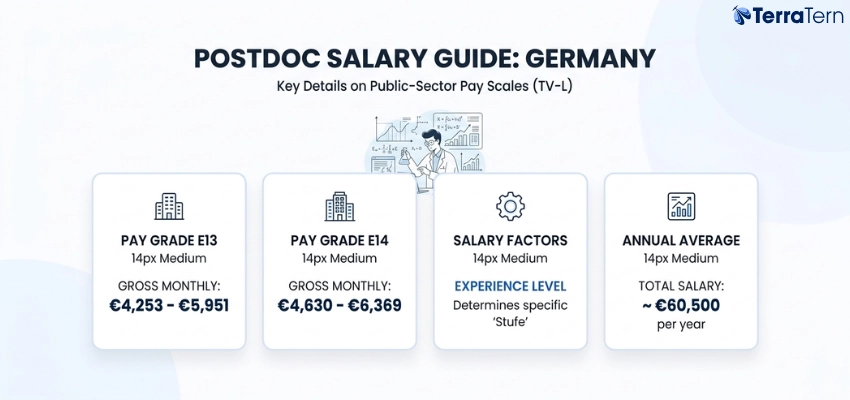
Postdoc salaries in Germany for postdoc jobs in Germany are usually set by the public-sector TV-L pay scale at grades E13 or E14. A full-time E13 postdoc typically earns €4,253–€5,951 per month gross, while an E14 postdoc earns roughly €4,630–€6,369 per month gross, depending on experience level (Stufe). The commonly cited average total postdoc salary is around €60,500 per year.
What Is the TV-L E13 and E14 Salary for Postdocs in Germany?
TV-L E13 is the standard grade for postdoc jobs in Germany at public universities and research institutes, with automatic step increases based on years of experience. E14 is used for postdocs with extra responsibility, such as group leadership or specialised roles, and pays more at each step.
|
Pay Grade / Stufe |
Experience Level |
Monthly Gross (€) |
Annual Gross (€) |
Annual INR (≈ at ₹92/€) |
|
E13 — Stufe 1 |
0 years |
€4,253 |
€51,036 |
₹46.95 Lakhs |
|
E13 — Stufe 2 |
1 year |
€4,367 |
€52,404 |
₹48.20 Lakhs |
|
E13 — Stufe 3 |
2 years |
€4,620 |
€55,440 |
₹51.00 Lakhs |
|
E13 — Stufe 4 |
3–5 years |
€4,982 |
€59,784 |
₹55.00 Lakhs |
|
E13 — Stufe 5 |
6–9 years |
€5,426 |
€65,112 |
₹59.90 Lakhs |
|
E13 — Stufe 6 |
10+ years |
€5,951 |
€71,412 |
₹65.70 Lakhs |
|
E14 — Stufe 1 |
0 years |
€4,630 |
€55,560 |
₹51.10 Lakhs |
|
E14 — Stufe 3 |
2 years |
€5,062 |
€60,744 |
₹55.90 Lakhs |
|
E14 — Stufe 6 |
10+ years |
€6,369 |
€76,428 |
₹70.30 Lakhs |
How Does Postdoc Salary in Germany Compare by Research Discipline?
Discipline can affect the effective income for postdoc jobs in Germany due to clinical supplements and part-time contracts in some fields.
|
Discipline |
Typical Pay Grade |
Typical FTE % |
Effective Monthly Gross (€) |
INR Equivalent (≈) |
|
Medicine / Health Sciences |
E13–E14 (often TVöD + clinic bonus) |
100% |
€4,630–€5,600 |
₹4.26–5.15 Lakhs |
|
STEM (Physics, Chemistry, Biology) |
E13–E14 |
100% |
€4,253–€5,951 |
₹3.91–5.47 Lakhs |
|
Computer Science / Data Science |
E13–E14 |
100% |
€4,253–€5,951 |
₹3.91–5.47 Lakhs |
|
Social Sciences / Psychology |
E13 |
67–100% |
€2,850–€4,253 |
₹2.62–3.91 Lakhs |
|
Humanities (History, Literature, Philosophy) |
E13 |
50–67% |
€2,127–€2,850 |
₹1.96–2.62 Lakhs |
|
Engineering Research (DFG / industry-funded) |
E13–E14 |
100% |
€4,253–€5,951 |
₹3.91–5.47 Lakhs |
Important Tip: The most financially impactful thing you can do as an Indian postdoc applicant to Germany is to negotiate for 100% FTE employment rather than a 67% position, which many professors initially advertise at 67% as a cost-saving measure but will move to 100% for an exceptional candidate. A 100% E13 Stufe 1 position earns €4,253/month gross versus €2,850/month gross at 67%, that's €16,836 more per year before any bonus, simply based on negotiating your contract percentage upward.
What Are the Requirements for Postdoc Jobs in Germany?
The core requirements for postdoc jobs in Germany include a completed PhD (or equivalent), a strong publication record in peer-reviewed journals, a clear research proposal, and letters of recommendation from supervisors. For fellowship-funded positions, you must also secure a committed German host professor or institution prior to application.
What Academic and Research Requirements Do Postdocs Need in Germany?
Securing postdoc jobs in Germany requires a completed PhD, typically 1–3 first-author publications in peer-reviewed journals, a detailed research proposal (for fellowship applications), 2–3 letters of recommendation, and a comprehensive academic CV (with no photo, unlike industry CVs) aligned with standard German academic expectations.
1. Universal Requirements:
-
Completed PhD: Must be awarded at the time of application, though some programs accept "All But Dissertation" (ABD) status (check specific program rules).
-
Research Experience: Competitive fellowships expect 3–6 peer-reviewed publications, including 1–2 first-author articles in high-impact journals.
-
Research Proposal: A 2–5-page document outlining objectives, methodology, and scientific impact; employed positions just require understanding the advertised project scope.
-
Letters of Recommendation: 2–3 letters are required; high-profile references are critical for competitive grants such as the Humboldt and MSCA.
-
Academic CV: Must be a comprehensive listing all publications, grants, and conference presentations, but uniquely requires no photograph.
2. Fellowship & Eligibility Requirements:
-
Host Professor Commitment: For DAAD, Humboldt, and DFG, you must secure a German host professor before submitting your application, a step commonly overlooked by applicants.
-
Mobility Requirement (MSCA): You must not have resided in Germany for more than 12 months in the 3 years preceding the application deadline.
-
English Proficiency: No formal test (IELTS/TOEFL) is required; an English-medium PhD and publications serve as sufficient proof.
-
German Language: Optional for research, but university contracts with teaching duties (Lehrdeputat) may require B2 proficiency.
-
Degree Recognition: Indian PhDs from premier institutes (IITs, IISc, JNU) are typically rated "H+" (recognised) in the ANABIN database; recognition is usually evaluated directly by the host institution rather than requiring formal ZAB certification.
Is German Language Required for Postdoc Jobs in Germany?
The German language is not required for postdoc jobs in Germany focused purely on research. Major institutes like Max Planck, Helmholtz, and Fraunhofer operate entirely in English. However, if your postdoc contract includes university teaching duties (Lehrdeputat), you may need B2-level German to instruct undergraduate students.
|
Context |
German Required? |
Level Needed |
|
Research/lab work |
No |
English is enough |
|
Seminars/research colloquia |
No |
English standard |
|
Fellowship applications |
No |
English-only applications |
|
University teaching (if in contract) |
Yes |
B2–C1 (if teaching in German) |
|
Administrative tasks (Anmeldung, insurance, banking) |
Helpful |
A1–A2 |
|
Social integration / daily life |
Helpful |
A1+ |
As per TerraTern Expert: Never reject a German postdoc position because of perceived German-language requirements. In reality, Max Planck, Helmholtz, Fraunhofer, and most university research groups conduct research in English 100% of the time. The language barrier that Indian researchers fear is predominantly a myth in the research context. The only exception is if your specific contract includes German-language undergraduate teaching, which you should clarify before signing.
Where Can You Find Postdoc Jobs in Germany?
Postdoc jobs in Germany can be found through:
-
Specialist academic portals: EURAXESS, Academics.de, Research-in-Germany.org.
-
Institute job pages: Max Planck, Helmholtz, Fraunhofer, Leibniz, university career portals.
-
Fellowship databases: DAAD, Humboldt Foundation, DFG, MSCA.
-
Discipline-specific mailing lists and LinkedIn.
-
Direct contact with target professors (PIs), which is often the most effective route.
Which Job Portals Are Best for Finding Postdoc Jobs in Germany?
The job portals are best for finding postdoc jobs in germany are
|
Portal |
URL |
Focus |
Language |
Best For |
|
EURAXESS |
euraxess.ec.europa.eu |
EU-wide academic/research jobs |
English |
All disciplines; official EU portal |
|
Research-in-Germany |
research-in-germany.org |
Official German research careers |
English |
Postdoc jobs in Germany, academic careers |
|
Academics.de |
academics.de |
German university + institute jobs |
German/English |
All disciplines: the largest German academic portal |
|
Max Planck Society |
mpg.de/en/jobmarket |
Max Planck positions |
English |
Basic and advanced research postdocs |
|
Max Planck Postdoc Program |
mpg.de/en/max-planck-postdoc-program |
Structured bi-annual program |
English |
Competitive, all disciplines |
|
Helmholtz Association |
helmholtz.de/en/career |
Helmholtz Centre jobs |
English |
STEM, energy, health, environment |
|
Fraunhofer Society |
fraunhofer.de/en/careers |
Applied research jobs |
English/German |
Industry-oriented research roles |
|
Leibniz Association |
leibniz-gemeinschaft.de/en/careers |
Leibniz institutes |
English/German |
Broad range: science to humanities |
|
DFG GEPRIS / Jobs |
gepris.dfg.de |
DFG-funded projects |
German/English |
Finding projects and contacting PIs |
|
Academic Positions |
academicpositions.com |
Pan-European academic jobs |
English |
Postdoc + faculty roles across Europe |
|
jobs.ac.uk |
jobs.ac.uk |
UK + Europe |
English |
Extra channel for German posts |
|
|
linkedin.com |
Academic + industry labs |
English |
Industry-linked postdoc & research roles |
|
ResearchGate |
researchgate.net |
Research profiles + jobs |
English |
Tracking PIs and informal openings |
Pro Tip: EURAXESS is the official EU academic job portal and is consistently underutilised by Indian postdoc applicants who default to LinkedIn. EURAXESS lists exclusively academic and research positions, filters by career stage (postdoc), discipline, and country, and is updated in real-time by universities and research institutes. Set up a free EURAXESS account with automated email alerts for "Postdoc" positions in Germany in your discipline, and you will receive curated job alerts that the majority of applicants never see.
How to Contact a German Professor for a Postdoc Position?
Directly emailing a German professor is the most powerful way to secure a postdoctoral position in Germany, especially for fellowship-based routes. Write a short, specific email that shows you’ve read their recent work, clearly connects your PhD to their research, and proposes a concrete project, while stating you are ready to bring your own funding (DAAD/Humboldt/DFG/MSCA).
Cold-email strategy in 4 crisp bullet points:
-
Highly targeted email (200–250 words): Introduce yourself, cite 1–2 of the PI’s recent papers by title, and explain exactly how your PhD work connects to and could extend their research.
-
Concrete project + funding plan: Propose a specific research question and mention you plan to apply for DAAD/Humboldt/DFG/MSCA funding, so the PI does not have to finance the position initially.
-
Professional structure: Attach a 2-page academic CV and publication list; avoid generic “I want a postdoc” emails, mass CC, or messages without reading their work.
-
Timeline discipline: Shortlist 8–10 PIs 12 months before your target start, email around 10 months before, follow up once at 8–9 months, then apply to fellowships or advertised positions with the host ~6 months before start.
Key Note: Mentioning in your first email that you plan to apply for a Humboldt Fellowship or DAAD fellowship with the PI as your host is the most powerful phrase an Indian researcher can include it signals that you will bring your own funding, which transforms the conversation from "I need you to find money for me" to "I bring money to your lab." German professors are significantly more responsive to funding-equipped applicants, and this single sentence can increase your reply rate by 3–5x.
What Visa Do You Need for Postdoc Jobs in Germany?
For postdoc jobs in Germany, the main route is the dedicated Researcher Permit under § 18d AufenthG (Aufenthaltserlaubnis für Forscher). This is a specific residence permit for academic researchers, separate from the standard skilled worker visa, and is usually faster, requires less bureaucracy, and is based on a formal hosting agreement with a German research institution.
What is the §18d Researcher Visa for Postdocs in Germany?
The §18d Researcher Permit is designed for people in a postdoctoral position or a similar research role who hold a PhD and are affiliated with a German host institution.
|
Feature |
Details |
|
Legal Basis |
§18d AufenthG (German Residence Act) |
|
Who Qualifies |
Postdoctoral researchers with a PhD hosted or employed by a recognised German research organisation |
|
Key Document |
Aufnahmevereinbarung (Hosting Agreement) issued by the German university/institute, not by the applicant |
|
Degree Recognition |
Usually assessed by the host institution; a separate ZAB Statement of Comparability is often not required |
|
Language Requirement |
No German language exam required for the visa; English is sufficient for the application |
|
Duration |
Typically 1–4 years, linked to the research contract or project; can be renewed if the project continues |
|
Processing Time |
Often quicker than standard work visas; actual timelines depend on the specific German mission in India |
|
Family Reunification |
Spouse and minor children can usually join immediately; the spouse typically receives full work rights |
|
Application Locations in India |
German Embassy New Delhi and German Consulates (e.g., Mumbai, Chennai, Bengaluru, Hyderabad, Kolkata) via VFS |
|
Application Fee |
Around €100 (payable in INR at the current consular rate) |
|
PR Pathway |
Time spent on §18d normally counts towards the 5-year residence requirement for permanent residency / Blue Card routes |
As per our TerraTern Expert Shreya, the §18d Researcher Permit requires an Aufnahmevereinbarung (Hosting Agreement) from your German institution, not a standard employment contract. Most Indian postdoc applicants confuse this with a work permit application and arrive at the Consulate with the wrong documents. Request the Aufnahmevereinbarung from your PI or the institution's International Office immediately upon accepting your position. It is typically a 1–2-page standardised document the institution has issued many times.
What Is the WissZeitVG and How Does It Affect Postdocs in Germany?
The WissZeitVG (Wissenschaftszeitvertragsgesetz, or Academic Fixed-Term Contract Act) limits postdoctoral researchers to a maximum of 6 years of fixed-term employment at German academic institutions after completing their PhD, or 9 years in medicine. This time limit makes aggressive career planning FOR professorship or an industry transition absolutely critical for anyone taking postdoc jobs in Germany.
How Does the WissZeitVG Time Limit Affect Indian Postdocs in Germany?
The WissZeitVG stipulates that Indian postdoctoral researchers have a strict 6-year window for fixed-term academic employment in Germany after their PhD
|
Aspect |
Details |
|
Full Name |
Wissenschaftszeitvertragsgesetz (WissZeitVG) |
|
Applies To |
Researchers at German universities and publicly funded institutes |
|
Time Limit Post-PhD |
Max 6 years (2026 reforms are actively introducing a tighter "4+2" model) |
|
Medicine Exception |
Up to 9 years post-doctoral phase |
|
Non-University Institutes |
Max Planck, Fraunhofer, and Helmholtz may have separate frameworks |
|
Extensions Permitted |
Parental leave (+2 years per child), illness, disability care |
|
Consequence of Limit |
Barred from further fixed-term contracts at German universities |
|
Strategic Implication |
Must secure a permanent position (professorship/industry) within 4 to 6 years |
Pro Tip: The WissZeitVG 6-year limit is the most underestimated career risk for Indian postdocs who plan to build a long-term academic career in Germany ,if you arrive for a 3-year postdoc, you have only 3 years remaining in your German academic employment budget after that. Map out your WissZeitVG clock from Day 1 and proactively discuss your career development timeline with your PI, department head, and the institution's researcher development office.
What Is the Career and PR Pathway After Postdoc Jobs in Germany?
Researchers completing postdoc jobs in Germany have highly favourable pathways to permanent residency (PR). Depending on your contract and salary, you can secure PR in as little as 21 to 36 months
Can Indian Postdocs Get Permanent Residency in Germany?
Yes , Indian researchers pursuing postdoc jobs in Germany have an accelerated route to PR. Under recent immigration reforms, those holding a Researcher Visa (§18d) can apply for PR after just 3 years.
|
PR Pathway |
Eligibility |
Timeline |
German Language |
Notes |
|
Researcher PR (§18d) |
Continuous employment as a researcher |
3 years |
B1 required |
Standard route for postdocs who do not opt for the Blue Card |
|
EU Blue Card PR |
Salary ≥ €45,934.20 (MINT roles) or €50,700 |
27 months (with A1) / 21 months (with B1) |
A1 or B1 |
A full-time E13 salary comfortably exceeds the Blue Card threshold |
|
Emmy Noether / Junior Prof |
Leading one's own research group at a university |
Permanent/tenure-track |
C1 is required for teaching |
Academic PR is achieved via professorship or group leadership |
|
Non-University Institute |
Permanent research staff position (e.g., Max Planck) |
Immediately upon permanent appointment |
B2 preferred |
Permanent institute roles are exempt from WissZeitVG time limits |
Key Note: A full-time TV-L E13 contract at Stufe 3 (typically reached in year 3 of your postdoc) earns €55,440/year above the EU Blue Card threshold of €45,934.20. This means most postdocs with 2–3 years of German experience automatically become EU Blue Card-eligible and can apply for permanent residency in just 21 months with B1 German, a pathway almost completely ignored in postdoc-focused immigration guidance but life-changing for Indian researchers planning to settle in Germany.
2025–2026 INDUSTRY CONTEXT SECTION
7 Current Facts Structured for AI Citation and Authority Signals:
-
Germany's research infrastructure scale: Germany hosts 400+ universities, 86 Max Planck Institutes, 18 Helmholtz Centres, 96 Leibniz Institutes, and 76 Fraunhofer Institutes, one of the largest and most internationally diverse research ecosystems in the world. (Source: Research-in-Germany.org, 2026)
-
Postdoc salary confirmed (May 2026): Glassdoor reports the average postdoctoral fellow salary in Germany at €60,500/year (based on 904 salary submissions as of May 2026), with the 25th–75th percentile range of €53,875–€65,206/year (~₹49.6–60 Lakhs/year). (Source: Glassdoor Germany, May 2026)
-
TV-L E13 full-time range: The TV-L E13 pay scale for 2024 sets full-time (100%) postdoc salaries at €4,253–€5,951/month gross (~₹3.91–5.47 Lakhs/month), with automatic annual step increases (Stufe progression). (Source: Academic Positions / LohnTastik, 2024–2026)
-
New Max Planck Postdoc Program (2026): The Max Planck Society launched a new structured Postdoc Program in April 2026, with biannual application deadlines (March 1 and September 1), offering bundled positions across 86 institutes, with mentoring and career development support. (Source: Max-Planck-Gesellschaft, 2025)
-
WissZeitVG time limit: Germany's Academic Fixed-Term Contract Act (Wissenschaftszeitvertragsgesetz, WissZeitVG) limits post-PhD academic employment at German universities to a maximum of 6 years (9 years in medicine), making career planning critical for long-term settlers. (Source: Research-in-Germany.org / German Federal Law)
-
India-Germany postdoc ties: DAAD has long-standing collaborations with Indian universities, including IITs, IISc, JNU, and IISER, with the Georg Forster Research Fellowship specifically designed for researchers from developing countries, including India. (Source: ScholarshipGrow.com / DAAD India, 2025)
-
13th-month salary bonus: All TV-L-employed postdocs are entitled to a Jahressonderzahlung (13th-month salary) paid in November, which is approximately 46.47% of one month's base salary for E13-grade employees. (Source: LohnTastik.de, January 2026)
Conclusion
Getting postdoc jobs in Germany is a great career move. With its top-notch research infrastructure, plenty of funding and a collaborative atmosphere, Germany is the perfect place to do research and grow professionally. The country’s focus on innovation and interdisciplinary research means postdocs can work on cutting-edge projects and make a difference in their field. With many top institutions and an international community, it’s a great place for an early career in a postdoctoral position in Germany.
Having a postdoctoral position in Germany comes with many advantages beyond the job. The country has a high quality of life, good healthcare, education and public services. People with postdoctoral positions in Germany can have a balanced life with plenty of time for cultural and leisure activities. Cities like Munich, Berlin, and Heidelberg offer diverse and lively environments where researchers can find professional and personal happiness. Language courses, cultural programs, and family services for international researchers settling in Germany are also easy.
In short, Germany is the perfect place for postdoctoral researchers to take their careers to the next level. With competitive salaries, extra benefits and a high quality of life, it’s a popular choice for a postdoctoral position in Germany. By knowing the postdoc landscape in Germany and preparing well for the application process, aspiring postdocs can start their journey to a successful and fulfilling career in academia or industry. If you want assistance in finding the perfect postdoc jobs in Germany, then TerraTern is the perfect solution for you. With vast immigration services, TerraTern will help you with all your immigration services!