
Key Highlights
- Why Choose Canada for Java Developer Jobs?
- Top Cities for Java Developer Jobs in Canada
- Java Jobs in Canada Salary: 2026 Breakdown (CAD & INR)
- How Should Indians Approach Immigration Pathways for Java Jobs in Canada in 2026?
- Building a Canada-Ready Resume for Java Roles
- Networking Strategies for Indian Java Developers
- Top Industries Hiring Java Developers in Canada
- What Challenges Do Indian Java Developers Commonly Face, and How to Handle Them?
- Adapting to Canadian Workplace Culture
- Conclusion
As Canada's thriving tech sector continues to demand a more skilled workforce to fill its growing number of roles, the opportunity for Java developer jobs in Canada has emerged as one of the most coveted career prospects for top-tier candidates globally in 2026.
If you're a foreigner and a Java developer, you should definitely look at the Java developer jobs in Canada for Indian professionals, as there are fewer hoops to jump through with respect to work permits and Express Entry. 2026 is the ideal year to take the plunge because the packages of competitive Java jobs in Canada are lucrative, and there are no fewer Java jobs in Canada for indian applicants in terms of Indian applicants.
Why Choose Canada for Java Developer Jobs?
As AI infrastructure, e-commerce, and fintech services continue to grow rapidly, Java developer jobs in Canada are poised to remain a market favourite through 2026. For the experienced Java developer, a strong job market, excellent employers, and a straightforward immigration process are more familiar as well. So the reason that Canada stands out:
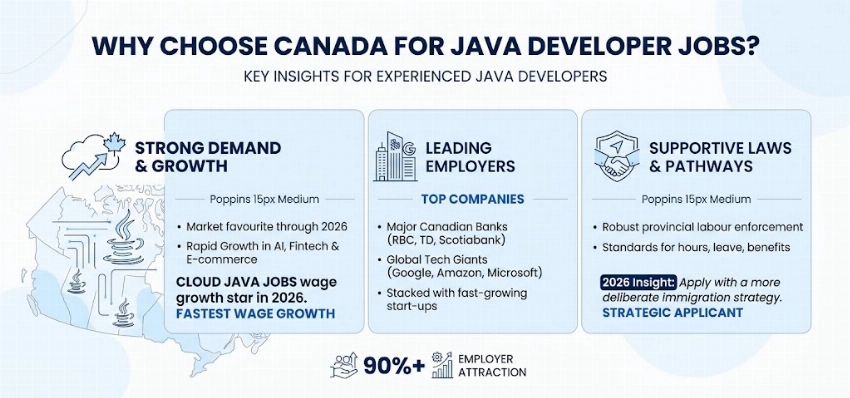
- Competitive Salaries: Salaries are in line with inflation, and cloud/cloud-adjacent Java developer jobs in Canada were the fastest to grow wages in Canada in 2026.
- Multiple Immigration Pathways: Express Entry, PNPs, and employer-driven pathways are still open, but not all of these strategies are equally applicable to software jobs today (see the breakdown below of each pathway).
- Enforcement: Of strong labour protections (standard hours, paid leave, parental benefits and labour standards) is robust at the provincial level.
- Schools: Include Canadian banks such as RBC, TD, and Scotiabank, as well as other global tech giants like Google, Amazon, and Microsoft – and they're also stacked with fast-growing start-ups that have Canadian offices.
- Diverse & Inclusive Workplaces: A multicultural workplace that encourages international hires and future-proofs their careers.
Key Note: Canada is still a strong target market for Java developers, but 2026 applicants need a more deliberate immigration strategy than in previous years. See the pathway section before you start applying.
Also Read: Top 10 Most In Demand Jobs in Canada: Latest Update
Top Cities for Java Developer Jobs in Canada
Canada's tech ecosystem spans multiple thriving cities, each offering unique opportunities for Java developer jobs in Canada. Whether you prefer finance-driven Toronto, innovative Vancouver, or bilingual Montreal, there's a perfect match for every Java professional. Here's a breakdown of the top cities driving Java jobs in Canada in 2026:
Toronto: Canada's Tech and Financial Hub
-
Banking Powerhouse: Toronto remains the largest market for Java developer jobs in Canada, anchored by top banks like RBC, TD, Scotiabank, and CIBC.
-
Global Tech Presence: Home to IBM, Shopify, and Google's Canadian offices, offering diverse Java jobs in Canada across industries.
-
Core Java Applications: Java powers banking backend systems, payment processing, and trading platforms in Toronto.
-
Highest-Paying City: Offers the top salary bracket for Java developer jobs in Canada for Indian professionals and other international talent.
Vancouver: Gaming, AI, and Startups
-
Gaming Industry Leader: Vancouver is a hotspot for Java developer jobs in Canada in gaming, with Electronic Arts leading the sector.
-
AI & Cloud Growth: Microsoft maintains a strong presence, offering Java roles tied to AI and cloud-based systems.
-
Thriving Startup Ecosystem: A growing hub for machine learning and blockchain startups, ideal for Java jobs in Canada for Indian developers seeking innovative roles.
-
Lifestyle & Work Balance: Combines career growth with one of Canada's most scenic living environments.
Montreal: Bilingual Tech Hub
-
AI Research Excellence: Anchored by world-renowned institutions like Mila, Montreal is a rising hub for AI-driven Java developer jobs in Canada.
-
Bilingual Advantage: English/French-speaking developers have a competitive edge in landing top Java jobs in Canada here.
-
Fintech & Research Focus: Strong demand for Java skills in fintech platforms and AI research applications.
-
Affordable Living: While salaries trail Toronto and Vancouver slightly, lower living costs balance the overall package for professionals.
Also Read: Nursing Job Vacancies in Canada: Eligibility, Salary & More
Java Jobs in Canada Salary: 2026 Breakdown (CAD & INR)
Salary is the most-searched question in this space, and it's also where stale content causes real damage. Canadian tech salaries have moved significantly since 2025.
The figures below reflect Java jobs in Canada salary trends based on 2026 reporting from Glassdoor, Talent.com, and market salary surveys, converted to INR at the August 2026 rate of approximately 1 CAD = INR 68. Whether you're targeting entry-level or senior Java developer jobs in Canada, this breakdown will help you benchmark offers accurately.
Average Java Developer Salary by City and Experience (Annual)
Toronto consistently leads the pack for Java developer jobs in Canada, driven by demand from banking and fintech giants, while Vancouver and Montreal offer slightly lower but competitive Java jobs in Canada salary ranges, balanced by lifestyle and cost-of-living advantages.
|
Experience Level |
Toronto |
Vancouver |
Montreal |
|
Entry-Level (0–2 yrs) |
CAD 70,000–90,000 (INR 47.6–61.2L) |
CAD 65,000–85,000 (INR 44.2–57.8L) |
CAD 60,000–80,000 (INR 40.8–54.4L) |
|
Mid-Level (3–5 yrs) |
CAD 90,000–130,000 (INR 61.2–88.4L) |
CAD 85,000–115,000 (INR 57.8–78.2L) |
CAD 80,000–105,000 (INR 54.4–71.4L) |
|
Senior-Level (6+ yrs) |
CAD 120,000–165,000 (INR 81.6L–1.12Cr) |
CAD 110,000–150,000 (INR 74.8L–1.02Cr) |
CAD 100,000–135,000 (INR 68–91.8L) |
Industry-Wise Salary Comparison (Annual)
Factors such as cloud-native certifications (AWS, Azure) and expertise in frameworks like Spring Boot can increase these Java jobs in Canada salary figures by 15–25%, especially within large multinational corporations. The sector you choose significantly impacts your earning potential. Finance and AI remain the highest-paying sectors for those seeking Java developer jobs in Canada.
|
Industry |
Salary Range (CAD) |
Salary Range (INR) |
|
Banking & Financial Services |
CAD 85,000–150,000 |
INR 57.8L–1.02Cr |
|
AI & Machine Learning Roles |
CAD 85,000–140,000 |
INR 57.8L–95.2L |
|
E-commerce Platforms |
CAD 75,000–130,000 |
INR 51L–88.4L |
|
Software Development Firms |
CAD 70,000–115,000 |
INR 47.6L–78.2L |
|
Gaming Industry |
CAD 65,000–105,000 |
INR 44.2L–71.4L |
Pro Tip: If your target range overlaps with the Toronto banking sector, prioritise applications there first it's the highest-paying and highest-volume market for Java skills in this guide.
Also Read: Digital Marketing Jobs in Canada: Latest Salaries & More 2025
How Should Indians Approach Immigration Pathways for Java Jobs in Canada in 2026?
This is the section that has changed the most since this guide was last updated, and it materially affects strategy, so read it carefully before applying anywhere. Understanding the new landscape is crucial for Indians targeting Java developer jobs in Canada, as outdated advice can cost you months of preparation. Here's the 2026 reality check for Java jobs in Canada:
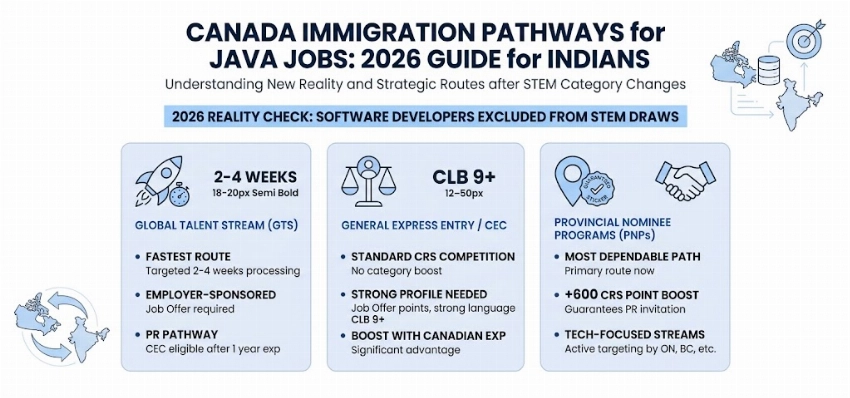
What Changed: STEM Category-Based Draws No Longer Cover Software Developers
-
STEM Draws Revised: Express Entry's STEM category-based draws, previously one of the more accessible PR routes for Java developer jobs in Canada, were significantly revised in 2026.
-
Occupation List Slashed: IRCC cut the STEM occupation list down to just 11 roles, removing software developers, data scientists, web designers, database analysts, and computer systems managers.
-
Old Advice Is Outdated: If older content told you to target the STEM category draws as a Java developer, that guidance is no longer accurate for Java developer jobs in Canada for Indian applicants.
-
New Strategy Needed: Java developers should now plan around three alternative routes outlined below.
1. Global Talent Stream (GTS) — Fastest Employer-Sponsored Route
-
Speed Advantage: Still the fastest route into Canada for tech talent in 2026, with LMIA processing targeted at 10–12 business days and work permits often issued within two weeks.
-
AI/Tech Fast-Track: A new AI/tech fast-track announced in 2026 aims to bring total processing to around 20 business days for qualifying roles.
-
Employer Requirements: Requires a job offer from a Canadian employer participating in GTS, plus a Labour Market Benefits Plan from the employer's side.
-
Path to PR: After one year of Canadian work experience on a GTS permit, Java jobs in Canada for Indian professionals become eligible for Canadian Experience Class (CEC) through Express Entry.
2. General Express Entry / Canadian Experience Class (CEC)
-
Standard CRS Competition: No longer boosted by STEM category eligibility for software roles, so this route now runs on standard CRS competition.
-
Competitive Profile Needed: A valid job offer with LMIA-backed points, strong language scores (CLB 9+), and a bachelor's degree can still put candidates in a competitive CRS range.
-
Canadian Experience Boost: Canadian work experience (via GTS or another work permit) meaningfully improves your position for Java jobs in Canada for Indian applicants.
-
Education Matters: Higher education credentials (Master's/PhD) and ECA reports remain critical for maximizing CRS points.
3. Provincial Nominee Programs (PNPs) — Now the More Reliable Route
-
Tech-Focused Streams: Ontario's OINP tech streams and British Columbia's BC PNP Tech Pilot continue to actively target software and IT occupations that STEM draws no longer cover.
-
600-Point Boost: A provincial nomination adds 600 CRS points, which effectively guarantees an Express Entry invitation in the next round.
-
Most Dependable Path: This has become the primary PR pathway for Java developer jobs in Canada, now that STEM draws exclude the role.
-
Multiple Provinces: Beyond Ontario and BC, provinces like Alberta and Nova Scotia also run tech-friendly PNP streams worth exploring.
2026 Immigration Pathways Comparison Table
Strategic Takeaway for Indian Java Developers
-
Best Combo Strategy: Start with GTS for fast entry → gain Canadian experience → apply via PNP or CEC for PR.
-
Salary + PR Alignment: Targeting Toronto or Vancouver employers not only maximises your Java jobs in Canada salary but also strengthens PNP eligibility.
-
Act Early: Immigration rules for Java developer jobs in Canada are evolving rapidly; lock in your pathway before further policy shifts in late 2026.
As per TerraTern Expert Shreya, don't apply under the assumption that a "tech" job offer gets you fast-tracked through STEM category draws in 2026 it doesn't for software developers anymore. Structure your application around GTS for the work permit and an Ontario or BC PNP tech stream for PR instead.
Also Read: Developer Jobs in Canada: Latest Pay, Scope & More
Building a Canada-Ready Resume for Java Roles
Use a reverse-chronological format, kept to 1–2 pages, with no dense paragraphs.
-
Lead with your stack and impact: Java, Spring Boot, microservices, RESTful APIs, and cloud platform experience framed around measurable outcomes ("reduced transaction latency by 30%" rather than "worked on backend systems").
-
Tailor each resume to the job description, mirroring its keywords, since many Canadian employers screen applications through ATS software.
-
Leave out your photo, marital status, and religion; none of these are expected on a Canadian resume, and including them can work against you.
-
Resumes built this way perform well against ATS screening for Java developer jobs in Canada while giving hiring managers a fast, scannable read.
|
Include |
Leave Out |
|
Quantified impact statements (latency, uptime, cost savings) |
Photograph |
|
Java, Spring Boot, microservices, REST API, cloud keywords |
Marital status |
|
Reverse-chronological work history, 1–2 pages |
Religion |
|
Keywords mirrored from the target job description |
Dense, unstructured paragraphs |
Also Read: CA Salary in Canada: Experts Latest Research Insights 2025
Networking Strategies for Indian Java Developers
A consistent presence across these channels compounds over time — recruiters searching for java developer jobs in Canada candidates increasingly source through LinkedIn and GitHub before resumes ever enter the pipeline.
-
LinkedIn: keep your headline current and specific ("Java Developer — Spring Boot — Microservices Cloud") and engage directly with Canadian recruiters and hiring managers.
-
Tech Meetups and Conferences: Toronto and Vancouver both run active in-person and virtual meetup scenes for backend and Java-specific communities.
-
Open-source and Forums: contributing to GitHub projects and staying active on Stack Overflow gives Canadian employers something concrete to evaluate beyond a resume.
|
Channel |
How to Use It |
|
|
Specific headline + direct outreach to recruiters and hiring managers |
|
Meetups & conferences |
Attend Toronto/Vancouver backend and Java community events |
|
Open-source / Stack Overflow |
Build a visible, evaluable public contribution record |
Top Industries Hiring Java Developers in Canada
Banking remains the strongest combination of pay and volume for Java developer jobs in Canada, with e-commerce and Montreal's AI ecosystem offering the next-best concentrations of demand.
- Banking and Financial Services: RBC, TD Bank, Scotiabank, and CIBC continue to run large in-house Java teams for trading systems, payment gateways, and risk platforms, making this the highest-paying sector for Java skills.
- E-commerce: Shopify, Amazon Canada, and Walmart Canada hire Java developers into API design, microservices, and cloud infrastructure roles supporting high-volume transaction systems.
- AI and Machine Learning-Adjacent Firms: Montreal's AI research ecosystem (Mila and affiliated startups) continues to need Java for data pipeline and backend infrastructure work supporting ML systems, even where the core research is done in Python.
|
Industry |
Example Employers |
Typical Java Focus |
|
Banking & financial services |
RBC, TD Bank, Scotiabank, CIBC |
Trading systems, payment gateways, risk platforms |
|
E-commerce |
Shopify, Amazon Canada, Walmart Canada |
API design, microservices, cloud infrastructure |
|
AI/ML-adjacent (Montreal) |
Mila and affiliated startups |
Data pipelines, backend infrastructure for ML systems |
Also Read: Software Engineer Jobs in Canada: Latest Pay, Scope
What Challenges Do Indian Java Developers Commonly Face, and How to Handle Them?
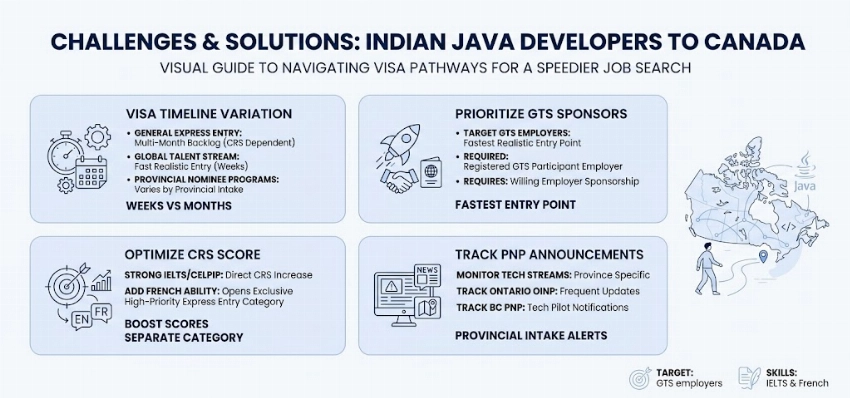
Visa timelines vary sharply by pathway. General Express Entry can run a multi-month backlog depending on CRS competition; the Global Talent Stream (GTS) is comparatively fast (weeks) but requires an employer already willing to sponsor; PNP tech streams sit somewhere in between depending on the province's current intake.
-
Prioritise applying to employers who are registered GTS participants; this is now the fastest realistic entry point.
-
Build your CRS score with strong IELTS/CELPIP results and, where possible, French-language ability, since it opens an entirely separate high-priority Express Entry category.
-
Track Ontario and BC PNP tech stream intake announcements directly, since these change more frequently than federal programmes.
-
Choosing the right pathway rather than defaulting to Express Entry alone is often the difference in how quickly a Java developer jobs in Canada search converts into an actual offer and work permit
|
Pathway |
Typical Timeline |
Best Suited For |
|
Express Entry (general) |
Multi-month, CRS-dependent |
Candidates with strong CRS scores or French ability |
|
Global Talent Stream (GTS) |
Weeks |
Candidates with an employer already willing to sponsor |
|
PNP tech streams (Ontario, BC) |
Varies with provincial intake |
Candidates tracking provincial announcements closely |
Also Read: Canada Python Developer Jobs: Latest Pay, Scope & More
Adapting to Canadian Workplace Culture
Adjusting to these norms early helps Indian developers integrate faster into teams built around Java developer jobs in Canada, where visibility and direct feedback carry more weight than in many hierarchical workplace cultures.
-
Communication is direct feedback, and disagreements are usually stated plainly rather than implied.
-
Networking matters for advancement; internal mobility and promotions are often influenced by visibility, not just output.
-
Feedback culture runs both ways; Canadian managers commonly solicit feedback from reports, which can feel unfamiliar coming from more hierarchical workplace norms.
|
Aspect |
Canadian Workplace Norm |
|
Communication style |
Direct; feedback and disagreement stated plainly |
|
Career advancement |
Driven by visibility and networking, not output alone |
|
Feedback flow |
Two-way — managers actively solicit input from reports |
Conclusion
Java developer jobs in Canada remain a realistic, well-paying target for Indian professionals in 2026, with Toronto's banking sector leading on salary and volume.
This year's key shift is on immigration: Express Entry's STEM category no longer covers software developer roles, making the Global Talent Stream and Ontario or BC PNP tech streams the more dependable route to a work permit and PR. Contact TerraTern to plan your Java developer visa pathway for Canada.
Contact TerraTern for more information on Java Developer Jobs in Canada.