


Key Highlights
- How to Move Out of India?
- Why Do People Move Out of India?
- How Do You Choose the Right Country to Move To?
- What Documents Do You Need Before Moving Out of India?
- How Do You Convert Your Bank Accounts Before Leaving India?
- Do You Need to Take a Language Test to Move Out of India?
- How Do You Plan Your Finances for Moving Abroad?
- What Is the Step-by-Step Timeline for Moving Out of India?
- What Should You Do After You Arrive in Your New Country?
- Industry Context Section
- Conclusion
Moving abroad is a major life decision that requires careful planning, financial preparation, and the right visa. Learning how to move out of India involves more than booking a flight. You'll need to make the right decision on which country to move to, establish your right to obtain a visa, collect necessary paperwork, arrange funding, find housing, and prepare for life in an unfamiliar country.
Many Indian citizens relocate abroad through work, study, family, and long-term settlement routes. This guide explains how to move out of India step by step, from choosing a visa route to preparing for arrival.
How to Move Out of India?

The first step in moving out of India is to pick the correct immigration path, prepare the necessary documents, fulfil visa requirements, get approval, and arrange for your move at least six months in advance of departure. This varies depending on your intentions to relocate for work, study, permanent visa (PR), work or business, or family sponsorship. Take any language, skills, medical, or credential-assessment tests required for your chosen visa route.
-
Select Your Immigration Route: Work visa, student visa, PR, business visa or family sponsorship.
-
Investigate Your Country of Destination: Familiarise yourself with the visa requirements, eligibility, visa costs and employment and study prospects in your country of destination.
-
Have all Necessary Documents Ready: Valid passport, certificates of educational attainment, employment history, police clearance, tax records and necessary papers.
-
Plan Finances: Budget for visa fees, travel, accommodation deposits, health insurance, and initial living costs.
-
Apply for a Relevant Visa: Prepare a visa application with supporting documents and provide a set of biometrics or medical exams as necessary.
-
Make a Relocation Plan: Create a relocation checklist early, then schedule housing, insurance, flights, and shipping around your visa timeline.
Also Read: How to Get a Job Outside India? Expert's Guide for Freshers
Why Do People Move Out of India?
The main reasons are education, jobs, settlement, and family.
-
Each route has a different process, visa type, and document set.
|
Motivation |
One-line Explanation |
|
Study |
Students relocate from India for better universities, courses, and global exposure. |
|
Work |
Skilled professionals emigrate from India for higher salaries and stronger career growth. |
|
PR or citizenship |
Many move for permanent residency, long-term settlement, and citizenship pathways. |
|
Family reunification |
Some relocate from India to join a spouse, parents, or children abroad. |
Pro Tip: Your motivation for moving determines your visa category. Choosing the wrong visa route can delay an application or lead to refusal.
How Do You Choose the Right Country to Move To?
The right country depends on your visa eligibility, employment prospects, language requirements, cost of living, and long-term goals. To move out of India, this comparison helps match your goal to the right destination.
-
Pick a country where your skills are in demand.
-
Check whether the country offers a clear PR route.
-
Compare language rules before applying.
-
If family migration matters, prioritise settlement-friendly destinations.
|
Country |
Popular Visa Route |
Language Requirement |
Avg. Time to PR |
Best For |
|
PR, work permit |
English/French |
Varies by programme, invitation rounds, eligibility, and processing times. |
Skilled workers |
|
|
Work visa, Blue Card |
German helpful |
Varies by residence permit. Eligible skilled workers may qualify for a settlement permit after three years, while EU Blue Card holders may qualify after 21 or 27 months, depending on German-language ability. |
Engineers, IT |
|
|
Skilled visa |
English |
Some skilled visa subclasses can lead directly to permanent residence, subject to invitation, points, occupation, health, and character requirements. |
Skilled migrants |
|
|
Work visa |
English |
The UAE does not have a conventional permanent-residence system, but eligible residents may obtain long-term residence options, such as the Golden Visa. |
Jobs, tax-free income |
|
|
Skilled Worker Visa |
English |
Many settlement routes require five years, but the qualifying period depends on the visa category. |
Professionals |
|
|
H-1B, student |
English |
Employment-based, family-based, investor, and other immigrant visa routes; temporary H-1B status may support an employment-based green-card process. |
Tech, study |
Key Note: Don't choose a country based on popularity alone. Match the country to the eligibility system that applies to your intended route, which may involve employer sponsorship, qualifications, family links, investment, or points.
What Documents Do You Need Before Moving Out of India?
Preparing the correct paperwork is one of the most important steps in how to move out of India. Missing or expired documents can delay your visa approval, travel, or settlement abroad.
|
Document |
Where to Obtain |
Processing Time |
Mandatory For |
|
Passport |
Passport Seva |
Varies |
All travelers |
|
Visa approval |
Destination country embassy/portal |
Varies |
Entry and stay |
|
Passport Seva |
Usually days to weeks |
Processing times vary by Passport Seva office, address-verification requirements, and the applicant’s circumstances |
|
|
Income Tax Clearance Certificate (ITCC) |
Income Tax Department |
Case-specific |
Rare tax cases |
|
Medical records |
Hospital/vaccination centre |
Immediate to a few days |
Health checks |
|
Educational certificates |
School/college/university |
Immediate if available |
Study and work visas |
What Is an Income Tax Clearance Certificate (ITCC) and Do You Need One?
Moving out of India does not require an Income Tax Clearance Certificate (ITCC) for most Indian citizens.
-
An Income Tax Clearance Certificate may be required only in limited cases under India’s tax rules; it is not a standard document for every person leaving India.
-
Most travellers leaving India for work, study, or permanent residency are not required to obtain an ITCC.
-
ITCC may be requested only in specific situations under Indian tax regulations, such as for certain foreign nationals or special tax-related cases.
-
If tax clearance is required in your circumstances, follow the current process prescribed by the Income Tax Department.
-
Check the latest government requirements before departure to determine whether an ITCC is necessary.
How Do You Get a Police Clearance Certificate (PCC)?
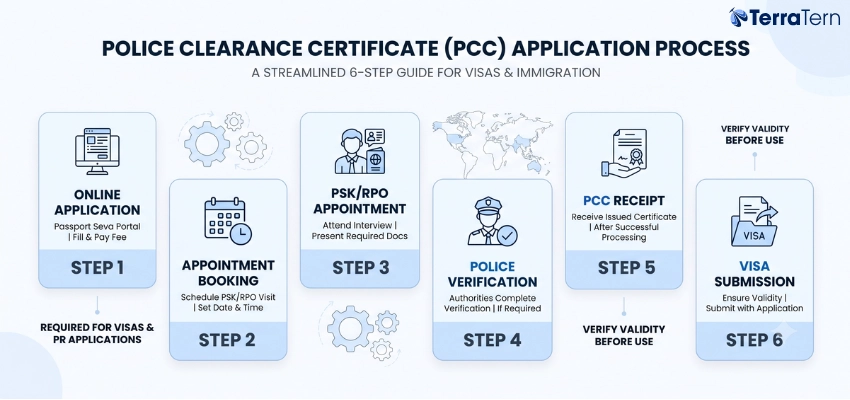
Many visa and immigration applications require a Police Clearance Certificate (PCC).
-
Apply online through the Passport Seva Portal or at the nearest Passport Seva Kendra (PSK) or Regional Passport Office (RPO).
-
Fill out the PCC application form and pay the prescribed fee.
-
Schedule and attend your appointment with the required documents.
-
Carry your passport, address proof, and any additional documents requested.
-
Complete police verification if required by the authorities.
-
Receive the PCC after successful verification and processing.
-
Ensure the PCC is valid when submitting your visa or permanent residency application.
What Other Documents Should You Prepare?
How to move out of India requires organising both original documents and certified copies.
-
Academic transcripts, degrees, and professional certifications.
-
Updated resume or CV and employment reference letters.
-
Job offer letter or university admission letter.
-
Birth and marriage certificates, if applicable.
-
Recent passport-size photographs meeting visa specifications.
-
International health insurance policy documents.
-
Medical examination and vaccination certificates, where required.
-
Proof of accommodation in your destination country.
-
Flight bookings and travel itinerary.
-
Copies of important documents stored securely in cloud storage and printed for backup.
As per our TerraTern Expert Divyansh, ITCC is only mandatory in specific tax-liability scenarios, not for every traveller. Confirm your obligation with a tax consultant before assuming you need one.
Also Read: 9 Best Jobs to Settle Abroad from India: Updated
How Do You Convert Your Bank Accounts Before Leaving India?
When preparing how to move out of India, updating your banking status is a mandatory legal compliance step.
-
Inform your Bank: Notify your bank promptly once your residential status changes under FEMA and follow its KYC and redesignation process.
-
Submit Required KYC: Provide the documents requested by your bank, which may include identity documents, PAN, passport, visa or residence proof, and an overseas address.
-
Fill out Conversion Forms: Sign the specific resident-to-NRO conversion application and FEMA declarations provided by your bank.
-
Wait for Processing: The bank will verify your documents. Processing times vary by bank, branch, documentation, and KYC checks.
What Is the Difference Between an NRE and NRO Account?
When you become a person resident outside India under FEMA, your existing resident account should be redesignated as an NRO account. Opening an NRE account is optional and depends on your banking needs.
|
Feature |
NRE Account (Non-Resident External) |
NRO Account (Non-Resident Ordinary) |
|
Purpose |
Parking foreign income earned outside India |
Managing income earned within India (e.g., rent, dividends) |
|
Repatriation |
Fully and freely repatriable to your new country |
Repatriation is generally permitted up to USD 1 million per financial year, subject to applicable taxes, documentation, and RBI/FEMA conditions. |
|
Taxability |
Interest earned is completely tax-free in India |
Interest earned is taxable in India (TDS applies) |
|
Currency |
Maintained in Indian rupees and funded through permitted foreign-currency remittances or transfers from eligible accounts |
Maintained in INR, and deposited in Indian Rupees |
Expert Tip: Delaying NRE/NRO conversion after becoming an NRI can trigger FEMA non-compliance. Contact your bank promptly after your FEMA residential status changes to update your account classification.”
Do You Need to Take a Language Test to Move Out of India?
Language-test requirements depend on the destination, visa route, institution, profession, and possible exemptions. If you are evaluating how to move out of India, securing your language certification is a primary hurdle.
|
Destination |
Required Test Options |
Minimum Score Band |
|
Canada |
IELTS General, PTE Core |
For Canada, the required test and score depend on the immigration programme. Federal Skilled Worker applicants must meet the applicable Canadian Language Benchmark requirement in each language ability. |
|
Australia |
IELTS General, PTE Academic |
For Australian skilled migration, ‘Competent English’ is usually demonstrated through approved test results that meet the required score in each component. |
|
United Kingdom |
IELTS UKVI, PTE Academic UKVI |
For the UK, English-language requirements vary by visa route and profession. Some healthcare roles also require separate registration standards set by the relevant regulator. |
|
Germany |
Goethe-Zertifikat, telc, or IELTS |
Germany’s language requirements vary by route and occupation. For example, some Opportunity Card applicants need at least A1 German or B2 English, while regulated professions may have separate German-language requirements. |
Important Tip: Book your language test at least 3 months before your visa application deadline; score reports and retake slots often have longer waits than expected.
How Do You Plan Your Finances for Moving Abroad?
Budget for visa fees, one-way/relocation travel, 3–6 months of living expenses in your destination currency, health insurance, and shipping costs before you move out of India. A solid financial buffer is critical when executing a plan on how to move out of India. Below is a rough cost-category checklist and budget range by destination tier for a single professional:
|
Cost Category |
Tier 1 (USA, Canada, UK, Australia) |
Tier 2 (Germany, France, EU) |
Tier 3 (UAE, Singapore, Asia) |
|
Visa & Processing Fees |
INR 1,50,000 – INR 3,00,000 |
INR 50,000 – INR 1,00,000 |
INR 20,000 – INR 70,000 |
|
Relocation Flight |
INR 70,000 – INR 1,20,000 |
INR 45,000 – INR 80,000 |
INR 15,000 – INR 35,000 |
|
Housing (Deposit + 1st Month) |
INR 1,50,000 – INR 3,00,000 |
INR 1,00,000 – INR 2,00,000 |
INR 80,000 – INR 2,00,000 |
|
Health Insurance |
INR 50,000 – INR 1,00,000 |
INR 40,000 – INR 80,000 |
Often employer-sponsored |
|
3–6 Month Living Buffer |
INR 4,00,000 – INR 8,00,000 |
INR 3,00,000 – INR 5,00,000 |
INR 2,00,000 – INR 4,00,000 |
|
Miscellaneous (Shipping, Setup) |
INR 50,000 – INR 1,00,000 |
INR 30,000 – INR 60,000 |
INR 20,000 – INR 50,000 |
Expert Advice: Keep a minimum 3-month emergency buffer in your destination currency; visa processing delays abroad are common and can strain a tight budget.
Also Read: How to Migrate to Germany from India? Experts Guide
What Is the Step-by-Step Timeline for Moving Out of India?
A successful move out of India follows a structured timeline, starting with visa and documentation 6 months out, financial and shipping arrangements 3 months out, and final logistics (packing, goodbyes, travel confirmation) in the last month. Understanding the timeline is the most critical part of figuring out how to move out of India without expensive delays.
|
Phase |
Key Focus Area |
India-Specific Compliance Tasks |
|
6 Months Out |
Visas & Qualifications |
Passport renewal, Police Clearance Certificate (PCC), Degree attestation. |
|
3 Months Out |
Finances & Logistics |
NRE/NRO account conversion, ITCC tax checks, Shipping quotes. |
|
1 Month Out |
Transition & Health |
Embassy medical checks, Forex card loading, Insurance purchase. |
|
Final Week |
Departure Prep |
Document folder organisation, Local SIM conversion, Cash withdrawal. |
What Should You Do 6 Months Before Departure?
Start your journey on how to move out of India by finalising your exact visa route (study, work, or PR) and destination country.
-
Book and prepare for your mandatory language proficiency tests (such as IELTS, PTE, or Goethe-Zertifikat).
-
Apply for your Police Clearance Certificate (PCC) via the local Passport Seva Kendra, as processing appointments and police verification can take several weeks.
-
Send your academic degrees for official credential evaluation (e.g., WES) or secure apostille attestation required by foreign embassies.
-
Renew your Indian passport immediately if it has less than 2 years of validity remaining.
What Should You Do 3 Months Before Departure?
Researching financial compliance is a massive part of how to move out of India. Discuss redesignating your resident account as an NRO account with your bank once your FEMA residential status changes; consider opening an NRE account if it suits your foreign-income and repatriation needs.
-
File your Income Tax Return (ITR) and verify if you fall under the new 2026 rules for an Income Tax Clearance Certificate (ITCC) under Section 420 of the Income Tax Act. You may need to submit forms to ensure no pending tax liabilities restrict your departure.
-
Request quotes from international moving companies and start aggressively decluttering your home.
-
Book refundable or flexible travel only after considering your visa decision timeline and any visa-specific travel restrictions.
-
Start hunting for short-term accommodation, Airbnb, or co-living spaces in your destination country.
What Should You Do 1 Month Before Departure?
To figure out how to move out of India smoothly, formally serve notice to your employer, landlord, and domestic utility providers.
-
Purchase comprehensive international health insurance that covers you from the exact moment you land.
-
Complete your mandatory medical check-ups with embassy-approved panel physicians.
-
Arrange a suitable foreign-exchange option, such as a multi-currency card, an international debit card, or a small amount of local currency.
-
Finalise international shipping arrangements and sell any remaining vehicles, heavy appliances, or furniture in India.
What Should You Do in Your Final Week in India?
The final stage of how to move out of India involves packing your suitcases and weighing them to strictly avoid airline excess baggage fees.
-
Organise a physical folder carrying your original passport, visa grant letter, ITCC proofs, medical records, and university or job offer letters.
-
Withdraw a small amount of physical cash in your destination’s currency for immediate airport expenses (like taxis, food, or local SIM cards).
-
Cancel your Indian broadband and convert your Indian mobile number to the cheapest international roaming or prepaid plan, this is crucial to keep your banking OTPs active overseas.
-
Spend quality time saying goodbye to family and friends before heading to the airport.
Important Note: Applicants who start visa paperwork less than 3 months before their target departure date face the highest rate of last-minute rejections and rescheduling.
What Should You Do After You Arrive in Your New Country?
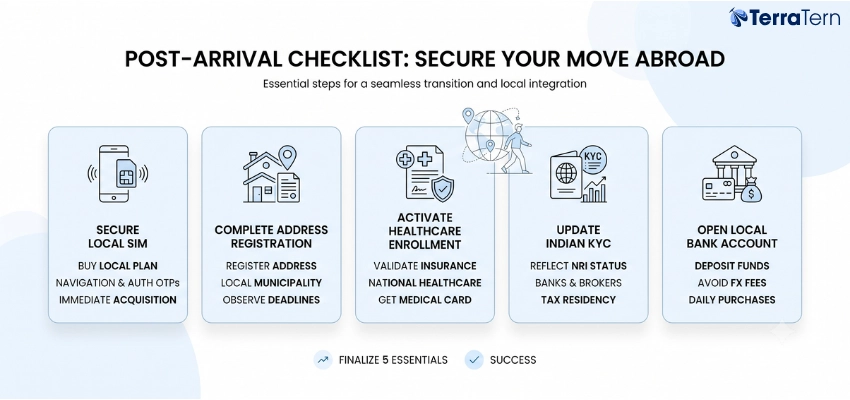
After arriving abroad, register with local authorities, open a local bank account, activate health insurance, and update your NRI status with Indian banks and tax authorities. Completing this checklist is the final step in learning how to move out of India securely without leaving loose ends.
-
Secure a Local SIM: Buy a local phone plan immediately for navigation and to receive authentication OTPs for local services.
-
Complete Address Registration: Register your new residential address with the local municipality or city council. Complete address registration within the deadline set by your destination country or local municipality. The process and deadline vary by location.
-
Activate Healthcare Enrollment: Validate your international health insurance or register for the national healthcare system to receive your local medical card.
-
Update Indian KYC: Log in to your Indian financial portals and update your contact details and tax residency where required with banks, brokers, mutual-fund platforms, insurers, other financial institutions, and mutual fund portfolios to reflect your new NRI status.
-
Open a Local Bank Account: Deposit your transferred funds into a local bank account to avoid expensive foreign transaction fees on daily purchases.
Pro Tip: Notify your Indian bank of your new NRI status within the RBI-recommended window; delays can complicate future repatriation of funds.
Industry Context Section
In 2026, Indian emigration is being shaped by rising skilled-worker demand in Canada and Germany, stricter income tax clearance enforcement and growing digitisation of visa processes. If you are researching how to move out of India this year, these are the most critical industry trends shaping the landscape:
-
Outbound Migration Boom: Over 1.4 million Indians are emigrating annually, with the Indian diaspora reaching a record 32 million globally in recent years.
-
Stricter ITCC Enforcement: The Income Tax Department has tightened regulations around the Income Tax Clearance Certificate (ITCC) under Section 230. Non-residents and individuals permanently relocating must ensure all tax liabilities are cleared before departure.
-
Germany's Opportunity Card: The new Chancenkarte point-based system allows Indian professionals scoring at least 6 points to live in Germany for 12 months to search for a job without needing prior employer sponsorship.
-
Canada Express Entry Shifts: With Canada dynamically adjusting its overall PR targets, the Express Entry draws in 2026 heavily prioritise category-based selections, meaning Indian applicants need targeted skills (like healthcare or trades) to compete effectively.
-
Testing Format Updates: PTE Core and IELTS One Skill Retake have become widely accepted for PR applications across major destinations in 2026, offering more flexibility for candidates struggling with a single testing module.
-
RBI Compliance Audits: Recent RBI/FEMA audits in 2025–2026 have resulted in stricter penalties for NRIs who fail to promptly convert their resident savings accounts into NRO/NRE accounts after relocating.
Key Note: Emigration rules change yearly; always verify ITCC and NRE/NRO requirements against the current financial year before finalising your departure date.
Also Read: How to Get a Job in Europe from India Guide
Conclusion
Successfully learning how to move out of India comes down to sequencing your visa strategy right first, then layering in financial, legal, and logistical steps on a clear timeline. By mastering these five pillars (visa selection, document attestation, NRE/NRO conversion, language testing, and timeline execution), you can eliminate the friction of international relocation. Ready to start your journey? Book a personalised consultation and eligibility check with TerraTern today.
Contact TerraTern for more information on How to Move Out of India: Complete Step-by-Step Guide 2026.




 AI Summary