


Key Highlights
- What Is the Overall Cost of Living in Australia vs Canada in 2026?
- How Does Rent and Housing Cost Compare in Australia vs Canada?
- How Do Food and Grocery Costs Differ in Australia vs Canada?
- What Is the Salary and Income Comparison Between Australia and Canada?
- How Does Healthcare Cost Compare in Australia vs Canada for Immigrants?
- What Are the Transportation Costs in Australia vs Canada?
- How Do Education and Childcare Costs Compare in Australia vs Canada?
- Which Country Has Better Immigration Opportunities: Australia or Canada?
- What Is the Overall Quality of Life Comparison in Australia vs Canada for Indians?
- Which Country Is Cheaper — Australia or Canada — for Indians in 2026?
- Conclusion
By 2026, the Australian vs Canadian cost of living will continue to benefit Canada predominantly, with most findings indicating that Canada will be approximately 10-15% cheaper overall for one person. The two countries are also more expensive than the international average; however, rent, transport, and restaurant prices are lower in Canada than in Australia, since the averages are offset by higher salaries. This makes Canada a little more affordable for students and immigrants, given the cost of living in Australia vs Canada.
What Is the Overall Cost of Living in Australia vs Canada in 2026?
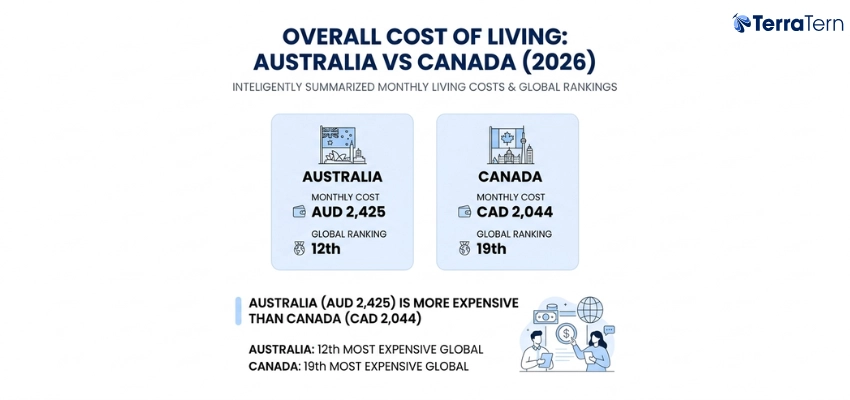
On the whole, Australia is more expensive than Canada in 2026, though the average amount spent every month is approximately AUD 2,425 (approximately 134 thousand rupees), and the cost of living in Canada is also expected to be approximately CAD 2044 (almost 113 thousand rupees). Based on the cost of living in Australia vs Canada, both countries are expensive by global standards, and Australia, however, ranks 12th most expensive, compared to Canada, which ranks 19th.
|
Indicator |
Australia (Avg) |
Canada (Avg) |
|
Monthly cost of living |
AUD 2,425 (~INR 1.34 lakh) |
CAD 2,044 (~INR 1.13 lakh) |
|
Rent index (relative) |
Higher (≈11–14% more) |
Slightly lower |
|
Groceries index |
Slightly higher |
Slightly lower |
|
Purchasing Power Index |
Higher (≈1.7 months’ expenses covered by typical salary) |
Moderate (≈1.5 months’ expenses) |
As per TerraTern Expert, Shreya, Canada is cheaper on paper, but your real purchasing power depends heavily on which city you choose to live in. Calgary or Adelaide is very different from Toronto or Sydney.
Also Read: Australia or Canada: Which is Better for Immigration?
How Does Rent and Housing Cost Compare in Australia vs Canada?
Rent is normally very costly in Australia, especially in Sydney and Melbourne. The average price of a 1-bedroom is AUD 2,209/month in the Australian city centre, and in Canada, it is CAD 1,865/month; this is almost 18 times higher. The median price of houses in Sydney and Melbourne consistently exceeds AUD 900,000, but housing affordability increases dramatically in the mid-tier and small cities in Canada. Renting outside major hubs such as Sydney, Melbourne, Toronto, or Vancouver is significantly more economical in both countries.
City-wise Rent Snapshot (2026)
|
City type/location |
1-bed city centre (AUD) |
2-bed city centre (AUD) |
1-bed outside centre (AUD) |
1-bed city centre (CAD) |
1-bed city centre (INR approx)* |
Country |
|
Sydney |
≈2,300 |
≈3,200+ |
≈1,800–1,900 |
– |
≈INR 1.26 lakh |
Australia |
|
Melbourne |
≈2,100–2,200 |
≈2,900–3,100 |
≈1,600–1,700 |
– |
≈INR 1.16–1.21 lakh |
Australia |
|
Brisbane |
≈1,600–1,800 |
≈2,300–2,500 |
≈1,200–1,400 |
– |
≈INR 0.88–0.99 lakh |
Australia |
|
Perth |
≈1,800–2,000 |
≈2,500–2,700 |
≈1,400–1,600 |
– |
≈INR 0.99–1.10 lakh |
Australia |
|
Adelaide |
≈1,500–1,700 |
≈2,200–2,400 |
≈1,100–1,300 |
– |
≈INR 0.82–0.93 lakh |
Australia |
|
Toronto |
– |
– |
– |
≈2,500–2,800 |
≈INR 1.38–1.54 lakh |
Canada |
|
Vancouver |
– |
– |
– |
≈2,800+ |
≈INR 1.54 lakh+ |
Canada |
|
Calgary |
– |
– |
– |
≈1,600–1,800 |
≈INR 0.88–0.99 lakh |
Canada |
|
Ottawa |
– |
– |
– |
≈1,800 |
≈INR 0.99 lakh |
Canada |
|
Montreal |
– |
– |
– |
≈1,600 |
≈INR 0.88 lakh |
Canada |
Which Are the Most Affordable Cities to Live in Australia for Indians?
The cheapest cities to live in Australia as an Indian are:
-
Brisbane: The cheapest of the three cities to rent (around AUD 1,600-1,800 1-bed apartment in the city centre), high livability, and an Indian population is on the rise; it is an excellent choice that Indians migrating to Brisbane should consider.
-
Adelaide: A little cheaper living standards, where median rents were approximately AUD 1,5001,700; often referred to as among the cheapest capital cities in Australia.
-
Perth: Mid-tier rental rates and rather low transaction-based housing peaks relative to Sydney/Melbourne, and, hence, is favourable in terms of the cost of living in Australia vs Canada index.
Which Are the Most Affordable Cities to Live in Canada for Indians?
These cities are relatively more comfortable in terms of housing-to-salary ratios compared to the cost of living in Australia vs Canada, particularly for Indian professionals and families. The most affordable cities in Canada are:
-
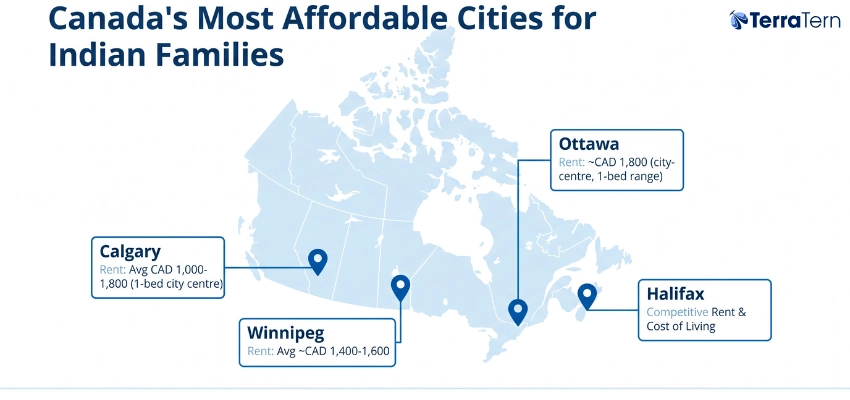
Calgary: Good cheap rent (average CAD 1,000-1,800 in a 1-bed in the city centre), no provincial income tax in Alberta, and good employment opportunities in energy and technology; a place liked by Indian families.
-
Ottawa: Median housing prices (CAD 1,800 city-centre, 1-bed range), good employment in the public sector and a well-established Indian community.
-
Halifax: Offers competitive rent and a lower overall cost of living, which has contributed to a growing Indian student population and strong quality-of-life indices.
-
Winnipeg: One of the most affordable cities in Canada (average rent ≈CAD 1,400-1600), but with a smaller yet friendly Indian population; this is a good option when Indian migrants are not interested in spending.
Important Note: Indians moving to Canada should seriously consider Calgary or Ottawa; lower housing costs, combined with Alberta's zero provincial income tax, can mean INR 3–5 lakh in annual savings compared to Toronto.
How Do Food and Grocery Costs Differ in Australia vs Canada?
The price of food and groceries is relatively higher in Canada compared to Australia. Comparing the cost of living in Australia and Canada will reveal that the average monthly cost of grocery shopping in Australia (a single person) is AUD 400-600 (approximately INR 22,000-33,000) and in Canada is CAD 300-450 (approximately 16,500-24,750), which again tilts the cost of living in Australia vs Canada in Canada’s favour.
|
Item (per kg or standard pack) |
Australia (AUD) |
Canada (CAD) |
India (INR) |
|
Milk (1 L) |
1.50–2.00 |
1.30–1.80 |
50–70 |
|
Bread (500 g) |
3.00–4.00 |
2.50–3.50 |
40–60 |
|
Eggs (12) |
5.00–7.00 |
4.00–5.50 |
60–90 |
|
Rice (1 kg, white) |
2.50–3.50 |
1.80–2.80 |
30–50 |
|
Dal/lentils (1 kg) |
3.00–4.50 |
2.50–3.50 |
90–130 |
|
Chicken (1 kg) |
10.00–15.00 |
8.00–12.00 |
200–300 |
|
Mid-range restaurant meal |
25–35 |
18–28 |
400–600 |
Expert Advice: Indians in both countries reduce food bills by 25–35% by shopping at Indian grocery stores in ethnic neighbourhoods. Factor this into your monthly budget, especially in Toronto's Brampton or Melbourne's Dandenong.
What Is the Salary and Income Comparison Between Australia and Canada?
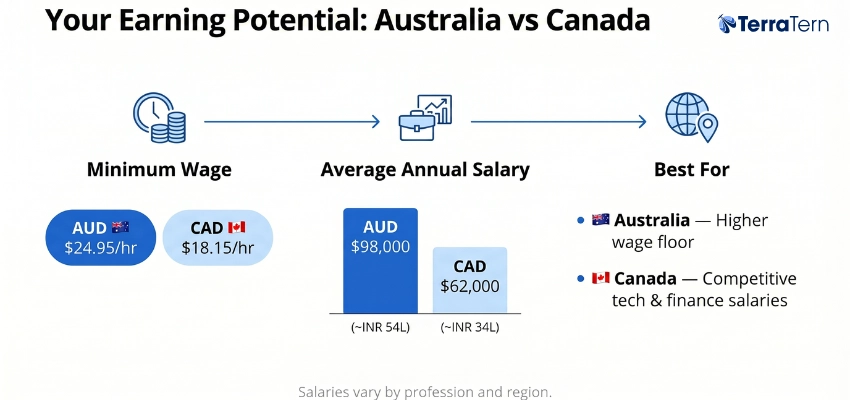
Australia offers higher minimum wages (AUD 24.95/hour as of mid-2026) compared to Canada’s federal minimum of CAD 18.15/hour. However, Canada often offers competitive salaries in tech and finance, especially when adjusted for lower living costs. The average annual salary is around AUD 98,000 (~INR 54 lakh) in Australia versus about CAD 62,000 (~INR 34 lakh) in Canada, though these vary widely by profession.
|
Profession |
Australia (AUD) |
Canada (CAD) |
Rough INR equivalent (AUD/CAD ≈ INR 55) |
|
Software Engineer |
110,000–140,000 |
90,000–120,000 |
~INR 60–77 lakh vs ~INR 50–66 lakh |
|
Doctor |
150,000–220,000 |
120,000–180,000 |
~INR 82–121 lakh vs ~INR 66–99 lakh |
|
Nurse |
80,000–100,000 |
70,000–90,000 |
~INR 44–55 lakh vs ~INR 38–50 lakh |
|
Civil Engineer |
85,000–110,000 |
70,000–90,000 |
~INR 47–60 lakh vs ~INR 38–50 lakh |
|
Accountant |
80,000–100,000 |
65,000–85,000 |
~INR 44–55 lakh vs ~INR 36–47 lakh |
|
Teacher |
65,000–85,000 |
55,000–70,000 |
~INR 36–47 lakh vs ~INR 30–38 lakh |
Is Salary in Australia Better Than Canada for Indian IT Professionals?
For Indian IT professionals, mid-level software engineers typically earn AUD 110,000–130,000 before tax in Australia versus CAD 90,000–115,000 in Canada, which translates to roughly INR 60–71 lakh vs INR 50–63 lakh post-tax after exchange-rate and tax adjustments.
-
Canada’s tech hubs (Toronto, Waterloo, Vancouver) have expanded rapidly, with strong demand and visa-friendly pathways, even though nominal salaries are slightly lower than in Australia.
-
When factoring in the cost of living in Australia vs Canada, Canadian tech salaries often feel more comfortable in big-city hubs due to lower housing and food costs.
How Does Income Tax Compare in Australia vs Canada?
Australia uses a progressive federal bracket system with a tax-free threshold of AUD 18,200; for a gross salary of ~INR 50 lakh (≈AUD 90,000), take-home is roughly 65–70% after tax and super.
-
Canada combines federal and provincial taxes; for a similar INR 50 lakh income (≈CAD 90,000), take-home is typically 60–67%, but drops less in Alberta due to no provincial income tax.
-
When viewed through the cost of living in Australia vs Canada, Alberta’s nil provincial tax and Canada’s universal healthcare can effectively boost real disposable income despite slightly lower headline wages.
Expert Tip: For Indian immigrants in mining, trades, or healthcare, Australia pays significantly more. For tech professionals eyeing the AI/startup ecosystem, Canada's Toronto–Waterloo corridor is increasingly competitive and offers lower living costs outside major cities.
Also Read: Canada vs. Australia - Where Should You Build Your Future?
How Does Healthcare Cost Compare in Australia vs Canada for Immigrants?
Both countries offer universal public healthcare. Australia’s Medicare covers citizens and permanent residents for free or subsidised care, including GP visits and most specialist services, significantly reducing out-of-pocket medical bills.
-
Both Australia and Canada rank in the global top 15 for healthcare quality, with strong infrastructure and skilled staff.
-
Australia generally offers faster GP access and shorter wait times for routine care than Canada.
-
In Canada, provincial plans fully cover hospital and doctor visits, but wait times for specialist care can stretch weeks to months.
-
Australia’s public system waiting times are moderate, though private insurance can further reduce delays for elective surgery.
-
For Indian immigrants, the cost of living in Australia vs Canada includes similar high-quality care, but Australia’s more immediate coverage after PR approval can ease early financial stress.
Do Indian Immigrants Need Private Health Insurance in Australia or Canada?
In Australia, Indian student- and temporary-visa holders must hold OVHC (Overseas Visitors Health Cover), typically costing AUD 600–900 per year, making this a fixed cost in the cost of living in Australia vs Canada for the first few years.
-
In Canada, permanent residents get provincial health insurance, but during the 3-month waiting period, they usually need private plans (around CAD 100–200/month), which is a short-term spike in living costs.
-
For Indian immigrants, planning for 3–6 months of private coverage in either country helps protect against unexpected medical bills and smooths the transition to the cost of living in Australia vs Canada.
Important Tip: Plan for at least CAD 150–200/month in private health insurance during Canada's 3-month waiting period, a cost most Indian immigrants underestimate when calculating their first-year budget.
What Are the Transportation Costs in Australia vs Canada?
Canada generally has cheaper transportation costs, with monthly public transit passes averaging roughly CAD 100–130 in major cities such as Toronto and Vancouver compared with AUD 150–200 in Sydney and Melbourne. Within the cost of living in Australia vs Canada, Australian cities are more car-dependent outside the CBD, while Canada’s large metros usually offer better-connected urban transit networks.
|
Item/city type |
Australia |
Canada |
|
Monthly transit pass (adult) |
Sydney/Melbourne: AUD 130–150/month |
Toronto/Vancouver: CAD 100–130/month |
|
One-way local transport ticket |
AUD 3.5–4.5 |
CAD 2.5–3.5 |
|
Fuel price per litre (approx.) |
AUD 2.00 |
CAD 1.60–1.80 |
|
Typical car ownership (annual) |
AUD 3,000–4,500 (incl. insurance, reg., fuel) |
CAD 2,500–4,000 (similar components) |
|
Relative car dependence outside the CBD |
Higher; suburbs are more car-focused |
Lower in major metros; transit reaches farther |
As per our Expert: If you're planning to live in a smaller Canadian or Australian city, factor in car ownership from day one. In Calgary or Brisbane, a car is nearly essential, and the costs can add AUD/CAD 600–900/month to your budget.
How Do Education and Childcare Costs Compare in Australia vs Canada?
Childcare is significantly cheaper in Canada. Monthly childcare costs average CAD 500–1,200 in Canada (with federal subsidy programs) versus AUD 1,500–2,500 in Australia, making Canada substantially more affordable for Indian families with young children. Within the cost of living in Australia vs Canada, Canada’s childcare-subsidy framework and lower tuition for many programs make it more budget-friendly for Indian families and students.
|
Item |
Australia (approx.) |
Canada (approx.) |
|
Monthly childcare (per child) |
AUD 1,500–2,500 |
CAD 500–1,200 (with subsidies) |
|
Public-school tuition (PR holder) |
Free |
Free |
|
International school tuition (annual) |
~AUD 15,000–30,000 |
~CAD 12,000–25,000 |
|
International undergrad tuition (annual) |
AUD 30,000–45,000 |
CAD 20,000–35,000 |
|
Health cover (student) |
OSHC: AUD 600–900/year |
UHIP-type or provincial: often ≤CAD 500 |
Which Country Is More Affordable for Indian Students: Australia or Canada?
For Indian students, Canada is generally more affordable on a month-to-month basis. Average monthly living costs for a student in Australia are roughly AUD 1,500–2,500, versus CAD 1,200–2,000 in Canada, with rent and groceries being the main areas of savings in Canada. Canadian institutions tend to award more automatic or need-based scholarships for international students, further improving the cost of living in Australia vs Canada for Indian students.
|
Factor |
Australia |
Canada |
|
Avg. monthly student living cost |
AUD 1,500–2,500 |
CAD 1,200–2,000 |
|
Post-study work rights (duration) |
2–5 years, depending on level |
1–3 years PGWP |
|
Work-allowed (student visa) |
Up to full-time, no strict weekly cap |
20 hours/week during term |
|
Typical scholarship availability |
Moderately competitive |
More generous federal/provincial schemes |
Pro Tip: Canada's federal $10/day childcare programme is a game-changer for Indian immigrant families. It can save a family INR 8–12 lakh annually compared to equivalent childcare costs in Sydney or Melbourne.
Which Country Has Better Immigration Opportunities: Australia or Canada?
Both countries have strong immigration pathways for skilled Indians, but their systems differ in speed and structure. Canada’s Express Entry is generally faster (6–12 months of processing), while Australia’s General Skilled Migration (GSM) is points-based and can take longer (often 6 months to 2+ years, depending on the visa subclass and backlog). Your eligibility and profession largely determine which route is easier, and the cost of living in Australia vs Canada then shapes which country is more affordable once you arrive.
Key Note: If speed to PR is your priority, Canada's Express Entry is generally faster. If salary and lifestyle are your priorities and your profession is in demand, Australia's skilled migration stream may offer a stronger long-term financial outcome.
What Is the Overall Quality of Life Comparison in Australia vs Canada for Indians?
Both countries rank among the world’s best for quality of life, but they offer slightly different advantages for Indian families. Australia scores higher for weather, outdoor lifestyle, and higher base wages, while Canada scores higher for cultural diversity, affordable childcare, and a strong social safety net all of which matter for long-term settlement planning. From the cost of living in Australia vs Canada perspective, Canada’s better-subsidised childcare and social protections make family life more affordable, while Australia’s higher wages and milder climate appeal to Indian singles and couples prioritising lifestyle.
As per TerraTern Expert, Divyansh, for Indians moving with family and planning long-term roots, Canada's stronger social safety net, free universal healthcare from day one (post-PR), and lower childcare costs often outweigh Australia's higher salaries, but if you're single or a couple, Australia's earning potential and lifestyle may be the edge.
Also Read: Canada or Australia: Which is Better for Indian Students
Which Country Is Cheaper — Australia or Canada — for Indians in 2026?
Cost of living in Australia vs Canada clearly favours Canada for most Indian families and professionals in 2026. Canada is roughly 12–19% cheaper overall, with lower rent outside Vancouver and Toronto, significantly cheaper childcare, and broadly similar or lower grocery and transit costs, even when accounting for higher tech-sector salaries in Australia.
1. Canada wins if you are
- Moving with a young family who will rely on Canada’s heavily subsidised childcare and universal healthcare, which shrinks the cost of living in Australia vs Canada for households.
- Settling outside Toronto and Vancouver (e.g., Calgary, Ottawa, Halifax, Winnipeg), where housing and rent are markedly lower than in Australian capital cities.
- A tech professional or healthcare worker prioritising faster PR through Express Entry, plus strong social-benefit levers such as healthcare and parental leave.
2. Australia wins if you are
- Working in mining, trades, or skilled physical roles where Australian wages and regional-nomination demand can offset the higher cost of living in Australia vs Canada.
- A single professional or couple without children who value higher base salaries, a warmer climate, and outdoor-focused lifestyles in cities like Brisbane, Adelaide, or Perth.
3. Monthly budget snapshot for Indians (approx., 2026)
- Single Person: ~INR 90,000 –1,10,000 in Canada vs ~INR 1,10,000–1,30,000 in Australia.
- Couple (No Kids): ~INR 1,40,000 – 1,70,000 in Canada vs ~INR 1,70,000–2,00,000 in Australia.
- Family of Four: ~INR 2,00,000 – 2,50,000 in Canada vs ~INR 2,60,000–3,20,000 in Australia, reflecting the cost of living in Australia vs Canada gap in housing and childcare.
Pro Tip: There is no universal "cheaper" country; it depends on your profession, family size, city choice, and long-term goals. Use a city-specific monthly budget calculator (not just national averages) before making your decision.
Conclusion
The cost of living in Australia vs Canada generally favours Canada, with lower rent outside major hubs, cheaper childcare, and comparable grocery bills. For Indian immigrants, Canada often offers better value for families and students, while Australia compensates with higher wages and a warmer, lifestyle-focused environment.
Contact TerraTern for more information on Cost of Living in Australia vs Canada: Which is Cheaper in 2026.




 AI Summary