Key Highlights
- Benefits of Banking Jobs in Germany
- Latest Facts and News
- Types of Banking Jobs in Germany
- Requirements for Banking Jobs in Germany for Indians
- Banking Jobs Salary in Germany
- Eligibility Criteria for Banking Jobs in Germany
- How to Apply for Banking Jobs in Germany?
- How TerraTern Can Help You With Banking Jobs in Germany
- Conclusion
Banking jobs in Germany remain a strong career path for Indians and other international professionals in 2026, offering competitive pay, clear progression, and visa-sponsoring roles in major financial hubs like Frankfurt, Munich, and Berlin. The German banking sector employs roughly over 550,000–600,000 people and continues to grow in digital banking, risk, and corporate finance, making it one of the most stable, high‑demand industries for foreigners.
Benefits of Banking Jobs in Germany
-
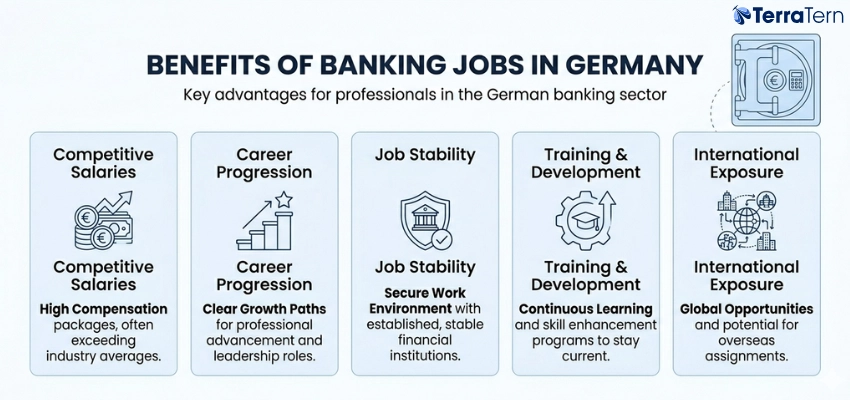
Competitive Salaries: Banking positions in Germany offer competitive compensation packages, often above average compared to other industries.
-
Career Progression: Opportunities for career advancement are plentiful, with clear paths for professional growth and development.
-
Job Stability: Banks in Germany are known for their stability, providing employees with a secure work environment.
-
Training and Development: Continuous learning and skill enhancement programs are common, ensuring employees stay updated with industry trends.
-
International Exposure: Many banks in Germany operate globally, offering employees exposure to international markets and opportunities for overseas assignments.
The banking sector in Germany stands as a pillar of its robust economy, encompassing a diverse array of financial institutions, from multinational banks to regional credit unions. Banking jobs in Germany play a pivotal role in driving economic growth, facilitating capital flow, and providing crucial financial services to businesses and individuals alike. Banking jobs in Germany contribute to the financial infrastructure and stimulate economic activity through lending, investment management, and financial advisory services. They are integral to maintaining stability in financial markets and supporting sustainable economic development.
Latest Facts and News
As Germany's banking sector continues to expand and evolve, recent developments highlight its pivotal role in the global financial landscape. Here are some key facts and trends shaping the industry's current trajectory:
-
Germany's banking sector employs over 600,000 people.
-
Recent trends show a 5% increase in banking job openings.
-
Major banks like Deutsche Bank and Commerzbank are expanding.
-
The average salary for banking professionals has risen by 3% in the past year.
-
Germany ranks 4th globally in terms of banking sector efficiency. Write a bridge for this
Types of Banking Jobs in Germany
Germany's banking sector offers a variety of career paths, each catering to different aspects of financial services.
1. Retail Banking:
-
Bank Teller: Handles daily customer transactions, such as deposits, withdrawals, and account inquiries.
-
Customer Service Representative: Assists customers with account management, product information, and problem resolution.
-
Branch Manager: Oversees the operations of a bank branch, manages staff, and ensures customer satisfaction.
2. Investment Banking:
-
Investment Banker: Provides financial advisory services, assists with mergers and acquisitions, and helps companies raise capital.
-
Equity Research Analyst: Analyses stocks and other securities to provide investment recommendations.
-
Trader: Buys and sells securities, commodities, or foreign currencies on behalf of the bank or its clients.
3. Corporate Banking:
-
Relationship Manager: Manages relationships with corporate clients, providing financial solutions and advisory services.
-
Credit Analyst: Evaluates the creditworthiness of corporate clients and assesses the risks of lending.
-
Treasury Manager: Manages the bank's liquidity, investments, and financial risk.
4. Private Banking and Wealth Management:
-
Wealth Manager: Provides personalised financial planning and investment management services to high-net-worth individuals.
-
Private Banker: Offers tailored banking services, including investment advice, to affluent clients.
-
Financial Advisor: Assists clients with retirement planning, investment strategies, and wealth preservation.
Also Read: How to Get Job in Germany from India? Latest Guide
5. Risk Management:
-
Risk Analyst: Identifies and assesses potential risks to the bank and develops strategies to mitigate them.
-
Compliance Officer: Ensures the bank complies with all regulatory requirements and internal policies.
-
Fraud Analyst: Detects and prevents fraudulent activities by analysing transaction data and trends.
6. Technology and Operations:
-
IT Specialist: Manages the bank's IT infrastructure, ensuring system security and efficiency.
-
Data Analyst: Analyses data to support decision-making processes and improve operational efficiency.
-
Operations Manager: Oversees the back-office operations, ensuring smooth and efficient transaction processing.
7. Financial Planning and Analysis:
-
Financial Analyst: Prepares financial reports, forecasts, and analyses to support strategic planning and decision-making.
-
Budget Analyst: Develops and monitors budgets, ensuring financial resources are allocated effectively.
-
Controller: Manages the bank's accounting and financial reporting functions, ensuring accuracy and compliance.
8. Human Resources and Training:
-
HR Manager: Manages recruitment, employee relations, and performance management within the bank.
-
Training and Development Specialist: Designs and implements training programs to enhance employee skills and knowledge.
-
Compensation and Benefits Manager: Develops and manages the bank's compensation and benefits programs to attract and retain talent.
Requirements for Banking Jobs in Germany for Indians
-
To land banking jobs in Germany for Indians, you must meet a mix of qualification, language, work‑permit, and soft‑skill requirements aligned with 2025–26 rules.
1. Educational & Professional Qualifications
-
A bachelor’s degree in finance, economics, accounting, or business is usually the minimum for most banking roles.
-
Master’s or MBA degrees are strongly preferred for investment‑banking, corporate‑finance, and senior‑risk roles.
-
International certifications such as CFA, FRM, or ACCA significantly strengthen your profile for risk, asset‑management, and corporate‑finance roles.
2. Work Experience
-
Relevant experience (2–5+ years) in commercial banking, investment banking, risk, compliance, or financial advisory is expected for mid‑level banking jobs in Germany.
-
Internships and project work in banking, asset management, or fintech are highly valued as evidence of practical skills.
3. Language Skills
-
German B2 level is often required for client‑facing and retail‑banking roles; A1–A2 may be acceptable for some back‑office or IT‑banking positions.
-
English C1 level is crucial for investment‑banking, corporate‑finance, and global‑team roles, where English is the primary working language.
4. Visa and Work‑Permit Pathways
-
EU Blue Card: for degree‑holders working in qualified banking roles with salary above the 2026 threshold (typically around €55,770/year for most sectors, sometimes lower for shortage‑type roles).
-
Skilled Worker Visa: for vocationally trained professionals and those with strong sector‑specific qualifications in finance or compliance.
-
Opportunity Card (Chancenkarte): allows eligible candidates (including Indians) to enter Germany and search for banking jobs for up to one year, facilitating the transition into banking jobs in Germany for Indians.
5. Cultural & Soft Skills
-
German employers value precision, punctuality, and structured documentation, especially in risk‑modelling, reporting, and compliance.
-
Demonstrating teamwork, adaptability to German‑style meetings, and willingness to learn local regulations helps you stand out.
-
Also Read: Germany Opportunity Card: Benefits, Eligibility & Apply
Banking Jobs Salary in Germany
When considering a career in the German banking sector, it's essential to understand the salary landscape. This includes knowing the average salaries for different roles and the various factors influencing compensation. Understanding these aspects can help local and international professionals, including Indians, navigate their career paths effectively.
1. Competitive Salaries:
Banking jobs in Germany generally offer competitive salaries compared to other sectors. Entry-level positions in retail banking may start at around €40,000 to €50,000 annually, while more specialised roles in investment banking or financial analysis can offer higher starting salaries.
2. Experience and Qualifications:
Salaries increase significantly with experience and additional qualifications. Mid-level professionals with 5-10 years of experience can expect to earn between €60,000 and €90,000 annually. Senior roles and executive positions can command salaries well above €100,000 per year.
3. Geographical Variations:
Salaries can vary based on location. Major financial hubs such as Frankfurt, Munich, and Berlin typically offer higher salaries due to the higher cost of living and concentration of financial institutions. For instance, investment bankers in Frankfurt may earn more than those in smaller cities.
4. Bonuses and Incentives:
Many banking roles include performance-based bonuses and incentives, which can significantly enhance overall compensation. Bonuses can range from 10% to 50% of the base salary, depending on the role and the individual's performance.
5. Additional Benefits:
Besides the base salary and bonuses, banking jobs often include additional benefits such as health insurance, retirement plans, paid vacation, and professional development opportunities. These benefits contribute to the overall attractiveness of banking careers in Germany:
|
Job Title |
Salary Range (EUR) |
Salary Range (INR) |
|
Bank Teller |
20,000 - 30,000 |
1,814,400 - 2,721,600 |
|
Customer Service Representative |
22,000 - 32,000 |
1,995,840 - 2,903,040 |
|
Branch Manager |
40,000 - 60,000 |
3,628,800 - 5,443,200 |
|
Investment Banker |
70,000 - 110,000 |
6,350,400 - 9,979,200 |
|
Equity Research Analyst |
60,000 - 90,000 |
5,443,200 - 8,164,800 |
|
Trader |
50,000 - 80,000 |
4,536,000 - 7,257,600 |
|
Relationship Manager |
45,000 - 70,000 |
4,082,400 - 6,350,400 |
|
Credit Analyst |
40,000 - 65,000 |
3,628,800 - 5,896,800 |
|
Wealth Manager |
50,000 - 75,000 |
4,536,000 - 6,804,000 |
|
Private Banker |
60,000 - 90,000 |
5,443,200 - 8,164,800 |
|
Financial Advisor |
40,000 - 60,000 |
3,628,800 - 5,443,200 |
Eligibility Criteria for Banking Jobs in Germany
Securing a position in the German banking sector requires meeting specific eligibility criteria. Whether you're a local professional or looking for banking jobs in Germany for Indians, understanding these requirements is essential for a successful application process.
1. Educational Qualifications
-
Bachelor's Degree: A minimum of a bachelor's degree in finance, economics, accounting, or a related field.
-
Advanced Degrees: A master's degree or MBA is highly advantageous and often preferred for higher-level positions.
-
Certifications: Professional certifications such as CFA, CPA, or FRM can significantly enhance your candidacy.
2. Professional Experience
-
Relevant Experience: Most banking jobs in Germany require several years of relevant experience in the financial sector.
-
Internships and Training: Prior internships or training programs in reputable financial institutions are beneficial.
3. Language Skills
-
German Proficiency: Fluency in German is often required, especially for client-facing roles. Many banking jobs in Germany for Indians stress the importance of language skills for effective communication and integration.
-
English Proficiency: A strong command of English is also necessary, given the international nature of the banking industry.
4. Work Permits and Visa
-
EU Blue Card: For highly skilled professionals, securing an EU Blue Card can facilitate the process.
-
Opportunity Card: Non-EU nationals, including Indians, need a valid Opportunity Card to be eligible for banking jobs in Germany. If you want to apply for a Germany Opportunity Card, then you should calculate your eligibility points using the Germany Immigration Calculator for free.
5. Additional Skills
-
Analytical Skills: Strong analytical and problem-solving abilities are essential.
-
Technical Proficiency: Familiarity with financial software and tools is often required.
-
Soft Skills: Excellent communication, teamwork, and adaptability are crucial for success.
Meeting these eligibility criteria can significantly improve your chance of securing a banking jobs in Germany for Indians. Well-compensated position in the German banking sector. For instance, understanding the salaries of banking jobs in Germany can help you negotiate better terms and plan your career trajectory effectively.
How to Apply for Banking Jobs in Germany?
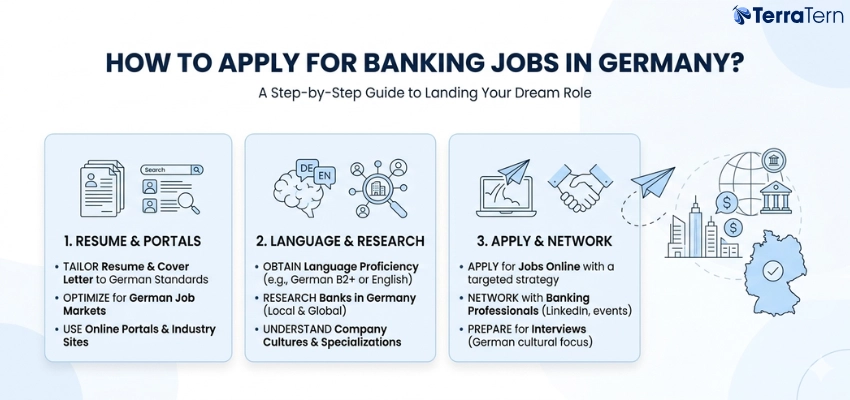
To successfully apply for banking jobs in Germany, it's essential to follow a strategic approach that encompasses thorough preparation, research, and networking. Here are the steps you should take:
1. Prepare Your Resume and Cover Letter:
Tailor your resume and cover letter to highlight your relevant qualifications, experience, and skills. Emphasise any international experience or certifications pertinent to the banking industry. Make sure your documents are formatted according to German standards.
2. Obtain Language Proficiency:
Proficiency in German is often a prerequisite. Take language courses to achieve at least a B2 level proficiency in German. If applying to international banks, ensure your English skills are strong and highlight your multilingual abilities.
3. Research Companies and Job Portals:
Identify banks and financial institutions in Germany that align with your career goals. Use job portals such as LinkedIn, Indeed, and StepStone to find job openings. Regularly check the career sections of the banks’ official websites.
4. Apply for Jobs Online:
Submit your applications through the banks’ websites or job portals. Ensure all required documents, such as your resume, cover letter, and certificates, are included. Follow up on your applications to show your enthusiasm and commitment.
5. Network with Professionals:
Attend industry events, seminars, and networking sessions. Join professional associations and online forums related to banking and finance in Germany. Networking can lead to job referrals and insider information about job openings.
6. Prepare for Interviews:
Once you secure an interview, thoroughly research the company and its culture. Practise common banking interview questions and be prepared to discuss your qualifications, experience, and why you want to work in Germany. Highlight your adaptability and cultural awareness.
Read More: How to Get a Job in Germany from India? Latest Guide
How TerraTern Can Help You With Banking Jobs in Germany
If you’re an Indian professional asking, “Which banking jobs in Germany offer visa sponsorship?” or wondering, “What banking jobs salary in Germany can I realistically expect?”, TerraTern is designed to turn your questions into clear, step-by-step action. We bridge the gap between your current profile and the visa-sponsored banking roles you’re targeting in Germany. Here’s how TerraTern can help you with your specific problem:
-
Eligibility and Visa Pathway Mapping: We help you assess your degree, work experience, and language level to see which visa route fits best: EU Blue Card, Skilled Worker Visa, or Opportunity Card, all tailored for banking jobs in Germany for Indians.
-
Target Role Selection and City Strategy: Instead of applying randomly, we guide you toward high‑sponsoring, high‑salary roles such as credit-risk analyst, compliance/AML officer, IT-banking specialist, and corporate-finance roles in cities like Frankfurt, Berlin, Munich, and Hamburg.
-
Application Package and CV Optimisation: We help you build a German-style CV and cover letter that speaks the language of German banks, highlighting your banking-relevant projects, tools (Excel, SQL, SAP), and certifications (CFA/FRM/ACCA) so your profile stands out among Indian and international candidates.
-
Salary Benchmarking and Negotiation Support: Using 2024–25 data on banking job salaries in Germany, we help you understand realistic pay ranges for your target role and city so you can negotiate confidently without under- or overpricing yourself.
Visa Support and Documentation Roadmap: From checking if your degree is recognised in Germany to preparing documents for the embassy, we provide a clear checklist so you don’t miss critical steps for your banking job visa in Germany.
Conclusion
In summary, securing banking jobs in Germany involves understanding visa requirements, adapting to the local work culture, and meeting specific eligibility criteria. Effective job search strategies and crafting tailored resumes and cover letters are essential for success. The salaries of banking jobs in Germany are competitive, especially for Indians. If you’re ready to embark on a rewarding career, search for banking jobs in Germany today. Take advantage of the numerous opportunities and resources available, and set yourself up for a prosperous future in the German banking sector.
To know more about banking jobs in Germany, visit TerraTern now!




 AI Summary