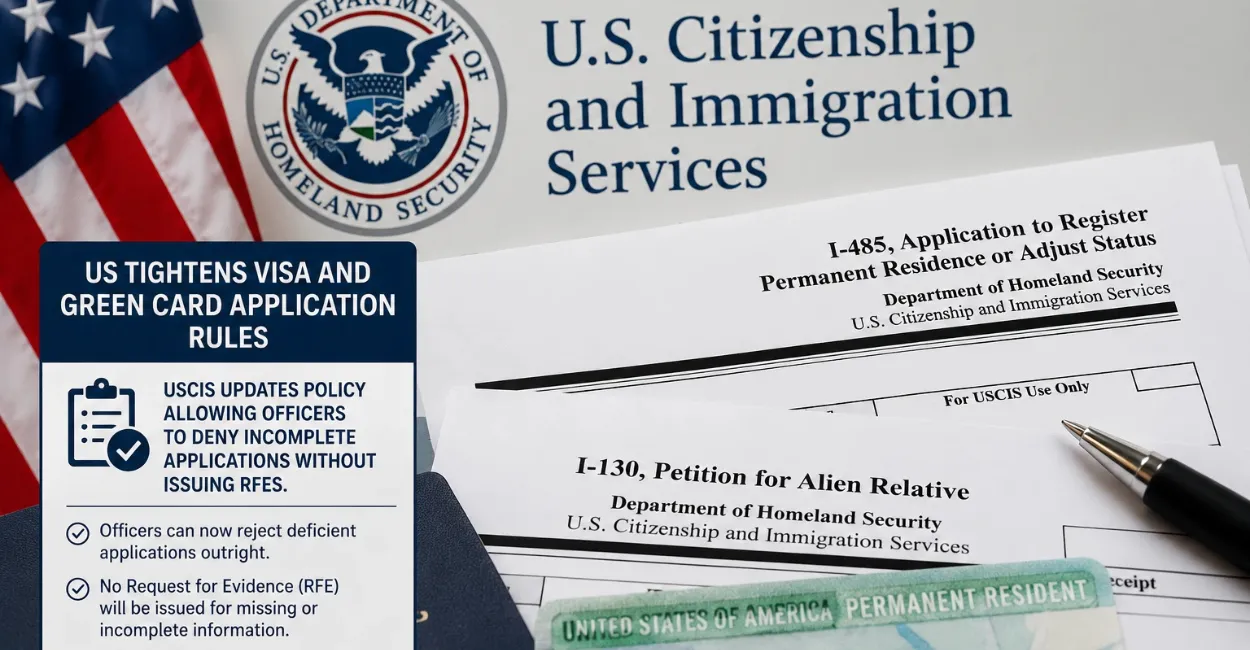


The U.S. immigration system is tightening up, and the new immigration policy from the U.S. Citizenship and Immigration Services (USCIS) reminds all applicants to submit their immigration applications complete and well-documented. The guidance now grants USCIS officers greater discretion in determining whether to grant immigration benefits for complete applications submitted at the time of filing but that do not satisfy the criteria for granting benefits at that time, and not routinely send such applications back to submitters with a Request for Evidence (RFE) or Notice of Intent to Deny (NOID).
The decision likely will affect those seeking visas, green cards, work permits, adjustment of status and other immigration benefits, and as such, careful preparation is more crucial than ever. The agency's continued focus on increased enforcement, efficiency, and minimisation of incomplete/frivolous filings has been reflected in the policy.
USCIS Gives Officers Greater Authority
USCIS has issued new policy guidance to allow immigration officers more discretion in reviewing immigration benefit requests. Adjudicating officers are no longer required to seek missing documents or further evidence but may refuse an application if the applicant does not provide the documents at the time of application or demonstrate eligibility.
While USCIS always had the discretion to reject an application that is deficient, earlier guidance tended to favour issuing an RFE or NOID before taking final action. The new policy alters that by providing officers with more leeway for failing to process a partial request without giving an applicant another chance to "complete" his or her files.
Also Read: USCIS Removes Biometrics Fee for Most Immigration Cases
What Has Changed Under the New USCIS Policy?
The revised policy has a significant impact on the way to deal with incomplete applications by immigration officers.
Key changes include:
-
Applications may be refused if they are not accompanied by the necessary initial evidence.
-
RFEs are no longer anticipated for all cases that are missing and are not expected.
-
Applicants must establish eligibility when they first submit the application.
-
If there is missing documentation, it will be denied immediately.
-
Officers have the discretion to issue RFEs where appropriate but are no longer required to do so.
The new guidance puts a focus on the fact that if the applicant doesn't meet the requirements for filing the initial application, they don't get extra chances for correction.
Why USCIS Introduced the New Guidance?
The updated policy aims to:
-
Ensure more efficient processing of applications.
-
Minimise miscommunication-related delays in submission.
-
Increase the security of immigration procedures.
-
Prevent any speculative or low-quality applications.
-
Remind applicants to submit full documentation starting from the initial application.
USCIS said that applicants must submit all necessary forms and supporting evidence and documentation at the time of filing, as specified in each form's instructions.
Which Immigration Benefits Could Be Affected?
The policy is broadly applicable to immigration benefit requests by USCIS.
These may include:
-
Employment-based immigration petitions
-
Family-sponsored immigration petitions
-
Adjustment of Status applications
-
Employment Authorisation Documents (EAD)
-
Green card applications
-
Naturalization applications
-
Humanitarian benefit requests
-
Extension and change of status applications
-
Certain nonimmigrant petitions
All applicants making any USCIS-stamped immigration application should assume that if their application was incomplete, it may now be denied – not postponed. All applicants who submit any application involving immigration through USCIS should presume that if it was incomplete, it may currently be denied – not postponed.
Difference Between an RFE and an Immediate Denial
In the past, applicants who did not provide required information were sent an RFE seeking further documents within a certain time period.
Under the revised approach:
|
Previous Practice |
Updated Policy |
|
Missing documents often triggered an RFE |
Missing documents may lead directly to denial |
|
Applicants had another opportunity to respond |
Officers may deny without requesting more evidence |
|
Longer processing timelines |
Potentially faster decisions |
|
More flexibility for applicants |
Greater responsibility on applicants |
Of course, USCIS has not completely taken the place of an RFE. Officers can still issue them if there's more evidence that might answer questions of eligibility. But they are not required to anymore in all situations.
Also Read: USCIS Announces Grace Period for New Immigration Forms
What This Means for Applicants
The amended policy assigns increased responsibility to the applicant, employer, attorneys, and petitioner to make sure applications are complete before they are submitted.
Applicants should now:
-
Be cautious of official USCIS filing instructions.
-
Attach all necessary supporting documents.
-
Submit properly completed forms.
-
Verify signatures.
-
Double-check filing fees.
-
Prompt for evidence that indicates eligibility.
A simple omission that previously may have resulted in an RFE could now end with a denial.
Impact on Indian Students and Skilled Workers
Indian nationals are among the highest employment-based visa, family petition, adjustment of status, and employment authorisation applicant categories.
The revised guidance might impact in particular:
H-1B Professionals
Candidates should make sure that the necessary paperwork from the employer is in order if they change their status or apply for work-based benefits.
F-1 Students
Care must be taken to follow filing instructions for students seeking Optional Practical Training (OPT), STEM OPT, or immigration status changes.
Employment-Based Green Card Applicants
Failing to provide necessary evidence, like employment eligibility or sponsorship information or supporting documentation, may increase the risk of denial.
Family-Based Applicants
Applicants who wish to adjust their status or obtain immigration benefits based on family sponsorship should make sure that civil documents are attached while they are applying for immigrant benefits.
The policy remains the same for all applicants, but it is more evident in countries with a high number of filings – such as India.
Relation to USCIS' Broader Enforcement Approach
Connection to USCIS enforcement policy, strategy, and means in general.
The new instructions are part of a larger push for stricter immigration enforcement.
In the last few years, USCIS has stressed policies that focus on:
-
Greater applicant accountability
-
Increased documentation requirements
-
Stronger fraud prevention
-
Improved speed of resolution of obviously poor filings.
-
The need to make existing regulations more consistent.
The agency believes the amendments will enhance efficiencies while honouring the intent of the law to only grant immigration benefits to those who are eligible.
Signature Rules Introduced Earlier Complement the New Policy
The new guidance comes after another major USCIS update in 2026 that introduced a new policy about signatures on immigration benefit requests.
Under that rule:
-
Incomplete signatures and applications may be rejected or denied. You may keep filing fees after they are denied.
-
Applicants may be required to apply for new applications.
-
Some officers cannot accept applications with incomplete signatures.
These measures are combined to ensure USCIS has an accurate and complete application on file.
How Can Applicants Reduce the Risk of Denial?
Applicants should apply with a more comprehensive approach because of the more rigorous review criteria.
Consider good practice such as:
Review Official Instructions
All USCIS forms have extensive instructions on how to file. A lack of any one of the necessary documents will cause issues.
Use Updated Forms
Be sure to use the most current version of the forms when applying.
Submit Complete Evidence
Submit all documentation needed; don't expect USCIS to follow up with missing documents later.
Verify Signatures
Make sure all necessary signatures are in place and legible.
Organize Documentation
Evidence is presented clearly and organised, which makes it easier to review and reduces the likelihood of missing information.
Seek Professional Guidance
Many immigration cases are of a complex nature and may make sense to be reviewed by immigration lawyers or attorneys who are experienced in handling immigration cases or by an accredited representative.
Will USCIS Still Issue RFEs?
Yes. This revised guidance does not remove Requests for Evidence.
USCIS officers are still free to issue RFEs when they believe more evidence may shed light on eligibility.
However, if an applicant is unable to submit a complete application, he or she should no longer rely on the expectation that an RFE will be issued. If the missing evidence is required to establish eligibility, the application may be denied at this point.
Also Read: USCIS Introduces Armed Special Agents with Full Law Enforcement Powers
What Applicants Should Expect Going Forward?
The new policy should lead to more high-quality applications and fewer incomplete applications in adjudication.
Applicants can expect:
-
Increased focus on the accuracy of filing.
-
Limited opportunities to revise and correct after submission
-
More efficient processing of obviously inadequate applications
-
The preparation of documents is becoming more important. Document preparation gains importance.
-
Additional scrutiny before submitting
The message for applicants is clear: The complete application is more important than ever.
Conclusion
The new USCIS guidance is further evidence of the government's intention to increase the rigour of immigration casework by allowing the government to deny requests for immigration benefits without issuing a Request for Evidence in certain instances. The agency will make every effort to allow the applicant to submit missing or late documents if they are needed, but shouldn't assume an opportunity to correct avoidable errors after filing. Careful preparation, the proper documentation, and following USCIS instructions for filing are now a necessity in any application for a work visa, green card, adjustment of status, or other immigration benefit. Accurate and complete applications will give applicants a better chance of successfully navigating US immigration.
Contact TerraTern for more information.





