
Key Highlights
This IELTS General Reading Practice Test consists of multiple reading passages in 3 sections. Section 1 consists of 2 passages, "Mainly Beaches" and “Sydney Water: Advice For Customers Paying a Bill”; Section 2 covers "Company Car Parking Policy" along with “Ensuring Safety In The Office”; and finally, Section 3 focuses on "Roman Roads". The test includes a variety of question types, such as True/False/Not Given, Matching Headings, Matching Information, Notes Completion, Multiple Choice, Diagram Completion, and Sentence Completion. You have 60 minutes to complete the entire test.
Section 1 {Q1–Q14}
Manly Beaches
IELTS Matching Information Questions (Q1–Q7)
Sydney Water: Advice for Customers Paying a Bill
IELTS True / False / Not Given Questions (Q8–Q14)
Section 2 {Q15–Q27}
Company Car Parking Policy
IELTS Sentence Completion Questions (Q15–Q20)
Ensuring Safety In The Office
IELTS Note Completion Questions (Q21–Q27)
Section 3 {Q28–Q40}
Roman Roads
IELTS Matching Information Questions (Q28–Q33)
IELTS Multiple Choice Questions (Q34–Q37)
IELTS Diagram Completion Questions (Q38–Q40)
READING GENERAL: TEST PAPER 15
Section 1
Read the text below and answer Questions 1–7.
Manly Beaches
The next time you visit Manly — just 30 minutes by ferry from the centre of Sydney, Australia’s largest city — consider exploring some of these lesser-known beaches.
A. Fairy Bower
Situated within a marine protection area, this beach offers ideal conditions for paddling, snorkelling, or even scuba diving. There is a small gift shop selling unusual souvenirs, as well as a kiosk where you can rent stand-up paddleboards. Please note that buses do not stop nearby, so you will need to walk to reach it.
B. North Steyne
Located slightly further from the ferry than the main beach, this popular spot generally feels less crowded. Professional lifeguards patrol the beach; however, the surf can be dangerous, so check the conditions carefully if swimming with children. If you are interested in learning to surf, Manly Surf School operates from the surf club on the beach. Please note that surfboards are reserved for students and are not available for general hire.
C. Delwood
This secluded cove can be reached via a scenic harbour walkway from the ferry. There are no shops in the area, so bring your own picnic. It is a peaceful place to swim from the rocks, and you will likely have the beach almost entirely to yourself.
D. Little Manly
This well-liked harbour beach features a netted swimming area, making it a safe option for families. The enclosed section allows parents to easily supervise children playing in the water. Facilities include a large playground, public barbecue areas, and toilets, making it an excellent choice for a family outing.
E. East Esplanade
Located next to Manly Wharf, this beach is lively throughout the day. It is the closest beach to both the ferry and bus stops. Kayakers gather here at sunrise, visitors relax on the sand during the day, and after work, people meet on the grass with drinks, snacks, and music to watch the sunset.
F. Shelly Beach
This beach is ideal for those who prefer calm waters without large waves. You can rent a beach chair or visit the Boathouse Café for breakfast or lunch. However, Shelly Beach can become very crowded, particularly on sunny weekend afternoons.
Questions 1–7
Look at the six beach descriptions, A–F.
For which beach are the following statements true?
1. You can buy food at this beach.
2. You can learn to do a sport at this beach.
3. This beach can be uncomfortably busy.
4. Adults can supervise their children without much difficulty at this beach.
5. This beach is nearest to public transport.
6. People are employed to supervise swimmers at this beach.
7. You can rent sports equipment at this beach.
Sydney Water: Advice For Customers Paying a Bill
Read the text below and answer Questions 8–14.
About Your Bill
Sydney Water provides services to more than five million people across Greater Sydney. If you own a property, you will receive a bill from us. This bill usually covers water and wastewater services, although additional charges may sometimes apply. Most bills are issued quarterly after the water meter has been read. If your property does not have a meter, the bill is sent at the beginning of each quarter.
When Do We Send the Bill?
If you prefer to receive monthly bills, you can request monthly meter readings. This service costs $32.52 per quarter, and the extra charge will appear on the first bill of each quarter. To arrange this, call us on 13 20 92.
What If You Can’t Pay the Bill?
We understand that paying bills can sometimes be difficult. If you are experiencing financial hardship, we offer a range of assistance options. If you receive a pension, you may be eligible for a reduction on your bill. However, to qualify, you must both own and live in your home.
How Can You Access Your Billing History?
- Register for eBill: By signing up for Sydney Water’s online billing service, eBill, you can view your past bills at any time. Once registered, you will stop receiving paper bills and instead receive electronic copies.
- Prefer Paper Bills? You can cancel your eBill registration after saving the electronic bills you need. You will then resume receiving paper bills; however, you will no longer have access to your online billing records.
- Contact Us: We can provide a statement detailing the charges applied and the payments received for your last five bills.
- Need Older Records? If you require billing information from before your most recent five bills, you can request a ‘billing record search statement’ for a fee of $28.04.
How Do You Stop a Charge on a Bill?
A fixed charge will be removed from your bill if a licensed plumber disconnects your water or wastewater service. The plumber must apply for the disconnection and follow Sydney Water’s official procedures.
Questions 8–14
Do the following statements agree with the information given in the text?
On your answer sheet, write:
TRUE – if the statement agrees with the information
FALSE – if the statement contradicts the information
NOT GIVEN – if there is no information about this
8. All property owners receive Sydney Water bills.
9. Customers without a water meter are required to pay an additional charge.
10. Customers who decide to receive a monthly bill have to pay an extra fee.
11. Pensioners living in rented accommodation may qualify for a discount.
12. Customers who register for eBill receive both paper and electronic bills.
13. Customers who request billing information from earlier than their last five bills must pay a fee.
14. A fixed charge can be removed if a licensed plumber disconnects the water supply.
Section 2
Read the text below and answer Questions 15–20.
Company Car Parking Policy
DG Contracts recognises that many employees require a vehicle for work-related duties and aims to provide parking spaces for as many staff members as possible. However, parking availability is limited. For this reason, DG Contracts actively encourages employees to reduce their carbon footprint by using public transport, walking, cycling, or arranging car-sharing where possible.
The purpose of this parking policy is to allocate spaces in a fair and equitable manner. Priority is given to employees who claim above a specified mileage for business travel. Those allocated a parking space will receive a parking permit along with a designated space number. Any unallocated spaces may be used by employees on a first-come, first-served basis. In certain cases, specific areas are reserved for company vehicles, which must be securely parked overnight. However, employees may use these designated areas during the daytime.
If an employee leaves the company before their parking permit expires, the permit will be transferred to their replacement, provided the new employee requires one. Similarly, if a permit holder takes maternity leave or is absent from work for an extended period, their parking permit will be reassigned to the staff member covering their role during their absence.
Employees who park in DG Contracts’ car parks do so at their own risk and are expected to comply with all rules outlined in the parking policy. Any complaints regarding car parking facilities at DG company car parks should be directed to the HR Manager.
Questions 15–20
Complete the sentences below.
Choose ONE WORD ONLY from the text for each answer.
15. Parking is limited, so the use of alternative forms of transport and the __________ of cars is encouraged.
16. Employees who claim the highest __________ for business travel are given priority for parking spaces.
17. Certain parking spaces are reserved for company vehicles at __________ but may be used by staff during the day.
18. If an employee leaves the company permanently, their parking space will usually be transferred to their __________.
19. If an employee takes extended leave, their parking space will be allocated to the person providing __________ for them.
20. Any __________ regarding car parking should be directed to the HR Manager.
Ensuring Safety In The Office
Read the text below and answer Questions 21–27.
While it is widely recognised that safety and health risks exist in workplaces filled with heavy machinery and equipment, many people are unaware that offices can also contain numerous hazards.
The most frequent injuries in office environments are slips, trips and falls. Walkways cluttered with boxes, files and other items create tripping risks. To prevent accidents, all materials should be stored properly to avoid the build-up of clutter. In addition, electrical cables stretched across walkways not only pose an electrical danger but also create a serious tripping hazard. These should always be securely fastened and safely covered.
Standing on a rolling office chair to reach high objects is a major fall risk. Employees who need to access items stored at height should instead use a stepladder. The stepladder must be fully opened and positioned on stable, level ground.
Collisions may occur when employees turn into hallways or move around blind corners. Installing mirrors in such areas can help prevent these accidents by improving visibility. Flooring can also be hazardous. Marble and tile surfaces may become extremely slippery, particularly when wet. Using carpets can significantly reduce the risk of falls, especially near main entrances where employees may enter with wet footwear.
Another common source of injury involves workers being struck by objects. Filing cabinets can tip over if drawers are left open, and both cabinets and desks can become tripping hazards if not properly closed. Stacks of materials or equipment can cause serious injuries if they fall. Heavy objects should always be stored close to the floor, and shelves should never be loaded beyond their recommended weight capacity.
Since office workers spend much of their day seated at desks, they are particularly vulnerable to strains and injuries caused by poor posture and repetitive movements. Desks, chairs, monitor stands and related equipment should be adjustable to accommodate a wide range of employees. Typing from printed documents can lead to neck strain if workers repeatedly look down at the document and then back up at the screen. This issue can be addressed by using document holders, which position papers at screen height and help maintain proper posture. Incorrect placement of the computer mouse can also result in neck strain; it should always be kept next to the keyboard and at the same height.
Questions 21–27
Complete the notes below.
Choose ONE WORD ONLY from the text for each answer.
Ensuring Office Safety
To prevent slips, trips, falls, and collisions, make sure that:
- boxes, files and other items are stored properly
- items such as 21. __________ do not create tripping hazards
- employees do not use 22. __________ to reach objects placed at height
- 23. __________ are installed at blind corners
- floors are covered with 24. __________, particularly near entrances
To prevent injuries caused by falling or moving objects, ensure that:
- 25. __________ in office furniture remain closed
- heavy objects are stored close to the floor
To reduce injuries related to posture and repetitive movement, ensure that:
- office furniture is 26. __________
- 27. __________ are provided to hold documents at screen height
- The computer mouse is positioned next to the keyboard
Section 3
Read the text below and answer Questions 28–40.
Roman Roads
A. The long, straight roads constructed by the Romans have, in many cases, become just as famous as their greatest emperors and generals. Building on earlier routes and creating many new ones, Roman engineers were bold in their determination to connect two points in the straightest possible line, regardless of geographical challenges or labour costs. As a result, road construction required bridges, tunnels, viaducts and numerous other architectural and engineering structures. These impressive yet highly practical achievements extended from Europe to the eastern regions of the Roman Empire.
B. Although the Romans did not invent roads, they developed an idea that dated back to the Bronze Age and maximised their potential. The first and most famous major Roman road was the Via Appia, or Appian Way. Built in 312 BCE and stretching 196 kilometres, it linked Rome to the ancient city of Capua in Italy in an almost perfectly straight line. Appropriately, the Romans called it the Regina Viarum — the “Queen of Roads.” Similar to a modern highway, it bypassed small towns and largely ignored geographical obstacles. The road was later extended to a total length of 569 kilometres.
C. The public Roman road network eventually covered more than 120,000 kilometres. In addition to allowing the rapid movement of troops and the wheeled vehicles that supplied them with food and equipment, these roads encouraged trade and cultural exchange. Roads also served as a powerful symbol of Roman authority. For this reason, many began and ended at triumphal arches. The prestige associated with road construction is reflected in the fact that roads were often named after the officials who financed them. For example, the Via Appia was named after the Roman magistrate Appius Claudius Caecus.
D. To achieve the goal of constructing the shortest possible routes, Roman engineers overcame numerous challenges. After careful surveying to ensure straight alignment and determine the required engineering methods, marshes were drained, forests cleared, streams diverted, bedrock cut through, mountainsides carved, rivers crossed with bridges, valleys spanned with viaducts and tunnels driven through mountains. Once completed, the roads were levelled, reinforced with retaining walls or terracing, and carefully maintained — in some cases for over 800 years.
E. Major Roman roads were typically about 4.2 metres wide, allowing two vehicles to pass each other. Construction began with digging a trench and laying a foundation of large stones. This was followed by a thick layer of smaller broken materials, often crushed brick. A layer of fine gravel was then added. This upper section, known as the nucleus, was finally covered with stone blocks or slabs. In mountainous areas, slabs sometimes featured ridges to improve grip for animals and grooves to guide wheeled vehicles.
The road surface was slightly raised in the centre and sloped towards the edges to allow rainwater to drain away. Many roads also had parallel ditches on either side to collect runoff. Pedestrian paths made of compacted gravel usually ran along both sides, ranging from one to three metres in width. These were separated from the main road by upright kerbstones. Busy sections often included pull-over areas for vehicles, some equipped with facilities for travellers and their animals. Milestones were placed at regular intervals, frequently recording details of maintenance and repairs, as well as the official responsible.
F. Enduring examples of Roman engineering brilliance include the many arched bridges and viaducts that still stand today. Built to achieve straight-line routes, these structures demonstrate remarkable durability. Bridge piers crossing rivers were often constructed with a pointed prow shape to reduce water resistance and were made from massive, long-lasting stone blocks. The upper sections were typically reinforced with iron clamps. One of the most impressive examples is the bridge at Narni, measuring 180 metres in length, 8 metres in width and 33 metres in height. It featured four enormous semicircular arches, including one spanning 32.1 metres — among the longest block-arch spans of the ancient world. Recently damaged by earthquakes, the bridge is currently undergoing restoration.
The Romans’ advanced engineering and surveying skills were so effective that many of their roads formed the foundation of modern routes across Europe and the Middle East. In Italy, several roads still retain their original Roman names for certain sections. Some bridges, such as the one at Tre Ponti in Venice, continue to carry road traffic today.
Questions 28–33
The passage is divided into six sections, labelled A–F.
Which section contains the following information?
28. The different purposes served by Roman roads
29. A reference to Roman road structures that still exist today
30. An explanation of the initial preparation carried out before road construction
31. The historical period when the concept of road building first began
32. The result of damage caused by a natural event
33. The overall length of the Roman road network
Questions 34–37
Choose the correct letter, A, B, C or D.
34. In Section A, which feature of Roman road construction does the writer highlight?
A. The durability and long-lasting nature of the roads
B. The impressive design, combined with its practical use
C. The large workforce required to build them
D. The influential individuals who funded the projects
35. The writer compares the Appian Way to a modern highway because
A. It was gradually extended over time.
B. It required a long period to complete.
C. It was used by many travellers.
D. It was planned to bypass certain places.
36. According to the passage, triumphal arches were built to
A. Demonstrate the authority of Rome.
B. Celebrate the completion of a road.
C. Display the names of significant roads.
D. Allow entry for important officials.
37. What typical function of milestones is described in Section E?
A. Showing travellers the total distance of the road
B. Identifying sections that required repair
C. Recording information about road maintenance
D. Indicating stopping places for travellers and their animals
Questions 38–40
Label the diagram below.
Choose NO MORE THAN TWO WORDS from the text for each answer.
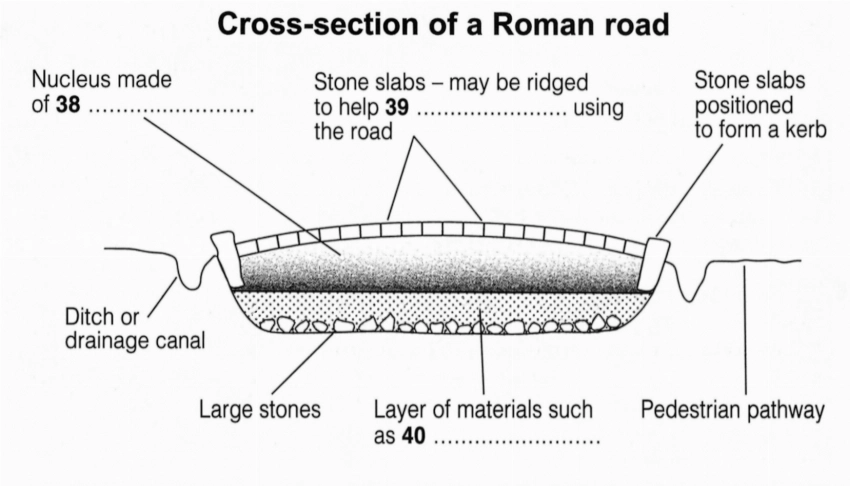
38. .……………
39. .…………..
40. .………….
Answers

Unlock Remaining Answer

