
Key Highlights
This IELTS Academic Reading Practice Test consists of three reading passages. Passage 1 is titled "The Roman Tunnels"; Passage 2 covers " Changes In Reading Habits"; and Passage 3 focuses on " Have Teenagers Always Existed?". The test includes a variety of question types, such as True/False/Not Given, Short Answer, Diagram Completion, Multiple Choice, Yes/No/Not Given, Summary Completion, Match the Following and Matching Ending. You have 60 minutes to complete the entire test.
Passage 1 {Q1–Q13}
The Roman Tunnels
Diagram Completion Questions (Q1–Q6)
True / False / Not Given Questions (Q7–Q10)
Short Answer Type Questions (Q11–Q13)
Passage 2 {Q14–Q26}
Changes in Reading Habits
Multiple Choice Questions (Q14–Q17)
Summary Completion Questions (Q18–Q22)
Yes / No / Not Given Questions (Q23–Q26)
Passage 3 {Q27–Q40}
Have Teenagers Always Existed?
Multiple Choice Questions (Q27–Q30)
Yes / No / Not Given Questions (Q31–Q36)
Matching Ending Questions (Q37–Q40)
READING ACADEMIC: TEST PAPER 11
Passage 1
You should spend 20 minutes on Questions 1-13, which are based on the Reading Passage 1.
Roman Tunnels
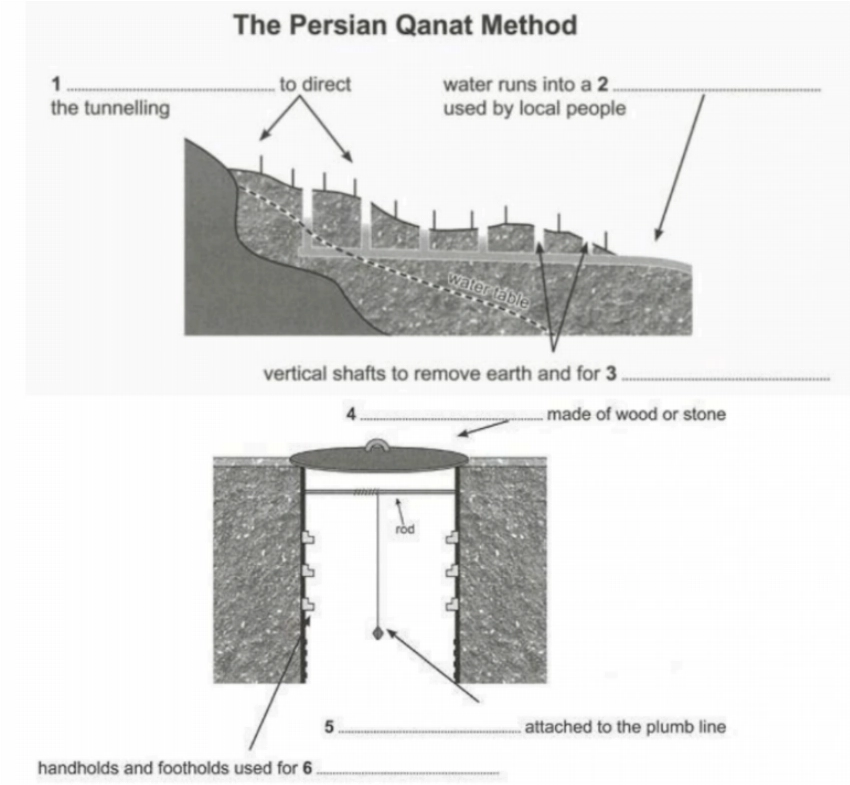
A. The Persians, who lived in present-day Iran, were one of the first civilisations to build tunnels that provided a reliable supply of water to human settlements in dry areas. In the early first millennium BCE, they introduced the qanat method of tunnel construction, which consisted of placing posts over a hill in a straight line to ensure that the tunnel kept to its route and then digging vertical shafts down into the ground at regular intervals.
Underground, workers removed the earth from between the ends of the shafts, creating a tunnel. The excavated soil was taken up to the surface using the shafts, which also provided ventilation during the work. Once the tunnel was completed, it allowed water to flow from the top of a hillside down towards a canal, which supplied water for human use. Remarkably, some qanats built by the Persians 2,700 years ago are still in use today.
B. They later passed on their knowledge to the Romans, who also used the qanat method to construct water-supply tunnels for agriculture. Roman qanat tunnels were constructed with vertical shafts dug at intervals of between 30 and 60 meters. The shafts were equipped with handholds and footholds to help those climbing in and out of them and were covered with a wooden or stone lid. To ensure that the shafts were vertical, the Romans hung a plumb line from a rod placed across the top of each shaft and made sure that the weight at the end of it hung in the centre of the shaft. Plumb lines were also used to measure the depth of the shaft and to determine the slope of the tunnel. The 5.6-kilometre-long Claudius tunnel, built in 41 CE to drain the Fucine Lake in central Italy, had shafts that were up to 122 meters deep, took 11 years to build and involved approximately 30,000 workers.
C. By the 6th century BCE, a second method of tunnel construction appeared, called the counter-excavation method, in which the tunnel was constructed from both ends. It was used to cut through high mountains when the qanat method was not a practical alternative. This method required greater planning and advanced knowledge of surveying, mathematics and geometry as both ends of a tunnel had to meet correctly at the centre of the mountain. Adjustments to the direction of the tunnel also had to be made whenever builders encountered geological problems or when it deviated from its set path. They constantly checked the tunnel’s advancing direction, for example, by looking back at the light that penetrated through the tunnel mouth, and made corrections whenever necessary. Large deviations could happen, and they could result in one end of the tunnel not being usable. An inscription written on the side of a 428-meter tunnel, built by the Romans as part of the Saldae aqueduct system in modern-day Algeria, describes how the two teams of builders missed each other in the mountain and how the later construction of a lateral link between both corridors corrected the initial error.
D. The Romans dug tunnels for their roads using the counter-excavation method whenever they encountered obstacles such as hills or mountains that were too high for roads to pass over. An example is the 37-meter-long, 6-meter-high Furlo Pass Tunnel, which was built in Italy in 69-79 CE. Remarkably, modern roads still use this tunnel today. Tunnels were also built for mineral extraction. Miners would locate a mineral vein and then pursue it with shafts and tunnels underground. Traces of such tunnels used to mine gold can still be found at the Dolaucothi mines in Wales. When the sole purpose of a tunnel was mineral extraction, construction required less planning, as the tunnel route was determined by the mineral vein.
E. Roman tunnel projects were carefully planned and carried out. The length of time it took to construct a tunnel depended on the method being used and the type of rock being excavated. The qanat construction method was usually faster than the counter-excavation method as it was more straightforward. This was because the mountain could be excavated not only from the tunnel mouths but also from shafts. The type of rock could also influence construction times. When the rock was hard, the Romans employed a technique called fire quenching, which consisted of heating the rock with fire and then suddenly cooling it with cold water so that it would crack. Progress through hard rock could be very slow, and it was not uncommon for tunnels to take years, if not decades, to be built. Construction marks left on a Roman tunnel in Bologna show that the rate of advance through solid rock was 30 centimetres per day. In contrast, the rate of advance of the Claudius tunnel can be calculated at 1.4 meters per day. Most tunnels had inscriptions showing the names of patrons who ordered construction and sometimes the name of the architect. For example, the 1.4-kilometre Cevlik tunnel in Turkey, built to divert the floodwater threatening the harbour of the ancient city of Seleuceia Pieria, had inscriptions on the entrance, still visible today, that also indicate that the tunnel was started in 69 CE and was completed in 81 CE.
Questions 1-6
Label the diagram below.
Choose ONE WORD ONLY from the passage for each Answer.
Questions 7-10
Do the following statements agree with the information given in the reading Passage?
In boxes 7-10 on your answer sheet, write
TRUE if the statement agrees with the information
FALSE if the statement contradicts the information
NOT GIVEN if there is no information on this
7. The counter-excavation method completely replaced the qanat method in the 6th century BCE.
8. Only experienced builders were employed to construct a tunnel using the counter-excavation method.
9. The information about a problem that occurred during the construction of the Saldae aqueduct system was found in an ancient book.
10. The mistake made by the builders of the Saldae aqueduct system was that the two parts of the tunnel failed to meet.
Questions 11-13
Answer the questions below.
Choose NO MORE THAN TWO WORDS from the passage for each answer.
Write your answers in boxes 11-13 on your answer sheet.
11. What type of mineral were the Dolaucothi mines in Wales built to extract?
12. In addition to the patron, whose name might be carved onto a tunnel?
13. What part of Seleuceia Pieria was the Qevlik tunnel built to protect?
Passage 2
You should spend 20 minutes on Questions 14-27, which are based on the reading Passage 2.
Changes in Reading Habits
Look around on your next plane trip. The iPad is the new pacifier for babies and toddlers. Younger school-aged children read stories on smartphones; older kids don’t read at all, but hunch over video games. Parents and other passengers read on tablets or skim a flotilla of email and news feeds. Unbeknownst to most of us, an invisible, game-changing transformation links everyone in this picture: the neuronal circuit that underlies the brain’s ability to read is subtly, rapidly changing, and this has implications for everyone from the pre-reading toddler to the expert adult.
As work in neurosciences indicates, the acquisition of literacy necessitated a new circuit in our species’ brain more than 6,000 years ago. That circuit evolved from a very simple mechanism for decoding basic information, like the number of goats in one’s herd, to the present, highly elaborated reading brain.
My research depicts how the present reading brain enables the development of some of our most important intellectual and affective processes: internalised knowledge, analogical reasoning, and inference; perspective-taking and empathy, critical analysis and the generation of insight. Research surfacing in many parts of the world now cautions that each of these essential ‘deep reading processes' may be under threat as we move into digital-based modes of reading.
This is not a simple, binary issue of print versus digital reading and technological innovations. As MIT scholar Sherry Turkle has written, we do not err as a society when we innovate, but when we ignore what we disrupt or diminish while innovating. In this hinge moment between print and digital cultures, society needs to confront what is diminishing in the expert reading circuit, what our children and older students are not developing, and what we can do about it.
We know from research that the reading circuit is not given to human beings through a genetic blueprint like vision or language; it needs an environment to develop. Further, it will adapt to that environment’s requirements – from different writing systems to the characteristics of whatever medium is used. If the dominant medium advantages processes that are fast, multi-task oriented and well-suited for large volumes of information, like the current digital medium, so will the reading circuit. As UCLA psychologist Patricia Greenfield writes, the result is that less attention and time will be allocated to slower, time-demanding deep reading processes.
Increasing reports from educators and from researchers in psychology and the humanities bear this out. English literature scholar and teacher Mark Edmundson describes how many college students actively avoid the classic literature of the 19th and 20th centuries in favour of something simpler as they no longer have the patience to read longer, denser, more difficult texts. We should be less concerned with students’ ‘cognitive impatience’, however, than by what may underlie it: the potential inability of large numbers of students to read with a level of critical analysis sufficient to comprehend the complexity of thought and argument found in more demanding texts.
Multiple studies show that digital screen use may be causing a variety of troubling downstream effects on reading comprehension in older high school and college students. In Stavanger, Norway, psychologist Anne Mangen and colleagues studied how high school students comprehend the same material in different mediums. Mangen’s group asked subjects questions about a short story whose plot had universal student appeal; half of the students read the story on a tablet, the other half in paperback. Results indicated that students who read from print were superior in their comprehension to screen-reading peers, particularly in their ability to sequence detail and reconstruct the plot in chronological order.
Ziming Liu from San Jose State University has conducted a series of studies which indicate that the ‘new norm’ in reading is skimming, involving word-spotting and browsing through the text. Many readers now use a pattern when reading in which they sample the first line and then word-spot through the rest of the text. When the reading brain skims like this, it reduces the time allocated to deep reading processes. In other words, we don’t have time to grasp complexity, to understand another’s feelings, to perceive beauty, and to create thoughts of the reader’s own.
The possibility that critical analysis, empathy and other deep reading processes could become the unintended ‘collateral damage’ of our digital culture is not a straightforward binary issue about print versus digital reading. It is about how we all have begun to read on various media and how that changes not only what we read, but also the purposes for which we read. Nor is it only about the young. The subtle atrophy of critical analysis and empathy affects us all equally. It affects our ability to navigate a constant bombardment of information. It incentivises a retreat to the most familiar stores of unchecked information, which require and receive no analysis, leaving us susceptible to false information and irrational ideas.
There’s an old rule in neuroscience that does not alter with age: use it or lose it. It is a very hopeful principle when applied to critical thought in the reading brain because it implies choice. The story of the changing reading brain is hardly finished. We possess both the science and the technology to identify and redress the changes in how we read before they become entrenched. If we work to understand exactly what we will lose, alongside the extraordinary new capacities that the digital world has brought us, there is as much reason for excitement as caution.
Questions 14-17
Choose the correct letter, A, B, C or D.
14. What is the writer’s main point in the first paragraph?
A. Our use of technology is having a hidden effect on us.
B. Technology can be used to help youngsters read.
C. Travellers should be encouraged to use technology on planes.
D. Playing games is a more popular use of technology than reading.
15. What main point does Sherry Turkle make about innovation?
A. Technological innovation has led to a reduction in print reading.
B. We should pay attention to what might be lost when innovation occurs.
C. We should encourage more young people to become involved in innovation.
D. There is a difference between developing products and developing ideas.
16. What point is the writer making in the fourth paragraph?
A. Humans have an inborn ability to read and write.
B. Reading can be done using many different media.
C. Writing systems make unexpected demands on the brain.
D. Some brain circuits adjust to whatever is required of them.
17. According to Mark Edmundson, the attitude of college students
A. has changed the way he teaches.
B. has influenced what they select to read.
C. does not worry him as much as it does others.
D. does not match the views of the general public
Questions 18-22
Complete the summary using the list of words, A-H, below.
Write the correct letter, A-H, in boxes 18-22 on your answer sheet.
Studies On Digital Screen Use
There have been many studies on digital screen use, showing some 18. _______ trends. Psychologist Anne Mangen gave high-school students a short story to read, half using digital and half using print mediums. Her team then used a question-and-answer technique to find out how 19. _______ each group’s understanding of the plot was. The findings showed a clear pattern in the responses, with those who read screens finding the order of information 20. _______ to recall. Studies by Ziming Liu show that students are tending to read 21. _______ words and phrases in a text to save time. This approach, she says, gives the reader a superficial understanding of the 22._______ content of material, leaving no time for thought.
A. fast
B. isolated
C. emotional
D. worrying
E. many
F. hard
G. combined
H. thorough
Do the following statements agree with the views of the writer in Reading Passage 2?
In boxes 23-26 on your answer sheet, write
YES if the statement agrees with the views of the writer
NO if the statement contradicts the views of the writer
NOT GIVEN if it is impossible to say what the writer thinks about this
23. The medium we use to read can affect our choice of reading content.
24. Some age groups are more likely to lose their complex reading skills than others.
25. False information has become more widespread in today’s digital era.
26. We still have opportunities to rectify the problems that technology is presenting.
Passage 3
You should spend 20 minutes on Questions 28-40, which are based on reading Passage 3.
Have Teenagers Always Existed?
A. Our ancestor, Homo erectus, may not have had culture or even language, but did they have teenagers? That question has been contested in the past few years, with some anthropologists claiming evidence of an adolescent phase in human fossils. This is not merely an academic debate. Humans today are the only animals on Earth to have a teenage phase, yet we have very little idea why. Establishing exactly when adolescence first evolved and finding out what sorts of changes in our bodies and lifestyles it was associated with could help us understand its purpose. Why do we, uniquely, have a growth spurt so late in life?
B. Until recently, the dominant explanation was that physical growth is delayed by our need to grow large brains and to learn all the behaviour patterns associated with humanity – speaking, social interaction and so on. While such behaviour is still developing, humans cannot easily fend for themselves, so it is best to stay small and look youthful. That way, your parents and other members of the social group are motivated to continue looking after you. What’s more, studies of mammals show a strong relationship between brain size and the rate of development, with larger-brained animals taking longer to reach adulthood. Humans are at the far end of this spectrum. If this theory is correct, and the development of large brains accounts for the teenage growth spurt, the origin of adolescence should have been with the evolution of our own species (Homo sapiens) and Neanderthals, starting almost 200,000 years ago. The trouble is, some of the fossil evidence seems to tell a different story.
C. The human fossil record is extremely sparse, and the number of fossilised children is minuscule. Nevertheless, in the past few years, anthropologists have begun to look at what can be learned of the lives of our ancestors from these youngsters. One of the most studied is the famous Turkana boy, an almost complete skeleton of Homo erectus from 1.6 million years ago, found in Kenya in 1984. Accurately assessing how old someone is from their skeleton is a tricky business. Even with a modern human, you can only make a rough estimate based on the developmental stage of teeth and bones and the skeleton’s general size.
D. You need as many developmental markers as possible to get an estimate of age. The Turkana boy’s teeth made him 10 or II years old. The features of his skeleton put him at 13, but he was as tall as a modern 15-year-old. Susan Anton of New York University points to research by Margaret Clegg, who studied a collection of 18th- and 19th-century skeletons whose ages at death were known. When she tried to age the skeletons without checking the records, she found similar discrepancies to those of the Turkana boy. One 10-year-old boy, for example, had a dental age of 9, the skeleton of a 6-year-old, but was tall enough to be 11. The Turkana kid still has a rounded skull and needs more growth to reach the adult shape,’ Anton adds. She thinks that Homo erectus had already developed modern human patterns of growth, with a late, if not quite so extreme, adolescent spurt. She believes A Turkana boy was just about to enter it.
E. If Anton is right, that theory contradicts the orthodox idea linking late growth with the development of a large brain. Anthropologist Steven Leigh from the University of Illinois goes further. He believes the idea of adolescence as catch-up growth does not explain why the growth rate increases so dramatically. He says that many apes have growth spurts in particular body regions that are associated with reaching maturity, and this makes sense because by timing the short but crucial spells of maturation to coincide with the seasons when food is plentiful, they minimise the risk of being without adequate food supplies while growing. What makes humans unique is that the whole skeleton is involved. For Leigh, this is the key.
F. According to his theory, adolescence evolved as an integral part of efficient upright locomotion, as well as to accommodate more complex brains. Fossil evidence suggests that our ancestors first walked on two legs six million years ago. If proficient walking was important for survival, perhaps the teenage growth spurt has very ancient origins. While many anthropologists will consider Leigh’s theory a step too far, he is not the only one with new ideas about the evolution of teenagers.
G. Another approach, which has produced a surprising result, relies on the minute analysis of tooth growth. Every nine days or so, the growing teeth of both apes and humans acquire ridges on their enamel surface. These are like rings in a tree trunk: the number of them tells you how long the crown of a tooth took to form. Across mammals, the rate at which teeth develop is closely related to how fast the brain grows and the age at which you mature. Teeth are good indicators of life history because their growth is less related to the environment and nutrition than is the growth of the skeleton.
H. A more decisive piece of evidence came last year, when researchers in France and Spain published their findings from a study of Neanderthal teeth. Neanderthals had much more fleshy tooth growth than Homo erectus, who went before them, and hence, possibly, a shorter childhood. Lead researcher Fernando Ramirez-Rozzi thinks Neanderthals died young, about 25 years old, primarily because of the cold, harsh environment they had to endure in glacial Europe. They evolved to grow up quicker than their immediate ancestors. Neanderthals and Homo erectus probably had to reach adulthood fairly quickly, without delaying for an adolescent growth spurt. So it still looks as though we are the original teenagers.
Questions 27-30
Choose the correct letter, A, B, C or D.
Write the correct letter in boxes 27-30 on your answer sheet.
27. In the first paragraph, why does the writer say ‘This is not merely an academic debate’?
A. Anthropologists’ theories need to be backed up by practical research.
B. There have been some important misunderstandings among anthropologists.
C. The attitudes of anthropologists towards adolescence are changing.
D. The work of anthropologists could inform our understanding of modern adolescence.
28. What was Susan Anton’s opinion of the Turkana boy?
A. He would have experienced an adolescent phase had he lived.
B. His skull showed he had already reached adulthood.
C. His skeleton and teeth could not be compared to those from a more modern age.
D. He must have grown much faster than others alive at the time.
29. What point does Steven Leigh make?
A. Different parts of the human skeleton develop at different speeds.
B. The growth period of many apes is confined to times when there is enough food.
C. Humans have different rates of development from each other depending on living conditions.
D. The growth phase in most apes lasts longer if more food is available.
30. What can we learn from a mammal’s teeth?
A. A poor diet will cause them to grow more slowly.
B. They are a better indication of a lifestyle than a skeleton.
C. Their growing period is difficult to predict accurately.
D. Their speed of growth is directly related to the body’s speed of development.
Questions 31-36
Do the following statements agree with the claims of the writer in Reading Passage 3?
In boxes 31-36 on your answer sheet, write
YES, if the statement agrees with the claims of the writer
NO, if the statement contradicts the claims of the writer
NOT GIVEN, if it is impossible to say what the writer thinks about this
31. It is difficult for anthropologists to do research on human fossils because they are so rare.
32. Modern methods mean it is possible to predict the age of a skeleton with Accuracy.
33. Susan Anton’s conclusion about the Turkana boy reinforces an established Idea.
34. Steven Leigh’s ideas are likely to be met with disbelief by many anthropologists.
35. Researchers in France and Spain developed a unique method of analysing teeth.
36. There has been too little research comparing the brains of Homo erectus and Neanderthals.
Questions 37-40
Complete each sentence with the correct ending, A-G, below.
Write the correct letter, A-G, in boxes 37-40 on your answer sheet.
37. Until recently, delayed growth in humans until adolescence was felt to be due to ______
38. In her research, Margaret Clegg discovered ______
39. Steven Leigh thought the existence of adolescence is connected to______
40. Research on Neanderthals suggests that they had short lives because of ______
A. inconsistencies between height, skeleton and dental evidence.
B. the fact that human beings walk on two legs.
C. the way teeth grew.
D. a need to be dependent on others for survival.
E. difficult climatic conditions.
F. increased quantities of food.
G. the existence of much larger brains than previously
Answers

Unlock Remaining Answer

