Key Highlights
Step up your preparation with the IELTS Listening Practice Test. Test your listening skills, then explore the transcript and answer key to understand your results.
In this test, you will listen to 4 Sections and answer Questions 1–40 based on the information you hear. Each Section reflects a typical situation you may encounter in the actual IELTS Listening exam.
-
Section 1: A man enquires about evening classes at a community centre, including course schedules, costs, and requirements.
-
Section 2: A project manager assigns volunteer groups different tasks to help restore and improve the community gardens at Hadley Park.
-
Section 3: Two students prepare a presentation on food waste, discussing its causes, impacts, and innovative solutions to reduce it.
-
Section 4: A lecturer explains the traditions, construction, symbolism, and cultural significance of Māori kite making.
By completing this practice test, you can strengthen your listening skills, understand spoken English more effectively, and prepare yourself confidently for the IELTS exam.
IELTS Listening Practice Test 75
Section 1
This audio contains answers for questions 1–10.
Questions 1-6
Complete the table below.
Write NO MORE THAN ONE WORD OR A NUMBER.
Community Centre Evening Classes
|
Class |
Where |
When |
What to bring |
Cost |
|
Painting with watercolours |
In the hall |
at 1. …………………pm on Tuesdays |
water jar and set of 2. ………….. |
£ 45 – 4 classes |
|
Maori language |
The small room at 3. …………….of the building |
Starts in 4. ……………. |
Small decoder |
£ 40 – 5 classes |
|
Digital photography |
Room 9 |
6 pm Wednesday evenings |
The 5. ………..for the camera |
6. £…….. – 8 classes |
Questions 7-10
Complete the sentences below.
Write ONE WORD ONLY for each answer.
7. The watercolour class suits people who are…………..
8. To find out about the Maori language class, contact Jason…………..
9. For the photography class, check the………… for the camera.
10. There is a trip to a local………………. in the final week of the photography class.
Section 2
This audio contains answers to questions 11–20.
Questions 11 and 12
Choose TWO letters A-E.
Which TWO tasks will the volunteers in group A be responsible for?
A. Widening pathways
B. Planting trees
C. Picking up rubbish
D. Putting up signs
E. Building fences
Questions 13 and 14
Choose TWO letters A-E.
Which TWO items should volunteers in group A bring with them?
A. Food and water
B. Boots
C. Gloves
D. Raincoats
E. Their own tools
Questions 15-20
Label the plan below.
Write the correct letter A-I next to questions 15-20.
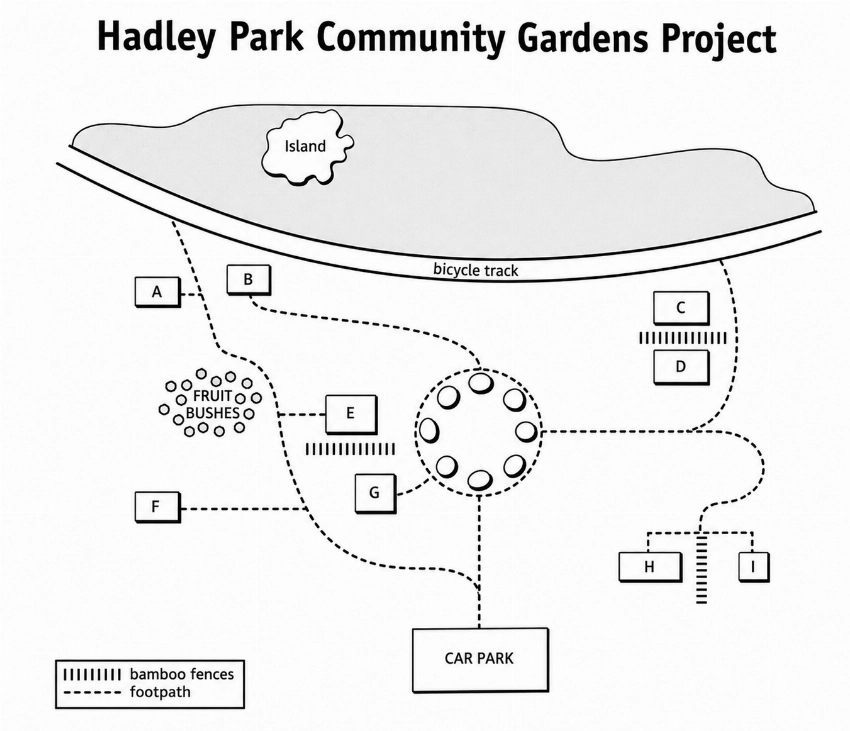
15. Vegetable Beds-
16. Bee Hives-
17. Seating-
18. Adventure Playground-
19. Sand Area-
20. Pond-
Section 3
This audio contains answers for questions 21-30.
Questions 21-25
Choose the correct letter: A, B or C.
Food Waste
21. What point does Robert make about the 2013 study in Britain?
A. It focused more on packaging than on wasted food.
B. It proved that households produced more waste than restaurants.
C. It included liquid waste as well as solid waste.
22. The speakers agree that food waste reports should emphasise the connection between carbon dioxide emissions and
A. Food production.
B. Transport of food to landfill sites.
C. Distribution of food products.
23. Television programmes now tend to focus on
A. The nutritional value of food products.
B. The origin of food products.
C. The chemicals found in food products.
24. For Anna, the most significant point about food waste is
A. The moral aspect.
B. The environmental impact.
C. The economic effect.
25. Anna and Robert decide to begin their presentation by
A. Handing out a questionnaire.
B. Providing statistical evidence.
C. Showing images of wasted food.
Questions 26-30
What advantage do the speakers identify for each of the following projects?
Choose FIVE answers from the box and write the correct letter A-G next to Questions 26-30.
Advantages
A. It should save time
B. It will create new jobs
C. It will benefit local communities
D. It will make money
E. It will encourage personal responsibility
F. It will be easy to advertise
G. It will involve very little cost
Projects
26. Edible patch
27. Ripeness centre
28. Waste tracking technology
29. Smartphone application
30. Food waste composting
Section 4
This audio contains answers to questions 31-40.
Questions 31-40
Complete the notes below.
Write ONE WORD for each answer.
Kite Making By The Maori People Of New Zealand
Making And Appearance Of Kites
- The priests who made the kites had rules for size and scale
- 31. ................ was not allowed during a kite’s preparation
Kites:
- Often represented a god, a bird or a 32. ................
- Had frames that were decorated with grasses and 33. ...............
- Had a line of noisy 34. ................. attached to them.
- Could be triangular, rectangular or 35. ................ shaped.
- Had patterns made from clay mixed with 36. .................... oil.
- Sometimes had human head masks with 37. ................... and a tattoo.
Purpose And Function Of Kites:
- A way of sending 38. .................... to the gods
- A way of telling other villages that a 39. .................. was necessary
- A means of 40. .................... if enemies were coming.
Answers

Unlock Remaining Answer