Key Highlights
Step up your preparation with the IELTS Listening Practice Test. Test your listening skills, then explore the transcript and answer key to understand your results.
In this test, you will listen to 4 Sections and answer Questions 1-40 based on the information you hear. Each Section reflects a typical situation you may encounter in the actual IELTS Listening exam.
-
Section 1: A woman seeks advice from a neighbour about repairing water damage in her house and discusses local plumbers and plasterers.
-
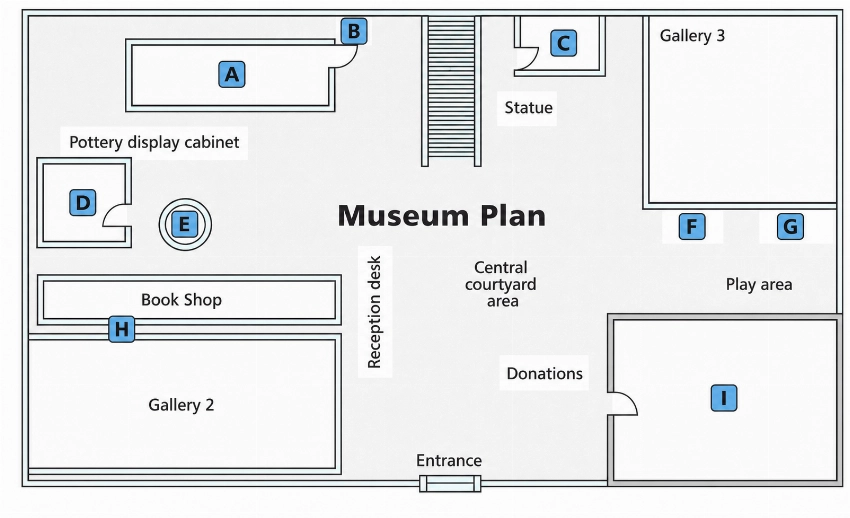
Section 2: A museum education officer briefs students on their upcoming work placement, including rules, duties, and museum facilities.
-
Section 3: A Business Studies student discusses possible IT projects for a local engineering company and raises concerns about group coursework.
-
Section 4: A wildlife expert explains the habitat, adaptations, diet, behaviour, and survival of the tawny owl in the UK.
By completing this practice test, you can strengthen your listening skills, understand spoken English more effectively, and prepare yourself confidently for the IELTS exam.
IELTS Listening Practice Test 63
Section 1
This audio contains answers to questions 1-10.
Questions 1 and 2
Complete the notes below.
Write NO MORE THAN ONE WORD for each answer.
Advice on plumbers and decorators
- Don’t call a plumber during the 1. ...............
- Look at trade website: www. 2. ............... .com
Questions 3-10
Complete the table below.
Write NO MORE THAN ONE WORD for each answer.
|
Name |
Positive Points |
Negative Points |
|
Peake’s Plumbing |
|
|
|
John Damerol Plumbing Services |
|
|
|
Simonson Platerers |
|
|
|
H.L. Plaster |
|
|
Section 2
This audio contains answers to questions 11-20.
Questions 11-15
Choose the correct letter A, B or C.
11. On Monday, what will be the students’ working day?
A. 9 am – 5 pm
B. 8.45 am – 5 pm
C. 9 am – 4.45 pm
12. While working in the museum, students are encouraged to wear
A. Formal clothing, such as a suit
B. Cap with the museum logo
C. Their own casual clothes
13. If students are ill or going to be late, they must inform
A. The museum receptionist
B. Their museum supervisor
C. Their school placement tutor
14. The most popular task while on work placement is usually
A. Making presentations in local primary schools
B. Talking to elderly people in care homes
C. Conducting workshops in the museum
15. The best form of preparation before starting their work placement is to read
A. The history of the museum on the website
B. The museum regulations and safety guidance
C. Notes made by previous work placement students
Questions 16-20
Label the plan below. Write the correct letter A-I next to questions 16-20.
Where in the museum are the following places?
16. Sign-in office
17. Gallery 1
18. Key box
19. Kitchen area
20. Staff noticeboard
Section 3
This audio contains answers for questions 21-30.
Questions 21-26
What is the tutor’s opinion of the following company projects?
Choose FIVE answers from the box, and write the correct letter, A-H, next to questions 21-26.
Tutor’s Opinion
A. It would be very rewarding for the student.
B. It is too ambitious.
C. It would be difficult to evaluate.
D. It wouldn’t be sufficiently challenging.
E. It would involve extra costs.
F. It is beyond the student’s current ability.
G. It is already being done by another student.
H. It would probably have the greatest impact on the company.
Company Projects
21. Customer database
22. Online sales catalogue
23. Payroll
24. Stock inventory
25. Internal security
26. Customer services
Questions 27-28
Choose TWO letters, A-E.
Which TWO problems do Sam and the tutor identify concerning group assignments?
A. Personal relationships.
B. Cultural differences.
C. Division of labour.
D. Group leadership.
E. Group size.
Questions 29-30
Choose TWO letters, A-E.
Which TWO problems does Sam identify concerning the lecturers?
A. Punctuality.
B. Organisation.
C. Accessibility.
D. Helpfulness.
E. Teaching materials.
Section 4
This audio contains answers to questions 31-40.
Questions 31-40
Complete the notes below.
Write ONE WORD ONLY for each answer.
The Tawny Owl
Most 31. .............. owl species in the UK
Strongly Nocturnal
Habitat:
Mainly lives in 32. ................. but can also be seen in urban areas, e.g. parks.
Adaptations:
- Short wings and 33. ................., for navigation
- Brown and 34. ............... feathers, for camouflage
- Large eyes (more effective than those of 35. ............... ), for good night vision
- Very good spatial 36. ................ for predicting where prey might be found
- Excellent 37. .................. for locating prey from a perch
Diet
The main food is small mammals.
Owls in urban areas eat more 38. .................
Survival
Two-thirds of young owls die within a 39. .................
Owls don’t disperse over long distances.
Owls seem to dislike flying over large areas of 40. ....................
Answers

Unlock Remaining Answer